
You're staring at a half-finished offer, a client who wants to move quickly, and a contract draft that feels either too vague or too heavy. That's the usual moment people start searching for a service agreement template UK buyers can use, because the risk isn't only legal, it's confusion before payment, scope drift during delivery, and awkward arguments when the work is done differently from what was expected.
A solid agreement does more than tick a compliance box. In the UK, it's meant to define the relationship, set the payment rules, and make the boundaries of the work clear across England, Scotland, Wales, and Northern Ireland, while still reflecting the legal framework that turns an agreement into a binding contract through offer, acceptance, consideration, and intention to create legal relations. For a plain-English overview of the wider contract basics, everything you need about contracts is a useful companion read.
Table of Contents
- Downloadable Service Agreement Template UK
- Essential Clauses in a UK Service Agreement
- Choosing the Right Contract Terms for Your Service
- Aligning Your Agreement with Your OfferLink
- How to Customize and Finalize Your Template
- Key Legal Considerations – Jurisdiction, VAT, and GDPR
- Common Mistakes to Avoid in Service Agreements
- Integrating the Agreement with AmaJova Order Records
- Quick Reference – Red Flags and Safe Harbours
- When to Seek Professional Legal Advice
Downloadable Service Agreement Template UK
A usable template needs to do one thing well from the start, turn a sale into a document both sides can rely on. In practice, that means the draft should already contain scope of work, payment terms, timelines, confidentiality, termination, and liability, because those are the clauses that stop a service from becoming an argument later. UK-facing template providers also frame these agreements as valid across the home nations, but only if the wording is adapted to the actual deal and the agreement reflects the legal rules around contract formation and consumer protection, including the Consumer Rights Act 2015 for consumer-facing services and the older implied terms that still matter in business-to-business work.
What a starter template should include
A basic structure usually works best when it reads in the order the job will take place. Start with the parties, define the services in plain language, set the fee and payment timing, then cover delivery, ownership, confidentiality, termination, and what happens if things go wrong. That sequence helps the client understand the purchase, but it also forces the seller to notice gaps before the work begins.
A template on its own is never enough if the service itself is specialised. A design retainer, a consultancy package, a live workshop, and a done-for-you implementation all carry different risks, so the wording has to match the delivery model rather than sit there as generic boilerplate.
Practical rule: if a clause cannot be explained in one sentence to a buyer, it probably needs rewriting before it is sent out.
Sellers who want a broader commercial context can also use contract basics and drafting guidance as a reference point, but the true test is whether the draft matches the service being sold, not whether it sounds legal.
Essential Clauses in a UK Service Agreement
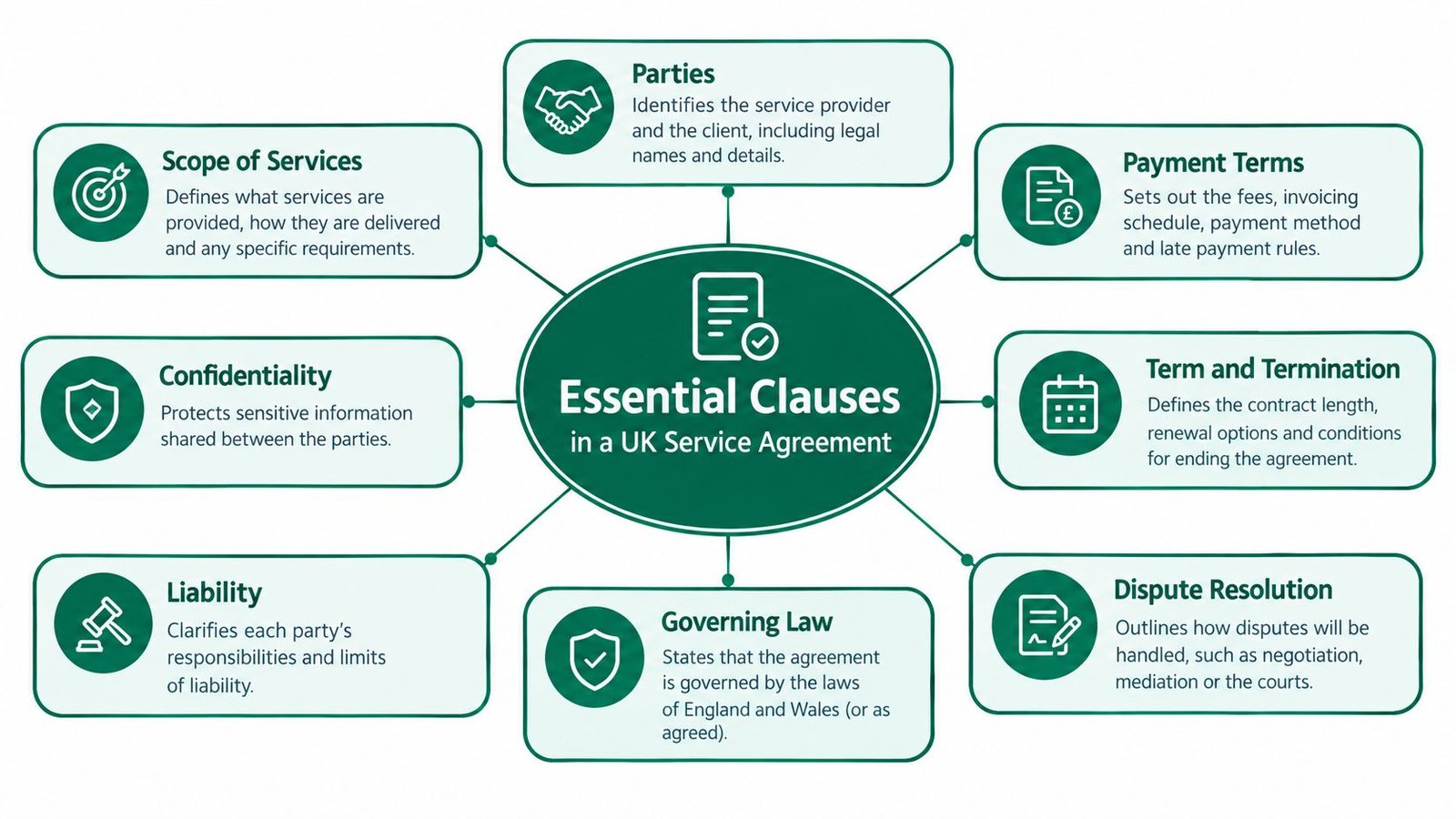
The most useful contracts are rarely the longest ones. They are the ones that make the seller's obligations readable, measurable, and enforceable without forcing a dispute over every detail.
The clauses that actually carry the weight
Scope of Services is the first protection point, because it defines what is included and what is not. If the deliverables are not listed clearly, the buyer may assume extras are included, and that is where time gets eaten up without extra payment.
Payment Terms should set the price, due dates, deposit rules if any, and what happens when the invoice is late. The wording should also deal with variable pricing carefully, because when price is not fixed the customer may owe a reasonable charge, which makes vague drafting risky.
Term and Termination protects both sides from being trapped in a bad fit. A seller needs to know whether notice is required, whether termination is for convenience or breach, and whether unpaid work survives termination.
Intellectual Property decides who owns drafts, outputs, and supporting materials. That matters especially for creative, technical, and educational work, where a seller may want to retain reusable methods while licensing the final deliverable.
Confidentiality keeps commercially sensitive information from being reused or exposed. It matters even for short projects, because many disputes start when the client shares data too widely or the seller reuses examples too casually.
Limitation of Liability is the seller's risk boundary. If it is too broad, one mistake can become disproportionate exposure, but if it is too narrow or unrealistic, it can be challenged or rejected by a serious client.
A clause stack that mirrors real service work
The UK model public-sector approach shows how mature service contracts often go further, with service levels, standards, insurance, subcontracting, records, data protection, force majeure, dispute resolution, notices, conflict of interest, and governing law all sitting in the same document. That structure is useful for private sellers too, because it keeps the contract tied to actual delivery instead of treating it like a formality.
A contract that only says “services to be agreed” usually creates more work, not less.
Choosing the Right Contract Terms for Your Service
Different services need different risk settings. A fixed-price website build, a monthly consultancy, and a one-off training session should not be forced into the same commercial terms just because the template looks tidy.
| Clause | Option A | Option B | Seller Consideration |
|---|---|---|---|
| Pricing | Fixed price | Time and materials | Fixed price gives certainty, but scope must be tight. Time and materials suits uncertain work, but needs stronger reporting. |
| Liability | Capped liability | Uncapped liability | A cap can keep risk proportionate. Uncapped exposure usually belongs only where the seller has deliberately accepted it. |
| Termination | Short notice | Longer notice | Short notice gives flexibility. Longer notice can protect recurring income, but may frustrate a buyer if delivery is unclear. |
| Delivery | Milestone-based | Continuous service | Milestones help with accountability. Ongoing services need better review points and payment triggers. |
A seller choosing between these options should not ask which version sounds more professional. The better question is which version matches how the service is delivered, billed, and paused in real life. That is why a consultancy retainer looks very different from a one-off content package.
The internal commercial mechanics matter too, especially if payouts, delivery confirmation, or refund handling sit in a platform workflow. The payout policy guidance is useful as a reminder that contract wording and payment operations need to point in the same direction.
Good fit example: fixed scope, fixed fee, clear revisions.
Poor fit example: a broad “support as needed” promise with a flat price and no change control.
Aligning Your Agreement with Your OfferLink

The cleanest sales process happens when the offer page and the contract tell the same story. If the Agreement says one thing and the OfferLink says something softer or broader, buyers get mixed signals before they even pay.
Turning legal language into buyer-facing clarity
The OfferLink should use the same core promises as the contract, but in simpler language. If the agreement defines the scope tightly, the offer page should list inclusions, limits, timelines, and any optional extras in plain English. That reduces back-and-forth, and it also makes the buyer more likely to understand what they are buying.
Digital selling workflows matter. A service agreement stops being a separate PDF when it becomes part of the order journey, because the offer description, order record, fulfilment steps, and signed terms all need to support the same commercial understanding.
The practical benefit is simple. Buyers who can see what is included before payment are less likely to dispute deliverables later, and sellers spend less time untangling expectations that were never written down clearly. Platforms that structure the offer and order record around a single transaction, such as AmaJova, fit that logic because the contract language can be mirrored in the offer content and attached records without forcing the buyer to hunt through scattered messages.
What to keep consistent
- Inclusions: list the exact service components.
- Boundaries: state what is excluded or charged separately.
- Timing: show delivery windows or booking steps.
- Dependencies: flag what the buyer must provide.
- Proof of agreement: keep the signed terms attached to the order record.
Consistency here does more than look organised. It gives the seller one version of the deal instead of three slightly different ones.
How to Customize and Finalize Your Template
A template becomes useful only after it has been filled in properly. The job is to replace placeholders with facts, then check that every clause still makes sense once the project details are in place.
A practical finalisation workflow
- Fill in the parties and dates. Names, trading details, start date, and service period should be accurate and consistent everywhere they appear.
- Replace broad wording with exact deliverables. If the work is “strategy support”, define what that means in practice.
- Check the money clauses. Fee, VAT treatment, deposits, and invoice timing should all be aligned before the draft is sent.
- Review the legal references. Jurisdiction, consumer status if relevant, and data handling should match the actual seller-client relationship.
- Sign and store the executed version securely. The signed agreement should be easy to retrieve if there is a delivery dispute or a payment query.
Digital signing helps when the workflow is clear, but the signature is only useful if the stored copy is the final version both sides accepted. A messy file trail creates the same problems as no contract at all.
Final check: if any clause depends on “we'll sort it later”, it is not ready.
Key Legal Considerations – Jurisdiction, VAT, and GDPR
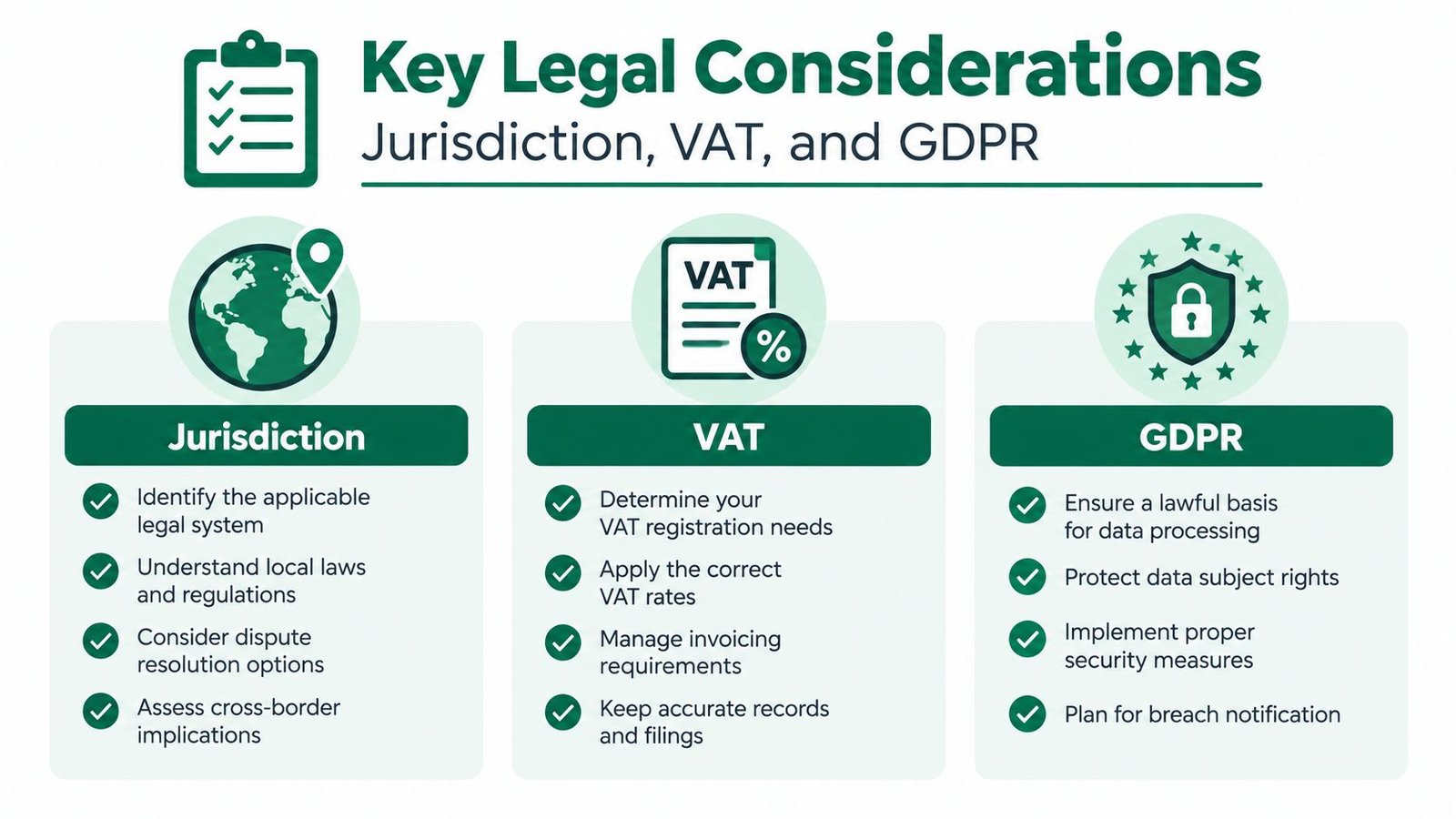
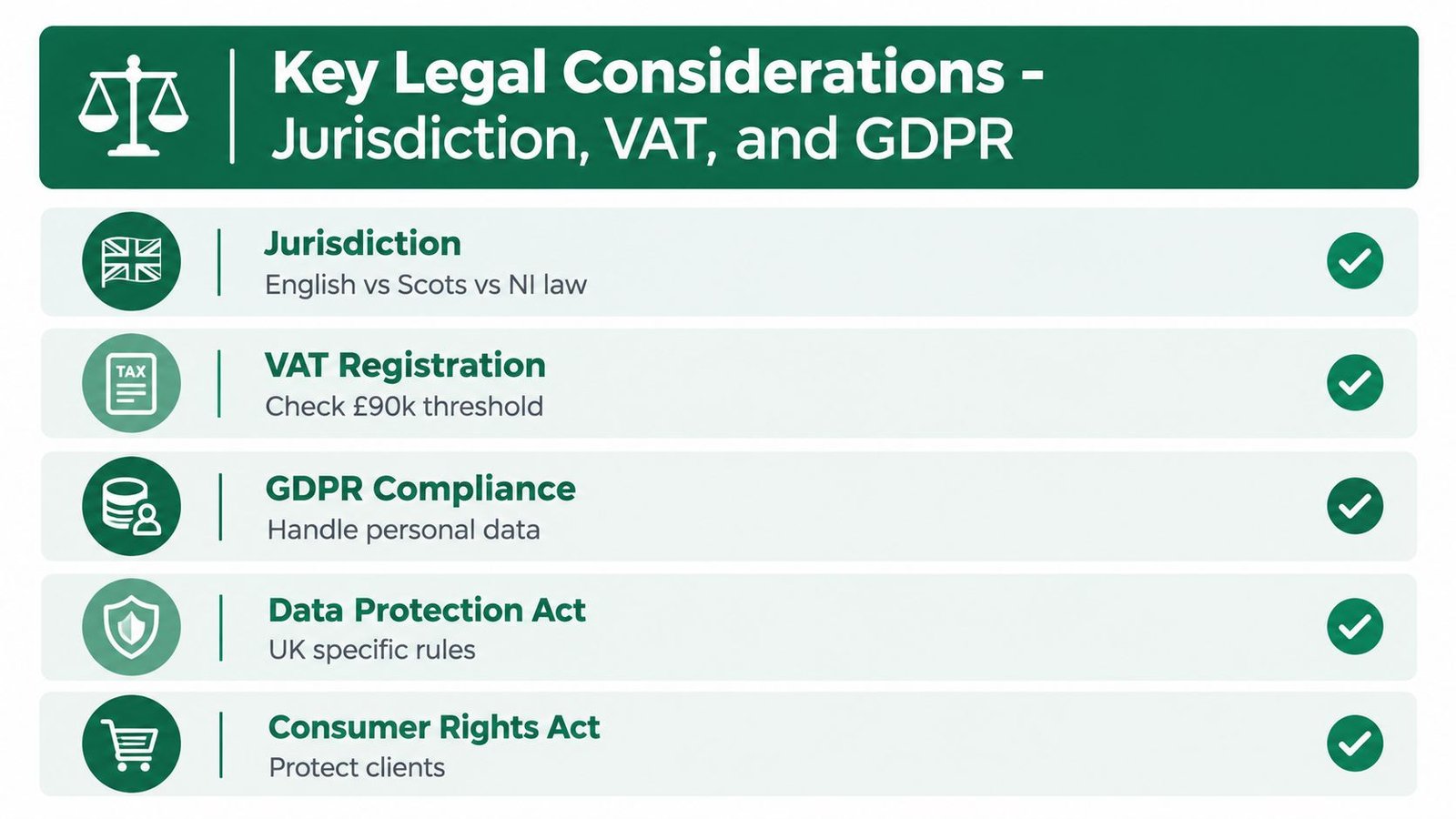
A UK service agreement is not complete until the legal environment around it has been checked. Jurisdiction, tax, and data handling each change the risk profile, and sellers often overlook them because the commercial terms look fine on the surface.
Jurisdiction means more than a line at the bottom
A jurisdiction clause decides which legal system governs the dispute. That matters because England and Wales, Scotland, and Northern Ireland have different legal frameworks, and a template written for one system should not be pasted into another without checking the language carefully.
The UK government's consumer-facing rules also matter if the buyer is a consumer rather than a business. Under the Consumer Rights Act 2015, a trader supplying a service to a consumer is treated as including a term that the service must be carried out with reasonable care and skill. That makes service quality a legal issue, not just a reputational one. For consumer-facing online sales, the seller also needs to make costs clear and provide pre-contract information, as set out in government guidance on consumer contracts. Snyp's DPA compliance guide is a useful cross-check when the service includes personal data handling, especially where a seller is acting as a processor rather than a controller.
VAT and data protection shape delivery
VAT treatment needs checking before the offer goes live, because pricing language can mislead if it does not match the actual tax position. The contract and the offer page should say the same thing about whether VAT is included or added.
Data protection is just as important if the seller handles client names, emails, files, or other personal data during delivery. The agreement should make clear what data is collected, who can access it, and how it will be used in the service process.
The seller protection policy is relevant here because a clear platform record only works when the underlying contract and data handling practices are equally clear. Without that alignment, a seller can end up with a neat document and a messy operational trail.
Common Mistakes to Avoid in Service Agreements
The biggest mistake is treating the contract as a dispute document instead of a sales document. By the time a disagreement starts, the deal is already strained, so the agreement should have prevented the ambiguity in the first place.
A second common error is vague scope language. “Support as needed” or “all reasonable revisions” sounds flexible, but it usually gives the buyer room to expect more than the seller planned to provide.
Another trap is ignoring ownership of work product. If the contract does not say who owns drafts, templates, source files, or final outputs, the seller may lose control over valuable material or give away more rights than intended.
For a useful reminder on document discipline and lifecycle control, contract management best practices is a sensible reference point.
Red flags sellers should spot quickly
- Open-ended scope: work described too broadly to price properly.
- Missing payment triggers: no deposit, no invoice date, no late-payment wording.
- Silent IP terms: no clear ownership or licensing position.
- No termination path: no exit clause if the project stalls.
- Unclear revision rules: too many changes without extra fees.
A strong template reduces friction before money changes hands. That is the true value, because trust is easier to build when the contract already answers the obvious questions.
Integrating the Agreement with AmaJova Order Records
A signed agreement is stronger when it sits beside the order record instead of floating in an email thread. That keeps the commercial details, the fulfilment steps, and the final terms together when both sides need to check what was agreed.
Why a single record matters
When the agreement is attached to the same order trail as the offer, payment, and delivery notes, the seller has one place to confirm the transaction. That helps if the buyer asks for a copy later, if the delivery is disputed, or if a payment issue needs to be checked against the terms.
Here, a platform workflow such as order management workflow becomes practical rather than theoretical. The order record should point back to the signed contract, and the contract should reflect the same scope, deadlines, and expectations that appeared on the offer page.
The payoff is administrative clarity. Messages do not have to be reconstructed from memory, and the parties can see the same source of truth instead of version-chasing across inboxes and chat threads.
Operational rule: if a term affects fulfilment, it belongs in the contract and in the order record.
That structure also supports better after-sales handling. If the buyer questions what was included, the seller can point to the signed terms and the linked order details without rewriting the story of the deal.
Quick Reference – Red Flags and Safe Harbours
A fast review is often enough to spot whether a draft is usable or dangerous. Sellers do not need to become solicitors to notice the difference between a balanced clause and one that shifts too much risk.
| Clause Type | Red Flag Indicator | Safe Harbour Alternative |
|---|---|---|
| Scope | “All services as required” | Specific deliverables and exclusions |
| Payment | “Payment to follow” | Clear amount, invoice timing, and due date |
| Liability | No cap, no exclusions | Sensible cap with defined carve-outs |
| Termination | No exit wording | Notice period and breach termination |
| IP | Client owns everything by default | Clear ownership or licence wording |
| Revisions | Unlimited changes | Defined revision rounds or change fees |
A safe harbour clause is not about being aggressive. It is about making the deal predictable enough that both sides can perform without constant negotiation.
When to Seek Professional Legal Advice
A template is usually enough for straightforward work, but some deals deserve legal review before anything is signed. High-value projects, complex IP transfers, regulated services, and arrangements involving subcontractors or joint ownership deserve a closer look because one bad assumption can spread across the whole contract.
Sellers should also get advice if the work crosses consumer and business boundaries, if the data flow is sensitive, or if the contract will be used repeatedly at scale. In those situations, the legal cost of a review is often easier to justify than the cost of cleaning up a broken agreement later.
A sensible threshold for escalation
If the contract changes the way the business operates, not just the wording of a single sale, it is time for a solicitor. The same is true where jurisdiction, tax, or IP rights are not obvious from the draft.
For smaller, standardised services, a well-customised template can be enough if the scope is clear, the payment terms are precise, and the delivery record is tidy. For anything beyond that, professional advice turns a generic form into a contract that matches the risk.
AmaJova helps sellers package services, products, digital products, and live sessions into a single OfferLink with a structured order record, which makes it easier to keep the offer, the terms, and the fulfilment trail aligned. If a service agreement needs to work as part of a real sales workflow, not just as a PDF, visit AmaJova and see how a clearer order journey can support the contract behind it.