
Selling services online usually falls apart in the same place. A coach is juggling DMs, a Calendly link, a bank transfer and a half-finished email thread. A designer is sending scope details in one message, price in another and delivery files somewhere else entirely. Buyers do not trust that mess, and they shouldn't.
The fix is not more hustle. It's a clearer offer. In the UK, internet sales are already a major part of retail behaviour, with the average weekly value of internet sales in Great Britain at £2.6 billion in June 2025, representing 27.8% of all retail sales, and online spending values rising 4.5% between June 2024 and June 2025 Commons Library analysis. That scale matters because it proves buyers are comfortable purchasing online, but it also means they expect clarity, not improvisation.
If a service sale feels hard to close, the problem is usually not traffic. It's uncertainty. Buyers want to know what they're getting, what happens after they pay, how the work is delivered and what happens if something goes wrong. For a useful companion on structuring your workflow, compare AI tools for solopreneurs, then come back to the fundamentals here, because tools never fix a vague offer.
Table of Contents
- What It Really Takes to Sell Services Online
- Defining Your Service Offer So Buyers Understand It
- Pricing Your Service Without Undercutting Yourself
- Building Trust Before a Buyer Commits to Pay
- Designing Checkout That UK Buyers Will Complete
- Running Delivery and Communication From One Order Record
- Scaling What Works After Your First Ten Sales
What It Really Takes to Sell Services Online
The first mistake service sellers make is treating a service like a chat, not a contract. A buyer clicks around, asks a few questions, gets a price by DM, then waits for a calendar slot, a payment link and a loose promise that the work will “cover everything.” That process loses sales because every extra message adds doubt.
Start with the offer, not the channel
A service becomes easier to sell when it is written like a specification. The buyer should be able to see the outcome, the scope, the delivery route and the price in one place. That is true whether the service is coaching, design, consulting, education or a booked session.
The offer page has to do the work that a salesperson, an inbox and a contract normally split between them. If the buyer needs to bounce between Instagram, email and a payment app to understand the offer, the sale is already leaking. A single page with a single order record removes that friction.
Practical rule: if the buyer can't repeat the offer in one sentence after reading it, the offer isn't ready.
Service sales also behave differently from product sales because there is no stock to count and no parcel to ship. The main risk is ambiguity, not logistics. That's why the structure of the page matters more than clever copy.
If the buyer understands what happens before and after payment, the sale feels safe. If not, the cheapest traffic in the world won't save it.
Defining Your Service Offer So Buyers Understand It
A vague offer sounds flexible, but it sells poorly. “Social media management,” “brand identity package” or “coaching session” tells the buyer almost nothing about what they are buying. Strong offers read like short contracts, because that is what the buyer is judging.
Write the offer in this order
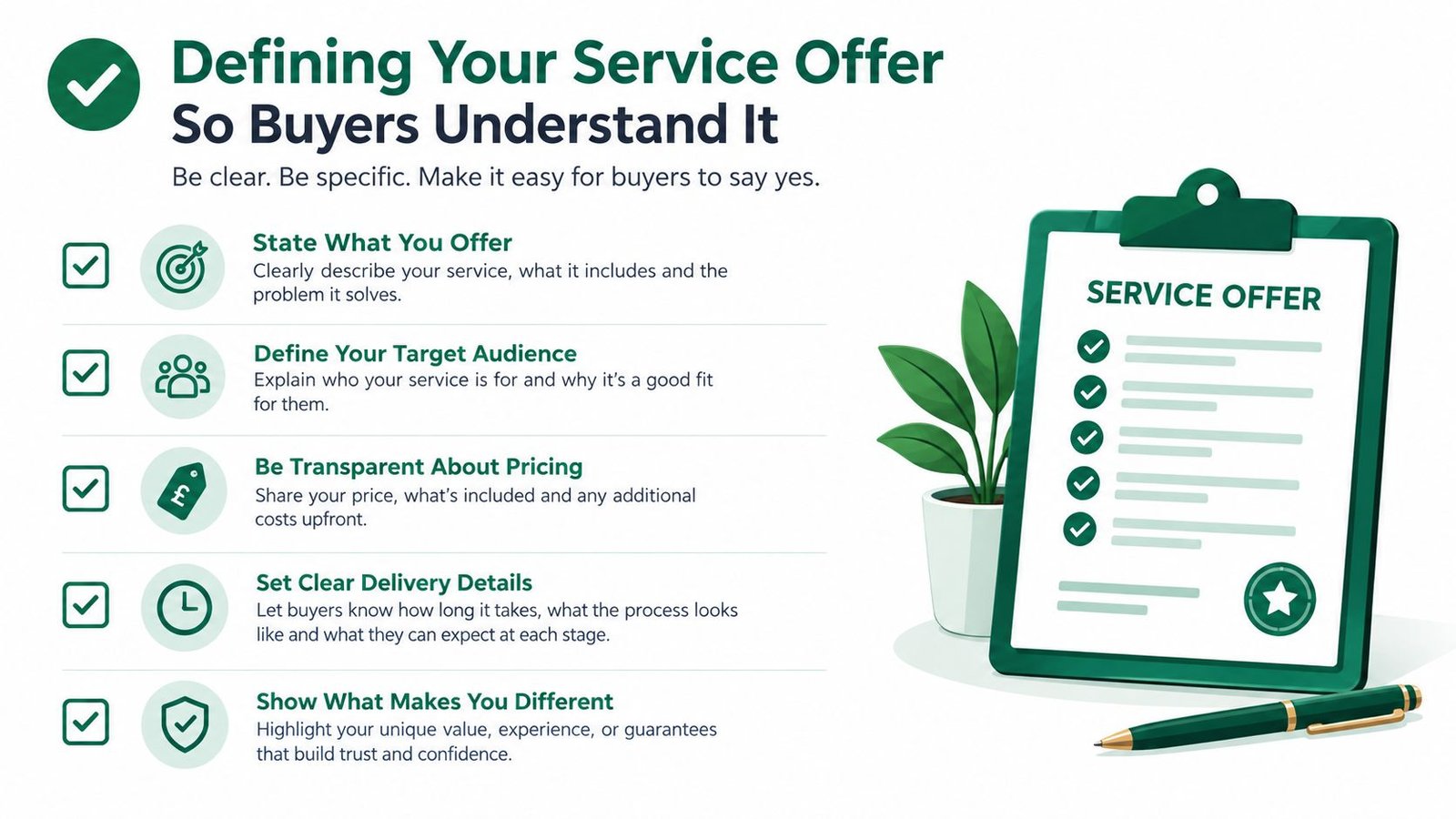
Start with the customer outcome. State the change the buyer gets. Then list what is included, what is excluded, what gets delivered, how long it takes and how many revisions are included. After that, set buyer responsibilities, cancellation terms and the handover process.
That order matters because it answers the buyer's real questions before they ask them. It also protects the seller later when someone asks for extras that were never part of the deal. Clear specification cuts down disputes and makes the offer easier to sell.
A weak version sounds like this, “Brand identity package, DM for price.” A precise version sounds like this, “Brand identity sprint for new wellness businesses, includes logo direction, colour palette, typography selection, one mood board round, two revision rounds, final files in SVG, PNG and PDF, delivery within 10 working days, feedback due within 48 hours.”
A precise offer is a better purchase decision as well as better copy. UK consumers lean heavily on independent evidence before buying, with 89% using online customer reviews when researching a product or service and 69% saying mostly negative reviews put them off CMA news on fake and misleading reviews. A vague offer gives them nothing to judge. A precise offer shows that the seller knows exactly what is being sold.
The public page should carry the same discipline as the paperwork behind it. A buyer wants to see the scope, the limits and the handover before payment, not after a dispute starts. The point is clarity, not legal theatre.
Pricing Your Service Without Undercutting Yourself
Price is where many freelancers wobble because they start from fear instead of structure. They guess, undercharge, then spend the next month resenting the work. Good pricing starts with the actual shape of the offer, not a vague sense of what feels affordable.
Match the model to the work
Hourly pricing works when the buyer needs open-ended support. Project pricing works when the scope is bounded. Packaged pricing works when the service can be repeated with the same core inputs and outputs. A consultation, a three-session package and a project engagement should not share the same price logic.
The seller also needs to price the invisible work. Discovery calls, revisions, admin, follow-up messages and handover take time. If they are not priced in, the headline number becomes fantasy. Optional extras can help when buyers regularly ask for add-ons, but they need to be explicit, not hidden.
Price the risk, not just the hours. If a job can expand, stall or trigger extra communication, the price has to absorb that uncertainty.
Cash flow matters just as much as margin. UK companies reported payments averaging 31.8 days overdue, including 31.0 days for micro and small businesses Coface UK payment survey. For solo service sellers, that's reason enough to prefer an offer page that takes payment up front, or at least requires a clear deposit, rather than waiting until after delivery.
A useful pricing page should show the price visibly, not hide it behind “enquire now” if the offer is standardised. Hidden pricing invites lowball negotiation and attracts the wrong buyer. For a practical pricing framework, the resource on how to price services is a sensible reference point.
Building Trust Before a Buyer Commits to Pay
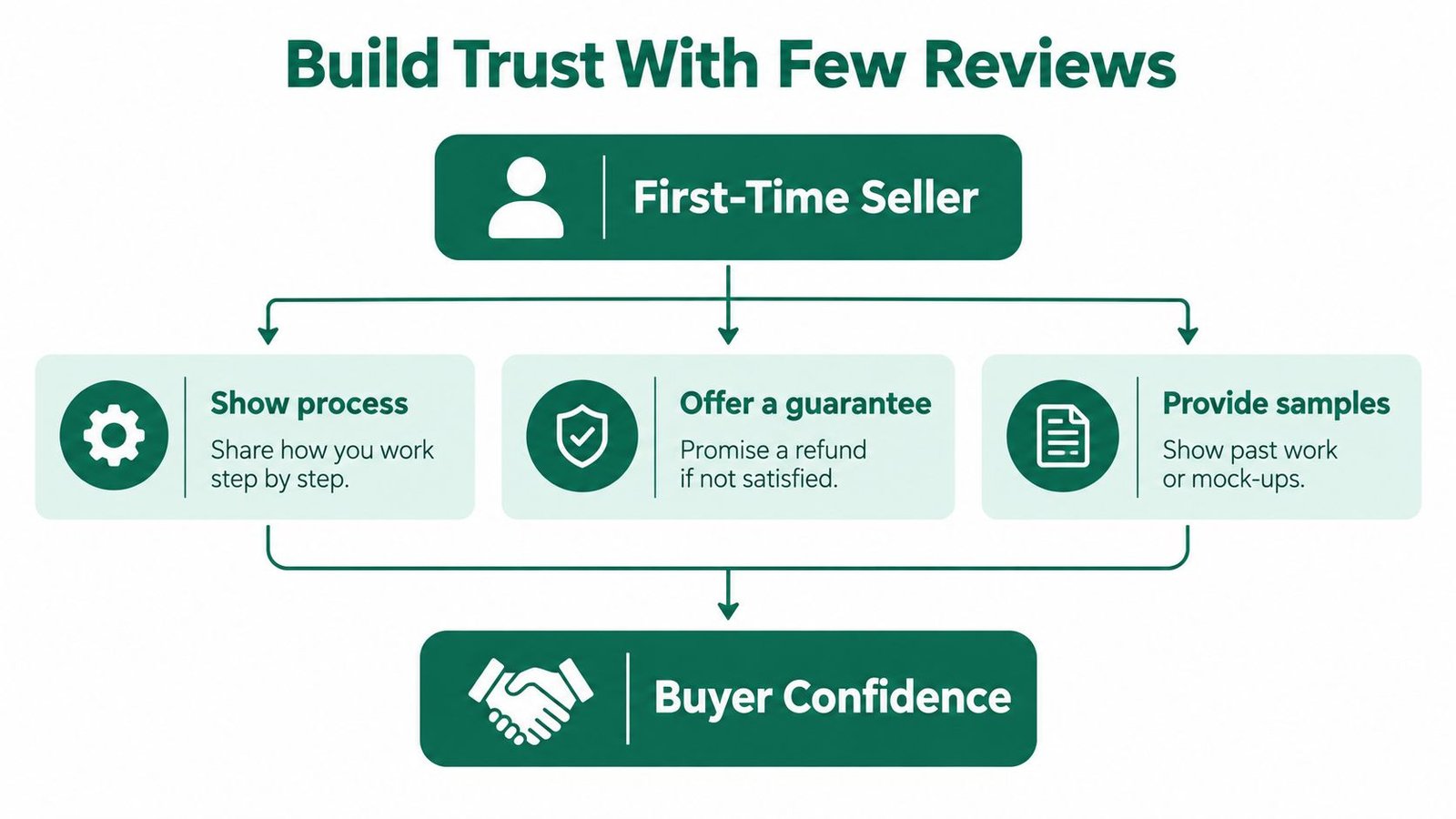
A first-time buyer is looking for proof that the seller is real, the offer is specific, and the payment path feels safe. If reviews are thin, fill the gap with clear process, visible terms, and evidence placed where the buyer is deciding.
Show the signals that reduce risk
The offer page should show the seller's identity, business details, service scope, inclusions and exclusions, timelines, support route, and a secure checkout. Those are not decorative extras. They are the trust structure that replaces reputation when the seller is still building it.
UK government research found that 57% of UK adults considered online retail outlets trustworthy, while only 45% trusted online marketplaces, and 42% cited previous experience of buying the product as the main factor building confidence in safety OPSS delivery report. Service sellers should read that plainly. Buyers want a clear, accountable seller, not a busy-looking profile.
Put the strongest trust signals next to the offer, not on a separate page. The buyer needs to see evidence while deciding, not after paying. Testimonials should sit beside the promise they support. Samples should appear where the buyer is about to commit, not hidden three clicks away.
For early feedback, the guide to testimonial collection for e-commerce is worth using because the process matters more than the slogan. Ask for verified reviews after fulfilment, not before. Publish them in full, and leave in criticism that helps a real buyer make a better decision.
For buyers who still hesitate, place verification badges, secure-payment indicators, and a clear service-agreement link beside the price, not in the footer. The service agreement template for UK sellers gives those trust signals written terms that buyers can inspect before they pay.
Designing Checkout That UK Buyers Will Complete
A pretty checkout doesn't convert if it feels uncertain. UK buyers want to see exactly what they're paying, who they're paying, what happens next and whether the payment method looks familiar. That's the moment to remove doubt, not add design fluff.
Put the decision information above the button
The page should show the total payable amount, currency, seller identity, service scope, delivery or booking timing, support route and a recognisable secure-payment indicator before the buyer commits. UK research reports that 72% of adults look for secure payment options before buying from an unfamiliar online store, while 67% would avoid a seller requesting unusual or insecure payment methods YouGov on online store legitimacy.
That means checkout should be short and specific. Only collect the details needed to process payment and fulfil the service. Don't make people solve price maths in another currency or hunt through messages to confirm what's included. A clear, single page with a visible order summary is the right pattern.
Buyers don't need more persuasion at checkout. They need less uncertainty.
Track the funnel with separate events for offer views, checkout starts and successful payments so the seller can see where people are dropping off. A high checkout-start rate with weak payment success usually points to friction or trust issues. A clean record also makes it easier to support the buyer later, because the order details are already attached to the sale.
A higher-conversion checkout reference for Instagram marketers is useful here because social traffic is often impatient and mobile-led. The same principle applies to services, the page has to answer the buyer fast, then let them pay without detours.
Running Delivery and Communication From One Order Record
Service sellers lose control the moment delivery starts living in too many places. One message in email, one promise in WhatsApp, one date in a calendar and one file in Drive creates confusion the second a buyer asks what was agreed. A unified order record fixes that.
Keep every stage attached to the same sale
The seller should confirm the order, send the onboarding message, record milestones, attach delivery evidence, note revisions and mark completion in one place. That way, the promise, the work and the proof all stay linked. When the buyer asks a question later, the answer is already in the record.
| Stage | What the seller does | What is recorded against the order |
|---|---|---|
| Order confirmation | Confirms the purchase and next steps | Price, scope, date, buyer details |
| Onboarding | Collects required information | Brief, assets, deadlines, responsibilities |
| Milestones | Sends progress updates | Messages, agreed changes, timestamps |
| Delivery | Shares the finished work | Files, links, access details, evidence |
| Buyer confirmation | Requests sign-off or feedback | Approval, revision notes, outstanding issues |
| Completion | Closes the engagement | Final status, refund or dispute notes |
That structure matters because it keeps scope creep visible while the work is still open. If a buyer asks for extras, the seller can point to the original scope instead of arguing from memory. If there's a dispute, the history is already organised.
The legal side matters too. For online services, including consultancy, coaching and booked sessions, consumers generally have a 14-day cancellation period beginning the day after the service contract is made, and the right can end where the service is fully performed after the customer's prior express request and acknowledgement legislation.gov.uk. The practical point is simple. The offer page and checkout flow need to state cancellation terms before payment, and they need to distinguish ordinary acceptance from the express request and acknowledgement needed for early performance.
Digital content needs different treatment. For downloads and streaming access, the buyer's express agreement to begin supply during the cancellation period and acknowledgement that the cancellation right will be lost must be captured properly, and that consent has to appear in the contract confirmation GOV.UK online selling guidance. Services that begin during the cooling-off period need their own careful setup too, because the legal effect depends on how the work is structured.
Physical goods follow different cancellation rules, with distance sellers generally needing to give cancellation information before contract formation GOV.UK distance selling guidance. VAT registration is a separate operational decision, not something to discover late, so it belongs in the business planning stage rather than the checkout copy.
For a working template that keeps everything in one place, the order management workflow resource is worth using as a reference when setting up service delivery.
Scaling What Works After Your First Ten Sales
Once the first orders land, the job changes. The seller doesn't need a louder message. They need a tighter loop. The fastest way to improve a service offer is to watch where buyers hesitate, where delivery slows and where support gets messy.
Audit the funnel, not just the traffic
Track visits, checkout starts, paid orders, fulfilment completion and refund or dispute rate separately. Then fix the largest drop first. That order matters because traffic is useless if buyers keep leaving at checkout, and a strong checkout means nothing if delivery breaks later.
A clean review process should follow the first wave of real buyers. Request feedback after fulfilment, publish it where the offer is being sold, and respond to criticism like an operator, not a marketer. That creates proof without inventing a reputation.
After the core offer converts consistently, expand sideways into related services instead of making the original offer vague again. A designer can add a logo add-on, then a brand kit. A consultant can move from one-off sessions to a package. A tutor can add recorded resources or live sessions. The new offer should feel adjacent, not random.
Scaling rule: earn the second offer with the first one. Don't build a wider menu until the original sale is clear, repeatable and easy to fulfil.
For a practical launch audit, the checklist is straightforward. The offer states the outcome. The scope is written down. The price is visible. The checkout feels safe. The order record keeps communication together. The cancellation terms are clear. The buyer knows what happens next.
If that's in place, the seller can stop improvising and start selling like a professional.
If the current offer still lives across DMs, calendars and scattered payment links, AmaJova gives sellers one place to turn a service, product, download or live session into a structured OfferLink with scope, price, checkout and order record together. Visit AmaJova to see how a clearer offer page can reduce confusion before payment and keep fulfilment connected after the sale.