You've got a folder of high-resolution files, a printer quote, and a rough sense of what an A3 print should cost. Then the first order lands, you weigh the tube at the Post Office counter, and the postage comes back at close to a third of the price you charged. Nothing about the artwork changed. The listing stopped being about the artwork the moment it became a parcel.
That gap between the price on the page and the cost of getting the print to a door is where most UK print sellers lose money. Format, postage, packaging, returns and price are one decision, not five. Get them in the wrong order and you spend the next year paying to fulfil orders you thought were profitable.
A working sequence looks like this. Decide the format and who fulfils it, because that fixes the parcel. Test the parcel and the damage route, because that fixes the postage cost and the replacement risk. Price from those numbers, not from what similar prints sell for. Then write the returns position and publish. The rest of this guide walks that sequence with the figures and the paperwork attached.
Table of Contents
- Choose Your Print Format and Fulfilment Model
- Test Shipping and Protect Prints From Damage
- Price Each Print to Cover Costs, Delivery and VAT
- Returns, Cancellations and Who Carries the Risk
- Set Up Each Print Listing, Step by Step
- Track the Sales Figures That Show Which Prints Sell
- Launch Your First Print Listing and Promote It
Choose Your Print Format and Fulfilment Model
Print formats and fulfilment routes compared
| Format | Typical postage | Packaging need | Main risk | Best fit |
|---|---|---|---|---|
| A5 or A4 unframed open edition | Large letter where size limits allow, otherwise small parcel | Rigid card or board mailer | Bent corners | High volume, lower price |
| A3 unframed limited edition | Small parcel | Rigid tube or board mailer with corner protection | Creasing and lost tracking | Signed and numbered editions |
| Framed A3 or larger | Carrier that accepts large parcels | Corner guards, foam and a strong box | Glass breakage | Premium wall pieces |
| Digital download printed at home | None | None | Buyer print quality varies | No stock and no postage |
Read the postage column first. It's the line that decides whether a format can carry its own price, and it's the column sellers skip when they're excited about a new size. A framed A3 isn't an A3 with a frame screwed on. It's a different carrier, a heavier box and a breakage risk you now own.
The UK market supports the cheaper formats. The Art Market Report 2024 published by UBS put UK art market sales at approximately USD 10.4 billion in 2024, down 5% from roughly USD 10.9 billion in 2023. Traders competing for discretionary spend do better with clearly priced prints at accessible price points than with one expensive headline piece.
Which route fits your setup
- Self-fulfilment suits sellers who want to check colour and paper with their own eyes and can pack orders at home without a stock room turning into an obstacle course.
- Print-on-demand suits anyone with no storage and a wide catalogue of designs, because nothing is printed until it's sold. The trade-off is less control over paper and colour, so the sample check matters more, not less, and the print on demand advice from Striped Circle covers the setup if you're starting from scratch.
- Digital downloads remove postage and damage entirely, and shift print quality onto the buyer's home printer and paper choices.
- Framed work only makes sense once you've priced the carrier and the replacement cost of broken glass into the piece.
There's a practical distinction that decides packaging before you've sold anything: smaller prints can travel as large letters where the size and weight limits allow, while A3 and above normally need a parcel, and framed pieces need a carrier set up for larger, fragile parcels, as FreeWebStore's guide to selling art online sets out.
Practical rule: choose the format by the parcel it makes, not by how it looks on a wall.
Pick one format and one fulfilment route for your first five designs, then test that pair with a single real order before widening the range. Sellers who add laser-cut or wood-mounted formats later are effectively starting a second fulfilment conversation, and the guidance on selling laser-cut products is worth reading before committing to that expansion.
Test Shipping and Protect Prints From Damage
The classic mistake isn't bad packaging. It's advertising fast delivery on a print that still needs to be produced, approved or collected from a local printer. Buyers read a delivery promise as a date, and every stage that runs after that promise is a complaint waiting to happen. Test the route before you write the promise.
Start with a sample order of each format from your print partner or printer and inspect it properly: colour accuracy against your file, black density, paper curl, trimming, corner protection, moisture resistance and tracking. Then report a deliberately damaged sample through the replacement route. That tells you how long a replacement takes and what it costs you, which is a number no supplier page states.
Yet delivery friction is what kills the sale before any of this matters. DHL-related research cited in Grumspot's ecommerce conversion research reported that 80% of British shoppers abandon a purchase when their preferred delivery option isn't available, while 78.5% of those who abandoned over delivery cited high shipping cost and 41.6% cited slow delivery. Treat those as diagnostic priorities rather than guaranteed effects: the message is that a missing or expensive option on your page is doing damage before the buyer has seen the print quality.
Match the container to the format
- A4 and below: a rigid card or board mailer, as a large letter where the size and weight limits allow.
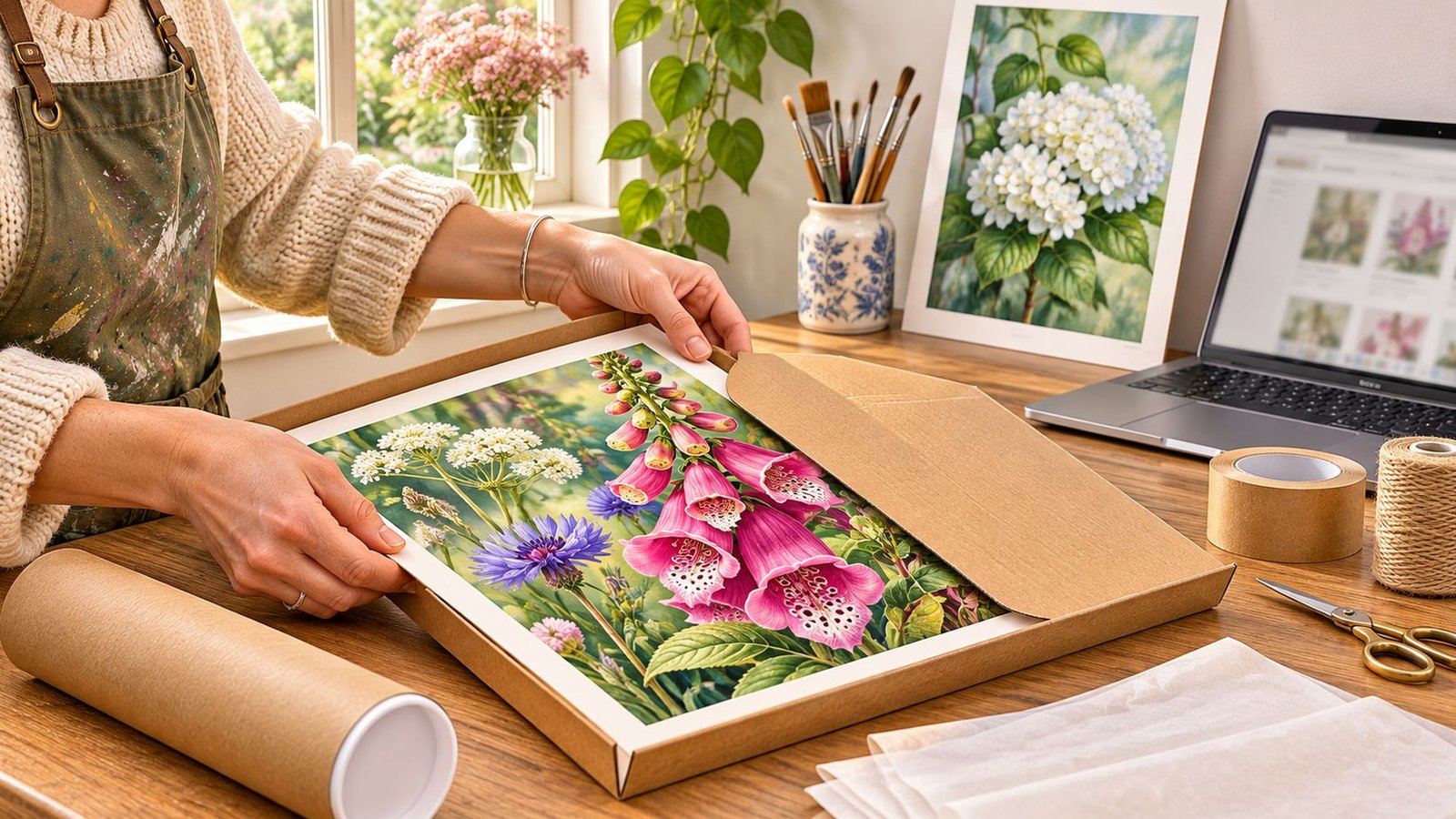
- A3 and above: a rigid tube or a board mailer with corner protection, because creasing and lost tracking are the two failure modes.
- Framed work: a strong box with corner guards and foam, sent through a carrier that accepts large parcels.
Record the packed dimensions and weight for every product, because postage is priced on those figures and not on the print size. The Famous Movie Posters shipping guidance is a useful second reference for poster-specific packing. Offer a transparent standard option and, where the margin allows, a tracked or express one.
Before launch, run a pilot of at least five destination tests across England, Scotland, Wales and Northern Ireland, plus one EU destination. If you're already trading, thirty real orders gives you a usable picture. Track damage rate, on-time dispatch, delivery complaints, refund rate and margin after postage. Then apply one hard test: if shipping exceeds roughly 20% to 25% of the print price, fix the format or the bundle before testing a free-delivery threshold, because an apparent conversion gain that loses money on every order isn't a gain.
Sellers who add low-value items to the range face the same parcel maths at a smaller scale, which is why the guide to selling greeting cards online is a useful companion to this section.
Price Each Print to Cover Costs, Delivery and VAT
Cost lines that make up a print price
| Cost line | Where to find it | What sellers often miss |
|---|---|---|
| Production cost | Printer quote for each size and paper | Spoilage from test and reprint sheets |
| Packaging | Supplier price for each mailer, tube or box | Framed work needs extra protection |
| Postage | Carrier price for the packed weight and size | Using one postage rate for every size |
| Marketplace or platform fee | Terms of each channel you sell through | Pricing before deducting fees |
| Damage allowance | Damage rate from your test orders | Assuming zero damage |
| VAT | HMRC guidance for your turnover and customer location | Treating VAT as something to add later |
Build the price in one direction only. Start with the printer quote for that size and paper, add the packaging cost for that specific container, add postage for the packed weight and dimensions, add the marketplace fee your channel charges, and add a damage allowance based on what your own test orders showed. That total is the floor. Compare it with the price the buyer sees, then adjust the format or the price before publishing rather than after the first ten orders.
Two lines catch people out. The first is spoilage: test sheets, reprints and one damaged replacement per twenty or thirty orders are real costs, and pricing at zero for them means the shop subsidises its own quality control. The second is using one postage figure across a range, which makes small prints expensive and large prints loss-making.
The VAT position, plainly
For a UK seller of art prints, GOV.UK's VAT registration guidance sets registration as generally required when taxable turnover exceeds £90,000 in the previous 12 months, or when you expect it to exceed £90,000 in the next 30 days. Taxable turnover is the total value of non-exempt goods and services supplied, so print sales sit alongside other taxable business income rather than being judged on their own. Voluntary registration below the threshold is possible.
Whether displayed prices include VAT depends on the product, your status and the customer's location, so confirm the position with HMRC or a tax adviser before deciding how prices appear at checkout. Cross-border routes add their own tests: GOV.UK's VAT thresholds guidance identifies a separate £8,818 threshold for certain sales from Northern Ireland to consumers in EU countries, based on total EU sales in a calendar year. Check the current guidance for each route rather than assuming UK rules settle the question.
Write the total cost for each format on one line before you set any price. If the line doesn't include postage to the packed weight, it isn't the cost.
Test every bundle and free-delivery threshold against margin after postage. A discount that loses money on each order is a slower way of going out of business, not a sales strategy.
Returns, Cancellations and Who Carries the Risk
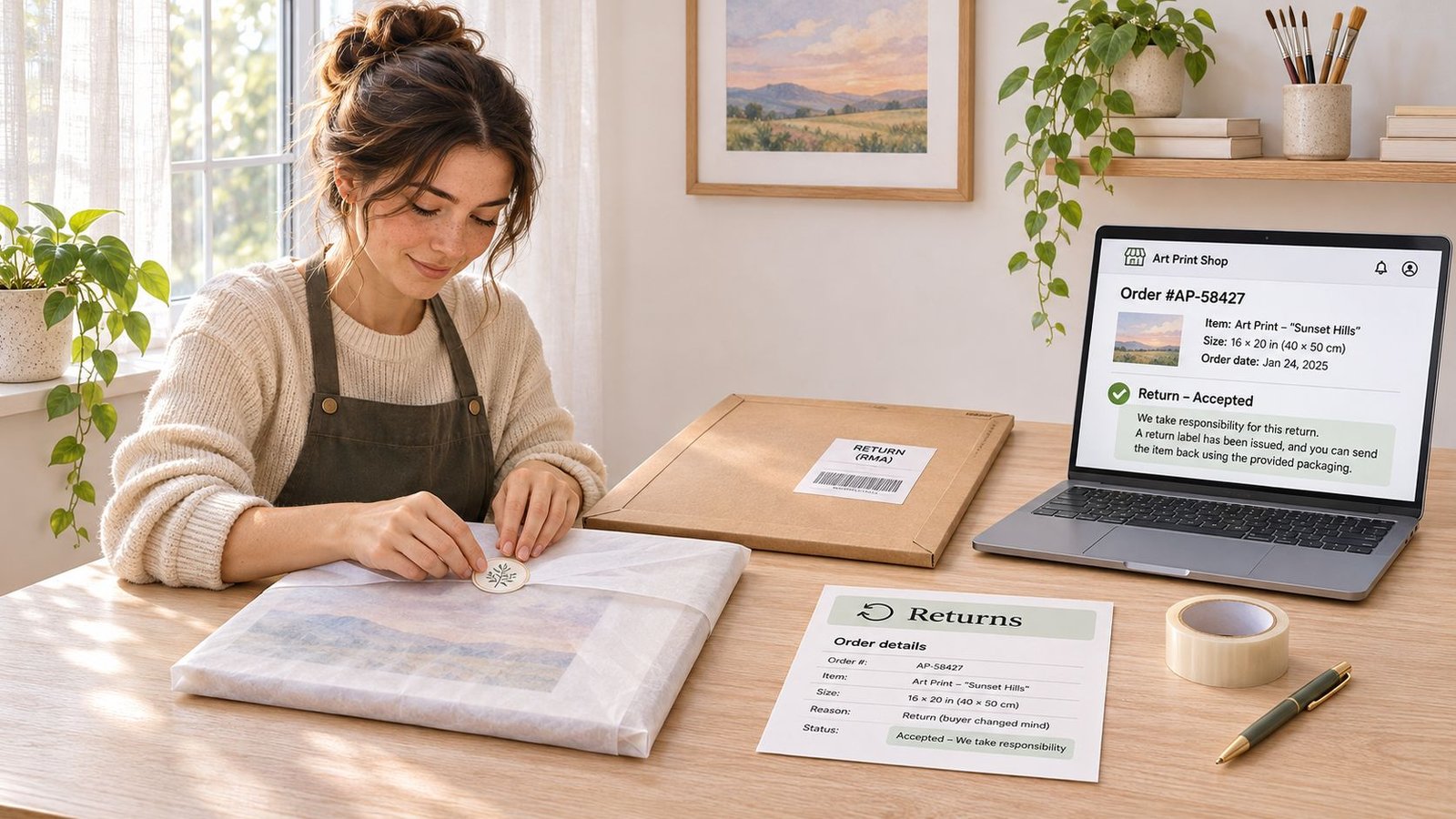
The belief worth correcting first is that a print-on-demand partner absorbs the legal relationship. It doesn't. The seller remains responsible for lawful offers, accurate descriptions, fulfilment, required licences, verification, taxes and cooperation with transaction reviews. Your printer is a supplier. The buyer's contract is with you.
So the pre-contract information has to be on the page before payment: your identity and contact details, the total price including delivery, and the cancellation rights. Government guidance on the Consumer Contracts (Information, Cancellation and Additional Payments) Regulations sets out that consumers generally have 14 calendar days from receiving the goods to cancel many online purchases. That period is separate from the time the buyer then has to return the item, which is why sellers who state one window and mean the other end up arguing about dates.
The personalised-goods exception is narrower than the internet suggests. A standard catalogue print shouldn't be marked non-returnable because it was printed after the order arrived. A print carrying the buyer's own wording, bespoke dimensions or their own image may be treated differently, and unusual or bespoke orders warrant legal advice specific to the circumstances rather than a copied policy paragraph.
A six-question check for every print on the page
- Is this print standard, personalised, or made to the buyer's specification?
- Who handles support, and how quickly will they answer?
- What is the delivery window, stated as processing time plus transit time?
- What happens if the buyer changes their mind, and who pays return postage?
- How is damage claimed, and what evidence do you need, such as photos of the packaging and the print?
- Which terms are statutory and which are your own voluntary extras?
That last question matters more than it looks. A longer return window or a no-questions replacement is a commercial choice, and labelling it clearly keeps it from being read as a legal right. Rhinehart Studio's guide to print-on-demand rules in the UK makes the same point about responsibility: the seller stays answerable for product information, returns and the customer relationship even when someone else prints and posts the item.
Set Up Each Print Listing, Step by Step
1. Create one offer per format or edition, not one per artwork. An A4 open edition, an A3 limited edition and a framed version are three products with three costs and three parcels. Merging them into one listing forces the buyer to guess and forces you to average your postage. In practice, step one is adding the images, the description, your price and the details the buyer needs to that individual offer.
2. Export files at the final print size and 300 ppi in the colour profile your printer specifies. Keep an untouched master file so you can re-export later without degrading it. The common slip is enlarging a web image, which prints soft at A3 and looks like a printing fault rather than a file fault.
3. Photograph or mock up four things. A full artwork view, a scale reference in a typical UK room, a close-up of the paper texture and a shot of the packaging as it arrives. Buyers judge print quality from these images because they can't touch the paper. If your lighting is flat or your colour is off, the print will look worse than it is, so it's worth reading about lighting and camera settings for art before you shoot a whole catalogue.
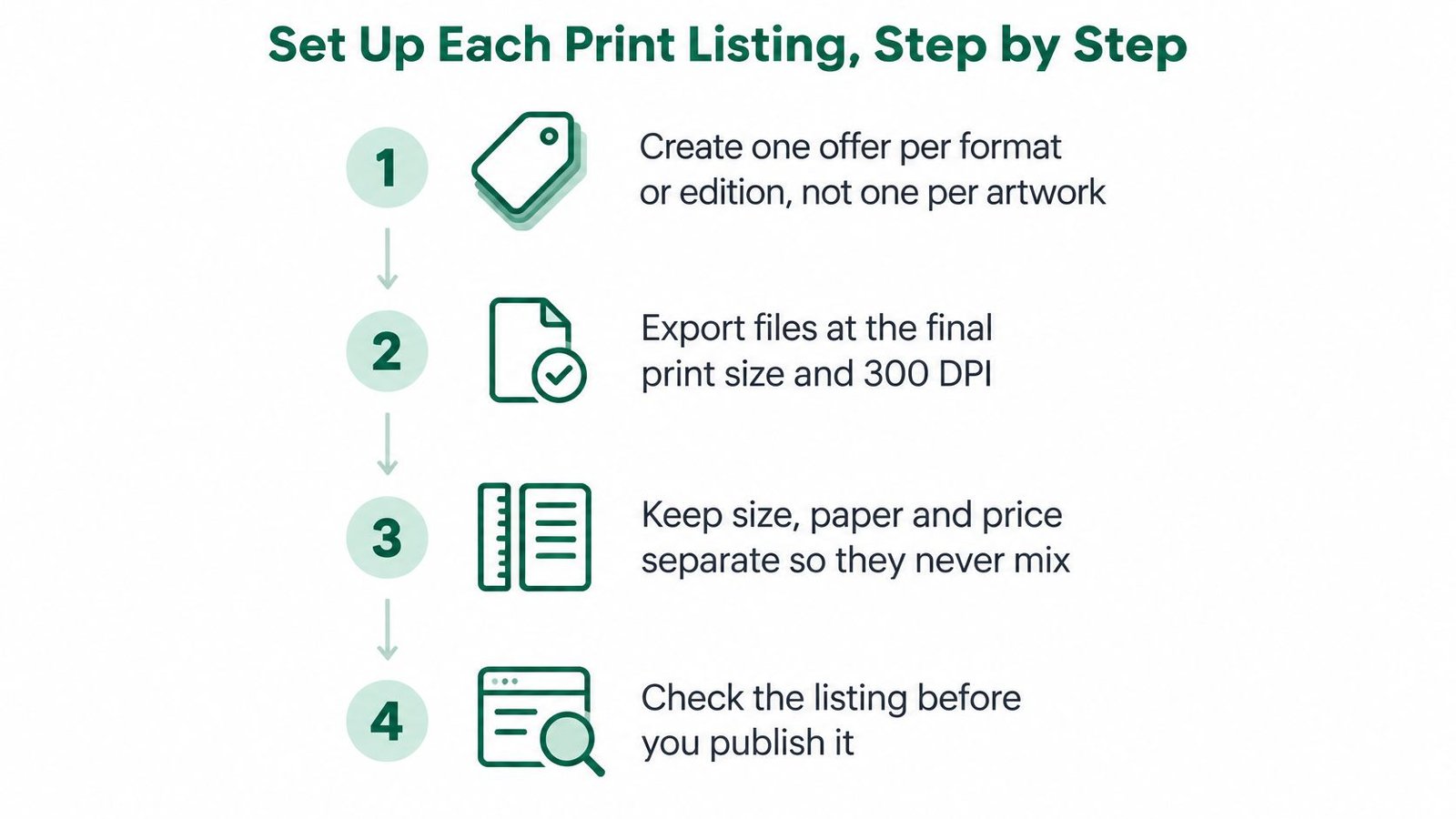
4. Write the specifications that decide a purchase. Paper stock, exact dimensions, image area and border, edition number, signing details, and a plain note that colours can vary slightly between screen and print. Vagueness here converts into refund requests later, because the buyer builds an expectation you never agreed to.
5. Set the delivered price with postage visible before checkout. Nothing should appear for the first time at the payment step. A postage figure that arrives late reads as a trick even when it's your cost.
6. State processing time separately from transit time, and give a dispatch cut-off. "Dispatched within three working days, delivered in two to three working days after dispatch" is honest and testable. "Fast delivery" on a print that still has to be produced is the mistake that generates the complaint.
7. Review the draft as a buyer would before publishing. Read the page and check that size, price, delivery and returns can all be answered from the page alone. A completed draft should be reviewed before it goes live, because the details a buyer needs are exactly the ones a seller stops noticing after the third edit.
Track the Sales Figures That Show Which Prints Sell
Sales metrics to review each week or month
| Metric | What it tells you | Review how often |
|---|---|---|
| Offer page visits | How many people see the listing | Weekly |
| Checkout starts | How many buyers chose to buy | Weekly |
| Completed orders | Real sales from the listing | Weekly |
| Abandoned checkouts | Where buyers stopped and what they saw | Weekly |
| Damage rate | Packaging and print handling | Every 30 orders |
| Refund rate | Product match and clarity of returns | Monthly |
| Margin after postage | Whether each print is profitable | Monthly |
| Repeat buyers | Trust in the shop and the next offer to make | Monthly |
Run this as a single spreadsheet with one row per week and one column per metric, plus columns for traffic source and device type. That's the whole system. It takes ten minutes on a Monday and it stops you optimising the thing you happen to be looking at.
Reading the numbers is where the value sits. Many page views with few checkout starts usually means the price or the delivery terms aren't clear on the page. Many checkout starts with few completed orders points to a surprise at payment or a fussy payment step. A rising damage rate is a packaging problem, and no amount of advertising spend will fix it.
Basket abandonment in the UK is high enough that it belongs in the plan rather than in the panic. UK conversion-rate research compiled by Carlos Alba Media reported roughly 74% basket abandonment in late 2024, rising to 76% on mobile against 67% on computers. The same compilation notes that conversion benchmarks vary by source, with roughly 1.68% overall in September 2025 and around 3.8% for arts and crafts in one benchmark set. Treat all of it as directional: a new shop should build a baseline over at least 500 relevant sessions and compare mobile against desktop before changing anything.
Practical rule: fix the page before you buy traffic. Mobile-first images, a visible delivery date and one clear checkout path do more than an ad budget spent against a confusing listing.
Record destination and cumulative cross-border sales by country as you go, so international obligations show up in your figures before they show up in a letter. Then note which buyers have ordered before. A second-print offer to someone who already trusts the shop is the cheapest sale available, and the guide to keeping track of customer orders covers the record-keeping that makes it possible.
Launch Your First Print Listing and Promote It
One sequence, in order. Choose one format from the first table and five designs. Build the listings using the procedure above, then place a test order yourself, or ask someone in another part of the UK to buy one, and time the delivery against the window you published. Do this before you promote anything. A launch that sends traffic to a page with an untested delivery promise wastes the only attention spike you'll get from that audience.
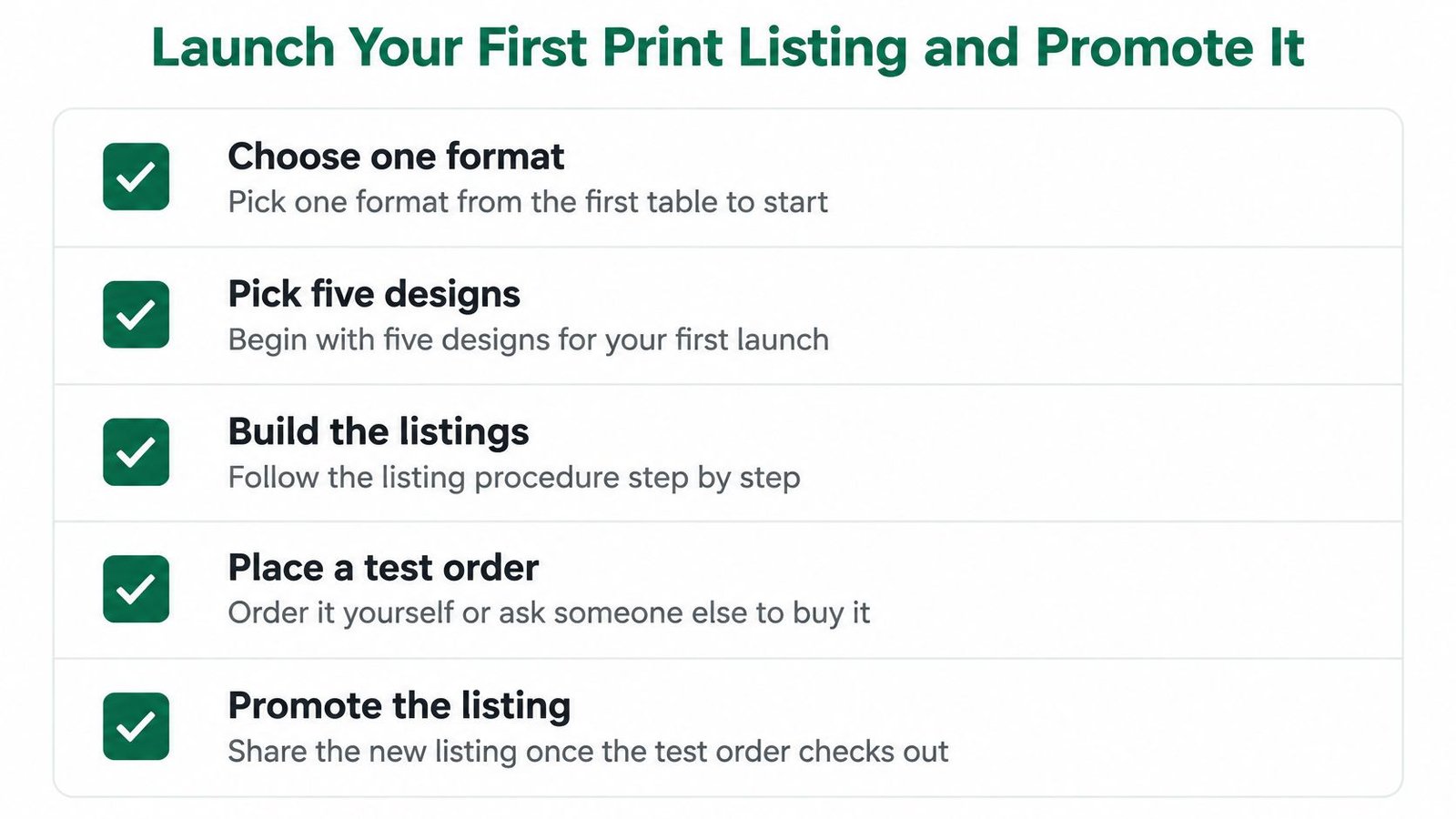
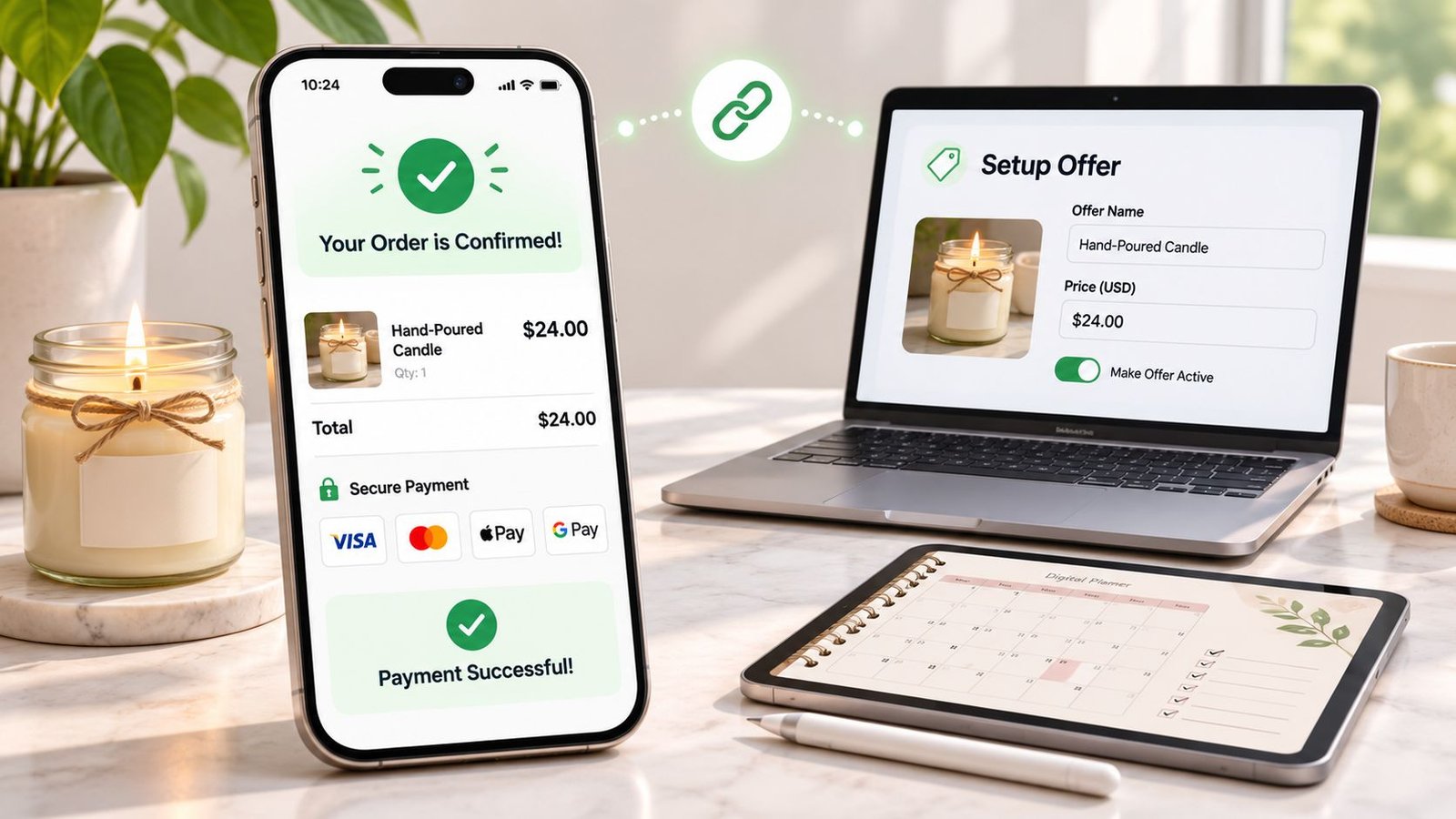
Then share the link where your audience already is: your own site or artist page if you have one, social profile links, email to people who already follow the work, and any marketplace you sell through. AmaJova's OfferLink works on this basis, since a seller shares one link in bio, socials, messages, email, paid campaigns or an existing website, and an OfferLink can be created without a website at all. Keep the first message plain: the artwork, the format, the delivered price. No urgency claims you can't back up.
Expect modest, compounding growth rather than a spike. The UK online art market was estimated at approximately USD 730.42 million in 2024, with forecasts indicating growth to about USD 1.42 billion by 2035 at a projected compound annual growth rate of around 6.2% between 2025 and 2035, according to Spherical Insights' UK online art market report. Those are commercial projections rather than official statistics, but the shape is the useful part: a rate like that rewards consistent cataloguing and repeat purchasing more than one-off promotional pushes.
Record the traffic source of every visit so you can see which channel brings buyers rather than browsers. After two weeks, write down the baseline figures from the metrics table and keep them. Every later change, a new format, a new postage option, a new photograph, can then be judged against something real instead of a feeling about last month.
AmaJova turns a physical product into a single OfferLink with the images, description, price and fulfilment details a buyer needs before paying, then keeps checkout, messages and the order record in one place. If you're selling prints, that means one link you can put in a bio, an email or a message, with delivery expectations stated before anyone reaches the payment step. Have a look at AmaJova and build the first listing around the format and parcel you've already costed.