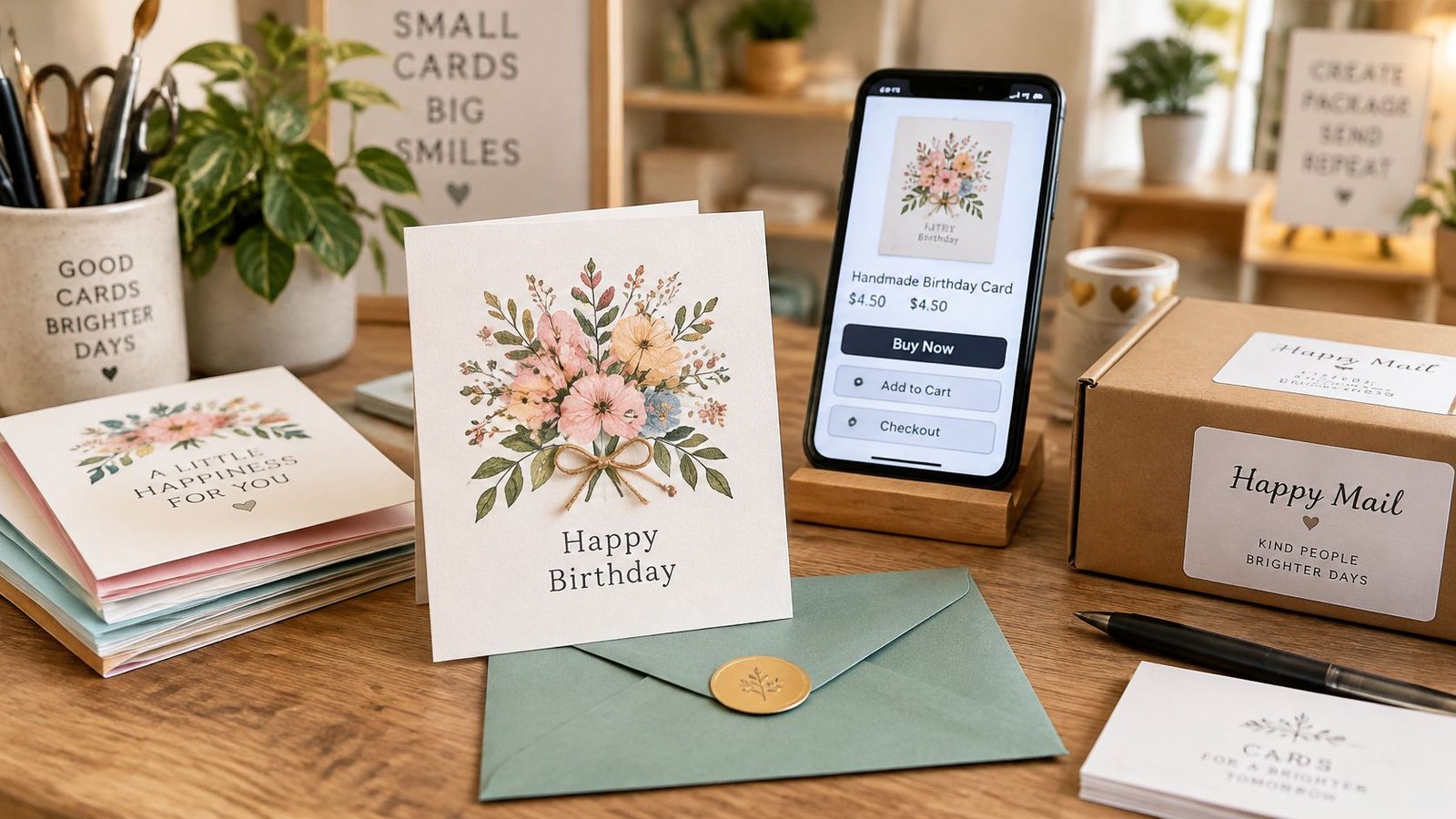
Sell greeting cards online by turning one clear offer into a simple journey: make it, share the link, get paid, then send the order. Start with a single card, a counted pack or a printable instead of building a huge catalogue.
Table of Contents
- Build a Direct Route From Card to Checkout
- From a Finished Card to a Paid Order
- What a Physical Card Offer Must Say
- What a Printable Offer Must Say
- Photos That Answer Questions
- Inclusions, Extras and Boundaries
- Build the Price From Actual Costs
- What to Specify for Each Card Offer
- Set Delivery Expectations Clearly
- Publish a Clear Final Offer
- Use Channels Your Buyers Already Use
- Match Your Content to Real Occasions
- Create Posts That Remove Doubt
- Test a Small Range
- Pack Physical Cards Safely
- Solve Common Order Problems
- Control Stock and Payouts
- Can You Sell Greeting Cards Online Without a Website
- Should You Sell Printed Cards, Printables or Both
- How Should Postage and Delivery Times Be Handled
- What Should You Do if a Card Arrives Damaged
Build a Direct Route From Card to Checkout
A buyer should understand what you are selling without having to message you first. Show what arrives, how many cards are included, whether an envelope is included, the price and when you will post it.
Say you are selling five A6 birthday cards with envelopes for a set price. Or perhaps just a single A5 thank-you card. A printable seller might offer a printable PDF for home printing instead. Different formats need different details, but all of them can sit inside one tidy offer.
From a Finished Card to a Paid Order
Here is the short version of how that works in practice. You do the preparation once, the buyer sees something clear enough to pay for straight away.
| Stage | What the seller does | What the buyer sees |
|---|---|---|
| Prepare | Pick the card, pack or printable and confirm what is included | Clear photos and an honest description |
| Price | Set the price and spell out postage or download terms | The cost and fulfilment terms before paying |
| Publish | Create one OfferLink with all the details | A neat page with images, inclusions and checkout |
| Share | Send the link where your buyers already spend time | The same offer wherever they find you |
| Fulfil | Post the card or release the file | An order record plus clear fulfilment updates |
Once that simple system is in place, reusing it becomes straightforward. The same flow also suits sellers who want to reach nearby buyers as a maker through a local marketplace or sales channel.
The UK numbers support keeping things focused. Moonpig reported online greeting-card sales of approximately £212 million in 2023, around 15% of the UK singles market by value. Online sales were up roughly 7% on 2022, with its model pointing to about 9% annual growth from 2024 to 2027 and an online share of 19–20%. Read the full findings in Moonpig’s UK market report.
The strongest offer is specific enough to understand and simple enough to buy in a few clicks.
Seasonal sets, personalised cards, boxed sets and limited runs can all work as separate offers. Just settle the essentials first:
- exact size and quantity
- what is included, envelopes and extras
- personalisation options, if any
- price, postage and turnaround time
Agree all of that before payment, not after.
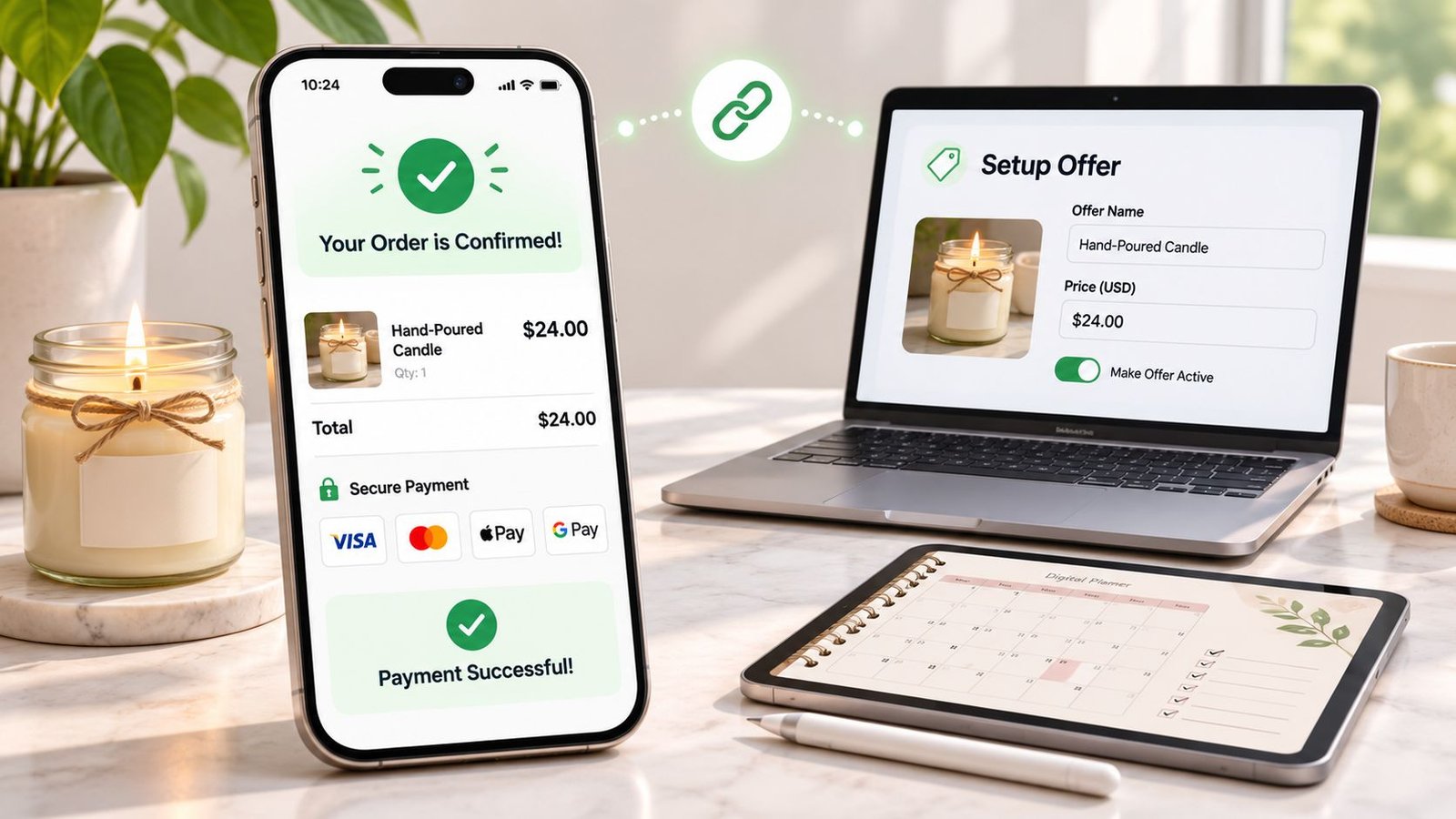
AmaJova follows the same practical rhythm: Create, Share, Sell, Fulfil and Get paid. For help turning an offer into a shareable payment page, see how to create a payment link.
Start with your simplest card offer, add the details a stranger would need, and publish it as one clear link.
First thing to sort out: will you pop a real card in the post, or send a file the buyer prints themselves? Choose one option per listing.
The two need quite different details, and mixing them up is what leaves buyers guessing.
What a Physical Card Offer Must Say
If you are posting it, describe the finished card. Size, folded or flat, what is inside. Avoid jargon.
Say it in plain words — A6 or 5×7 inches, 300gsm textured card, blank inside, envelope included or not. And be clear: is this one card, or a counted pack of ten?
One more thing that saves hassle. Mention how many you can sensibly send in a normal week. It stops a small limited run looking like endless stock.
- Finished size, e.g. A6 or 5×7 inches
- Stock and finish in plain English, like 300gsm textured card
- Single card, or a counted pack of ten
What a Printable Offer Must Say
Selling the download? Buyers need the practical points up front. File type, what size it is meant to print at, whether you have included crop marks and bleed.
Also make it obvious it is a download after payment — no physical item in the post. Keep your personal-use note brief and practical, and check what applies where you live, as licensing and consumer rules vary by country.
Photos That Answer Questions
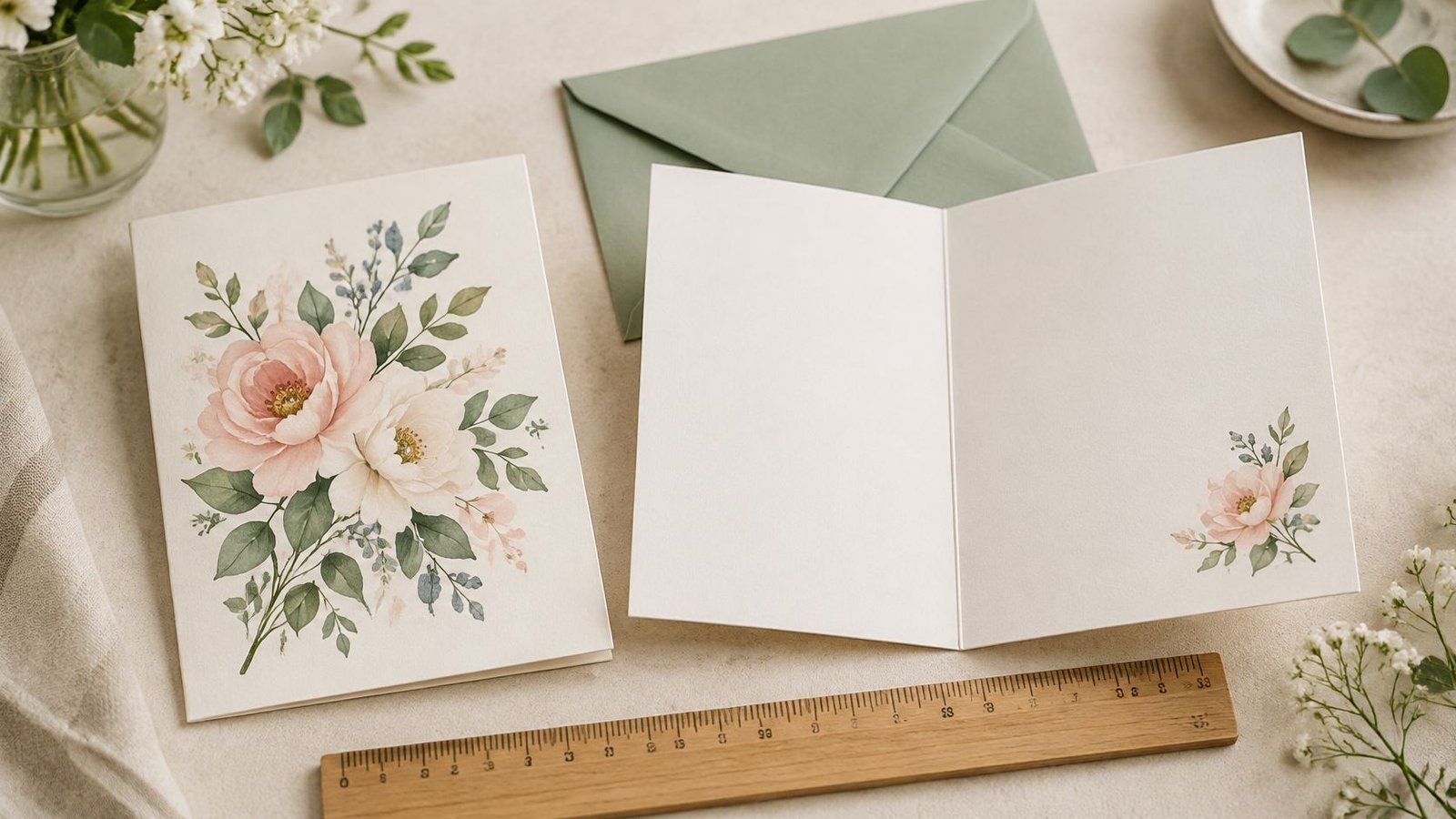
Good photos do half the selling for you. Show the front, then show the inside.
If there is an envelope, photograph that too. Place the card next to something familiar — a ruler, a teacup — so the scale is clear straight away.
Inclusions, Extras and Boundaries
Think of this part as your checklist. What is in the pack, what is not, and any small extra you are genuinely happy to provide.
That might be a short handwritten message or gift wrap. Only offer it if you can still manage it at Christmas-rush volume.
Be upfront about limits as well. Personalisation cut-offs, designs you will not alter. Add a short Q&A on the listing covering size, paper, envelopes and dispatch, so you are not answering the same direct messages every evening.
Ask the awkward questions on the offer, not in private messages.
When you build your OfferLink, keep those boundaries, FAQs, extras, price and fulfilment notes all in one place. AmaJova walks you through that set-up, so shoppers see exactly what they are paying for on the offer page — before they pay, not after.
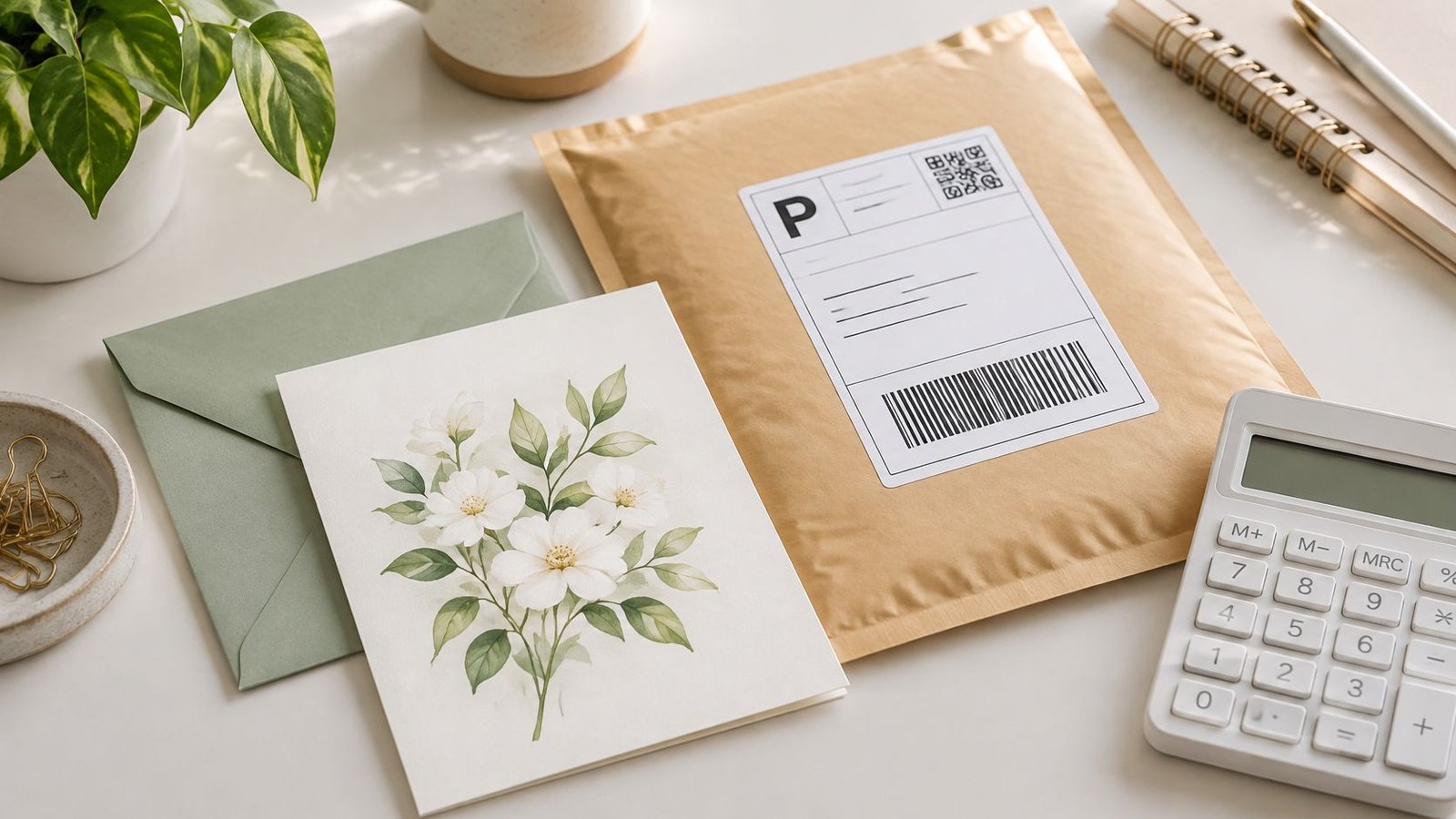
Price from what things actually cost you, not from a going rate you saw elsewhere. Materials or printing, envelopes, protective packaging, postage, checkout fees and your packing time all count.
That straightforward maths is what keeps a card shop viable.
Build the Price From Actual Costs
A single A6 card is cheap to pack but can cost you more in postage per order. A boxed set of eight reverses that — better postage per card, more work checking and cushioning the set.
A printable download avoids print and post entirely. You still spend time getting the file right and explaining sizes and formats, though.
Price for a quiet week in February, not just for Christmas.
A practical way to work it through is:
- Card stock or print cost, plus test prints
- Envelope and any sleeve or rigid mailer
- Postage for the areas you actually serve
- Checkout fees and a realistic allowance for fulfilment time
- A margin you can sustain month after month
What to Specify for Each Card Offer
Different offers create different expectations. Spell it out before anyone pays, and you will receive far fewer awkward messages later.
| Offer type | Details to state before payment | Main fulfilment task |
|---|---|---|
| Single physical card | Size, envelope, postage and dispatch window | Pack and post one card |
| Counted set | Number of cards, envelopes, packaging and postage | Check contents and protect the set |
| Printable download | File type, print size and access method | Prepare and release the file |
If you are listing one A6 birthday card at £4.95 including UK postage, say so plainly on the offer. And if postage is extra, show the full price before checkout so there are no surprises.
Set Delivery Expectations Clearly
Be upfront about where you post to, whether postage is included, and a dispatch window in working days you can genuinely keep. Only offer international delivery if you have priced it properly and are comfortable handling it.
Selling personalised cards? Publish your order cut-off and exactly what you need — a name, spelling, short message for the inside. It also helps to say what happens if those details arrive late.
For damaged or unusable cards, explain your own process in plain terms. Many sellers ask for a photo, then offer a replacement or refund. Present it as how you look after customers, not as legal advice.
Orders placed through AmaJova create an order record once payment is complete. Put format, envelope, dispatch time and any extras on the offer itself, so you start fulfilment with clarity rather than guesswork.
Publish a Clear Final Offer
Before you share the link, check a buyer could answer these in seconds:
- What exactly do I receive?
- What does it cost in total?
- When will it be dispatched?
- What happens if something goes wrong?
That level of clarity makes all the difference when learning how to sell greeting cards online. A precise offer reassures buyers, reduces queries, and helps you pack and post consistently.
Once your greeting card offer is sorted, give buyers one dependable place to buy from. Keep the same OfferLink instead of changing the price, what is included, or the dispatch promise from post to post. It makes the decision clearer and takes the guesswork out of checkout.
Use Channels Your Buyers Already Use
Share that link wherever your buyers spend time. Your social bio, direct messages, emails, paid ads, even your own website if you have one. With AmaJova, the idea is the same: one OfferLink shared across profiles, messages, email, campaigns and websites. Have a look at how to sell on Instagram for ideas tailored to that channel.
Say you have a birthday card to sell. Post it with a quick note about who it suits. Then use the same approach for wedding thank-yous, new baby cards, congratulations, local events — you get the idea.
One clear link makes every post easier to act on.
Match Your Content to Real Occasions
People do not just buy cards in December. A thank-you card is needed right after a wedding. A birthday design works in any month. Keep a loose content plan around the occasions your designs actually fit, then link each post back to the right offer.
Shopping online is now routine. Office for National Statistics data showed internet sales accounted for 27.5% of total UK retail sales in 2025, up from 27.1% in 2024. In December 2025, the online share reached 28.3%, with online spending up 11.1% on December 2024. Read the ONS retail sales findings.
So there is no need for a hard sell. Show the card, say what it is for, who it will suit, and point people to the offer.
Create Posts That Remove Doubt
Keep it short and visual. That is what works. Photograph the front and inside, say who it is for, and flag dispatch timing when there is a date involved.
A caption that does the job might read:
“A blank botanical birthday card for a thoughtful note, with an envelope included. Ordered cards are dispatched within the stated dispatch window on the offer page.”
Do not leave people hunting for the basics. Keep price, inclusions and delivery expectations on the OfferLink itself.
Selling a few different designs? Have a read of carousel marketing for online stores for a tidy way to show a small range.
Test a Small Range
Start small. A handful of designs or packs is plenty, rather than a huge catalogue straight away. Watch what actually gets ordered, keep those front and centre, and refine the descriptions as you go.
- Pick two occasions to focus on each week
- Share one relevant card for each
- Point back to the same clear offer
Consistency beats a flurry of posts then silence. Avoid income claims, and let real orders tell you which designs deserve more attention.
Once the payment lands, work from the order record itself. Do not try to rebuild it from memory.
Check the design, quantity, personalisation and delivery notes before you pack anything.
If an address looks incomplete, message the buyer before you post. A missing postcode needs confirming, not guessing. And if a design sells out, close it off. Do not quietly substitute another design.
Keep every promise, including the envelope, dispatch window and replacement process, in one place.
Pack Physical Cards Safely
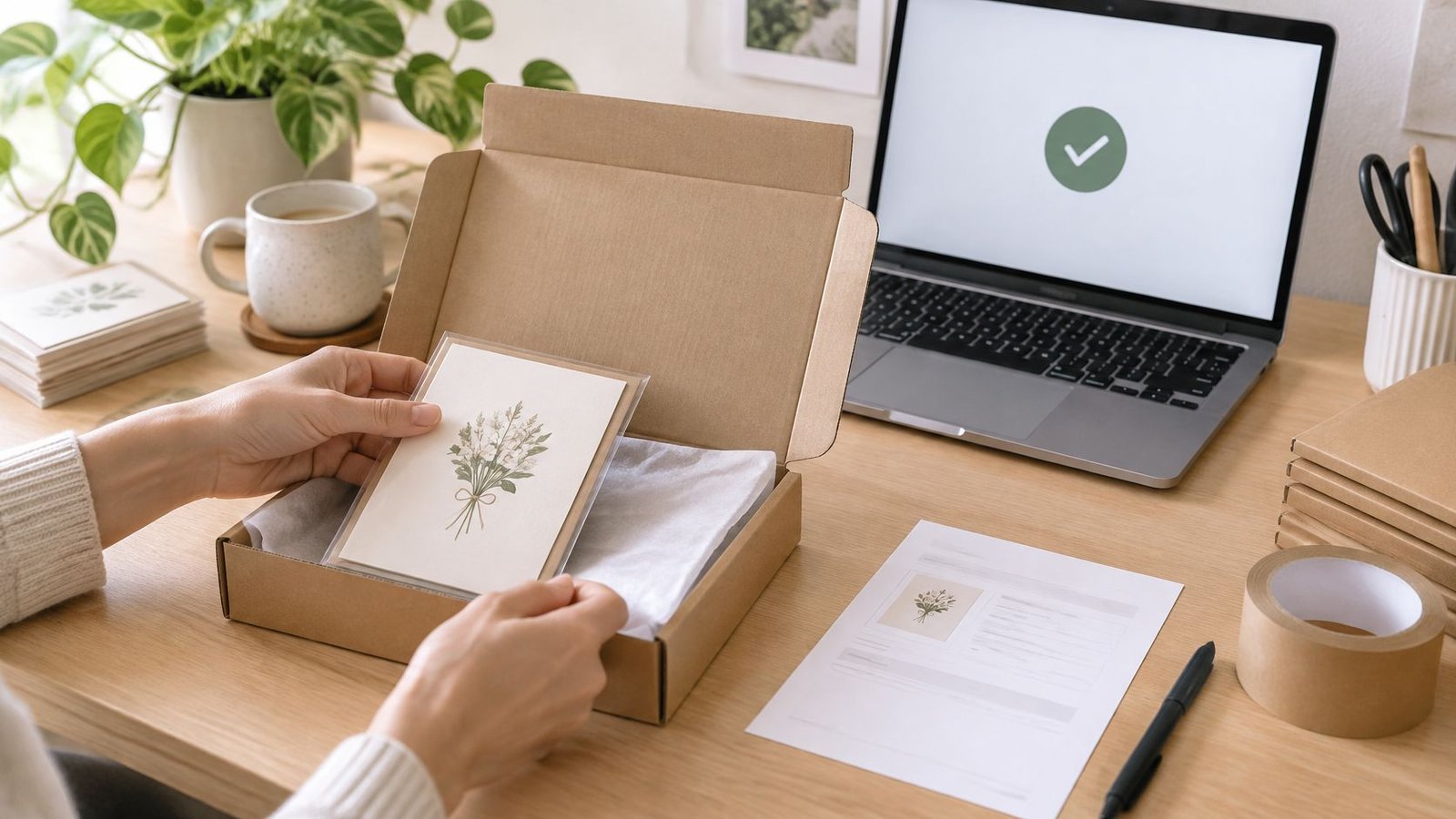
For physical cards, keep things flat and protect the corners. Include the promised envelope, then match the parcel against its packing note.
Post inside your stated window and let the buyer know it is on its way. Batching similar orders can save time, but still check each design and address one by one. Use practical guidance on tracking customer orders to keep the whole workflow visible.
Selling downloads instead? Release exactly the access your offer describes. Open the file first and confirm the size and format match the listing.
Solve Common Order Problems
When a card arrives damaged, follow your published replacement or refund process. Ask for a photo, keep the messages together, and resolve it through that route.
This is a seller service standard, not legal advice. Tax, consumer-law and courier-liability rules differ by location, so check the official guidance that fits your own situation.
Before you promote a limited run, be honest about stock and packing capacity. If you cannot meet the dispatch promise, pause or update the offer.
- An incomplete address means contact the buyer before posting
- A sold-out design should be closed, not replaced
- A damaged card follows your published replacement or refund process
Control Stock and Payouts
As you grow, understanding how ecommerce pages are put together can help with search visibility. Have a look at ecommerce SEO services for practical guidance.
Payment follows AmaJova's stated process for your seller account and offer. Start with one order, check it properly, then mark it complete.
Can You Sell Greeting Cards Online Without a Website
Yes, you absolutely can. You do not need a full shop to start testing a small range.
An OfferLink can hold your offer, price and fulfilment details in one place. Then you simply share that link directly with customers.
It is a straightforward way to see what sells before you commit to building anything larger.
Should You Sell Printed Cards, Printables or Both
It really comes down to what you can deliver well.
Choose printed cards when you are confident in the physical finish — the card stock, the print quality — and you can post reliably. Choose a printable when you are comfortable delivering the file as described and you can state the print size clearly.
Only sell both when each listing spells out exactly what the buyer will receive. No guessing. Is it arriving in the post, or as a file?
How Should Postage and Delivery Times Be Handled
Keep it clear. Only offer delivery to places you can price properly, and say upfront whether postage is included.
Give a dispatch window in working days that you can genuinely keep — even when Mother’s Day or Christmas arrives.
- Swap vague promises like “fast delivery” for something concrete, such as “dispatched within three working days”
- If your capacity changes, update the offer before anyone orders
That one habit will save you a lot of awkward messages later.
What Should You Do if a Card Arrives Damaged
Ask for a quick photo of the damage first. Then simply follow the replacement or refund process you have already set out in your offer.
This is your own customer-care process, not a legal ruling or guaranteed platform outcome.
And keep those messages saved alongside the order record. It makes life much easier if there is any further discussion.
Ready to turn your card range into one shareable OfferLink with AmaJova? Add your images, description, price, FAQs and fulfilment details, then share it in your bio, messages or existing website.
Start with one offer, publish it today and adjust things as customers respond. With a single link, you can test demand without the cost and effort of a full website. That keeps selling simple.
Build your first clear offer today. Start with AmaJova at AmaJova.