
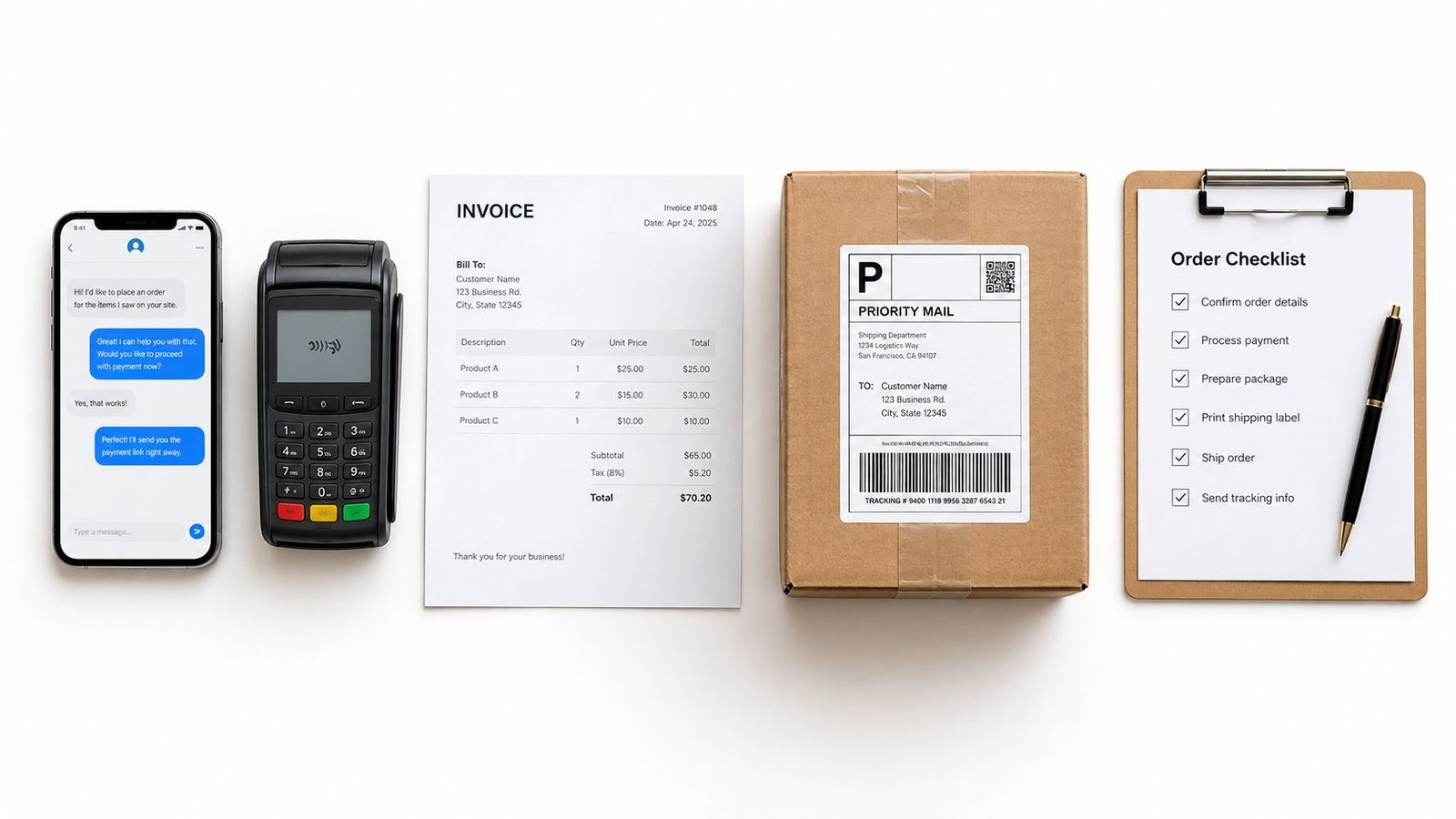
On a typical Tuesday morning, a two-person UK seller can be busy without moving a single order forward. Thirty-eight Instagram messages ask for different variants, three PayPal invoices have been sent but only one has been paid, and a Royal Mail Click & Drop label was printed before the delivery address was confirmed. Meanwhile, a customer is asking where a parcel is because the courier notification went to a different inbox.
The frustrating part is that the actual fulfilment might take only twenty minutes per order. The delay sits between the steps, where messages, spreadsheets, payment records and labels fail to agree. A reliable order management workflow gives every sale one record that survives capture, payment, fulfilment, communication and dispute resolution.
Table of Contents
- The Everyday Chaos a Good Order Management Workflow Solves
- What an Order Management Workflow Actually Is
- The Five Core Stages Every Workflow Must Cover
- Designing Capture and Payment Around a Single OfferLink
- Why Clarity Before Payment Beats Faster Dispatch
- Handling Disputes and Refunds Without Losing the Record
- A One-Page Workflow Checklist and Common Questions
The Everyday Chaos a Good Order Management Workflow Solves
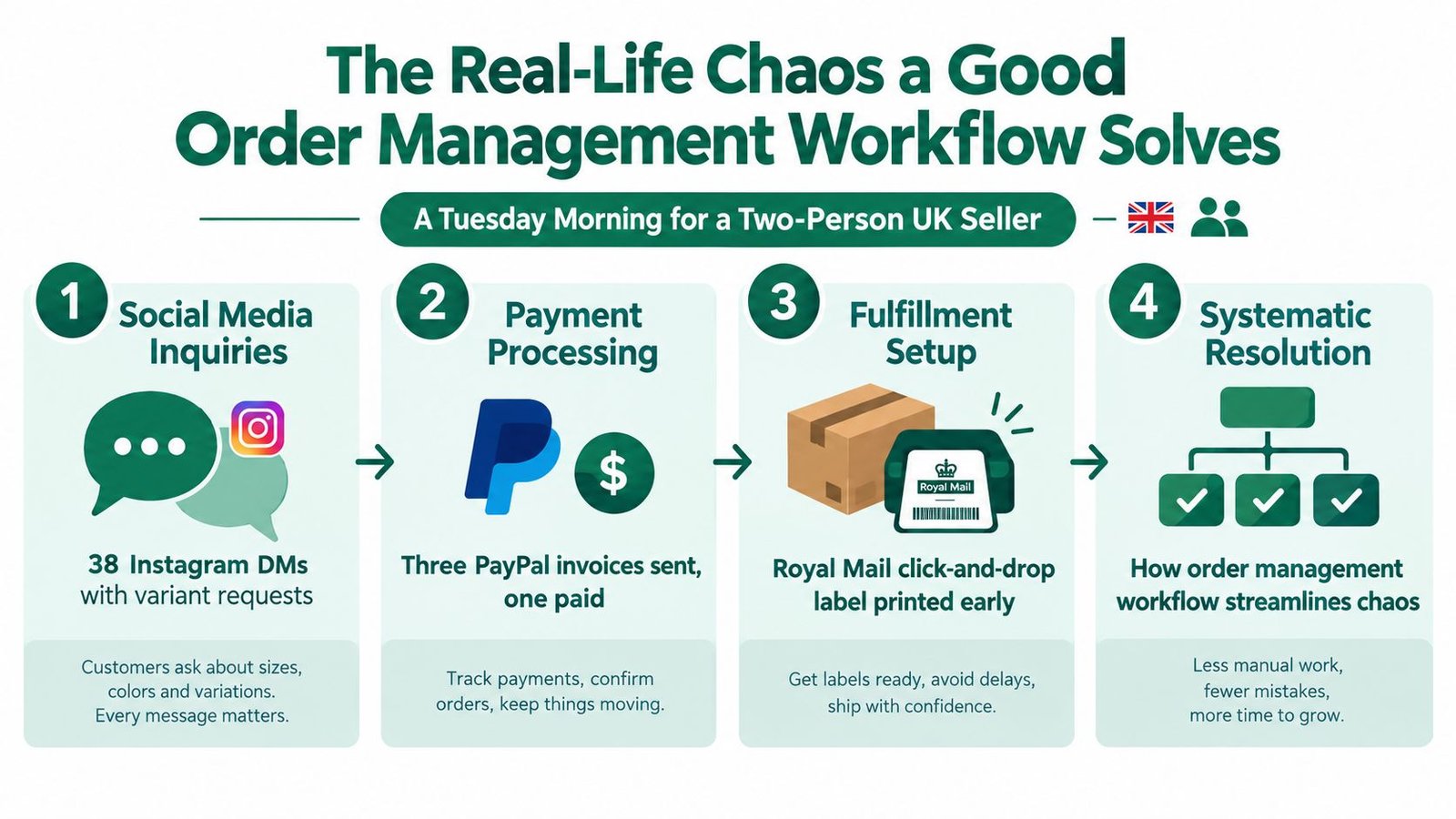
A two-person UK seller can have stock, packaging and a working carrier account, yet still lose time on every order. The product details sit in an Instagram conversation, payment in a PayPal invoice, order status in a spreadsheet and delivery information in a shipping dashboard. AmaJova's OfferLink model addresses this by keeping the sale tied to one record from the initial offer through fulfilment and any later dispute.
Each handover then becomes a search exercise. Which variant did the buyer select? Has the address been confirmed? Did payment clear before the label was created? Was the tracking message sent from the same record as the dispatch update? If the answers are scattered, the team copies details, checks timestamps and asks customers to repeat information that should already be settled.
The hidden cost is rework
Manual administration remains common among UK sellers. One UK business guide cites a 2025 SSON report in which 47% of organisations identified too many manual steps as a major challenge in handling orders. A separate UK-focused source reports that 98% of UK wholesalers still use at least some manual processes, while 27% of wholesale managers describe those processes as ineffective. These figures are reported in UK order-management research on manual processing.
The practical lesson is not to buy a large enterprise platform by default. Manual work becomes costly when responsibility passes between people or tools. Re-keying an address, matching an invoice to a message and checking whether a label reflects the latest instruction all create exception work. That queue stays invisible until a parcel is delayed, a return is disputed or a customer asks for evidence.
Practical rule: If the team has to remember what happens next, the workflow is unfinished.
A paper form, spreadsheet or specialist system can support the process. The operating requirement is consistent: one order timeline, one owner for the next action and one place to record the outcome. That record should remain usable for dispatch, UK returns handling and disputes, rather than ending when the parcel leaves the seller.
What an Order Management Workflow Actually Is
An order management workflow is the agreed sequence that moves a customer request from first enquiry to a closed, accounted-for sale. It covers products, digital products, services and live sessions, because all of them need clear ownership, payment status, delivery or access instructions and a way to resolve problems.
A useful workflow answers three questions at every handover:
- Who owns the next action? A seller may confirm the brief, a packer may prepare the item, and a support person may handle a dispute.
- What record changes? The order record, payment status, dispatch note, message log or dispute note must show what happened.
- What triggers the next step? Confirmed details, cleared payment, a tracking number, a buyer response or a cancellation request should move the order forward.
Without those rules, a small team often creates a patchwork of sticky notes, a shared inbox and a separate shipping tool. Each tool may work perfectly on its own, but no single artefact carries the complete order. The team then performs reconciliation manually, usually when a customer has already noticed a problem.
The record matters more than the platform
A spreadsheet can hold an order ID, buyer details, agreed scope, payment reference, fulfilment status and communication history. A more advanced system can add permissions, notifications, payment events and return states. Both can support a sound process if the team updates the same record consistently.
The workflow should also accommodate different fulfilment outcomes. A physical product may move from allocation to packing and dispatch. A digital product may require access instructions. A service or live session may need booking details, delivery dates and evidence of what was agreed before work began.
The five core stages are capture, payment, fulfilment, communication and dispute resolution. They should be sequential enough to prevent premature actions, but flexible enough to send an order back for human review when the details don't match.
The Five Core Stages Every Workflow Must Cover
A strong workflow doesn't automate every action blindly. It standardises the handovers where errors multiply, then keeps a human involved where judgement protects the customer relationship or the margin.
UK public-sector procurement illustrates the risk of re-keying. In the Government eMarketplace, an organisation that wants to process purchase orders in its own system must manually record the order details and enter them into its workflow after placing the order, as described in the Government eMarketplace guidance. The same cause and effect appears in small online businesses: transcription creates delay, rework and mismatch risk.
| Stage | What happens | Who owns it | Standardise this |
|---|---|---|---|
| Capture | The seller confirms the item, variant, scope, address and timing | Seller or sales owner | One order record and an order ID |
| Payment | The buyer pays against the confirmed record | Seller or payment owner | Payment status and transaction ID |
| Fulfilment | The team delivers, packs, ships, books or grants access | Fulfilment owner | Source details, completion evidence and timestamps |
| Communication | The buyer receives updates linked to status changes | Assigned support owner | Approved messages and response points |
| Dispute resolution | The seller records the issue, evidence and outcome | Support or owner | A reusable case note and resolution trail |
Capture comes before commitment
The first stage should settle what the buyer is buying. For a product, that includes the variant and delivery address. For a service, it includes scope, inclusions and timing. For a live session, it includes the booking details. The seller should record the outcome in one row or transaction record before taking payment.
Payment then follows the captured record, not an informal chat. The transaction ID, amount and payment status belong beside the order details. This prevents a seller from treating an invoice as paid merely because it was sent.
Fulfilment should read from the record
The fulfilment owner should pull the item, address or delivery instruction from the confirmed order record. After dispatch, the record should contain the timestamp and tracking number. For services and digital products, the equivalent evidence might be a delivered file, access instruction, booking confirmation or completed session note.
Automation can help once the rules are stable. Practical guidance on automating order fulfilment in 2026 is useful for comparing triggers, integrations and exception handling. The important constraint is that automation should act on trusted fields, not on incomplete messages.
Communication and disputes close the loop
Status-based communication reduces reliance on memory. A dispatch event can trigger a tracking message, while a confirmed booking can trigger preparation details. Disputes should retain the original record, payment reference, agreed terms, delivery evidence and every material message.
For sellers assessing their wider risk controls, the AmaJova seller protection information can sit alongside the operational record. It shouldn't replace the seller's own evidence discipline.
The process is complete only when the order is delivered, accessed, performed, returned, refunded, exchanged or formally closed. A workflow that stops at dispatch leaves the most expensive exceptions outside the system.
Designing Capture and Payment Around a Single OfferLink
Scattered messages force the seller to reconstruct the sale after the buyer has paid. A single OfferLink record changes the order from an informal conversation into a defined transaction, provided the seller records the details accurately before payment.
For a UK seller, the offer should state the item description, agreed price, delivery expectations, return position, buyer name and timestamp. A service offer should describe the scope and boundaries. A digital product should explain what access or delivery means. A live session should state the booking arrangement and any preparation the buyer must complete.
AmaJova OfferLink can be used as the working example because its structure brings the offer, payment and transaction history together. The seller can configure offer terms, collect payment on the same record, use a buyer confirmation step and retain an exportable transaction log. Those functions support the central workflow principle, but they don't remove the seller's responsibility to describe the offer correctly or handle legal obligations appropriately.
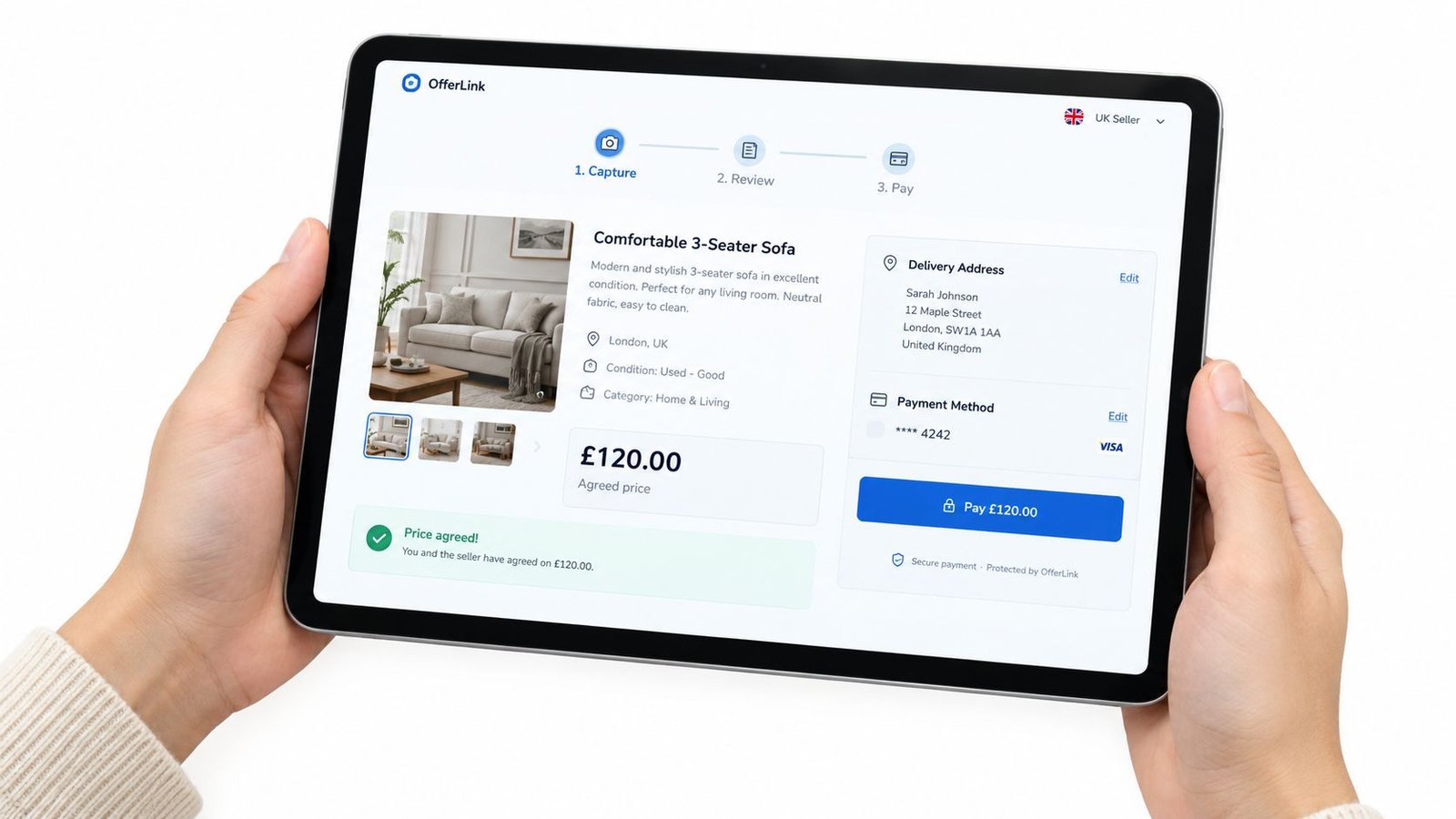
A £45 example
A maker agrees to sell a handmade item for £45. Instead of leaving the variant, delivery expectation and return position across WhatsApp messages, the seller places those terms in the OfferLink, records the buyer's name and creates the transaction record.
The buyer confirms the details and pays against that record. The seller then has one source for the agreed item and price, while the payment status and transaction reference can be checked before fulfilment starts. The example does not imply escrow, a payment guarantee or any particular payout timing. It shows how capture and payment can share a controlled record.
The same logic applies when selling a service or live session. A clear offer reduces the need to reconcile a chat thread with a separate payment statement, while the seller can still make a manual decision if the buyer asks for a change that falls outside the published terms. Further practical guidance on structuring online offers appears in AmaJova's guide to selling online.
Why Clarity Before Payment Beats Faster Dispatch
A seller who prioritises dispatch may feel efficient. The parcel leaves quickly, but the team later discovers that the buyer selected the wrong variant, expected a different delivery arrangement or never approved the artwork. A clarity-first seller spends more time before payment and less time repairing an order that was wrong from the beginning.
That trade-off matters in the UK returns environment. Non-food online returns were forecast at £25.1bn in 2025, down from £26.7bn in 2024, while the overall online return rate was forecast to ease from 21% to 19.5%, according to UK returns and reverse-logistics data. The figures describe a market-wide operational burden, not a guaranteed result for any individual seller.
The two operating choices
| Factor | Dispatch-first | Clarity-first |
|---|---|---|
| Customer brief | Assumed from messages | Written and confirmed |
| Artwork or personalisation | May be checked after payment | Approved before fulfilment |
| Delivery responsibility | Resolved when something goes wrong | Agreed before dispatch |
| Item condition | Often recorded only if disputed | Recorded at handover |
| Team workload | Fast initial action, more exception work | Slower release, fewer avoidable checks |
| Margin protection | Disputes absorb time and materials | Terms support proportionate decisions |
A clarity check should be short and repeatable. The seller can require a written brief, record signed artwork approval where relevant, state who carries the postage responsibility and photograph or note item condition at dispatch. For a service, the equivalent is a confirmed scope and a timestamp showing when delivery began.
Speed is valuable only when the team is moving the correct order through the correct path.
The UK cancellation rules reinforce the need for accurate timestamps and terms. For many distance sales, buyers have a 14-day cancellation window, followed by another 14 days to return goods after telling the seller they want to cancel. Sellers generally must refund within 14 days of receiving the goods, including standard delivery costs, as set out in the UK government guidance on returns and refunds.
A single OfferLink can capture the checks as part of payment, but it shouldn’t be treated as a substitute for clear fulfilment records. Faster dispatch is useful after the brief is settled. Before that point, clarity usually protects more time than speed creates.
Handling Disputes and Refunds Without Losing the Record
A dispute becomes harder when the seller has to search for the original agreement. The response should begin with the transaction record, not with a defensive explanation or an improvised goodwill offer.
For many online goods sales, the record should show the cancellation communication, return status, receipt of the item and refund action. For services, the timing is equally important. The cancellation period starts on the day after the distance contract is made and lasts 14 days. If the buyer asks for the service to begin during that period, the trader may charge for the value of work performed before cancellation, as explained in UK service cancellation guidance.
A reusable response pattern
- Acknowledge the issue. Confirm that the seller has received the complaint and state the date.
- Reference the order. Use the original OfferLink or order ID, not a loose description such as “the Instagram order”.
- Restate the agreement. Point to the item, scope, delivery expectation or cancellation term that the buyer accepted.
- Attach evidence. Include payment status, dispatch proof, tracking, delivery or access evidence and relevant messages.
- Offer the correct resolution. Record whether the outcome is investigation, replacement, refund, exchange or another agreed remedy.
- Close the case. Add the decision, date and any operational change needed to prevent repetition.
For an item reported as not received, the seller checks the address, dispatch timestamp, tracking event and communication history. For an item described as significantly different, the seller compares the delivered item with the original description, approved artwork or agreed specification. The same template works because the evidence changes while the order identity stays fixed.
Card-funded purchases may be challenged through chargeback in certain circumstances. The Financial Ombudsman Service explanation of chargeback describes the process, while the same guidance notes that PayPal disputes normally need to be opened within 180 days of payment. That deadline makes prompt evidence preservation more important than a polished inbox.
Guidance on order-confirmation email practice can help sellers improve the buyer-facing part of the process. For the policy and cancellation side, sellers should keep their operational steps aligned with AmaJova’s refunds and cancellations information. The asset is the record, not the goodwill gesture.
A One-Page Workflow Checklist and Common Questions
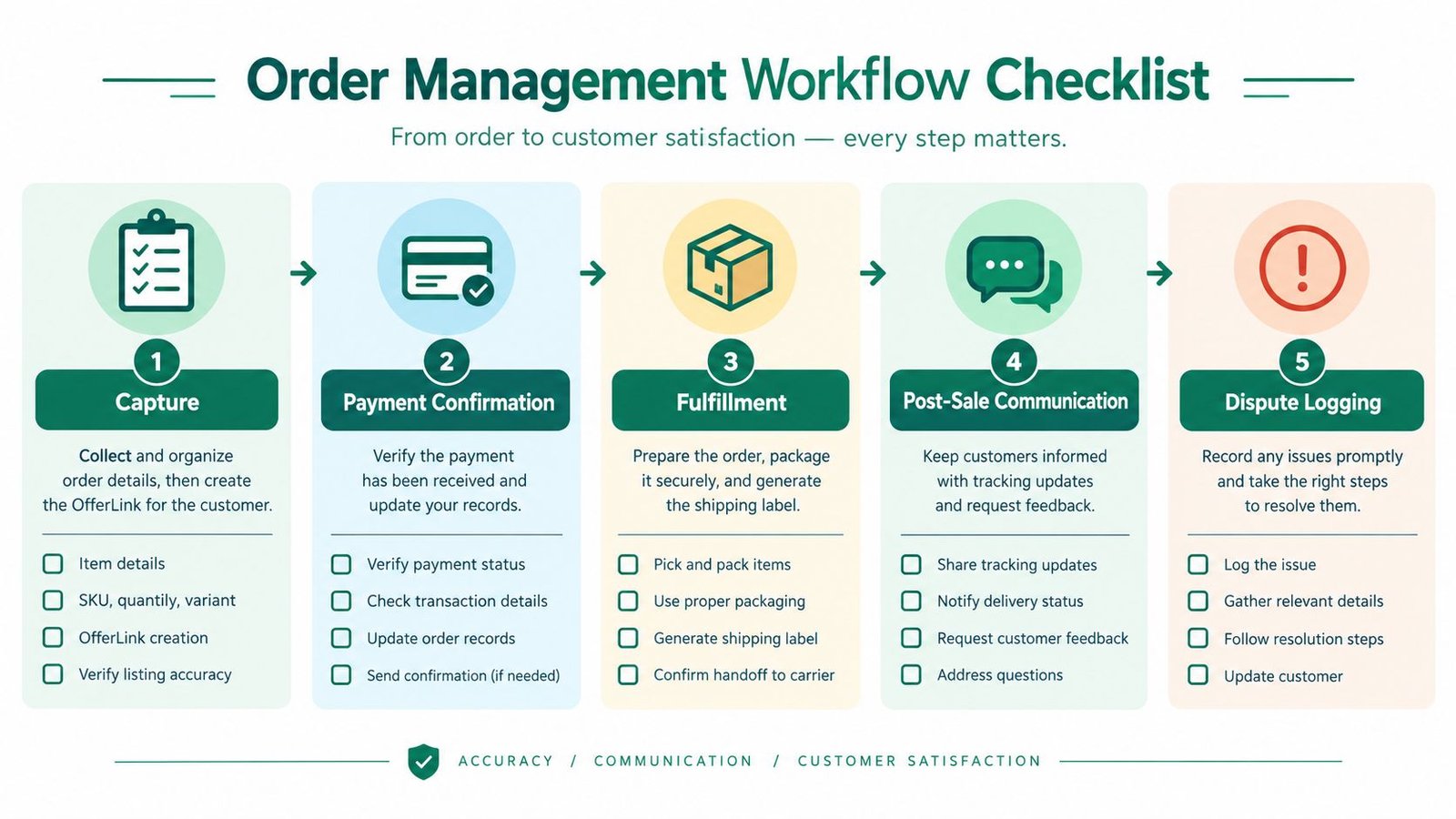
A seller can print the following beside the packing bench:
- Capture: Confirm item, variant, scope, address and timing.
- Create: Assign one order or OfferLink ID.
- Payment: Verify payment status and save the transaction reference.
- Fulfilment: Use the confirmed record to pack, deliver, book or grant access.
- Dispatch: Add the timestamp, tracking number or completion evidence.
- Communicate: Send the status update from the approved message template.
- Dispute: Log the issue, evidence, decision and resolution date.
- Close: Mark the order complete only when the customer journey has ended.
Common questions
When should a manual step remain? Keep human review for unclear briefs, unusual service requests, address changes and disputes. Automate predictable status updates, not judgement.
How long should records be retained? Sellers should confirm the relevant HMRC retention requirement for their circumstances and keep records in an organised, retrievable form. The commonly cited six-year period needs checking against the seller’s tax position and record type before it becomes a policy.
What if a platform changes its dispute window? Record the applicable terms at the time of sale, monitor the payment provider’s current rules and act on the shortest credible deadline.
Does a small seller need a dedicated OMS? Not necessarily. A controlled spreadsheet can work until multiple channels, people or fulfilment paths make reconciliation unreliable.
AmaJova provides structured OfferLinks for products, digital products, services and live sessions, connecting the offer details with payment, fulfilment communication and support records. Sellers who want to replace scattered messages with a clearer order management workflow can visit AmaJova and review how the platform fits their current selling process.