
The first sale usually starts in a messy place. Someone has a product, a service, a downloadable file or a live session idea, and the underlying question is not whether it can be sold online, but whether it should be launched as a full shop, listed on a marketplace or packaged into one clear offer page. For anyone figuring out how to start selling online in the UK, the wrong choice is usually the one that hides the offer behind too many moving parts before the first customer even sees it.
Table of Contents
- Why Selling Online in the UK Is Worth a Different Plan
- Sorting Out the UK Legal and Tax Basics
- Designing an Offer That Survives UK Distance Selling Rules
- Payments, VAT and Currency Done the Right Way
- Fulfilment and Order Records That Reduce Disputes
- Going to Market With Trust Signals That Convert
- A 30-Day Launch Plan and Common Pitfalls
Why Selling Online in the UK Is Worth a Different Plan
A new seller often thinks the choice is about design. It isn't. It's about whether the buyer can understand the offer fast enough to trust it, pay for it and know exactly what happens next.
The UK market makes that decision matter. Online sales represented 27.8% of all retail sales in Great Britain in June 2025, with average weekly online spending of £2.6 billion according to ONS retail sales data, and that was up from roughly 19% in 2019. In other words, online buying is no longer a side channel. It's a primary place where people compare, decide and purchase. ONS retail sales data for June 2025
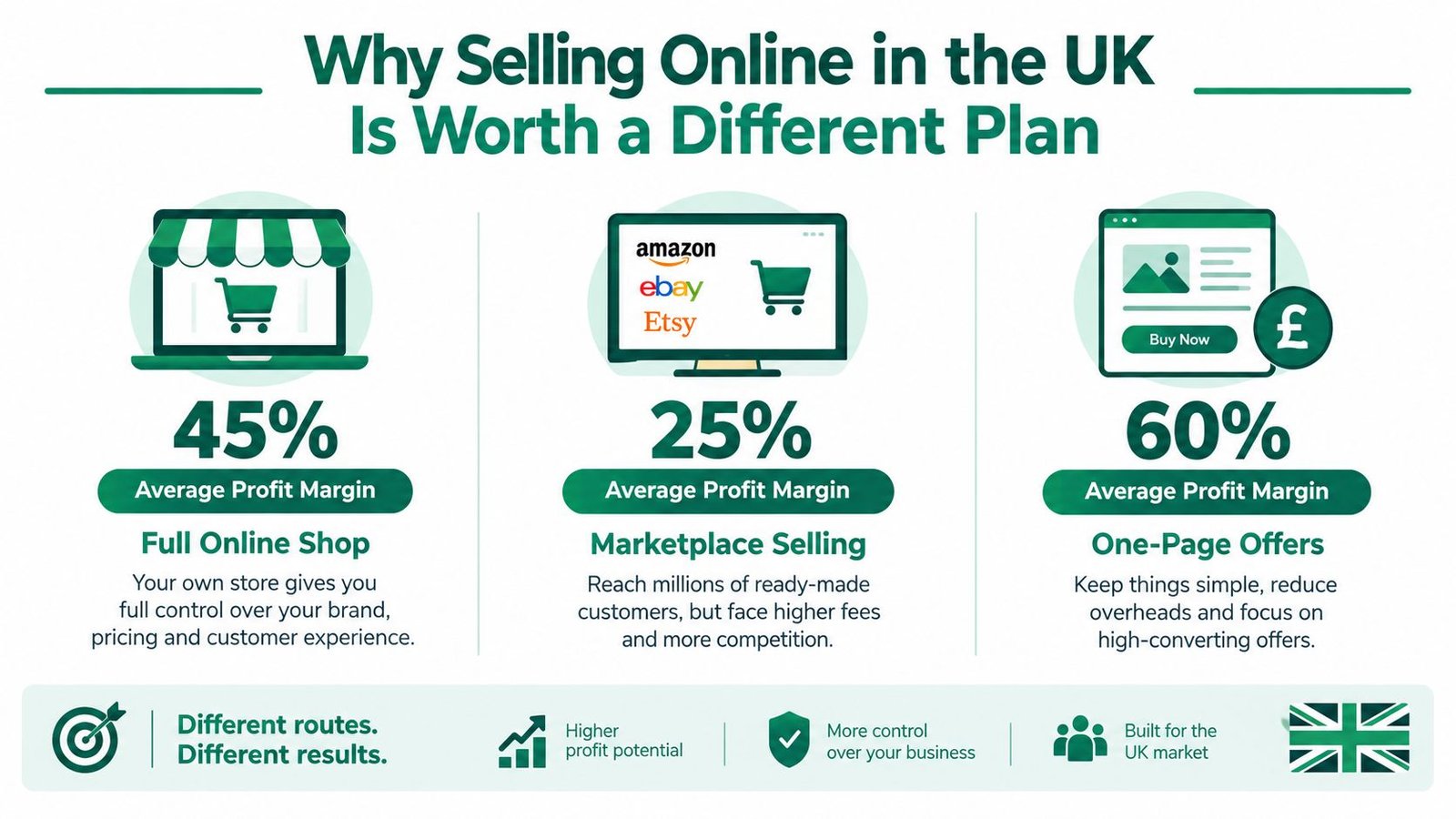
The three routes on the table
A first-time founder usually has three routes in front of them.
A full online shop gives control, but it also creates more work, more pages and more chances to confuse buyers. A marketplace can bring traffic, but the seller is competing inside someone else's rules and layout. A one-page offer is simpler. It pushes the buyer towards a single decision, which is often exactly what a new seller needs when trust and clarity matter more than catalogue size.
Practical rule: if the offer is still being tested, a clear offer page usually beats a half-built shop.
That logic becomes even stronger in the UK because buyers are not just local. ONS analysis found that online spending accounted for 50.5% of total UK card spending in September 2025, and international online spending still matters, with Ireland, the US and the rest of Europe leading the 2024 shares. ONS card spending and ecommerce insights
A seller who starts with a one-page offer can focus on the parts that close sales, title, scope, price, delivery or booking details, and proof of what the buyer receives. That is the right mindset for how to start selling online in the UK. The market is big, buyers compare quickly, and vague offers get ignored.
Sorting Out the UK Legal and Tax Basics
The first legal mistake new sellers make is treating setup as admin. It isn't admin. It's the foundation for every sale that follows, and it affects how a buyer sees the offer before payment.
Start with the business identity
A seller does not need to make the offer sound complicated to make it lawful. The basics are simple, state who is selling, how the buyer can contact them, what is being supplied and when fulfilment begins. For a sole trader or a limited company, the practical point is the same, buyers need to see a real business behind the checkout, not a vague profile or a casual post.
For UK sellers, VAT is the threshold that cannot be ignored. A business must register once taxable turnover exceeds £90,000 over the previous 12 months, or is expected to exceed it in the next 30 days, and registration is due within 30 days of the end of the month in which the threshold is passed. GOV.UK VAT registration guidance
Treat distance selling duties as part of the offer, not the footer
UK distance-selling rules require key information to be given clearly before purchase. That means the buyer needs to understand the offer type, scope, inclusions, price, payment method, delivery or booking timeline, cancellation terms, seller identity and contact details, plus a saveable order confirmation. A social post or a receipt on its own doesn't satisfy that standard.
For service businesses, a workable reference point is a structured agreement. A useful starting point is a service agreement template for UK sellers, because it forces the offer into plain, buyer-facing language before money changes hands.
Sellers who hide the terms usually create disputes later. Sellers who surface the terms early usually sell with fewer arguments later.
Don't skip digital consent
Digital products need special care. Before download or streaming begins, the seller must obtain the buyer's agreement to start immediately and their acknowledgement that the 14-day cancellation right is lost, and then send a durable confirmation the customer can save. GOV.UK online selling guidance for digital content
That is why the first checkout should be built around the offer, not around assumptions. A seller needs to know what is being sold, who is buying it and what rule applies if the buyer changes their mind. For pricing structure, a service pricing guide can help the seller stop guessing and start pricing the offer in a way that matches the actual delivery.
The sensible move is to get legal and tax decisions checked against the seller's own situation. VAT registration, business structure and consumer law all have context, and they deserve proper advice when the offer starts to gain traction.
Designing an Offer That Survives UK Distance Selling Rules
A weak offer page causes more damage than a weak advert. The buyer can forgive plain design. They won't forgive unclear terms, hidden extras or a checkout that leaves them guessing what they bought.
Build the page like a transaction record
The offer page should read like a buying decision, not a sales pitch. It needs a clear title, a measurable deliverable, the price, what's included, what's excluded, when fulfilment starts and how support works. For a physical product, that means the item, quantity and delivery expectation. For a service, that means scope, length, outputs, revisions and response times. For a live session, that means booking rules, access method and whether the session is recorded.
A seller using an OfferLink-style setup should treat the fields as mandatory thinking prompts. If the page can't answer those questions in plain English, the offer is still too vague.
| Offer type | Key pre-pay disclosures | Cancellation right | Confirmation required |
|---|---|---|---|
| Physical goods | Item, quantity, price, delivery, returns process | General distance-selling right applies | Saveable order confirmation |
| Digital content | What is supplied, when access starts, consent to immediate delivery | Right can be lost only with proper consent before access | Durable confirmation customer can save |
| Services or live sessions | Scope, timing, booking mechanics, exclusions, refund boundary | Depends on the service and when it starts | Saveable contract or order record |
The table above is the practical standard, not a marketing one. If the buyer can't see the boundaries before payment, the seller has built friction into the sale.
Treat cancellation and refund language as part of the price
The offer must tell the buyer what happens if they cancel. That includes the refund boundary, the process and the timing. For digital products, the immediate-delivery consent matters. For live services, the seller should define when the service is considered started and what happens if the buyer misses the session.
A well-structured page also protects the seller. It reduces the chance of someone claiming they were sold something different from what was delivered. That is exactly where a unified order page is useful, because the buyer can see the same details again after checkout without having to search for screenshots or messages.
Payments, VAT and Currency Done the Right Way
The payment layer is where a lot of new sellers get sloppy. They focus on getting paid, then forget that the buyer also needs clarity. That is a mistake, because unclear payment terms are one of the fastest ways to create complaints.
ONS analysis found online spending accounted for 50.5% of total UK card spending in September 2025, which is a good reminder that digital checkout is now normal buying behaviour, not an edge case. The same analysis also showed that 2024 international online spending was led by Ireland, the US and the rest of Europe. ONS card spending and ecommerce insights
Keep pre-pay disclosure plain
The buyer should see the final price, any service fee, the currency, the seller identity and the payment method before paying. If VAT applies, that needs to be clear too. A seller who buries costs in checkout is asking for abandoned baskets and chargeback-style disputes later.
For businesses below the VAT threshold, voluntary registration can sometimes make sense, but that decision should be made with proper tax advice. It changes pricing, invoicing and admin. For sellers using accounting support, striveX VAT accounting support is the kind of external resource that can help translate tax obligations into day-to-day records.
Match the currency to the buyer
Multi-currency checkout matters because UK sellers are not limited to UK buyers. If a buyer is abroad, a clear currency presentation and transparent fee handling reduce confusion before payment. AmaJova supports 150-plus currencies, which is useful where a seller is dealing with international customers and wants the order record to stay consistent across markets.
| Offer Type Versus Pre-Pay Disclosure | |||
|---|---|---|---|
| Offer type | Key pre-pay disclosures | Cancellation right | Confirmation required |
| Service | Scope, timing, exclusions, price, payment method | Depends on service start and terms | Saveable order record |
| Physical product | Item, delivery, returns process, refund timing | Distance-selling rules apply | Saveable order confirmation |
| Digital product | Content supplied, start of access, consent language | Can be lost with proper immediate-delivery consent | Durable confirmation |
| Live session | Booking time, access route, no-show rules, refund boundary | Depends on booking terms | Saveable booking confirmation |
The point is simple. If the seller is not explicit at checkout, the buyer fills in the blanks themselves. That is bad commerce.
Fulfilment and Order Records That Reduce Disputes
The moment after payment is where a seller either looks professional or starts creating headaches. Buyers don't need perfection. They need evidence, timing and a clean trail when something goes wrong.
Physical goods need a return-ready process
For physical products, the fulfilment process should start with a confirmation, then move to dispatch, tracking and delivery evidence. UK customers generally have 14 days from delivery to notify the seller of cancellation, another 14 days to return the goods, and the seller must refund within 14 days of receiving the return, including the original standard delivery charge. GOV.UK distance-selling rules
That means the seller should keep the order record, dispatch note, delivery proof and return correspondence. If the item arrives damaged or is disputed, those records matter more than the original sales post.
Digital and live offers need access logs, not parcel labels
Digital delivery is about access, not shipping. The seller should record when access was granted, what content was delivered, whether the buyer completed any consent step and when the order was marked complete. For live sessions, the record should show the booking confirmation, the scheduled time, attendance notes and any rescheduling messages.
A practical order management workflow resource is useful here because it pushes the seller to think in terms of messages, access steps, timeline and completion, not just payment collected.
If the seller cannot prove what happened after payment, the seller is relying on memory. That's a weak defence.
A unified order record is the cleanest answer for small teams, especially where the sale is not a parcel. It keeps delivery, support and dispute handling in one place, which saves time when the buyer asks for proof or clarification. For sellers packaging consultations, downloads or sessions, that record is often the difference between a fast resolution and a long email chain.
Going to Market With Trust Signals That Convert
New sellers often think marketing is about attention. For an online launch in the UK, it's really about trust. Buyers don't buy from the loudest seller. They buy from the one who looks clear, accountable and easy to challenge if something goes wrong.
Make the buyer feel protected before they pay
Trust signals do not have to be theatrical. Verification, transparent fees, a clear refund boundary, visible support routes and an order record are usually more convincing than glossy branding. If the seller is offering a service, the buyer wants to know what is included and how disputes are handled. If the seller is offering a product, the buyer wants confidence that returns won't become a mess.
UK merchant sentiment reflects that concern. In a DHL ecommerce report, 86% expected return fraud to rise in the surveyed year, and 69% of UK shoppers said they have returned an item bought online. DHL UK ecommerce insights report
Use the offer page as the trust asset
The seller should not hide behind a “brand story” when the buyer needs practical details. Response times, revision limits, inclusions, delivery windows and reporting routes should be visible on the offer itself. That is what turns a prospect into a buyer.
For social promotion, a useful reference on channel choice is how startups pick social platforms, because the right platform only matters if the seller is sending people to a page that answers their questions. Traffic without clarity just produces more hesitations.
The hard truth is that launch marketing for a new UK seller is mostly reassurance work. A buyer who can understand the offer, see the terms and trust the next step is already much closer to paying than a buyer who has been sold a vague promise.
A 30-Day Launch Plan and Common Pitfalls
The fastest way to launch is to stop trying to build everything at once. A seller needs a working offer, a clear checkout and a record of what happens after payment. Everything else can follow.
A simple four-week rollout
Week 1 should lock the offer and the legal shape of the sale. Pick the product, service, digital file or live session, define exactly what is included and confirm which consumer rules apply.
Week 2 should turn that into a public-facing page. Write the scope, inclusions, price, delivery or booking details, cancellation language and buyer support wording. If the offer feels complicated on the page, it is still too vague.
Week 3 should connect payment and tax handling. Check the VAT position, choose the currency presentation and make sure the checkout reflects the actual price, not an estimate. This is also the point to sanity-check the accounting process, especially if the seller expects international buyers or mixed taxable supplies.
Week 4 should focus on fulfilment evidence. Set up order records, dispatch or access logging, confirmation messages and a simple dispute process. If the seller can't show what was delivered, the launch is still unfinished.
The mistakes that catch first-time sellers
Vague inclusions are the classic error. The fix is to describe the deliverable in a way a buyer can repeat back without guessing.
Missing digital consent is another easy mistake. The fix is to make immediate-delivery agreement and loss of cancellation rights explicit before access starts, then send a durable confirmation.
Ignoring the order record is the most expensive one. The fix is to store messages, fulfilment steps and completion evidence in one place, especially where the sale is a service, download or live session.
The simplest launches usually outperform the clever ones because they leave less room for confusion.
For sellers comparing platforms, a practical eBay seller walkthrough can help show how marketplace selling differs from a structured offer page. The useful comparison is not feature count, it's whether the platform lets the seller present the offer clearly enough to avoid disputes.
A good launch in the UK is not about looking busy. It's about making the offer obvious, lawful and easy to buy. For sellers who want that structure without building a full storefront, AmaJova turns the sale into a single OfferLink with scope, pricing, checkout and order context in one place. Visit AmaJova and use it to package the offer before the first customer ever asks, “What exactly do I get?”