

A buyer says the download was wrong, the session didn’t cover what they expected, or the parcel arrived late and they want their money back. At that point, a seller protection policy is only useful if the seller already has the right records, the right disclosures, and a clear view of where platform rules stop and UK consumer law starts.
Table of Contents
- Introduction to Seller Protection Frameworks
- Coverage Categories and Eligibility Criteria
- Navigating the Claims and Dispute Process
- Essential Documentation and Evidence Retention
- Platform Protection Versus Statutory Consumer Rights
- Protected and Unprotected Scenarios for Online Offers
- Managing Chargebacks and Card Provider Disputes
- Quick Reference Guide and Policy Glossary
Introduction to Seller Protection Frameworks
A strong policy does not promise that every dispute goes away. It gives a seller a clearer position when a buyer challenges scope, delivery or performance after payment. In the UK, online and distance sales are subject to consumer-protection rules, including requirements to provide specified information before purchase and, in many circumstances, cancellation rights.
The timing and application of those rights depend on what is being sold. For goods, the cancellation period will generally run for 14 days after the consumer receives them, while services and digital content are subject to different rules. Digital content supplied immediately can also involve the consumer expressly agreeing to begin supply and acknowledging the effect this has on their cancellation right. Sellers should therefore check the rules that apply to their particular offer rather than applying one cancellation rule to every transaction. GOV.UK guidance on online and distance selling.
That matters because many disputes are really about expectations set before checkout. If a service page is vague, a digital product page hides the licence terms, or a live session page doesn’t say what’s included, the seller is already in a weak position before the complaint starts. The practical aim is not just fewer refunds, it’s a cleaner order record that shows what was promised, what was paid for, and what was delivered.
Practical rule: the strongest seller defence is usually the one created before payment, not the one assembled after a complaint arrives.
That is why seller protection has to be read as a framework, not a slogan. Platform tools may help with messaging, order tracking, or dispute review, but UK law still governs what must be disclosed and what remedies a buyer can claim. For independent sellers, that means every offer needs to be built so the checkout flow, fulfilment trail, and support trail line up cleanly if the order is later challenged.
Coverage Categories and Eligibility Criteria
Coverage starts with the offer page itself. Physical goods, downloads, services, and live sessions all need different fulfilment notes, but the common test is the same, the seller must make the buyer’s decision easy to audit later. UK government guidance requires clear information on the seller’s identity, price, delivery terms, and optional extras before purchase, and it warns that order pages should preserve a verifiable record of what was disclosed before payment gov.uk consumer protection law guidance.
What typically qualifies
A well-structured offer usually qualifies for stronger treatment when the seller can show:
- The item or service was described clearly, with inclusions and exclusions stated up front.
- The delivery or access method was disclosed, including timing, format, or booking details.
- Optional extras were visible before payment, not added after the buyer had already committed.
- The transaction record matches the page wording, so scope disputes can be checked against the original listing.
That record-keeping logic is the actual gatekeeper. A seller can’t rely on a vague “seller protection” label if the checkout page allowed hidden charges, unclear fulfilment promises, or last-minute add-ons. The more the order page mirrors the final invoice, the easier it is to defend a dispute.
What weakens eligibility
Missing terms don’t just create a customer service problem, they create an evidential one. If a buyer says they expected faster delivery, more coaching, extra revisions, or a different licence, the seller needs the original page to prove the opposite. Without that, the dispute becomes a credibility contest instead of a documentation exercise.
For sellers using a structured offer page, a useful reference point is the way seller terms are written on a platform that centralises offer details, because the practical value comes from keeping description, price, and fulfilment notes together in one record. That discipline is what helps a seller protect the transaction later, especially when the buyer’s complaint is really about boundaries that were never made explicit.
Navigating the Claims and Dispute Process
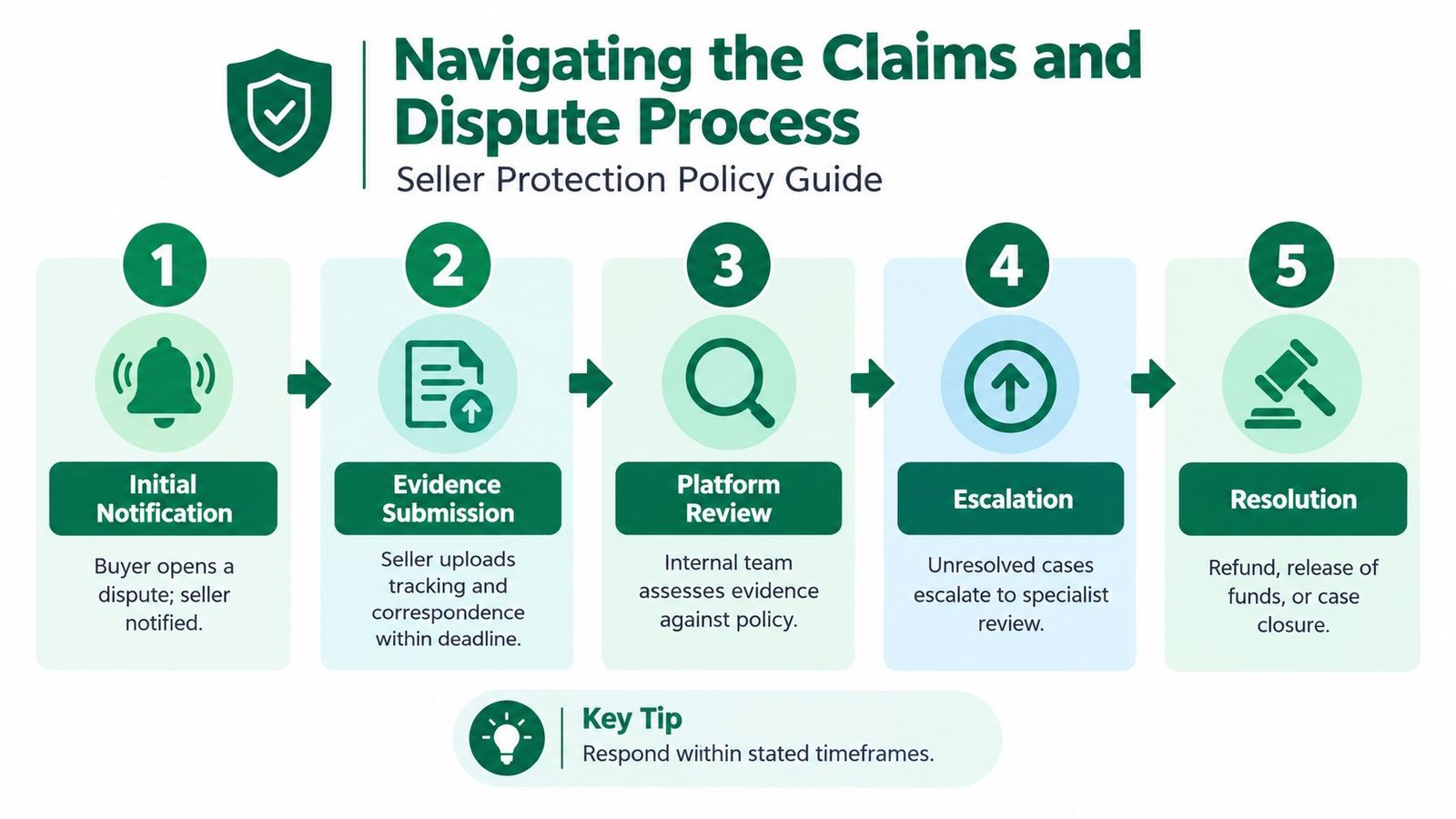
A dispute usually starts with a message, not a formal ruling. The buyer complains, the seller responds, and the first task is to identify exactly what is being disputed and gather the relevant order, payment, fulfilment and communication records.
The applicable process and deadlines will depend on the platform, payment provider and type of dispute, so sellers should follow the specific procedure and time limits given for the case rather than relying on a single universal dispute timetable.
Where the issue cannot be resolved directly, the seller may need to respond through the relevant platform, payment provider or other dispute-resolution route.
The dispute rhythm that works
The cleanest response is structured, not emotional.
-
Acknowledge the complaint quickly.
The aim is to show the seller is engaged and to narrow the exact issue. -
Pull the original order record.
The listing, checkout summary, messages, fulfilment steps, and payment confirmation should all sit in the same file set. -
Match the complaint against the disclosed terms.
If the buyer says the scope was different, the seller needs the original wording, not a memory of what was said. -
Submit evidence inside the platform deadline.
Missed deadlines weaken even strong cases because the reviewer sees an incomplete file. -
Escalate only when the platform process stalls.
The point of escalation is to move the case into a clearer decision framework, not to restart the argument.
The best evidence set is the one built from routine operations, not assembled in panic after the buyer has already escalated.
Why timing matters
Timing matters because dispute processes can impose specific response and evidence deadlines. Sellers who leave threads unanswered or send partial records usually hand the reviewer a simpler narrative to accept. A centralised dispute record also makes it easier to track which message confirmed the order, which note confirmed delivery, and which evidence shows that the seller met the stated terms.
For sellers using a structured order dashboard, the disputes page is the kind of place where the administrative burden becomes manageable, because the important thing is not the label on the dispute, it’s whether the seller can produce a coherent trail fast enough.
Essential Documentation and Evidence Retention
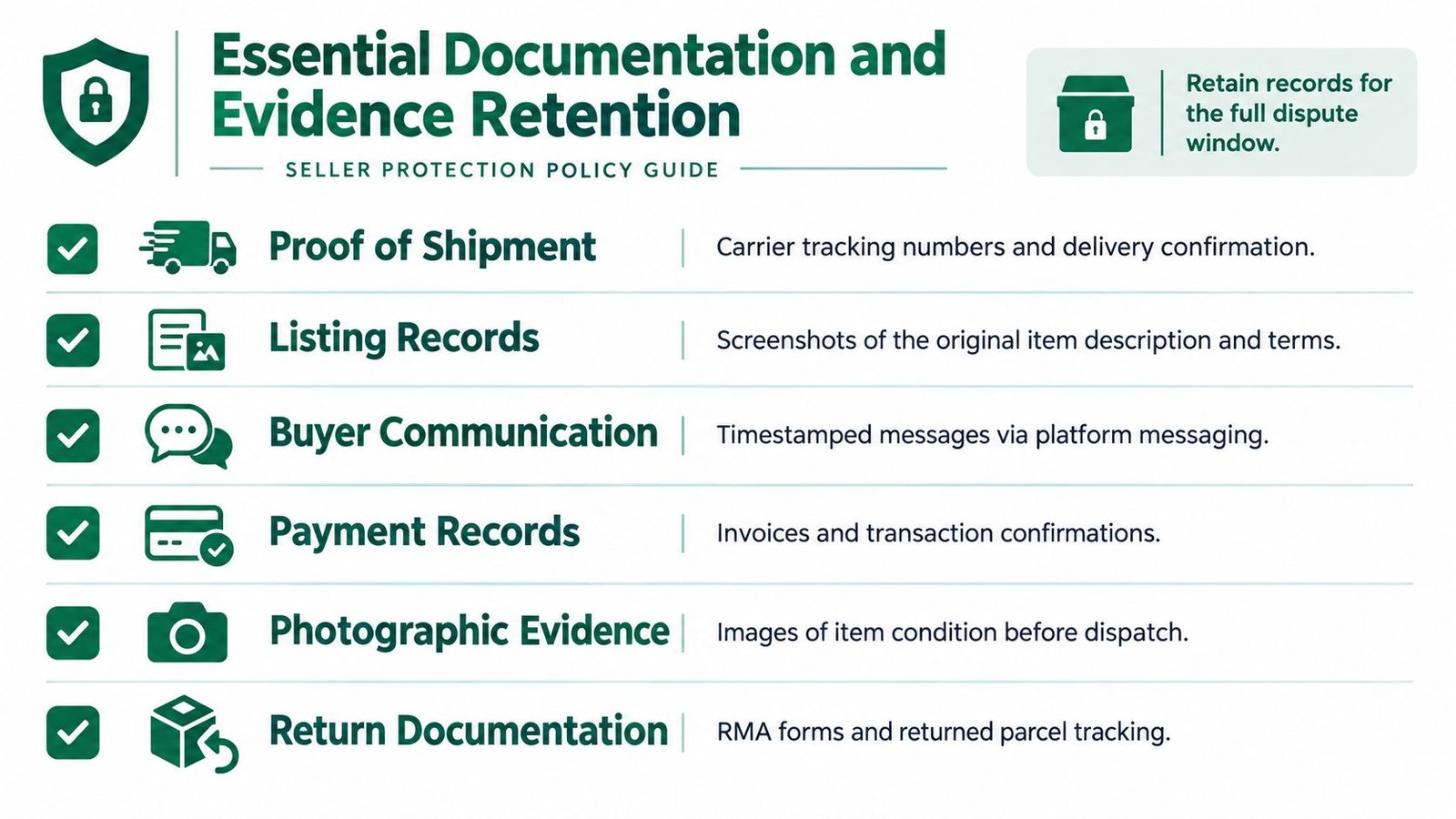
Seller protection rises or falls on records. A seller can have the right policy language and still lose a dispute if the evidence is scattered across inboxes, spreadsheets, and social messages. The practical standard is simple, every claim should be answerable from a saved order file.
What to keep for every order
At minimum, the file should contain:
- Listing records, so the original description and terms can be compared with the complaint.
- Payment records, including the transaction confirmation and order summary.
- Buyer messages, because timestamps often matter more than tone.
- Proof of shipment or fulfilment, depending on whether the order is physical, digital, or service-based.
- Delivery or access confirmation, such as carrier tracking, download access logs, or attendance records.
- Return or correction records, if the seller had to fix a problem or accept a return.
The reason this matters is straightforward. UK government guidance warns sellers to preserve a record of what was disclosed before payment, because that record is the first line of defence when a buyer disputes scope or expectations gov.uk consumer protection law guidance. If the seller can’t show the original promise, the later explanation carries less weight.
How to build evidence without slowing sales
Good systems create records as part of the normal flow. A checkout summary should capture inclusions and optional extras. A post-purchase email should repeat the key terms. A service booking should store the date, time, and agreed deliverables. A digital delivery flow should keep proof that the buyer received the content or confirmed access.
Useful habit: if a note would help defend a dispute later, it should be saved where the order lives, not left in a separate inbox thread.
The cleanest sellers do not treat evidence retention as a legal chore. They treat it as operational hygiene. When the records are complete, the seller can answer a complaint quickly, and that usually makes the dispute smaller, not larger.
Platform Protection Versus Statutory Consumer Rights
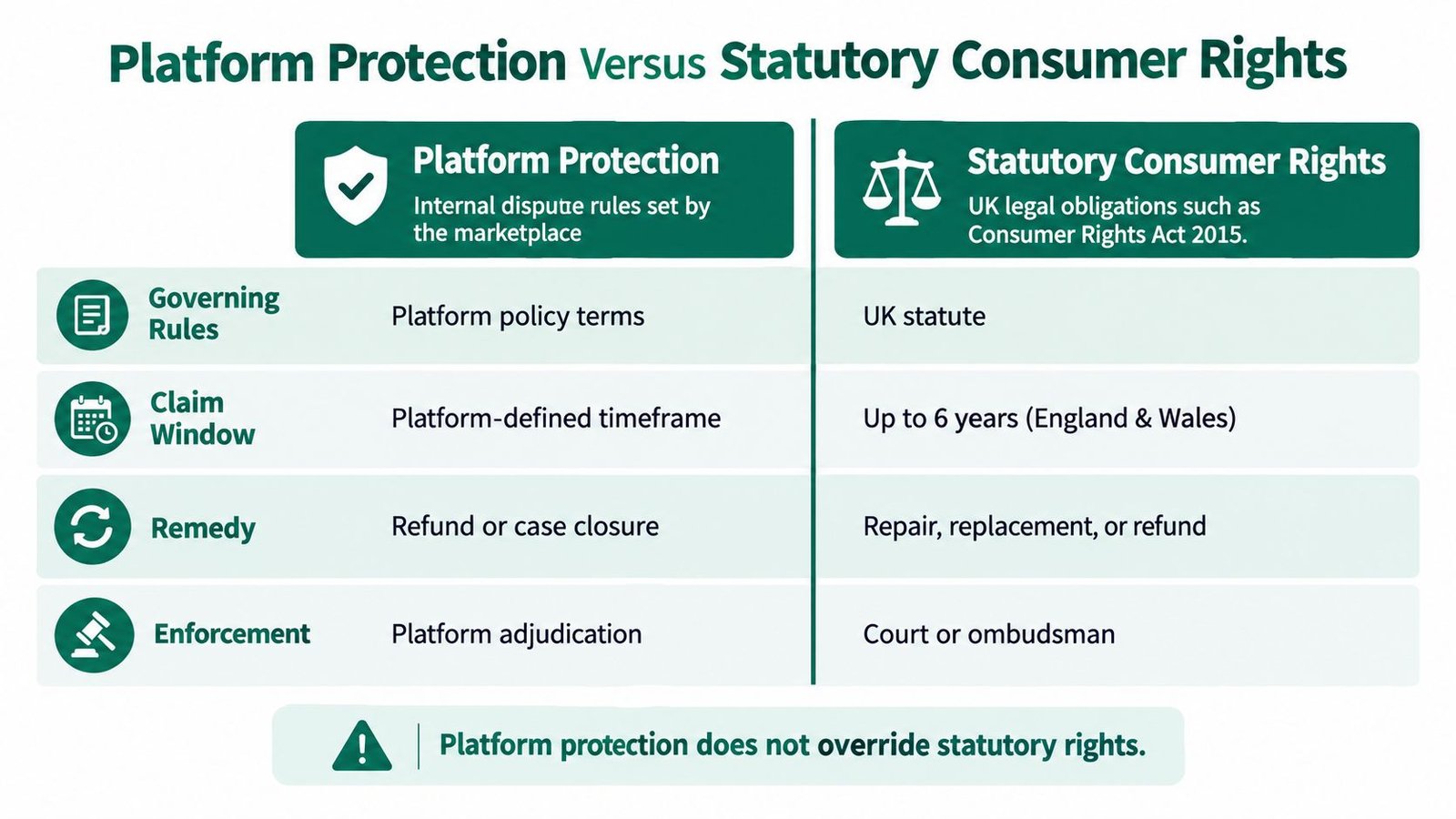
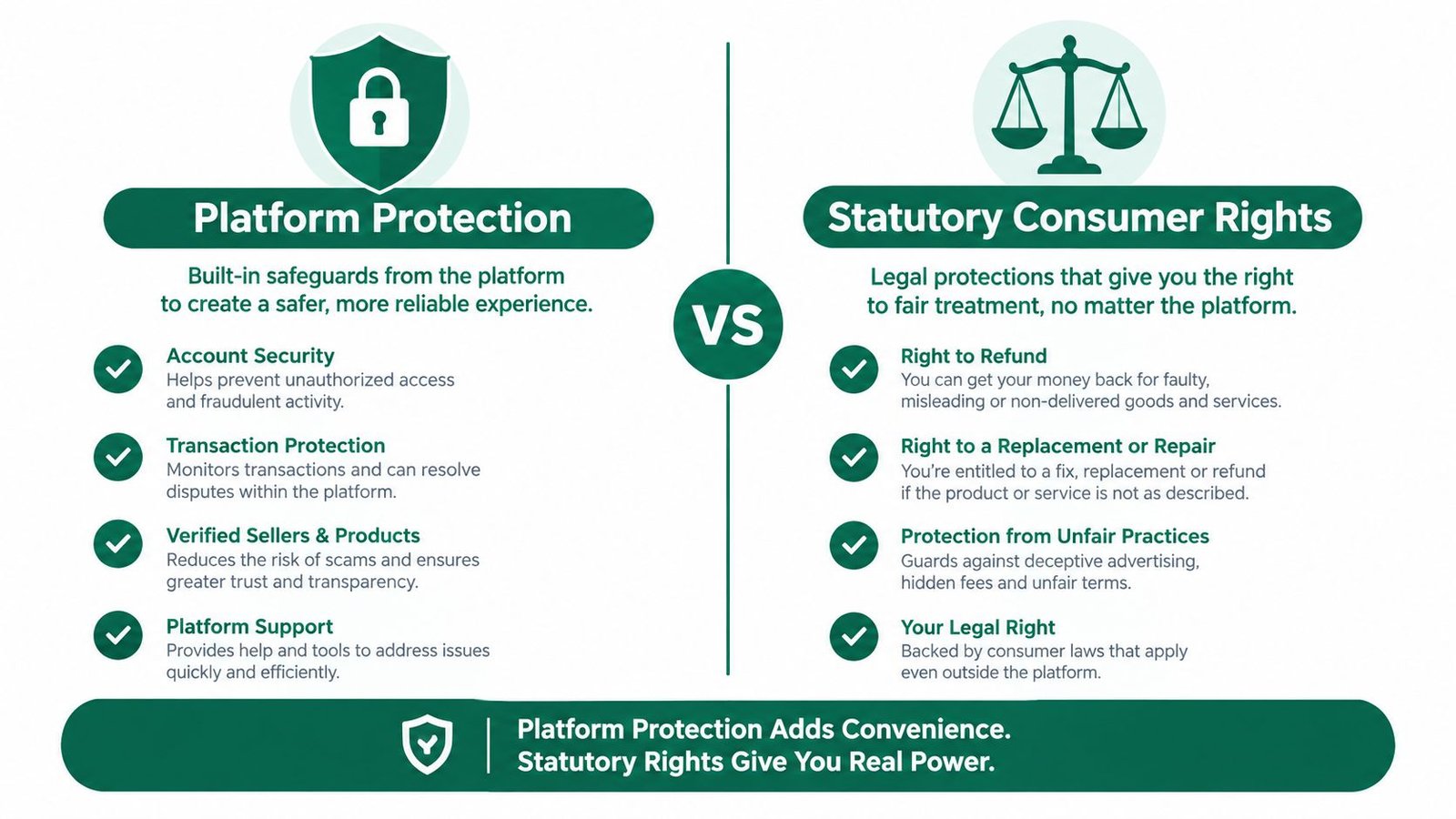
Card disputes add another layer. Chargeback, and Section 75 where it applies, can provide routes outside a platform’s own dispute process, so a closed platform case does not necessarily mean the matter is finished. For that reason, sellers should keep the listing, payment information, fulfilment records and buyer communications together so they can respond appropriately if a dispute moves beyond the platform.
The Financial Ombudsman Service provides guidance explaining both chargeback and Section 75 claims and the kinds of evidence that may be relevant. Financial Ombudsman Service guidance on problems with goods and services.
Services follow a separate track. They must match the agreed terms and be carried out with reasonable care and skill, and the remedy may be putting the work right or refunding part of the fee where the service falls short Consumer Rights Act 2015 guidance. A platform can decide how it handles the complaint inside its own rules, but that does not remove the statutory remedy the buyer may still pursue.
A real-world example helps. A customer buys access to a downloadable course, the files open correctly, but one module is missing a promised feature. The marketplace may treat that as a partial service dispute, while consumer law may still point to a digital-content remedy if the content does not match the contract. Sellers lose ground when they assume the platform’s decision settles everything.
Card disputes add another layer. Chargebacks, and Section 75 where it applies, can bypass the marketplace entirely, so a closed platform case does not guarantee the matter is finished. For that reason, a strong seller protection policy keeps the listing, fulfilment record, and service record aligned with the remedy a buyer could seek outside the platform. A clear payment protection overview helps sellers separate platform process from statutory rights and card-provider routes.
Protected and Unprotected Scenarios for Online Offers
A consultant sells a live strategy session and sends the buyer a confirmation email that repeats the agenda, duration, and deliverables. The session happens as booked, the notes are shared afterwards, and the order file shows the buyer accepted the terms before payment. That is the kind of transaction that usually gives the seller a workable defence if the buyer later says the session was “not what was expected.”
Now compare that with a creator selling a downloadable template pack but never recording the licence terms, the contents, or the access confirmation. If the buyer says the pack was incomplete, the seller has no strong evidence trail to show what was delivered or what the buyer agreed to before checkout. The difference is not just the product type, it’s the quality of the pre-sale record.
A small business shipping physical goods has a more obvious proof trail, but it can still fail on scope. A product page that hides optional extras or delivery limits can create a dispute even when the parcel arrives on time, because the buyer may argue they ordered something different from what was described. UK service law makes the same point in a different context, services must match what was agreed and be provided with reasonable care and skill, with remedies available if they don’t Consumer Rights Act 2015 guidance.
The practical distinction is easy to miss. A “not as described” claim isn’t defeated by confidence, it’s defeated by records. When the offer page is precise and the delivery trail is complete, the seller has a defence that can be checked. When the page is vague, the seller is left arguing intent instead of evidence.
Managing Chargebacks and Card Provider Disputes
Buyers don’t always stay inside the platform process. They can go straight to their card provider, and that changes the shape of the dispute completely. UK financial guidance says chargeback lets a customer ask their card provider to reverse a payment when goods or services were defective, and claims are usually raised within around 120 days of the expected delivery date or the date the problem was identified Financial Ombudsman Service guidance.
Why card disputes are different
Chargeback is not a marketplace decision. It is a financial network remedy, and the seller’s best defence is the transaction record that proves delivery, access, or performance. That means checkout terms, proof of dispatch, fulfilment logs, and buyer communications need to be stored in a form a bank can understand quickly.
Section 75 provides a separate form of protection for qualifying credit-card purchases. MoneyHelper explains that, subject to the relevant conditions, Section 75 of the Consumer Credit Act can apply when an individual item or qualifying purchase costs more than £100 and up to £30,000. The credit provider can share responsibility with the seller where, for example, goods or services are not supplied as promised or have been misrepresented. Section 75 is different from chargeback and does not apply to every payment or transaction, so sellers should avoid treating the £100–£30,000 range as the only eligibility test. MoneyHelper guidance on Section 75 and chargeback.
How sellers reduce exposure
The most effective defence is boring but consistent.
-
State the offer clearly before checkout.
Card providers look more favourably on records that match the later complaint. -
Keep fulfilment proof in one place.
Separate systems slow down the response and create gaps. -
Use precise delivery or access confirmations.
A buyer who disputes receipt is easier to answer when the seller can show the access or dispatch trail. -
Respond to complaints before they escalate.
A direct resolution often stops the buyer from going to their bank.
In a platform like AmaJova, the relevant internal record can also be anchored to the payout policy, which matters because a seller can only defend revenue properly when order and payout records line up.
Quick Reference Guide and Policy Glossary
A good seller protection policy gives a seller three things at once, a clear offer, a clean record, and a predictable response path. If any one of those is missing, the dispute becomes harder to manage because the buyer, the platform, or the card provider has less to inspect and more room to rely on assumptions.
Fast glossary
- Pre-contract transparency means the buyer sees the key facts before paying, including identity, price, delivery terms, and optional extras.
- Section 75 is the credit-card route that can create joint liability in qualifying purchases, which matters when a buyer bypasses the platform.
- Statutory remedy is the legal fix the buyer can pursue under UK law, such as repair, replacement, or price reduction.
- Chargeback is the card-provider process for reversing a payment when goods or services were defective or not provided.
- Evidence retention is the practice of storing the order page, messages, fulfilment proof, and payment records together.
Offer type summary
| Offer type | What needs to be visible before payment | What usually matters most in a dispute |
|---|---|---|
| Physical goods | Price, delivery terms, optional extras, identity | Dispatch proof and listing accuracy |
| Digital downloads | What's included, access method, licence terms | Access logs and consent records |
| Services | Scope, timing, deliverables, revision limits | Agreed brief and service completion evidence |
| Live sessions | Topic, duration, booking time, attendance terms | Booking confirmation and attendance trail |
The practical takeaway is simple. A seller doesn't need a complicated policy, but they do need one that matches the legal and operational reality of the sale. If the offer is clear, the records are kept, and the response path is defined, disputes are easier to resist, easier to settle, or easier to escalate on proper evidence.
AmaJova gives sellers a single OfferLink for products, services, digital products, and live sessions, with checkout, order records, and support tied back to the transaction. For sellers who want to build clearer offer pages and keep dispute evidence in one place, AmaJova is worth reviewing against the legal and operational points covered above.