
Three weekends go into making forty ceramic planters. The photographs are sharp, the price is sensible, the page goes live, and eleven days pass without an order. The planters aren't the problem. Nobody was asked whether they wanted them, and the page never said when they'd arrive or what happens if one turns up chipped.
A sellable item online needs three things before it needs promotion. A named buyer who already has the problem. A deliverable that can be produced, delivered or completed reliably, including the awkward parts such as returns, rescheduling and access. And a page that states scope, price and next steps before payment, so the buyer knows what they're agreeing to.
Most roundups rank items by popularity or by what someone earned selling them. That ordering hides the only question that matters after the order lands. Popularity doesn't pay for a second dispatch, a refund or a support thread that runs for three weeks.
The nine formats below are judged the same way: how to test demand without building the whole thing, how the order gets fulfilled when something goes wrong, and what the offer page has to say before the buyer pays. Physical products, files, services and live sessions each fail in different places.
Table of Contents
- 1. Handmade small-batch physical products
- 2. Print-on-demand merchandise
- 3. Printable templates and planners
- 4. Self-paced online courses
- 5. Ebooks and digital guides
- 6. Digital presets, fonts and design assets
- 7. Packaged creative and freelance services
- 8. One-to-one coaching and consultancy sessions
- 9. Live online workshops, masterclasses and cohort-based programmes
- How the nine sellable items online compare on fulfilment and effort
- Choose the Offer You Can Fulfil Well
1. Handmade small-batch physical products
Handmade goods are designed, made or finished by the seller in short runs: candles, ceramics, jewellery, stationery, textiles. The advantage is control. A small batch keeps cash out of stock, and each run shows which shapes, scents or colours people buy. Sellers on Etsy and Not On The High Street list candles, prints and jewellery in limited runs, and a potter might sell open-stock tableware alongside made-to-order commissions.
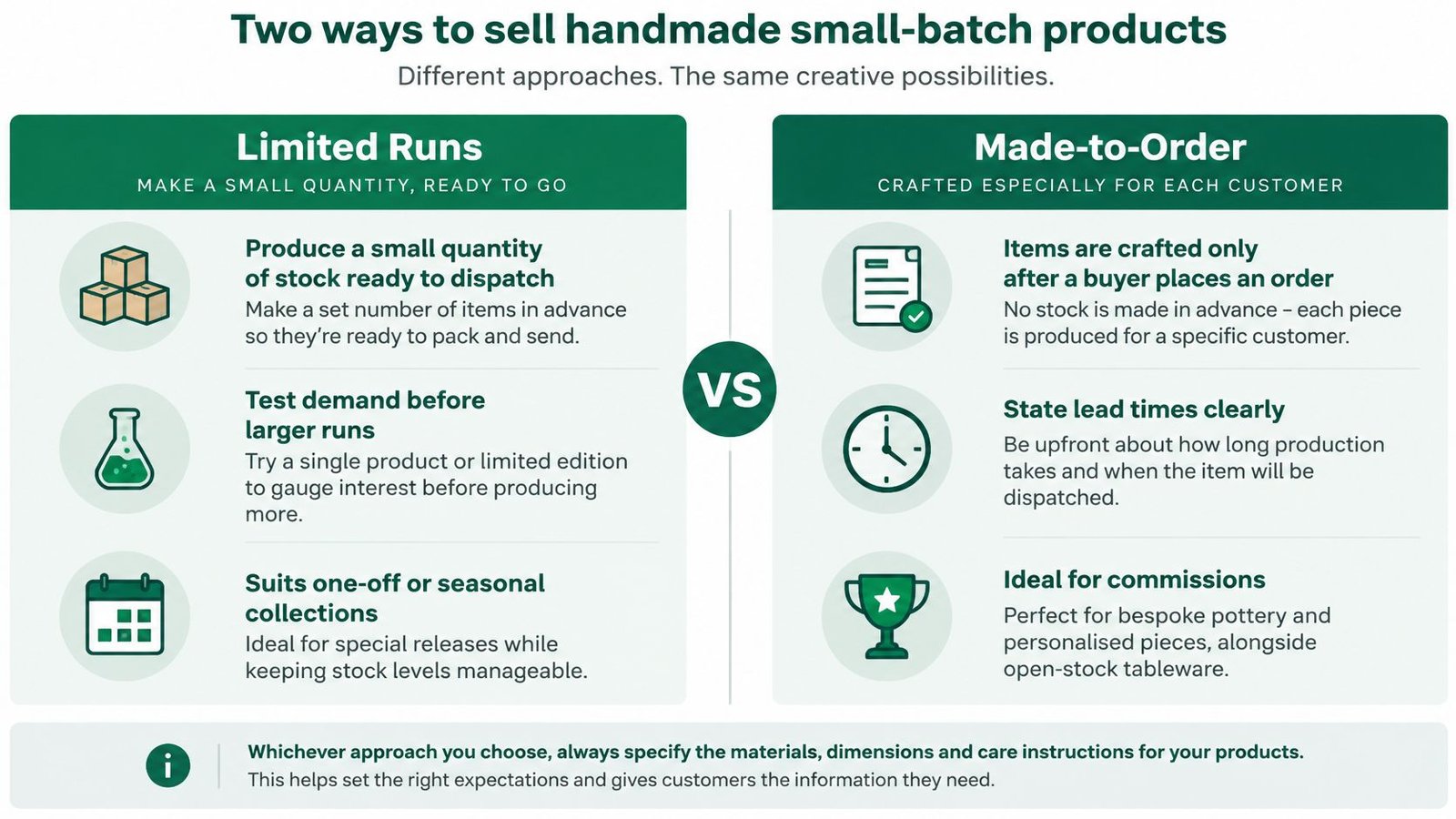
Test demand with ten pieces, not two hundred. Offer the batch to people who already follow the work, take orders before buying materials where the making allows it, and keep a short waiting list. If ten sell slowly, the design needs work, not a bigger advertising budget.
Fulfilment is where handmade sellers lose money. Clay chips, wax cracks in transit, and a two-week lead time becomes four when a kiln load fails. Buyers weigh this more heavily than sellers expect: nshift's ecommerce returns report records that 85.6% of consumers consider a retailer's returns policy important when deciding whether to buy online, and Ofcom data cited by Which? in the same report found that 71% of UK parcel recipients experienced a delivery issue in the previous six months.
What the offer page has to settle
State dimensions, materials, finish and the variation to expect between pieces. Give a dispatch date rather than a window. Explain packaging and what happens if an item arrives damaged.
- Price from a full cost build: materials, packaging, your time at a rate you'd accept, payment and platform costs, not materials alone.
- Photograph to scale: natural light, with a common object beside the piece so buyers can judge size.
The laser-cut product guidance covers the finishing and material questions that appear when a design moves from craft to a small production run. For printed textiles, the Cobra DTF guide to selling shirts walks through the production side.
On tax, HMRC's guidance on income from online platforms puts the £1,000 trading allowance at gross trading income per tax year, running from 6 April to 5 April and counted across all your online activities before expenses, not per product or per platform.
2. Print-on-demand merchandise
A print-on-demand product is printed only after an order: t-shirts, tote bags, mugs, posters. Artwork is uploaded, prices are set, and a supplier prints and usually ships. No stock, no upfront run, and a cheap way to test a design. The trade-off is that the seller controls the file, not the print, the blank or the courier.
Illustrators use the format to put a small set of designs on garments, and creators run seasonal capsules of three or four pieces rather than a permanent catalogue.

Test with samples and a narrow range. Order one of each product before promoting it, check the print on a dark garment, wash a shirt twice, and compare the blank's sizing to the chart you publish. Twenty files uploaded in an afternoon rarely outsell a capsule of three.
Where print on demand breaks
Fulfilment runs through a third party, so the seller owns the buyer's experience without owning the presses. Dispatch times that look acceptable on a supplier dashboard feel slow to someone who ordered for a birthday. Delivery messaging matters more here than anywhere else on this list. ecommercenews.uk's report on shopping scams found that more than one in four UK adults were targeted by an online-shopping scam in the past year, with fake delivery messages the most common form at 35%. A buyer who receives two "delivery" emails, one fake and one real, stops trusting both.
The test: if a stranger can't tell what arrives, who sends it and roughly when from the page alone, the page isn't finished.
Name the production arrangement in plain terms, publish the size chart, give a realistic production plus shipping estimate, and state the returns route for a printed item. Timing matters too: ONS retail data put the online share of retail sales at 27.5% across 2025, peaking at 32.5% in November. Designs and samples need to be ready by September if November is the target.
The Raccoon Transfers print on demand guide covers supplier setup and file preparation.
3. Printable templates and planners
A printable is a file that solves a small problem in one sitting: a budget tracker, a habit planner, an editable lesson pack, an invoice template, a wedding checklist. The buyer downloads, prints and uses it within minutes. That immediacy sells, and it's also why vague offers fail. "30 pages of planning" tells nobody whether their problem is covered.
Test demand by giving away one page. Publish a single sheet from the set, watch whether people ask for the rest, and take pre-orders for a bundle before designing page forty. Teachers selling classroom resource packs do exactly this with free samples.

Include the file details buyers ask for
State the format, page count, paper size (A4 and US Letter if you support both), whether the file is editable, and which software opens it. Then state the licence in one plain sentence: personal use only, or commercial use permitted.
Test prints are part of fulfilment. Print the file at home and at a print shop, check margins, check that fonts don't substitute, and check that a colour-heavy page is still usable in black and white. A planner that prints badly gets refunded and reviewed.
Demand for digital goods tracks the wider market. ONS retail sales data for September 2025 recorded online spending 3.5% higher than the previous quarter and 5.0% higher than a year earlier, with monthly online sales rising for the eighth consecutive period. Buyers are already paying online. The constraint is finding the file that answers their question.
4. Self-paced online courses
A self-paced course is a sequence of lessons, usually video plus worksheets and checkpoints, that a learner works through alone. It's the highest-effort item here and the one most often built before anyone asks for it. Twelve modules, six weeks of filming, no enquiries. Instructors publishing on Teachable, Thinkific or Udemy hit this pattern constantly.
Test with one module. Run a short pilot at a low price, or teach the material as a single live session first, and count how many people ask what comes next. A pilot that sells tells you to build the rest. One that doesn't tells you the topic interests you more than it interests a buyer.
Design the order in which people learn
Fulfilment for a course is delivery plus access: who gets in, on what device, for how long, and what happens when someone asks for help at module nine. State the outcome, the prerequisite knowledge and what the course doesn't cover before payment. Say what access period the buyer gets. A refund policy that ignores access questions creates arguments six weeks later.
Practical rule: if a course can't be described in one sentence about who it's for and what they'll be able to do, it isn't ready to sell.
VAT needs classifying before pricing. HMRC's guidance on VAT for digital services supplied to private consumers explains that electronically supplied digital services to UK consumers are liable to UK VAT, and that cross-border supplies to consumers outside the UK are treated differently, with the place of supply generally determined by where the consumer is located. Not every online course is automatically an electronically supplied service, so check what you're delivering.
Check consumer obligations for digital content on legislation.gov.uk, including the Consumer Rights Act 2015, before writing a refund term that contradicts them.
5. Ebooks and digital guides
A guide is long-form writing sold as a file: a how-to, a workbook, a reference handbook. It's the cheapest product to produce here and the easiest to make useless. A ninety-page document of general advice competes with free content. A thirty-page guide with a checklist, a worked example and a template doesn't.
Consultants sell practical guides to a specific process or certification, and self-published authors use Amazon Kindle Direct Publishing for the same format at book length.
Test with a chapter. Publish the most practical section, offer the rest to people who want it, and see whether anyone asks for the file before writing the other eighty pages.
The file has to open
Fulfilment is nearly invisible, which is why it goes wrong. The buyer needs the right file, one that opens, with a licence that answers "can I share this with my team?" before they think to ask.
- State page count, format and reader: PDF or EPUB, screen-only or print-friendly, and who the guide is for.
- Put the licence on the page: personal use, team use, or no resale.
- Add one usable asset: a checklist, calculator or template turns reading into doing.
Cover files do more work than page count in a thumbnail, and the ebook cover design guidance covers sizing and legibility at small sizes.
Digital guides also suit the smallest operations. The UK Government's Longitudinal Small Business Survey 2025 reports that 74% of SME employers used technology or web-based software to sell to customers or manage the business in 2025, up from 69% in 2024 and 61% in 2023, while 55% of businesses with no employees did so. For a one-person operation, the barrier is setup rather than subject knowledge, which is why a low-cost file beats a storefront build as a first product.
6. Digital presets, fonts and design assets
Presets, brushes, fonts, icon sets, mockups and graphic templates are tools other people use to save time. Build once, sell repeatedly, support it indefinitely. That last part is the one sellers underestimate, because a preset pack that produces eleven different results on eleven photographs generates messages for months. Photographers sell Lightroom presets with a short tutorial, and designers list mockup templates and font families on Creative Market.
Test with one sample and an honest before and after. A single preset applied to three photographs shot in ordinary conditions tells a buyer more than a gallery of perfect edits.
Compatibility is the product
Fulfilment for a digital asset is installation. If the file won't load into the buyer's software, the purchase has failed even though the download worked. State file types, software versions, install steps and whether a mobile version exists. Put a one-page install note inside the order record so it can be found again in six months.
Licence terms need the same precision: personal or commercial, single seat or team, and whether the asset can be used in client work. A photographer selling presets to other photographers is selling a business tool, so commercial rights usually decide the sale.
Support requests fall when the offer page shows the asset in use. Short walkthrough videos cut "how do I install this" messages, and a bundle pairing a template with a tutorial outsells the same file alone.
7. Packaged creative and freelance services
A packaged service is fixed scope at a fixed price: a logo package with two concepts and three revisions, a five-page website copy bundle, a video edit up to eight minutes. Buyers get a defined outcome, and sellers stop quoting every enquiry from scratch.
Test demand with a paid trial. A single-page audit at a modest price proves someone will pay for your judgement before you build a premium package around it. "How much for a website?" tells you nothing; a deposit tells you plenty.
Scope is the whole product
Fulfilment is the work plus the handover: what the buyer must supply, when, in what format, and how many rounds of changes are included. Most disputes in service work come from an unstated revision, not from bad design. Extras such as rush delivery or an additional revision round protect the price far better than a discount does.
ONS consumer card spending data shows online spending accounted for 50.5% of total card spending in September 2025, compared with 43.7% in September 2019. Buyers treat an online purchase as an ordinary transaction, and they expect a record of it: what was bought, what happens next, who to contact.
A service offer without a written scope is a negotiation with a deadline attached.
Metrics for a packaged offer go past conversion. Track questions asked before payment, work delivered on time, support messages per order, revisions used and refunds. Each points to a sentence missing from the offer page.
8. One-to-one coaching and consultancy sessions
A one-to-one session is paid time with an expert on a defined goal: a career decision, a pricing problem, a portfolio review, a language lesson. It's bookable, time-boxed and usually prepared in advance. The product is attention, and it's the easiest item here to sell badly, because a vague session invites a vague expectation.

Test with a handful of slots. Open three sessions for a fortnight ahead, take payment to hold the time, and read the intake form answers. Those questions shape the next package, whether that's a three-session block or a group workshop.
Fulfilment starts before the call. Send a short intake form, state the platform, send joining instructions with a backup link, and confirm the time zone in writing. Afterwards, deliver whatever was promised: notes, a recording, a next-step summary.
Say what the session is not
Coaching isn't regulated advice. A session that drifts into legal, medical or financial territory needs a referral, not an opinion, unless the seller is qualified and regulated to give one. State that boundary on the page rather than discovering it mid-call. Career coaches selling single sessions and three-session packages, and tutors selling trial lessons, both need this in writing.
Cancellation and rescheduling terms belong above the payment button, not in a footer. So does the tax position. HMRC's VAT guide sets out that for many business-to-consumer services the general rule is that the supply is made where the supplier belongs, while electronically supplied digital services are taxed where the consumer is located. A live consultation with a person is analysed differently from an automated download, so don't promise a tax treatment on the offer page.
Pricing a session is its own exercise, and the guidance on pricing your services covers rate-setting and packaging.
9. Live online workshops, masterclasses and cohort-based programmes
A live workshop is a scheduled session where teaching happens in real time, usually one to three hours with questions and a practical task. A cohort runs for weeks with sessions, assignments and peer feedback. The appeal is accountability and access to the teacher. The cost is that the seller's calendar becomes the product, and a badly scheduled session can't be fixed after the fact. Educators run exam-technique workshops; writing coaches run six-week cohorts with weekly feedback.
Test with one date. Run a single workshop on the narrowest, most useful slice of the topic, charge enough to cover preparation, and watch how many people stay to the end and what they ask at the close. A cohort should follow a proven workshop, not precede it.
Fulfilment is logistics plus facilitation
Dates, time zone, duration, platform, group size, recording access and what happens if someone misses a session all belong on the page. Send joining details and preparation materials in advance with a backup link, and test audio, video and screen sharing before the room opens. For a cohort, publish attendance expectations and how feedback works.
Filling the room brings marketing rules into play. GOV.UK's guidance on direct marketing explains that businesses sending promotional emails or texts to individual customers generally need permission first, must identify the sender, make clear that the message is marketing, explain any conditions, and offer an easy opt-out. Order confirmations and joining instructions sit outside those rules, so keep promotional sends separate from the order record instead of adding buyers to a launch list.
Plan each session around one clear outcome and rehearse the first fifteen minutes. The rest of the hour usually holds together once the opening does.
How the nine sellable items online compare on fulfilment and effort
| Item | Fulfilment | Delivery method | Main upfront effort | Best for |
|---|---|---|---|---|
| Handmade small-batch physical products | Make, pack and dispatch orders | Postal delivery | Crafting products and preparing stock | Sellers with craft skills testing small product ranges |
| Print-on-demand merchandise | Provider produces and ships each order | Printed products shipped by provider | Creating designs and setting up products | Designers and creators who want to sell without holding stock |
| Printable templates and planners | Provide files for customers to use or print | Digital download | Designing and testing files | Sellers creating practical tools for specific audiences |
| Self-paced online courses | Provide structured lessons and learning materials | Online course access | Planning, filming and editing lessons | Experts and educators teaching a skill or subject |
| Ebooks and digital guides | Provide a written guide or workbook | Digital download | Writing, editing and designing content | Specialists sharing practical knowledge |
| Digital presets, fonts and design assets | Provide files and usage instructions | Digital download | Creating and testing assets for compatible software | Creatives selling tools that save users time |
| Packaged creative and freelance services | Complete defined deliverables for each client | Digital files or agreed service outputs | Defining scope, pricing and workflow | Freelancers and agencies offering clear fixed-scope work |
| One-to-one coaching and consultancy sessions | Deliver personalised sessions and any agreed follow-up | Video call, phone or in person | Defining the offer and booking process | Experts providing personalised guidance |
| Live online workshops, masterclasses and cohort-based programmes | Facilitate scheduled sessions and learner support | Live online sessions, optionally with recordings | Planning sessions, scheduling and preparing materials | Educators and facilitators seeking interactive learning and accountability |
Choose the Offer You Can Fulfil Well
Every format above comes back to three questions. Is there a specific buyer with the problem this offer solves? Can the order be fulfilled reliably, including returns, rescheduling, access and support? Does the offer page state scope, price and next steps before the buyer pays? A yes to all three makes a modest offer work. A no to any one of them turns a promising launch into a support queue.
The temptation is to start with the format that looks most impressive. A cohort programme looks better on a profile than a printable planner. A custom product range looks more serious than ten pieces made to order. But the format that survives is the one whose worst day is manageable: the refund, the missed session, the file that won't open, the parcel that arrives late. Pick the failure you can handle before you pick the format you admire.
Practical starting point: take one offer you can already deliver, build the smallest version of it, and put it behind a single link shared in the channels you already have. A bio link, a mailing list, a message to past customers. Test it with real payment rather than interest, because a deposit is the only demand signal that costs the buyer something. If five people pay, the offer is real enough to improve. If nobody pays, the page or the buyer is wrong, and neither problem is fixed by adding another product.
Once an offer works, adding the second and third is straightforward. A guide can lead into a course, a course into a live cohort, a single session into a package. The order record matters as much as the sales page, because repeat buyers come from orders that were fulfilled without friction. A single page that holds the description, price, inclusions, fulfilment details and a record of what happened is the least glamorous and most useful piece of infrastructure a small seller owns.
The same three questions work when buying rather than selling. A guide such as how to choose an influencer course asks a seller the same things a buyer should ask: who is this for, what exactly is delivered, and what happens after payment.
AmaJova turns a service, a physical product, a digital download or a live session into one OfferLink page that carries the description, price, inclusions and fulfilment details, with secure checkout and an order record attached to it. Sellers can publish without building a storefront, and buyers see the scope before they pay. Take the one offer you can fulfil well and create it at AmaJova.