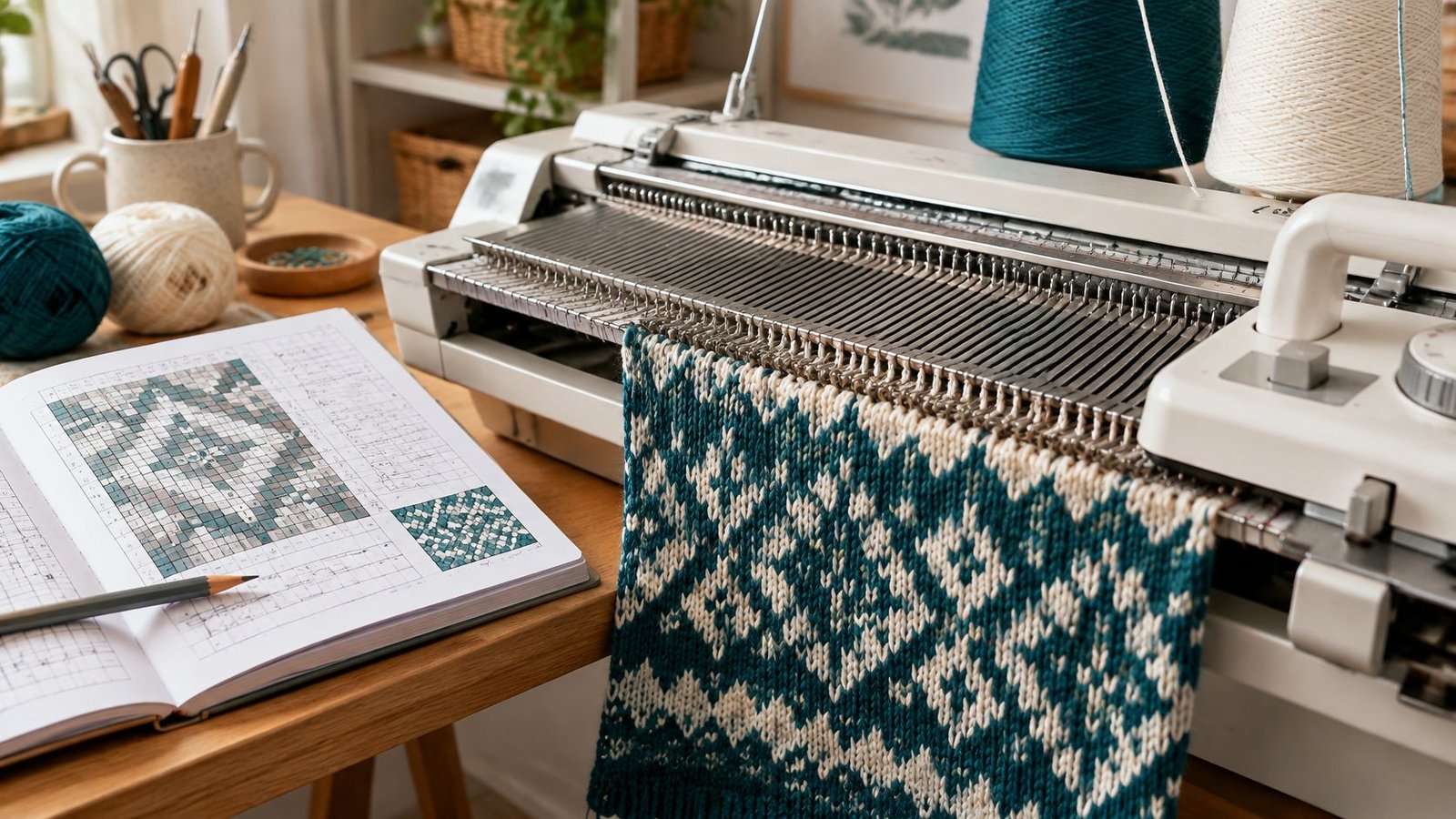
The hat came off the machine looking tidy, and it still will not fit. The chart said 120 needles, the yarn was the one in the photo, and the carriage ran without a jam. The finished piece is a size too small, because that needle count belonged to a finer bed than the one on the table.
That is the usual trap with machine knitting patterns. The diagram looks complete, yet the size only holds when the machine, the yarn and the stitch size match the sample that produced the numbers. A faster carriage does not repair a mismatch. It only makes the wrong size sooner.
Table of Contents
- What a Machine Knitting Pattern Controls
- Match Gauge Yarn and Tension First
- Identify the Pattern Type and Read It
- Convert Needle Counts Between Machines
- Check the Machine Setup Before Full Production
- Cost a Design You Can Repeat
- List Machine Limits Before You Sell
What a Machine Knitting Pattern Controls
Say the printed hat called for 120 needles on a fine bed, and the knitter cast that number on a standard 4.5 mm machine. Each loop sat further apart, the fabric grew wider per stitch than the designer measured, and the depth came up short once the piece was off the machine. The chart was not wrong for its own bed. It was incomplete for any other.
A machine knitting pattern is a set of instructions for needle selection, carriage passes, stitch size and shaping on a stated machine. It is not a hand-knitting pattern redrawn with denser squares. Needle pitch is the shelf spacing in an oven, the yarn is the ingredient, and tension is the heat. Change any one of them and the same recipe does not come out the same size.
Four terms settle most arguments about fit. A stitch is one loop on one needle. A row is one pass of the carriage across the needles in work. The tension dial on the carriage sets how much yarn each stitch takes. A finished measurement is taken after washing and drying, not while the fabric is still weighted on the bed.
A motif repeat selects the same needles again and again for the pattern. Shaping rows change how many needles stay in work, so the piece narrows or widens. Those two jobs can sit on the same chart, and mixing them up is how a fair isle band turns into an accidental decrease.
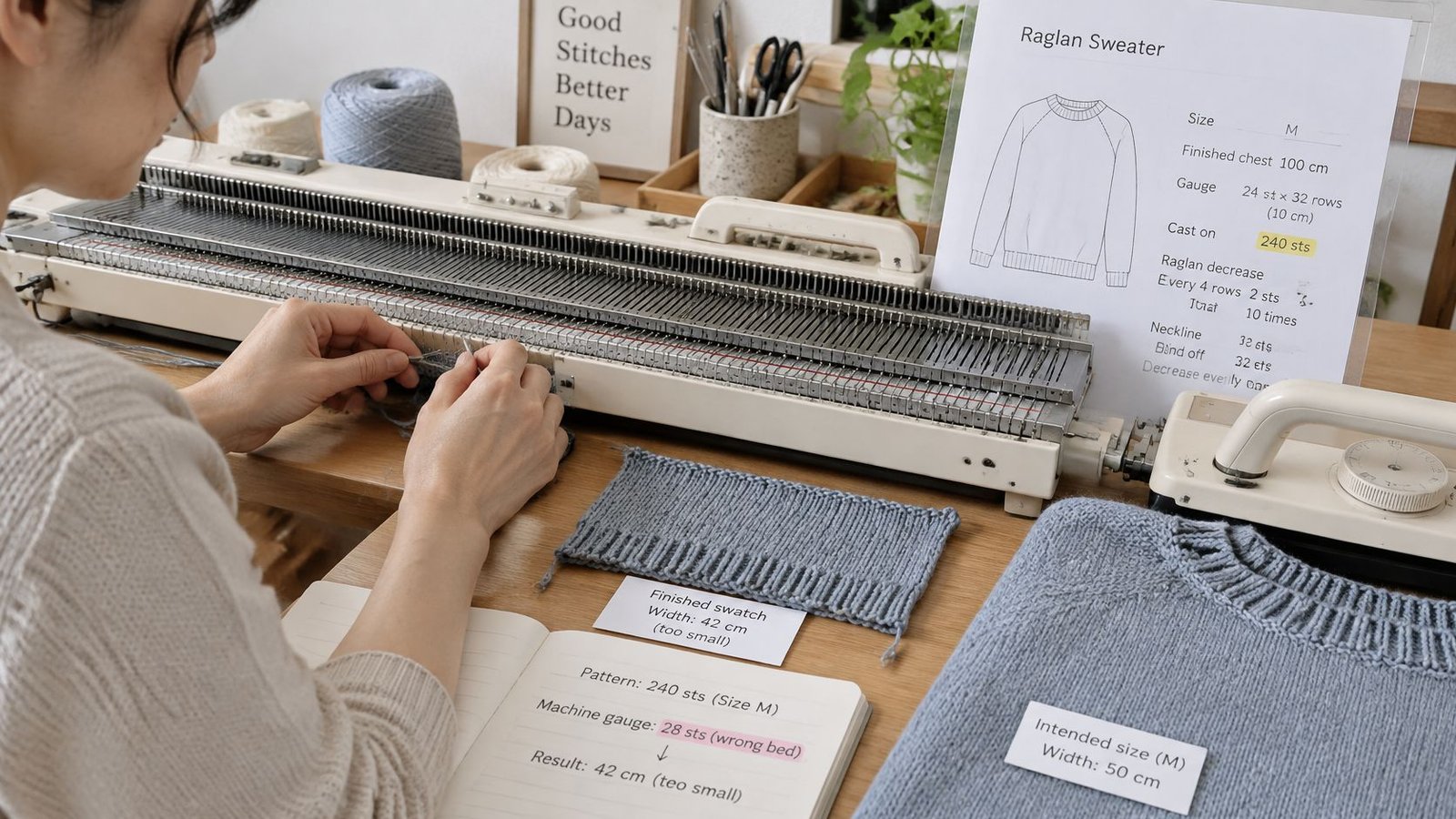
Four fields make the pattern usable:
- Machine class and gauge: the bed the numbers were knitted on, including needle pitch.
- Yarn and number of ends: the yarn, and whether it ran as one end or several.
- Tension from a washed swatch: the dial setting that produced the measured fabric after finishing.
- Construction: fully fashioned on the machine, or a rectangle cut and seamed later.
If those fields are missing, the stated size is a hope, not a specification. Buyers comparing beds can start with a plain guide to choosing an electronic knitting machine, then check whether that machine can even hold the pitch the pattern assumes.
Match Gauge Yarn and Tension First
Place the machine on the table below before reading a single chart row. Machine gauge here is the distance from the centre of one needle to the centre of the next, as the Knitting and Crochet Guild describes it. It is not the hand-knitting count of stitches in 10 cm. The pattern still needs that second figure, but it has to come from a washed swatch on the actual bed.
| Gauge category | Needle spacing | Usual yarn | What the pattern must record |
|---|---|---|---|
| Fine | 3.5–3.6 mm | Up to 3-ply, some fine 4-ply | Gauge, yarn, ends and tested tension |
| Standard | 4.5 mm | Up to 4-ply and some fine double knitting | Gauge, yarn, ends and tested tension |
| Mid-gauge | 6–7 mm | DK, including many hand-knitting yarns | Gauge, yarn, ends and tested tension |
| Chunky | 9 mm | DK, aran and light chunky | Gauge, yarn, ends and tested tension |
Accept or reject the yarn from one row
Match the machine to its row, then reject a heavier yarn instead of forcing the feeder. A chunky aran on a standard bed does not become a standard yarn because the colour is right. The hooks and the sinkers were built for a thinner strand. Forcing it bends needles, drops stitches and still fails to copy the designer's fabric.
The same Guild notes that tension controls stitch size and is commonly set on the carriage tension dial. Yarn weight alone does not fix the loop. Two knitters can run the same 4-ply on the same 4.5 mm bed and get different fabric if one sits at a looser dial setting. The pattern has to record the setting that produced the sample, not a guess based on the ball band.
A chart moved to another pitch cannot keep its needle count. Forty stitches on a 9 mm bed cover a very different width from forty stitches on a 4.5 mm bed. The motif may still be recognisable. The garment will not be the stated size.
Write it on the cover: gauge, yarn range and the tested tension belong on the pattern cover before any motif instruction. A buyer who cannot see those three lines cannot tell whether the chart is for their machine.
Hand-knitting tension, stitches and rows per 10 cm, still matters, and it is a second measurement. Knit the swatch, wash it the way the garment will be washed, dry it flat, then count. That washed count is the only one that should drive needle numbers. A schematic drawn from an unwashed piece will drift once the fibre relaxes.
Identify the Pattern Type and Read It
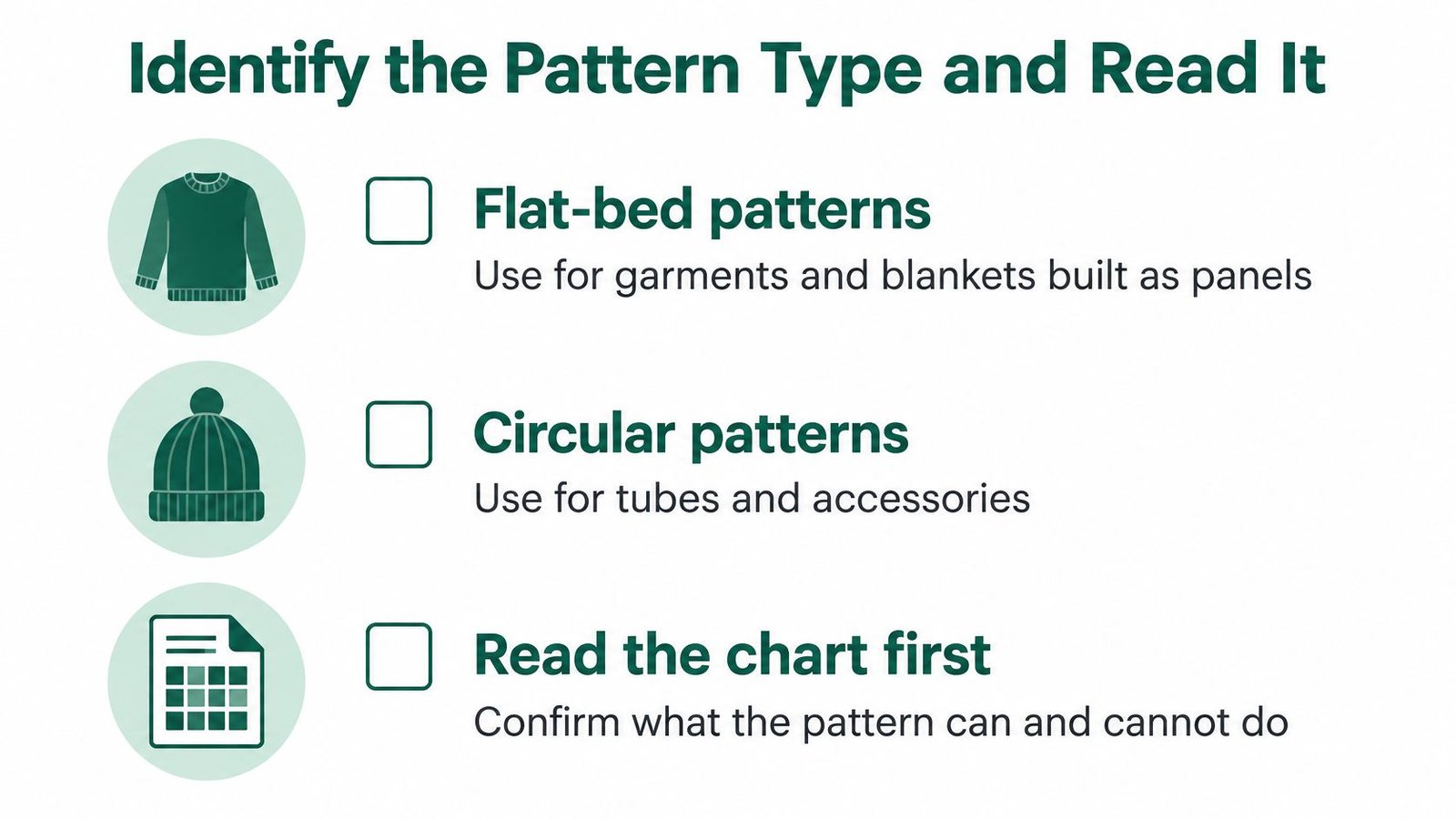
The pattern type fixes what the chart can do. Flat-bed patterns suit garments and blankets built as panels. Circular patterns suit tubes and accessories such as hats and cuffs. Written rows, drawn charts, punchcards and electronic selection files are the usual formats. A punchcard repeats a fixed selection. An electronic file can change needle selection row by row. Neither of them chooses the yarn or the tension. Those still sit in the header.
The same habit of reading a key before touching the work shows up in sewing. A clear walk-through of how to interpret a sewing pattern is a useful parallel, because a symbol only means what that sheet's key says.
Six steps in carriage order
- Read the header for machine, gauge, yarn and tension. Stop if the bed does not match.
- Read the cast-on and which needles start in work, including any waste yarn or ravel cord.
- Follow the row repeat in whatever format is supplied, punchcard, file or written rows.
- Mark knit, tuck, slip and transfer exactly as that designer's key defines them.
- Separate the motif repeat from shaping rows, so a pattern band is not treated as a decrease.
- Find seaming and washing notes. Finishing changes the size, and a missing wash note leaves the measurements unfinished.
A chart cell is a needle action, not automatically a knit stitch. A colour, a blank or a dot means only what the key says. Fair isle, tuck and slip are selection types the key must name. Treating every filled square as a plain knit stitch will knit the wrong fabric even when the needle count is right.
Rib and transfers need a second bed or a ribber. A single-bed knitter should stop if the pattern never says which bed is required. Guessing a ribber setting, or hanging a transfer by hand without a note, is how a clean chart becomes a tangled bed.
Write one chart row out in plain words before knitting it. "Needles 20 to 40 tuck, the rest knit, no transfer" is harder to misread than a row of unmarked squares.
Sellers who already package a measured, cut piece can see how a tight specification reads on a product page, as with a leather wallet pattern. The knitting file needs the same kind of limit in view, machine and bed, before anyone pays for it.
Convert Needle Counts Between Machines
A pattern written for one bed is a recipe for that bed. Follow it on a different machine and you are cooking at a different heat: same ingredients, different result. A finer or coarser bed does not inherit the old needle count, so the useful question is whether this pattern can be converted and still meet the stated size.
Gauge is an engineering constraint, not a preference. TechSoft's notes on computerised knitting machines show how far the constraint reaches: a standard domestic machine such as the Silver Reed SK840 uses a 4.5 mm needle pitch and a 200-needle bed and is specified for 3-ply, 4-ply and lighter double-knit yarns, while documented machine gauges run from about 5 to 32 gauge, with 12–22 gauge suited to wool jersey. The same notes record that a 10-gauge machine may use one yarn end where a 6-gauge machine uses two for a comparable thickness. That is the conversion problem in a sentence: needle spacing, not the chart, decides how much yarn fills each stitch.
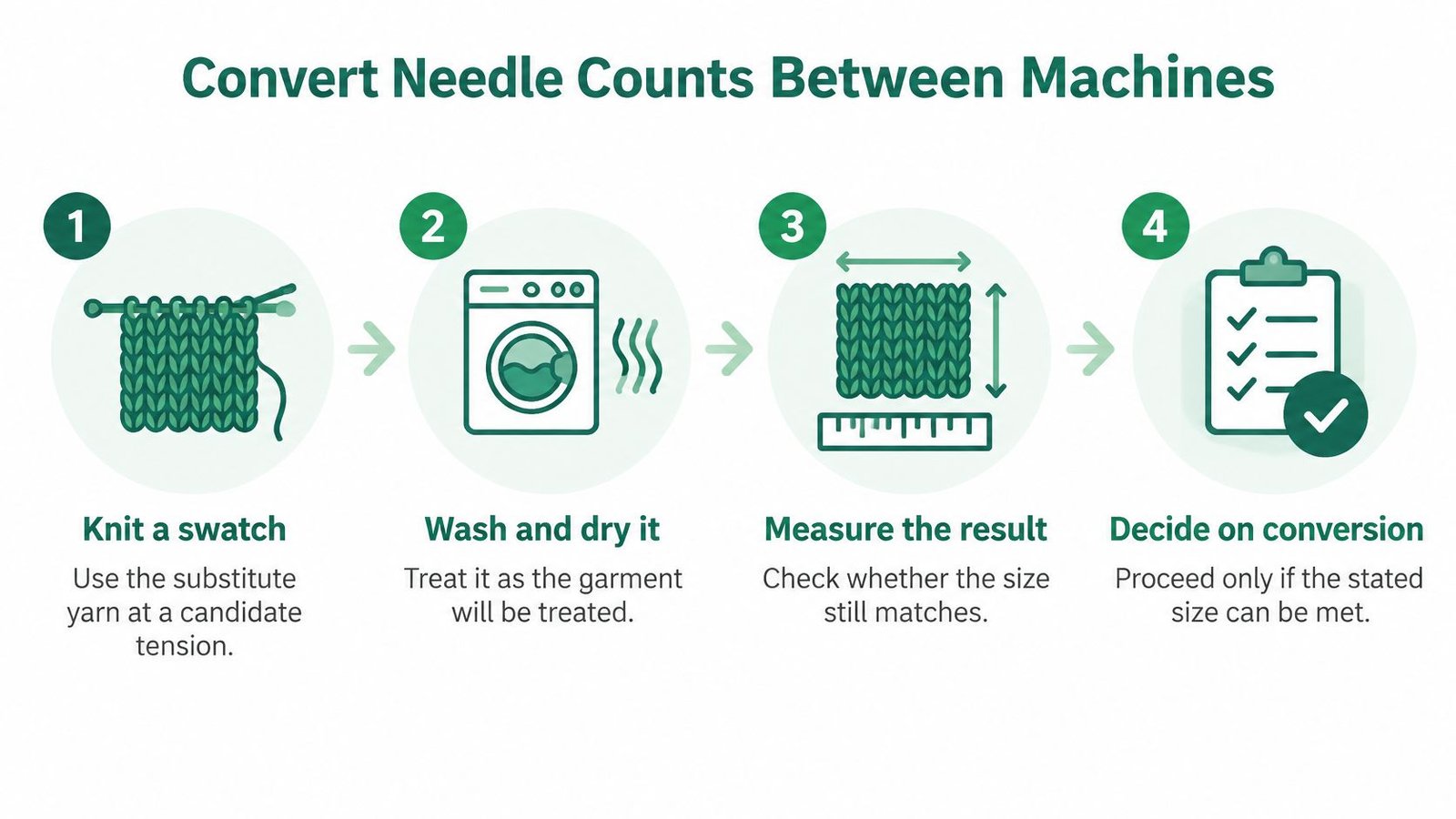
The metric workflow
- Knit a swatch in the substitute yarn at a candidate tension, wide enough to measure a clear 10 cm away from the edges.
- Wash and dry it as the garment will be finished, then count stitches and rows over 10 cm.
- Multiply the target width in centimetres by the stitches per centimetre, and round to a whole needle count. A 40 cm width at 3.2 stitches per centimetre needs 128 needles (40 × 3.2 = 128), not the old chart's number. Dividing instead of multiplying gives 12.5, which is the mistake that produces a piece a fraction of the intended width.
- Recalculate length from the washed row gauge the same way: rows per centimetre multiplied by the target length in centimetres.
- Rewrite fully fashioned shaping, or add seam allowance if the piece will be cut from a rectangle. A decrease every six rows on the old bed will not land in the same place.
- Stop if the yarn will not sit in the hooks without forcing the carriage. That is a yarn rejection, not a tension tweak.
A 9 mm chunky pattern cannot be keyed onto a standard 4.5 mm bed. Its needle count has to be recalculated on the actual machine with a new swatch. If yarn feed and stitch size are not adjusted, loop length, cover and recovery change, and the piece can drift, recover unevenly or overload needles.
When the swatch misses
| What you see | Usual cause | Change to test |
|---|---|---|
| Too wide after washing | Stitch size too loose or yarn heavier than the sample | Tighter tension or fewer needles, then rewash |
| Too narrow after washing | Tension tight or yarn thinner | Looser stitch size or more needles, then rewash |
| Jammed carriage or dropped stitches | Yarn too heavy for the pitch, or too many ends | Fewer ends or a coarser gauge |
| Length grows after washing | Rows counted before finishing | Recalculate from the washed row gauge |
| Fair isle pulls in | Floats too short for the pitch | Add width or ease the floats and retest on waste yarn |
Accept the conversion only when the washed swatch matches width and length and the carriage runs cleanly. A clean pass on waste yarn proves the bed moves; it says nothing about size after finishing. The washed piece is the only evidence that counts.
Check the Machine Setup Before Full Production
A correct stitch sequence can still be a bad setup. The UK Health and Safety Executive identifies BS EN ISO 11111-6:2005+A1:2009 as applicable to fabric-manufacturing machinery, including circular, flat-bed and warp-knitting machines, and points users to British Standards for flat and circular knitting machinery. That is a pointer to the standards, not a legal opinion on a home machine. The machine manual, and the standard that matches how the machine is used, still govern the setup.
Punchcards, electronic selection, transfers, tuck, slip, fair isle and multi-bed work all assume a carriage, sinkers, needles and yarn that suit the bed. A mismatch can drop stitches or let needles collide even when the chart is accurate.
What a robust pattern names
Name the machine class, the gauge, the bed layout, compatible attachments, the maximum working width, yarn-feed limits and any hand manipulation. Those fields separate a charting error from a machine that was never compatible, which makes a support message much easier to answer. A buyer on a single-bed chunky machine should be able to see, before purchase, that a ribber transfer is outside the tested setup.
People who already sell made goods with a stated process, including laser-cut products, know that the offer has to say what the machine can and cannot do. A knitting file needs the same honesty.
Three checks before a full piece
- Knit a small swatch in the stated yarn and tension, then wash and remeasure it before committing yarn to the garment.
- Inspect for dropped stitches and for needles that collide or fail to clear the carriage.
- Stop when the swatch shows needle interference. Do not knit through it. Check the carriage, sinkers and yarn against the manual, then try again only after the setup matches.
A chart that is right on paper can still be the wrong job for that carriage. Interference is a stop, not a row to push past.
Cost a Design You Can Repeat
A faster machine does not by itself make a sellable repeat. The Crafts Council 2025 Makers Survey found that 37% of UK respondents saw turnover shrink, while 22% reported growth. It describes portfolio makers who combine craft income with other paid work, under rising operating costs and competition from low-cost mass-produced goods. Those figures describe pressure on makers as a group. They do not predict any one knitter's takings.
Speed only helps once the design can be costed and repeated. A two-hour hat that needs a fresh tension experiment every time is slower, in money terms, than a slower plain fabric with locked settings.
Lines to fill before a price goes public
No sample prices belong on a general sheet. The maker's own invoices do that job. What has to be written down is the line itself. A standard-costing habit, the sort set out in control spending with standard costing, keeps those lines stable instead of rebuilding the sum from memory after every order.
| Cost line | Record this | How it changes the offer |
|---|---|---|
| Yarn | Grams or metres per size, fibre and number of ends | Heavier gauges and larger sizes use more yarn |
| Sampling | Yarn and time spent before a sellable swatch | A failed tension is a cost |
| Labour | Minutes to knit, finish and pack one size | Hand transfers and bigger sizes add time |
| Packaging and postage | Mailer and delivery zones for a physical item | Does not apply to a pattern file alone |
| Production ceiling | Pieces that can be finished in a week | Sets the made-to-order limit |
Repeatability is locked settings. Same gauge, same number of ends, same tension, same washed gauge and the same finishing, so the next piece matches the sample. A size range changes time even when the motif does not. The large size uses more yarn, more rows and often more hand transfers at the neck or armhole. Quoting one labour figure for every size underprices the biggest pieces.
For made-to-order work, the notes should include the queue limit and the measurements the customer must supply, such as chest, length and sleeve. Without a ceiling, a popular chart becomes a backlog the machine cannot clear.
Sell the design as a repeat only when the timed sample still leaves a margin after materials and labour, at a price the maker is willing to publish. If the margin disappears once hand finishing is timed properly, the design is a one-off, not a product line.
List Machine Limits Before You Sell
A buyer should see the tested limits before paying, not after the file is open. For a digital pattern, state the machine class and gauge, the yarn and number of ends, the tension, the washed-swatch method, the finished measurements, what was not tested, and whether conversion is supported. Say what the file contains, such as a written sheet, a chart, a punchcard or an electronic selection file. Say what it does not contain. It does not choose the buyer's yarn, and it does not guarantee a fit on an untested bed.
Physical products can include handmade items, branded products, merch and more. Digital products can include templates, guides, ebooks, resources and more. A tested knitting sheet sits in that second group. A finished jumper sits in the first, and the two offers should not share one vague description. Sellers who package downloadable files can compare how a tight file description reads on PLR digital products, where the buyer needs to know what the download is and what it is not.
A session sold with the file
If a live troubleshooting session is sold with the pattern, state its length, what the buyer must already have knitted, and that the session does not guarantee a particular garment. A half-hour call cannot rebuild a swatch that was never washed, and it cannot make a chunky yarn fit a fine bed. Writing that boundary into the offer prevents the session being treated as a fitting service.
Labels on finished knits
Finished knitted items need separate labelling from the pattern file. GOV.UK textile labelling guidance states that the label must show the fibre content, including fur and other animal parts, and that products made from two or more components with different fibre contents must show the content of each component. The indication must be clear and legible. Depending on how the product is supplied, it may appear on the product, its packaging or accompanying commercial documents. A contrasting trim or a lining cannot hide inside one vague "wool blend" line.
This applies to the physical textile being supplied, not to the pattern file used to make it. Check the current GOV.UK guidance for the actual goods. The notes here are general information, not legal advice.
Do not publish a pattern until gauge, yarn, washed size and conversion limits are written in the offer itself. A chart without those lines asks the buyer to guess, and a guess is how the hat comes out a size too small.
AmaJova turns a tested knitting pattern, a finished knit, a troubleshooting session or a related service into one OfferLink, with the machine limits, inclusions and price visible before checkout. That kind of clear offer suits makers who would rather state gauge, yarn and turnaround once than rebuild the description in every message. Visit AmaJova to set up the offer.