
The most popular advice about PLR digital products gets the order backwards. Sellers are told to buy a bundle, add a logo, upload it quickly and worry about rights later. That sequence creates the disputes that careful sellers avoid. A licence is not decoration for a sales page. It's the record that shows what can be changed, what can be sold and what a buyer can safely claim. Treat that evidence as part of the product and the offer becomes easier to trust, not harder to sell.
Table of Contents
- What PLR Digital Products Actually Give You
- Reading a PLR Licence Term by Term
- Auditing Every Asset in a PLR Bundle
- How to Adapt and Rebrand PLR Files Safely
- Selling PLR Products to UK Buyers Fairly
- Ethical and Commercial Uses That Set Your Offer Apart
- Check Your Rights Before You Publish
What PLR Digital Products Actually Give You
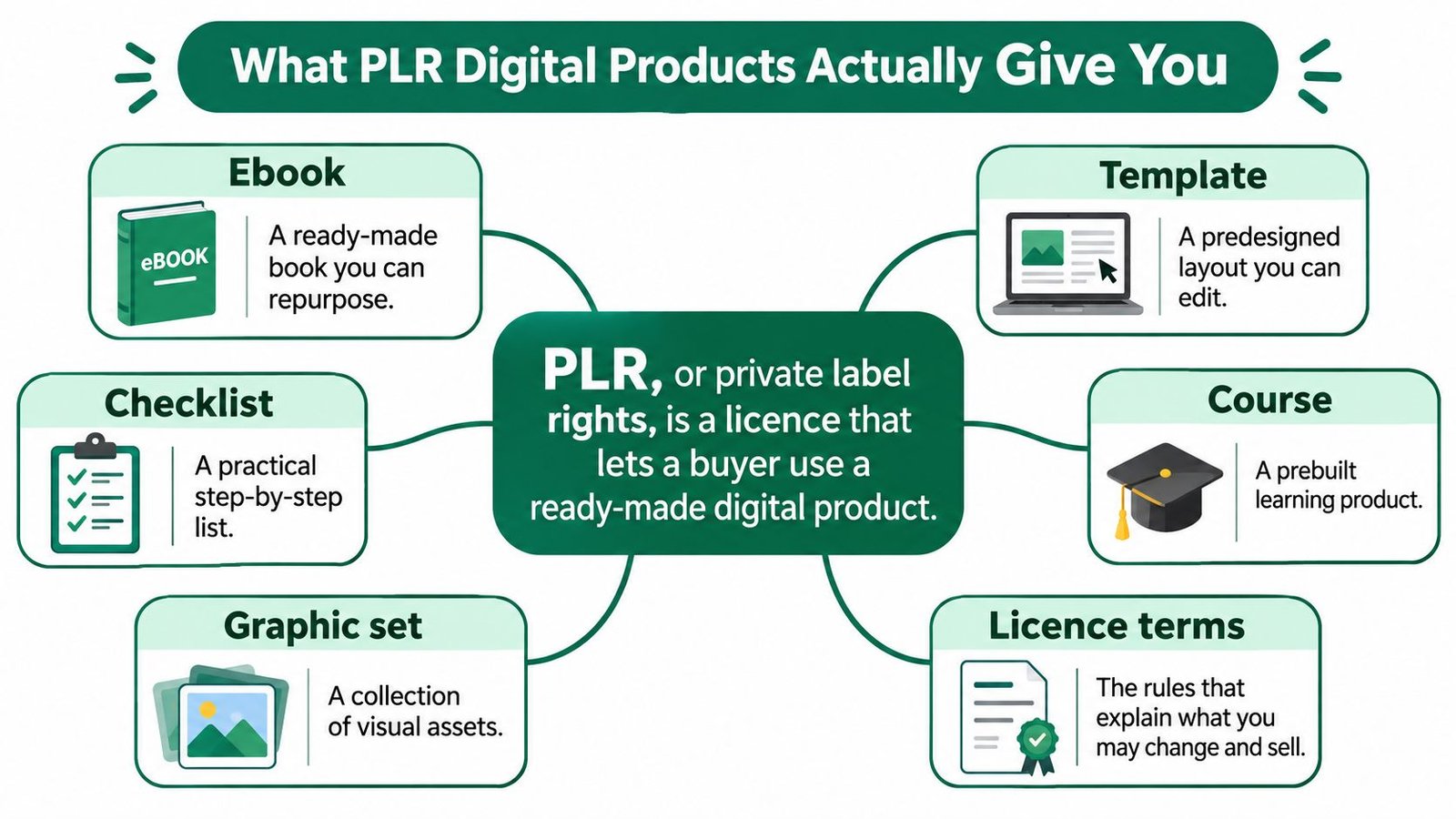
PLR, or private label rights, is a licence that lets a buyer use a ready-made digital product, such as an ebook, template, checklist, course or graphic set. Many licences allow editing, rebranding or resale, but only under stated conditions. The licence sets the boundary, not the title of the bundle.
Think of a restaurant using a recipe from a cookbook it didn't write. The publisher's terms decide whether the dish can be served, adapted or renamed. Using the recipe doesn't transfer ownership of the cookbook. PLR works the same way.
Three Roles and Three Examples
Three roles appear in most transactions. The original creator makes the material, the licensor sells permission to use it, and the buyer may become a seller of an adapted version. Those roles can overlap, but they aren't interchangeable.
A short ebook on sleep routines, an editable weekly planner and a set of social media graphics can all carry PLR terms. For UK creators and coaches, the appeal is clear. A finished base can save weeks of drafting, design and formatting, leaving time for audience knowledge and original examples. A broader starting point is the guide to what digital products include, which helps separate format from rights.
What PLR Doesn't Mean
A personal-use licence normally permits use by the buyer only. PLR usually goes further, but it shouldn't be confused with full resale rights or a transfer of master rights. Those arrangements answer different questions about who may pass permission onward.
Holding PLR doesn't make the buyer the copyright owner. It provides specified permission to use material that someone else created.
Apply three questions to every product before buying or publishing it:
- What can be changed? Confirm editing, translation and rebranding rights.
- What can be sold as it is? Check whether original files must stay within a larger product.
- What must be credited? Identify any required attribution and where it must appear.
Clear answers turn a ready-made file into a usable starting point. Vague answers mean the low purchase price could conceal substantial correction work later.
Reading a PLR Licence Term by Term
The licence, not the file format, decides what a seller may do. A PDF, design file or video tells the buyer how content is delivered. It says nothing about resale, authorship or sublicensing.
The UK government guidance on licensing copyright material states that a copyright licence is a contract defining what the buyer may do with a work, and licences can be restricted by rights granted, duration or other conditions. That principle gives sellers a practical task. Extract the operative terms before editing anything, then convert them into product records and plain customer-facing wording.
Terms to Extract Before Publishing
| Licence term | What to check | Why it matters |
|---|---|---|
| Resale of original files | Whether the files can be sold as they are or only inside a larger product | Selling unmodified files may fall outside the licence |
| Editing and adaptation | Whether changes, translation and rebranding are allowed | Some licences forbid altering the source files |
| Authorship claims | Whether you may present yourself as the author | Claiming authorship can breach the licence terms |
| Membership or library use | Whether the licence names memberships or shared libraries as a separate use | Memberships may need their own permission |
| Editable formats | Whether source files such as design or document formats can be passed on | Editable sources are commonly restricted |
| Sublicensing | Whether buyers may pass rights on to others | Determines what your customer can safely do |
| Territory and duration | Where and for how long the licence applies | Limits may not match the markets you sell in |
| Attribution | Whether credit to the original creator is required | Missing credit can breach the licence |
The common mistake is treating PLR as blanket permission. A licence might allow a seller to adapt an ebook while prohibiting resale of the untouched original. Another might permit a finished PDF but forbid passing on editable source files.
Store the result as a one-page licence summary. Include the licence version, purchase date, permitted uses and prohibited uses in ordinary words. Keep the original wording alongside it so a summary never replaces the contract.
Template products raise the same interpretive task, so template usage terms from Taja AI offer a useful comparison when checking how permitted use, modification and distribution can be separated. The point isn't to copy another provider's terms. It's to notice which questions a careful licence answers explicitly.
Publication gate: Any unanswered term is a reason to pause, ask the licensor for clarification or seek professional advice.
That pause protects both sides. The seller avoids promising unrestricted ownership when the actual offer is a limited licence to use adapted material.
Auditing Every Asset in a PLR Bundle
A bundle is only as safe as its weakest asset. Text may be cleared while an embedded photograph, font, template, piece of music or AI-assisted image carries a separate restriction. Auditing the bundle as one item misses those component-level problems.
Start by listing every asset in the delivered product, including covers, worksheets, embedded links and promotional graphics. Then record what permission applies to each one. A licence summary for the main ebook doesn't automatically clear a stock photograph placed inside it.
Rights to Confirm for Each Asset Type
| Asset type | Rights to confirm | Evidence to keep |
|---|---|---|
| Stock images | Commercial use and whether they may appear inside a resold product | Licence version and download record |
| Fonts | Embedding in templates and distribution rights | Licence file and terms |
| Templates and designs | Whether the underlying design can be resold | Source link and licence |
| Music and video | Commercial and bundled use | Licence and usage terms |
| AI-assisted text or images | Provider terms and whether human editing is documented | Tool terms and edit history |
| Quotations | Copyright status and permitted reuse | Source reference |
Every asset needs a provenance record. Keep the source or supplier, licence version, acquisition date, permitted commercial uses and proof of permission. Screenshots alone may be weak evidence if they don't show the account, date or version. Save the licence document where available.
Set a firm publication gate. Remove or replace any asset without a clear licence before the product goes live. Replacing one unclear image is cheaper than withdrawing an entire bundle after buyers have downloaded it.
Handling AI-Assisted Material Carefully
Written evidence submitted to Parliament on AI and copyright identifies unresolved issues around authorship, ownership and protection for AI-assisted works. Current UK copyright rules generally protect original works involving human intellectual effort, while the legal position for autonomously generated material remains unclear.
Document human editing with dates, draft versions and notes explaining substantive changes. Substantive restructuring, original examples and rewritten arguments provide a clearer record than cosmetic synonym changes. Sellers reviewing supplied text may also find checking originality in AI-assisted drafts useful as an additional screening step before closer source checks.
Editing doesn't cure a missing licence for a third-party image, font or trademark. Editable doesn't necessarily mean safe to resell.
Finish with a one-sheet test. Can the seller show, on a single page, where each asset came from and what may be done with it? If not, the audit isn't finished.
How to Adapt and Rebrand PLR Files Safely
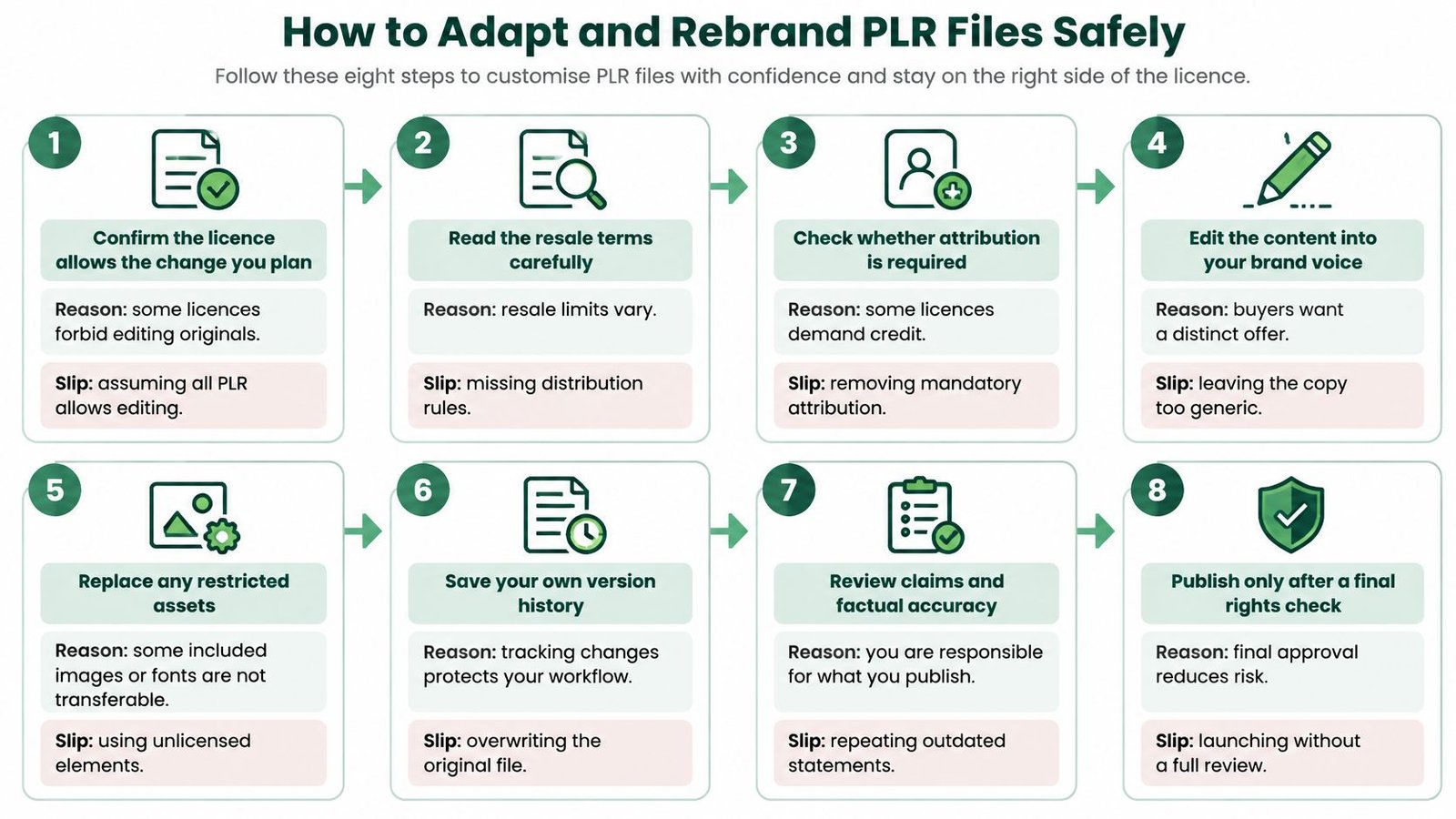
Safe adaptation follows a sequence. Changing colours and adding a logo before checking permission can waste hours on a product that cannot be sold in the planned form. Work through the rights first, then the creative changes.
Eight Steps From Source File to Finished Product
- Confirm the licence allows the planned change. Some licences forbid editing originals. The usual slip is assuming every PLR licence permits all adaptation.
- Save the licence and purchase record before starting. Keep the supplier, version and date together. Sellers often store the files but lose the terms that explain them.
- Remove assets that aren't covered. Replace unclear stock images, fonts or quotations instead of hoping they were included. Carrying one doubtful item into the final bundle undermines the audit.
- Add original material. Introduce examples, exercises, case scenarios or a new structure suited to a defined audience. Record the human editing so the contribution can be shown later.
- Rebrand only where permitted. Change the cover, layout and title within the licence terms. Avoid claiming authorship where the licence prohibits that claim.
- Check every name, statistic, quotation and factual claim. PLR source material can be dated or inaccurate. Repeating an unverified claim makes it part of the seller's own offer.
- Write buyer-facing licence wording. State what customers may use, adapt, share or resell and what's prohibited. Avoid legal jargon where plain wording gives the same boundary more clearly.
- Package the final files with a version date. Keep an untouched copy of the exact delivered version. Overwriting it during later updates makes complaints harder to investigate.
Working rule: Adapt the substance for a named audience, not just the surface for a new storefront.
A finished product has a clear title, accurate contents list and a licence statement buyers can understand without specialist help. Behind it sits a provenance file covering the source material and every embedded asset. The seller can reproduce the exact delivered version, show what was changed and explain why each use is permitted.
That combination is the difference between rebranding and responsible republication. It also gives support conversations a factual starting point. When a buyer asks whether a workbook can be placed in a membership library, the answer comes from the stored licence summary, not from memory or guesswork.
Selling PLR Products to UK Buyers Fairly
Say a buyer purchases a template bundle at 9pm and downloads it immediately. The convenience is obvious, but instant supply raises a consent question. Without the correct acknowledgement, the seller may not be able to rely on the buyer having given up the normal cancellation right.
Under the Consumer Contracts Regulations 2013, the normal cancellation period for digital content supplied by download is 14 days from the day the contract is entered into. Supply can begin during that period only if the customer expressly agrees to immediate supply and acknowledges that doing so removes the statutory cancellation right.
Making Consent Visible and Recordable
Use a clear, unticked consent mechanism at checkout. The buyer should actively choose immediate supply after seeing wording that explains the consequence. Retain evidence of the acknowledgement, including the time and wording version, rather than relying only on general acceptance of terms.
Before payment, buyers should see:
- File description: What the product contains and who it's for.
- Included formats: PDFs, editable files, videos or other deliverables.
- Access method: How and where files become available.
- Licence restrictions: Permitted adaptation, resale and sharing limits.
- Support scope: What help is included and what sits outside it.
- Refund process: How faults and access problems are reported.
Faulty digital content raises separate consumer rights. Keep file versions, access logs, update history and support records so a corrupted file can be distinguished from non-delivery or a licence misunderstanding. Those records also show whether a later update changed the product the buyer originally received.
A seller using visual discovery channels can compare pre-purchase presentation approaches in Pin Generator's digital product selling guide, while the practical guidance on selling PDFs online is relevant where the PLR offer is delivered mainly as documents. Marketing clarity doesn't replace checkout consent, but consistent wording reduces surprises.
A sample buyer-facing statement, checked against the licence held, could read: "You may use and adapt this product in your own business and sell your adapted version to your own customers. You may not resell or share the original files, or present the content as your own original authorship."
Application can depend on customer status, transaction structure and jurisdiction. Sellers should obtain professional advice for their circumstances rather than treating this wording as universally suitable.
Ethical and Commercial Uses That Set Your Offer Apart
Many buyers may hold the same source files. A generic copy with a new cover rarely gives customers a reason to choose one seller over another. Differentiation begins with honest positioning and useful transformation.
Non-exclusivity is not automatically a defect. A low-cost PLR product can still be valuable when its licence, provenance, audience fit and transformation requirements are explicit. Buyers can judge value properly when they know they aren't receiving exclusive rights.
Questions Buyers Deserve Answered
A standing FAQ should answer the questions a cautious buyer would ask:
- What's the origin? Whether the product is original, AI-assisted or mainly reformatted.
- Are rights exclusive? Whether other customers receive the same files.
- What's included after purchase? Support boundaries, updates and access arrangements.
- What happens after a complaint? How the seller responds if a component receives a copyright challenge.
Those disclosures matter in a market shaped by concern about creator rights. The Communications and Digital Committee report on generative AI and UK creative industries highlights widespread concern about unlicensed use of creators' work in AI training and limited transparency about what material models used. Sellers shouldn't claim more certainty about provenance than their records support.
Commercial value comes from fit. A generic planning guide becomes stronger as a short workbook for one trade, with scenarios drawn from that work. A broad course outline improves when it's rebuilt around one stated outcome. British spelling, UK settings and locally relevant examples can also make imported material feel considered rather than merely relabelled.
Ethical lines stay simple. Don't present purchased work as original research, don't misstate AI origin and give credit where required. Don't flood a marketplace with near-identical titles that force buyers to guess which version differs.
Finish with one test. After reading the sales page, would a buyer feel the product, its limits and its origin were accurately described? If the answer depends on fine print, the page needs rewriting.
Check Your Rights Before You Publish
A polished file can still be the wrong file to publish. Before listing a PLR product, sort it into go, pause or get advice. That final check connects each asset to its licence, and gives buyers a clearer reason to trust what they are purchasing.
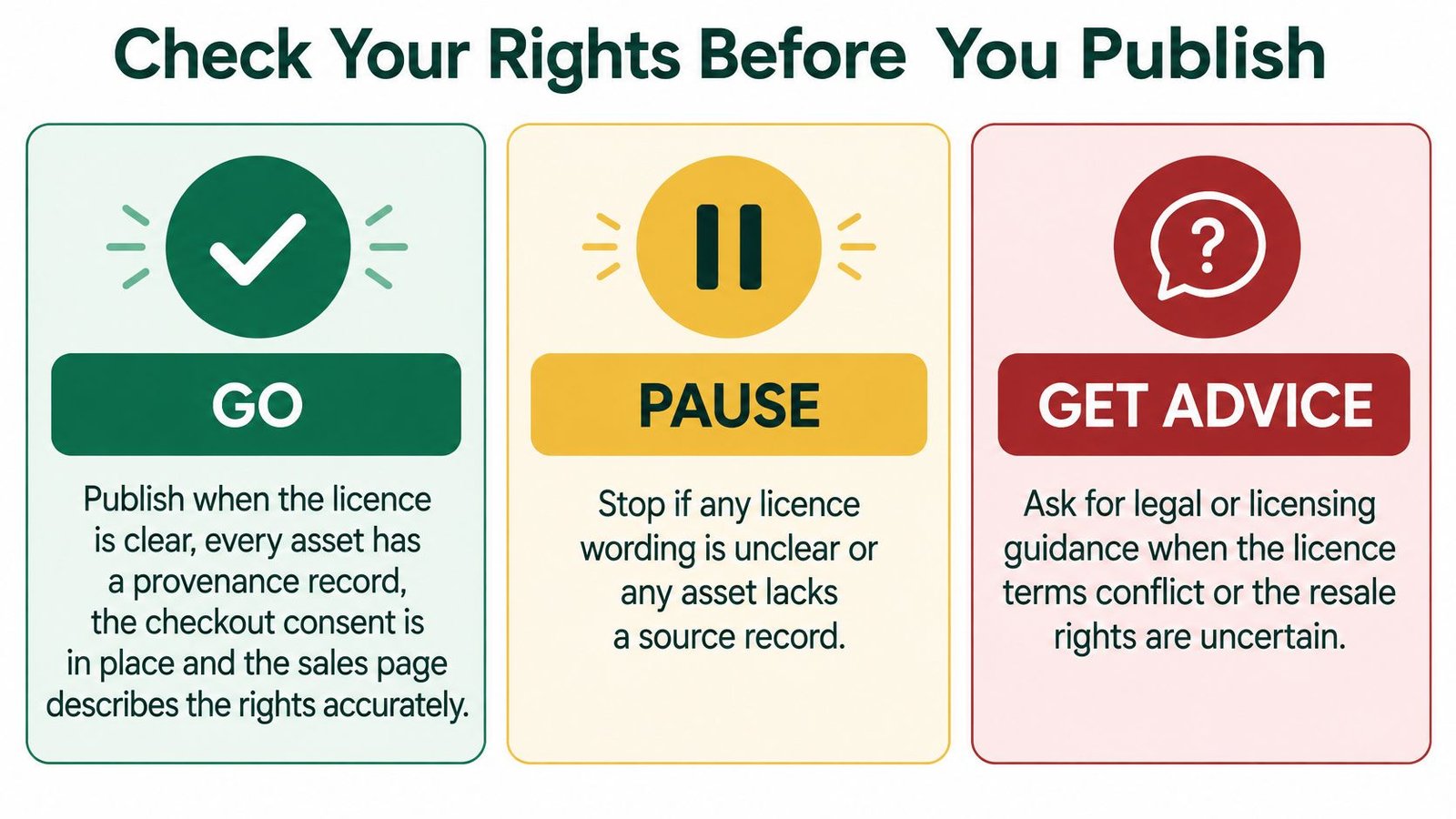
Go, Pause or Get Advice
Go when the licence is clear, every asset has a provenance record and the buyer's rights are stated accurately. The sales page should not present limited permission as ownership.
Pause if an asset lacks evidence, or the licence is unclear about resale, editing, editable formats or membership use. Pause, too, if AI-assisted material has no dated record of human editing. Replacing the asset or asking the licensor a specific question can help prevent a later withdrawal or dispute.
Get advice when the product is high-value, includes third-party trademarks, will be sold outside the UK, or has licence terms that appear to conflict. A solicitor or other qualified professional can help interpret terms for your particular situation.
Three Final Questions
- Can every file be traced? Keep the source, licence version and permitted use together, so you do not have to search old emails.
- Does the sales page state the buyer's rights plainly? Check that permitted and prohibited uses match your licence summary.
- Can you reproduce the delivered version? Keep a dated copy showing what the buyer received if a complaint arises later.
For digital products sold through AmaJova, the seller provides files or access through the buyer's order record. The order page brings messages, delivery or access, timeline, payment record and dispute status together. Buyers can also see seller information, price and fulfilment expectations before paying. This record does not grant rights, but it helps connect the licence promised to the files delivered and any later support.
Rights evidence is more than paperwork. It helps buyers understand the offer before paying and gives sellers a clear record if questions arise.
Run the three questions across your current catalogue. Mark each product go, pause or get advice, and pause listings that lack a licence, asset evidence or a copy of the delivered version. A clear record makes it easier to explain what you are selling and what the buyer may do with it.
Turn a checked PLR product into an OfferLink that states its contents, licence expectations, price and delivery route before payment. Keep the files or access connected to the buyer's order record. AmaJova lets sellers offer digital products through one link with secure checkout and an organised order record for fulfilment and support.