Digital products are goods supplied as data, software or access to digital functionality, such as downloads, apps, software, online courses, music, films and subscriptions. Their value arrives through a file, an account or a digital tool rather than through a parcel that can be held.
That simple answer hides a common source of confusion. A buyer can order almost anything through a phone, yet the phone and checkout don't make the item digital. What matters is what the buyer receives, how that item works, and what conditions govern its use after payment.
Table of Contents
- Why Digital Products Can Be More Than a Download
- Understanding the Definition of Digital Products
- How Digital Products Differ from Other Offer Types
- Exploring Common Digital Product Examples
- Delivery Methods and Key Product Characteristics
- Benefits and Trade-offs of Buying Digital Products
- How to Check a Digital Product Before Buying
- Final Guide to Choosing Digital Products
Why Digital Products Can Be More Than a Download
A buyer finds a polished budgeting template late at night, pays, and receives a download link within seconds. The file opens, but formulas break because it was built for desktop spreadsheet software while the buyer uses a browser-based version. Delivery technically happened, yet the product doesn't perform the job promised.
That small failure explains why what are digital products is a more useful question than it first appears. The word digital describes the substance being supplied, such as data, media or software functionality. It doesn't merely describe the screen used to browse, the card used to pay, or the speed of the confirmation email.
Where the Confusion Usually Starts
Many buyers treat a download link as the whole product. In practice, the purchase may include compatibility requirements, file formats, access duration, updates, licence limits and support boundaries. A smooth transaction page can't guarantee any of those details, and attractive preview images can't confirm that formulas work, videos play or fonts install correctly.
Similar confusion appears with media. A person researching how to save videos from social media may receive an MP4 file, but the act of downloading alone doesn't define a commercial digital product. A product exists when a seller packages specific content or functionality, describes what's included, and supplies it under stated terms.
- Contents: Exactly which files, lessons, tracks or features are included.
- Conditions: Required software, devices, access period and permitted use.
- Aftercare: Whether updates, corrections or support form part of the offer.
Readers who separate those three layers can judge an offer more accurately. The file matters, but so do the rights, technical fit and fulfilment record surrounding it. That distinction also prevents a common mistake, assuming every online purchase belongs in the same category because payment happened online.
Understanding the Definition of Digital Products
A physical book transfers paper, ink and binding. An ebook transfers data that a device displays as pages. The reading experience may feel similar, but the thing supplied is different.
UK Trading Standards guidance treats this kind of supply as digital content, meaning data produced and supplied in digital form, with examples including computer software, films, downloaded music and mobile applications, and Darlington Trading Standards explains that digital content sits within its own Consumer Rights Act framework. The definition covers downloads, apps, files, accounts and other access methods, so a product doesn't stop being digital merely because there's no file to save.
Separating the Product from Its Delivery Pipe
A streamed film helps separate substance from technology. The broadband connection is the pipe, the app is the doorway, and the film data is the product being accessed. Change the pipe from home broadband to mobile data and the film remains the same product.
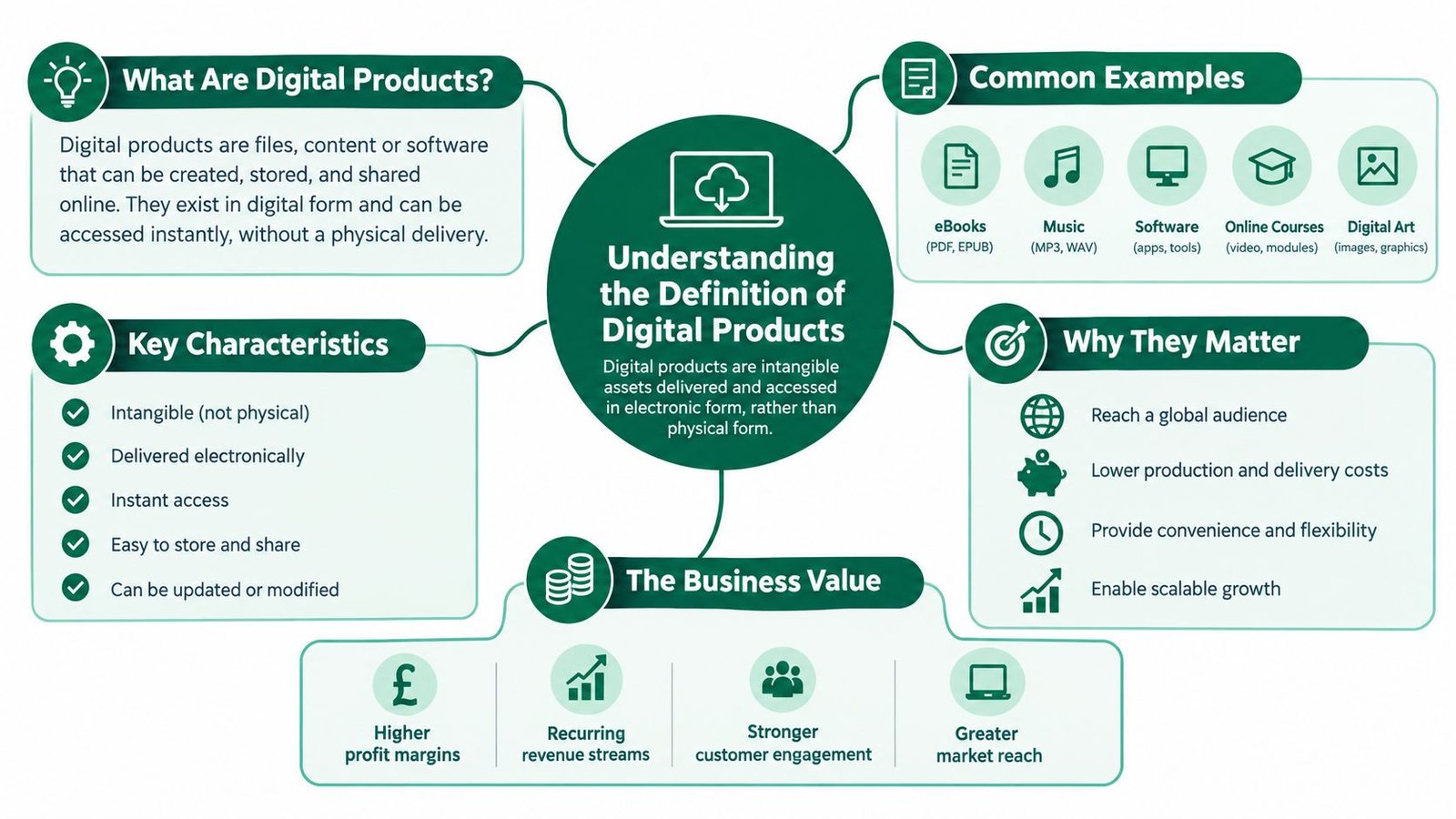
A digital product delivers its main value as data, software functionality or access to digital content, rather than as a tangible object handed to the buyer.
That sentence provides a practical test. If the buyer loses the physical object but keeps the value, the offer is probably digital. If the value disappears when the object disappears, it's probably physical, even when bought online.
National statistics use a similarly careful boundary. The Office for National Statistics reported digital products at 5.0% of UK gross value added in 2020, up from a revised 4.5% in 2019, under its narrow definition, as set out in ONS research on measuring the UK digital economy. That research gives a downloaded digital album as a digitally delivered product, while a traditional item sold through an online checkout doesn't automatically qualify.
Four Common Ways Value Arrives
- A file: An ebook, spreadsheet, image pack or PDF is downloaded and stored.
- An application: Software provides tools or functions on a phone, tablet or computer.
- Account access: Login details provide lessons, media, dashboards or membership areas.
- Gated functionality: A subscription permits continuing use of features controlled by the seller.
This approach builds the definition progressively. Data is the raw substance, functionality makes it useful, and delivery gives the buyer a way to use it. Once those pieces are visible, a CD posted to a home and the same album downloaded legally no longer look identical.
How Digital Products Differ from Other Offer Types
Classification becomes easier when buyers ask one question. What has the seller promised to deliver?
A digital product provides reusable data, files or functionality. A physical product transfers a tangible item. A service uses a person's work to produce a requested outcome, and a live session depends on people meeting at a scheduled time.
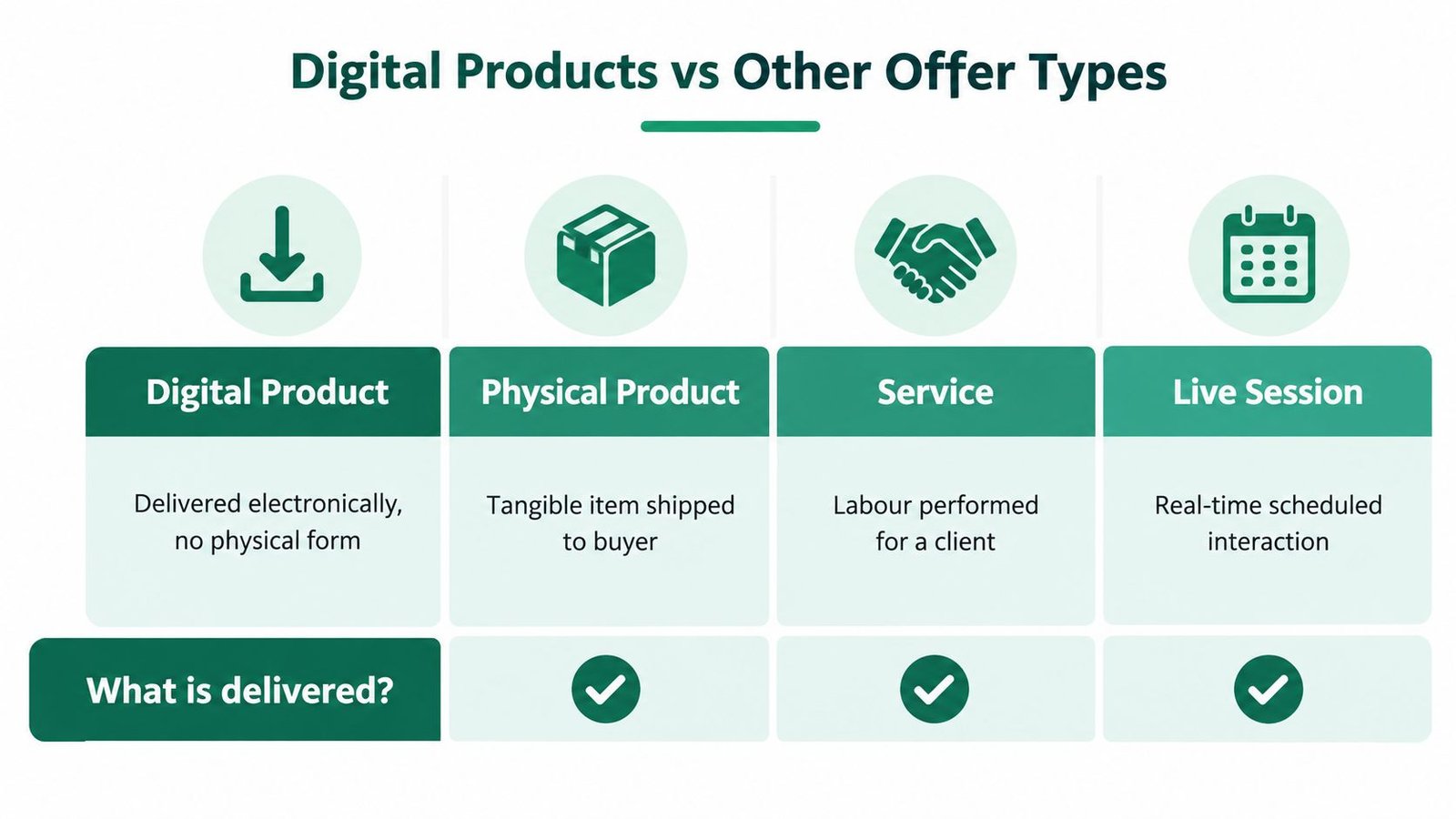
What the Buyer Receives
| Offer type | Primary value | Typical fulfilment | Clarify before buying |
|---|---|---|---|
| Digital product | Files, content or software functions | Download, account or app access | Compatibility, licence and access period |
| Physical product | A tangible item | Collection or shipping | Size, condition and delivery arrangements |
| Service | Work completed for a client | Labour, advice or production | Scope, revisions and completion standard |
| Live session | Real-time participation | Scheduled call, class or meeting | Date, duration and attendance requirements |
A recorded editing course is a digital product because buyers receive access to prepared lessons. A freelancer editing a client's footage provides a service because the value lies in work performed for that client. Further detail on that distinction appears in guidance on selling services online through a defined offer.
Hybrid offers complicate the picture. A coaching package might include live calls, recorded lessons and a workbook. That bundle doesn't need a single simplistic label, but each component needs its own fulfilment promise, timetable and access rule.
Classification rule: Classify an offer by its primary value and fulfilment method, not by the wording chosen for an advert.
That rule protects both sides. Sellers can organise production and support around the correct promise, while buyers can identify whether entitlement means a file, a finished outcome, attendance or possession. Clear classification also prevents a live workshop recording from being mistaken for personal tuition, or a template from being mistaken for a done-for-the-buyer service.
Exploring Common Digital Product Examples
Examples become clearer when each one follows the buyer's path from payment to use. The formats differ, but each delivers value without handing over a manufactured object.
An ebook usually arrives as a PDF, EPUB or account-based reader file. The buyer receives text and images, sometimes with restrictions on copying or sharing. A spreadsheet template promises functioning structure, such as formulas, dashboards or prewritten labels, and its value depends heavily on compatible software.
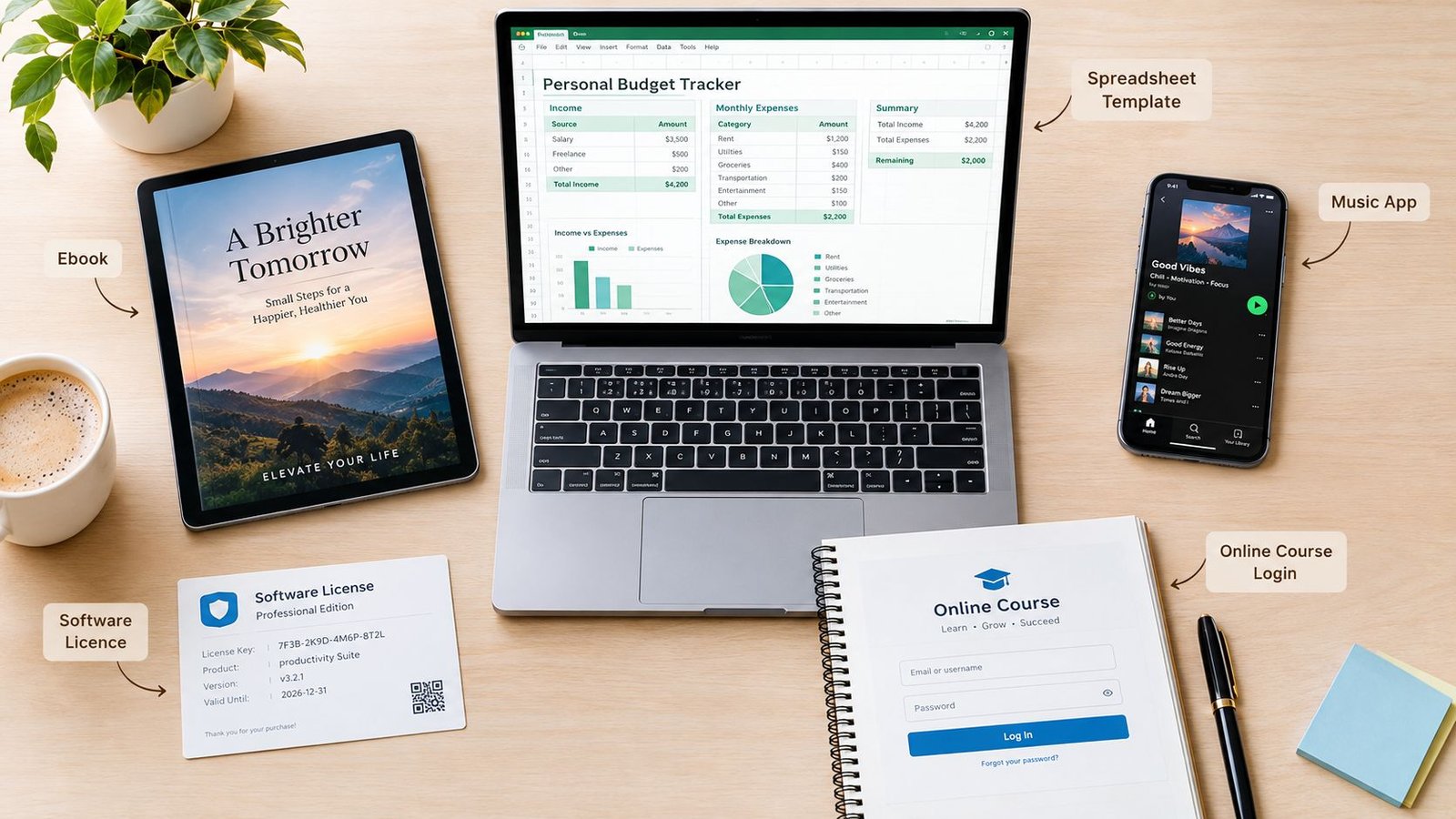
A design template may contain layered files, fonts, dimensions and instructions for editing in Canva, Adobe Photoshop or another named tool. A music download supplies audio files, while a video product might offer downloads, streaming or both. Similar access thinking applies outside retail, where a couple might use a Digital wedding registry as an online tool for organising gifts, though the registry service itself shouldn't be confused with the physical gifts listed on it.
Access Based Examples Need Different Questions
A mobile app supplies functionality through installed software. Device model, operating system, account requirements and update support determine whether it remains usable. A software licence may provide an activation key, a set number of users or a limited period of use, so the licence is often as important as the installer.
An online course usually combines video or audio lessons with worksheets, quizzes or downloadable resources behind an account. Buyers need to know whether access is permanent, time-limited or tied to an active subscription. A prompt library, stock-photo bundle or membership follows the same logic, with value defined by the collection available at a particular time.
- Template: Check the editing application and required version.
- App: Check supported devices, operating systems and account needs.
- Course: Check lesson list, access duration and downloadable materials.
- Subscription: Check renewal, cancellation and what remains available afterwards.
The label digital product therefore says very little on its own. Contents, functionality and conditions reveal whether an example suits a particular task.
Delivery Methods and Key Product Characteristics
Delivery is the route into the product, not the product itself. That distinction matters when a buyer receives login details but finds missing lessons, or downloads a file that requires software never mentioned on the sales page.
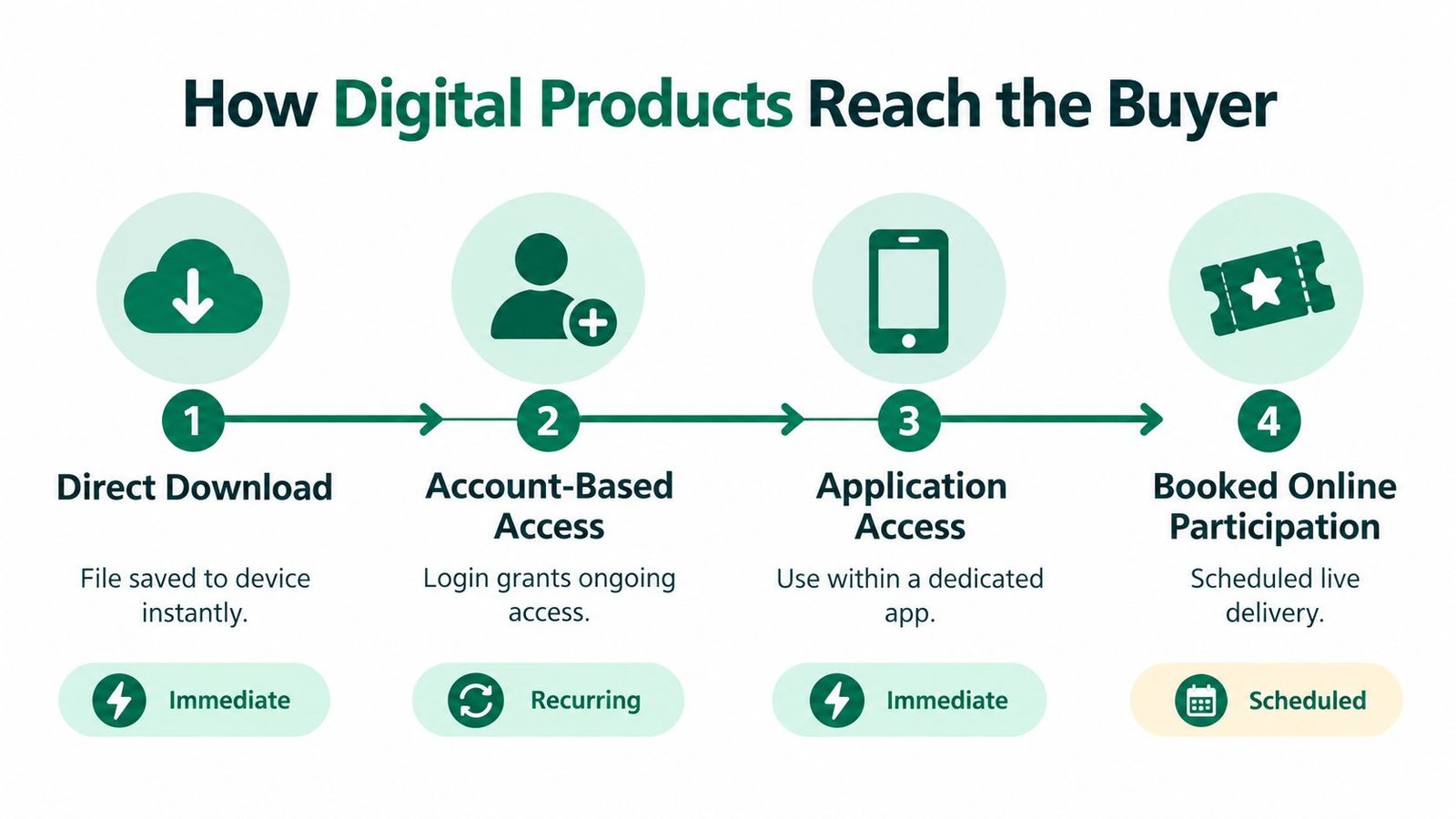
Four Routes to the Buyer
A direct download places a file on the buyer's device. Account-based access keeps content behind a login, allowing the seller to organise lessons, files or membership material in one place. Application access delivers value inside software, while booked online participation grants entry to a scheduled digital experience rather than a reusable file.
Timing also varies. Access may be immediate, recurring under a subscription, released in stages or available for a stated period. Sellers comparing routes can benefit from neutral guidance on how to choose a content sharing platform, alongside an overview of platform options for selling digital products, because storage, access control and buyer instructions affect fulfilment quality.
UK law gives these details practical weight. The Consumer Rights Act 2015 establishes a distinct legal framework for paid digital content, including standards relating to satisfactory quality, fitness for a stated purpose where applicable and conformity with the description, as explained in the official explanatory notes to the Consumer Rights Act 2015. Information about main characteristics, functionality and compatibility can therefore form part of the contractual promise.
Details That Define a Credible Offer
- Format: PDF, MP4, spreadsheet, design file, audio file or app.
- Compatibility: Supported devices, operating systems and third-party software.
- Version: Release number, edition, included features and known limits.
- Updates: Whether corrections or future editions are included.
- Licence: Permitted users, commercial use, resale and sharing boundaries.
- Support: The help channel, response scope and issues excluded.
Consider a social media template advertised as editable. That word doesn't reveal whether editing requires a paid Canva account, a desktop browser or a particular font licence. Precise technical metadata turns marketing language into an acceptance test, so delivery can be checked against the description instead of debated from memory.
Support needs the same boundary. Helping a buyer recover a broken link is fulfilment support. Redesigning the template for that buyer is additional service work. A strong offer page connects every promise to a fulfilment step and states where standard help ends.
Benefits and Trade-offs of Buying Digital Products
Convenience is the clearest benefit. There's no parcel to wait for, no shelf to clear, and suitable products can often be used shortly after checkout. A planner can be duplicated for a new month, a recorded lesson can be replayed, and a software tool can sit ready on a phone or laptop.
That convenience has conditions. Instant delivery doesn't help when instructions are unclear, a file is corrupted or the buyer lacks the named application. Digital format removes shipping friction, but it introduces device, account and compatibility friction that physical inspection can't resolve.
Where Digital Format Helps Most
- Repeat use: Templates, checklists and reference guides can support the same task many times.
- Search and storage: Files can be organised, searched and backed up without physical space.
- Flexible access: Account-based lessons and tools may be available across suitable devices.
- Targeted purchases: Buyers can obtain one specialist asset, such as a contract template or font, without buying a physical collection.
Sellers face a parallel set of trade-offs. Distribution can scale without packing each order, and physical storage requirements are lower. Product creation, testing, customer support, platform management and content maintenance still take time. Software changes can break a template, course material can become dated, and buyers may need help with access.
A digital product isn't automatically easier, cheaper or better. It's useful when its format solves the buyer's problem under the stated technical conditions.
Unsupported claims about passive income or universal time savings miss that point. A budgeting spreadsheet saves effort only if its formulas match the buyer's method and software. A course helps only if lesson depth, pace and access fit the learner's needs. Buyers benefit most by judging the practical job, not the fashionable label.
How to Check a Digital Product Before Buying
Careful checking starts before the price. A buyer needs evidence that the product contains the right material, works with available tools and can be used for the intended purpose.
A Practical Pre-Purchase Check
- List the contents: Confirm every file, lesson, feature, bonus and version included.
- Test compatibility: Match file types against the buyer's device, operating system and applications.
- Check access: Identify whether delivery is a download, login, licence key or scheduled entry.
- Confirm duration: Look for expiry dates, subscription dependence and download limits.
- Read the licence: Check personal use, commercial use, client work, sharing and resale rules.
- Clarify updates: Determine whether fixes, new editions or future lessons are included.
- Find support routes: Locate help for broken links, missing files and access failures before payment.
The phrase instant access shouldn't end the investigation. It might mean instant account creation, immediate release of one module, or a download link sent automatically. Sellers should explain the sequence after checkout, including where files appear and what happens if an email goes missing. Buyers can also review AmaJova buyer protection information where that platform is relevant to a transaction.
For UK-facing purchases, paid digital content must meet applicable standards and match its description. General rights can include repair or replacement first and, in some circumstances, a price reduction or refund, with section 36 of the Consumer Rights Act addressing conformity with the contract description. This is general information, not legal advice for a specific dispute.
Tax treatment deserves a separate check for international sales. HMRC states that digital services supplied to UK consumers are liable to UK VAT, while digital services supplied to consumers outside the UK are not liable to UK VAT in the UK but may be subject to VAT or an equivalent tax in the customer's country, according to HMRC guidance on supplying digital services to private consumers. Location and the nature of the supply can change the position, so current official guidance or professional tax advice may be necessary.
Final Guide to Choosing Digital Products
A confident choice begins with the job to be done. The buyer might need to plan meals, learn photo editing, produce invoices or prepare a presentation. Format becomes relevant only after that job is clear.
An ebook suits reading and reference. A template suits repeated production. Software suits an ongoing task that needs interactive functions, while a course suits structured learning. Choosing by job prevents a buyer from purchasing an attractive PDF when the actual requirement is editable functionality.
A Simple Decision Framework
- Define the outcome: State what should be finished, learned, automated or organised.
- Match the format: Decide whether that outcome requires reading, editing, listening, watching or interactive tools.
- Verify the conditions: Compare compatibility, access duration, licence scope and required accounts.
- Inspect the evidence: Look for contents lists, previews, version details and technical requirements.
- Preserve the record: Keep the description, receipt, delivery steps and support messages together.
A professional-looking page is only one signal. Better evidence comes from precise inclusions, honest limitations and a fulfilment sequence that a buyer can follow. If a course excludes live feedback, the page should say so. If a template works only in Microsoft Excel, that restriction belongs near the price rather than buried after checkout.
Statutory rights and optional commercial policies also need separating. A seller may offer a voluntary guarantee, bonus update or goodwill refund, but those promises don't replace the underlying obligation to supply content as described. Equally, a buyer's change of mind shouldn't be confused with a file that is faulty or materially different from its description.
The platform used to present an offer is another separate layer. On AmaJova, an OfferLink can present different offer types with scope, inclusions, price and fulfilment details in one transaction context. Whatever platform is used, the critical test remains the same, whether the promised digital value and the route to receiving it are clear before payment.
That test gives the term practical meaning. A digital product is not just something bought on the internet, and it isn't only a file. It's data or functionality, packaged under specific conditions, delivered through a stated method, and judged by whether it works as described.
Sellers ready to present downloads, courses, templates or other offers with clear scope, pricing and fulfilment details can create a single OfferLink through AmaJova. Buyers get the key expectations before payment, while sellers keep delivery, messages and support connected to the order record.