
Search for how to start an online business with no money and the advice is nearly identical wherever it appears: sign up for a free storefront, pick a template, connect a payment processor, start listing. Every part of that stack does have a free tier. The advice still fails, because it answers a question nobody with an empty budget is asking.
Nobody runs out of money because they couldn't find a free website builder. They run out because they spent six weeks building a shop for an offer no buyer had agreed to pay for, took money without written terms, and met the costs later in refunds, disputes, tax admin and hours lost on a storefront that never converted.
The scarce resource isn't software. It's the cash that stays payable even when the tools are free, plus the time needed to deliver whatever gets sold. A launch with no budget works when it's run as risk management: sell one defined thing, take payment before delivery, record every transaction, and spend only after a buyer has proved the offer with money. That is the sequence below, with the UK thresholds and rules that apply at each stage.
Table of Contents
- The Zero-Cash Launch Plan at a Glance
- How to Package a First Offer You Can Sell
- Getting Paid Without Chasing Invoices
- Finding Your First Five Paying Customers
- Tax, VAT and Data Rules to Check Early
- Decide Whether to Reinvest, Pause or Scale Your First Offer
The Zero-Cash Launch Plan at a Glance
The market case for a link-based launch is straightforward. Internet sales represented 27.1% of total UK retail sales in 2024, rising from 26.3% in the first quarter to 29.1% in the fourth, according to Office for National Statistics retail sales data. More than one pound in every four spent through retail businesses went online. For a founder with no stock, no premises and no ad budget, that supports selling a consultation, a freelance service, a downloadable template or a pre-order through a single shareable link.
| Stage | What you do | Cash needed | Done when |
|---|---|---|---|
| 1. Choose one offer | Package one existing skill as a defined service or download | £0 | A written one-paragraph offer exists |
| 2. Publish one offer page | Create one shareable link with price, inclusions and delivery time | £0, with no website build | The link works and anyone can read the scope before paying |
| 3. Find first buyers | Use direct messages and one social channel | £0 | Five to ten paid orders received |
| 4. Deliver and record | Fulfil each order and log refunds and hours | £0 | Every order completed and logged |
| 5. Reinvest or stop | Compare conversion, fulfilment time and refunds | Only after evidence | A written decision is recorded |
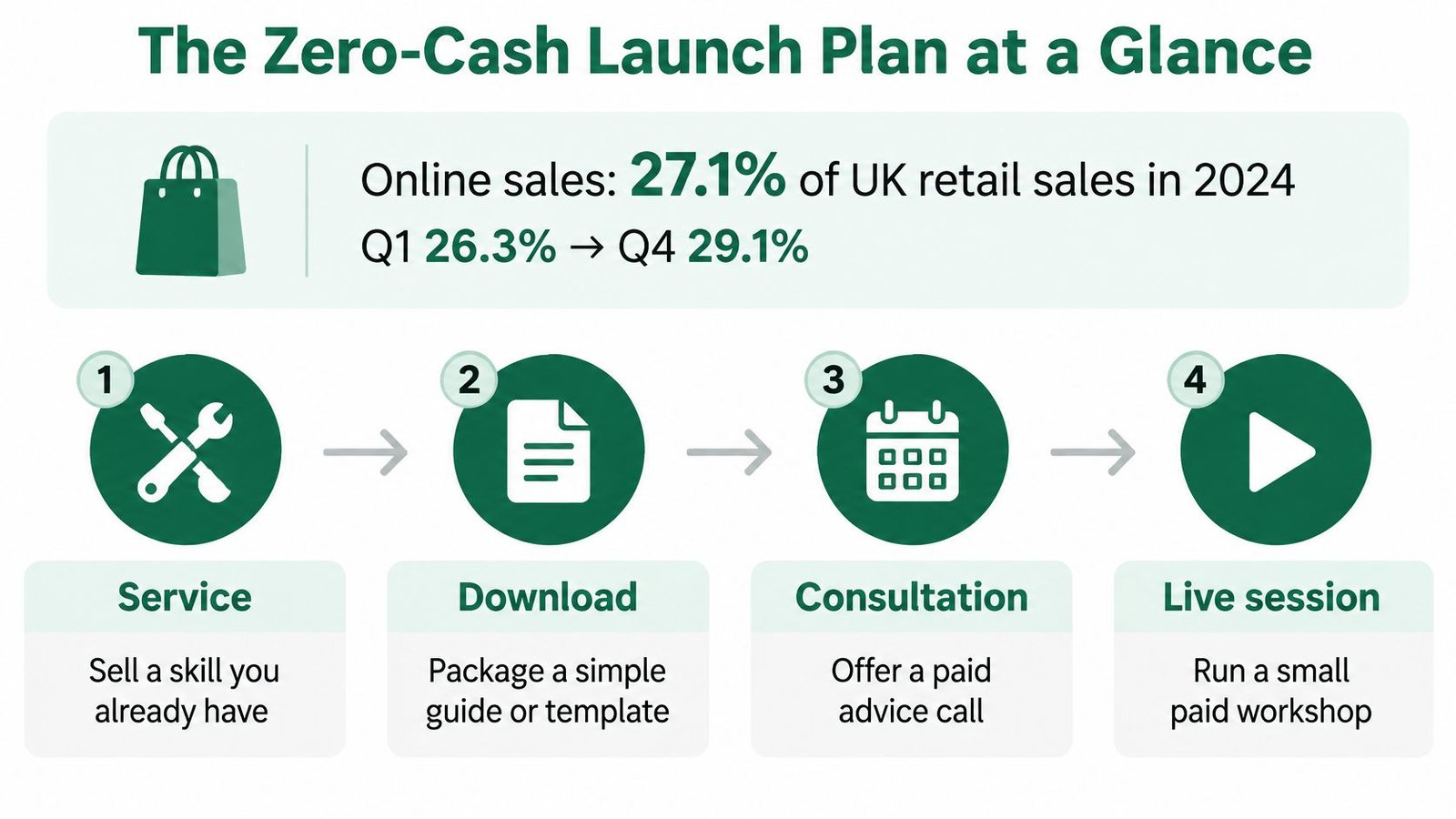
Each stage has a stopping condition, and that is the point. Stage three ends at five to ten paid orders, not at a thousand followers. Stage four ends when the last order is delivered and logged, including the hours each one took. Only stage five involves spending, and only after the numbers from the first four justify it.
Keeping stages one and two at zero isn't ideology. Most first offers don't sell, and the cheap way to learn that is an afternoon writing a scope, not a month buying stock. A single page that states price, inclusions, delivery time and cancellation terms does the job of a shop for one offer, and it takes minutes rather than weeks to put live.
Formalising the business comes later, once the activity justifies it. Sellers who later expand into other European markets, or who want to see how much heavier incorporation is elsewhere, can compare the process in a guide to register a company in Spain, where the steps and costs differ sharply from the UK sole-trader route.
How to Package a First Offer You Can Sell
Vague offers cause most early disputes. A buyer who can't tell what they're getting, when it arrives and what happens if it doesn't will ask for a refund, and they'll usually be right. Packaging the offer properly is the cheapest risk control available.
- List what people already pay you for. Write down every piece of work that has produced money, plus the things colleagues and friends ask for help with. Pick the one with the shortest delivery time and the clearest finish line, because that is the offer that can be tested this week.
- Name one buyer segment and one problem. "Freelance bookkeepers who need a one-off check of their VAT returns before a filing deadline" is a buyer and a problem. "Small businesses" is neither, and an offer aimed at them can't be priced or delivered predictably.
- Cap the deliverable. One 60-minute session, a five-page template, a ten-slide audit. A capped deliverable makes a fixed price possible and a refund argument unlikely.
- Write inclusions and exclusions together. List what the buyer gets, then list what they don't, including the number of revision rounds. Exclusions are the part sellers skip and the part that generates the awkward messages three days later.
- Price from time, then sanity-check the market. Estimate the hours, multiply by the rate the seller needs to earn, add third-party costs such as software or printing. Then look at comparable offers. If the number lands far below the market, the hours estimate is usually the thing that's wrong.
- Fix delivery time and cancellation terms before publishing. "Delivered within three working days of payment" beats "quick turnaround". Terms written before the first sale are terms; written after a complaint, they're an argument.
- Choose payment timing. Standard offers take full payment before delivery. Custom work takes a deposit, with the balance due at handover and both amounts stated in writing.
The usual slips are predictable. Unlimited revisions get promised to close a sale, a price gets quoted with no hours attached, and a delivery date gets agreed in a message thread that never reaches the offer page.
Treating the first five to ten paid orders as a controlled test rather than a launch is what keeps this stage cheap. Research cited by the UK Government's Backing Your Business evidence annex estimates that of 325,811 start-ups registered in 2020, only 47% survived to 2023, while just 2% reached £1 million turnover after three years. Committing cash before a buyer has committed any is a poor bet against those odds.
Track a short funnel through the test: qualified views, checkout starts, completed payments, delivery completion and refunds. If buyers keep asking the same question about scope, timing or support, the offer page is missing something, so rewrite it and run the test again. A detailed walkthrough of that positioning work sits in this guide to creating an irresistible offer.
Getting Paid Without Chasing Invoices
Payment risk sinks more no-budget sellers than weak reach does. Research cited by the UK Small Business Commissioner's survey of businesses with no employees found that 67.5% of self-employed people experienced late-payment issues in 2025, and 81.2% of those said the problem increased their stress. A solo seller with no cash buffer cannot absorb a three-month wait on an unpaid invoice.
Collection Controls to Set Before the First Sale
Full payment before access. For a download, a template or a booked session, the buyer pays and then receives. No exceptions, no "I'll send it once you've transferred".
A written deposit rule for custom work. State the deposit amount, what it secures and when the balance falls due. A deposit that only exists in a chat message isn't a deposit.
A recorded delivery date and revision limit. These were fixed when the offer was packaged. Put them on the offer page so the buyer reads them before paying, not after.
Extra requests quoted as separate paid orders. A scope change agreed in a message thread is the single most common route to unpaid work. Quote the addition, get acceptance, deliver it as its own order.
Completion evidence kept with each order. A delivered file, a session log, a signed-off draft. If a dispute arrives, evidence of delivery ends it quickly.
A named dispute route. Say who the buyer contacts, and how many working days a reply takes. A published route defuses most complaints before they escalate.
The Two Mistakes That Cost Most
Starting custom work before the deposit clears is the first. The second is accepting verbal changes to scope because the buyer seems reasonable and the relationship feels worth preserving. Both convert a priced offer into an open-ended favour.
Where a payment method or platform advertises its own buyer or seller protection, read exactly what it covers before relying on it. Protection is a backstop, never a substitute for written terms on the offer page. The mechanics of collecting money through a link are covered in this guide to creating a payment link.
Copy these lines onto the offer page before the first sale:
- Payment is taken in full before the file, session or booking is released.
- Custom work starts only once the stated deposit has cleared.
- Delivery happens within the stated working days of cleared payment.
- Revisions are limited to the number of rounds listed on this page.
- Additional work is quoted and paid as a separate order.
- Completion is recorded with a delivered file, log or sign-off.
- Disputes go to the contact address on this page, with a reply within the stated working days.
Finding Your First Five Paying Customers
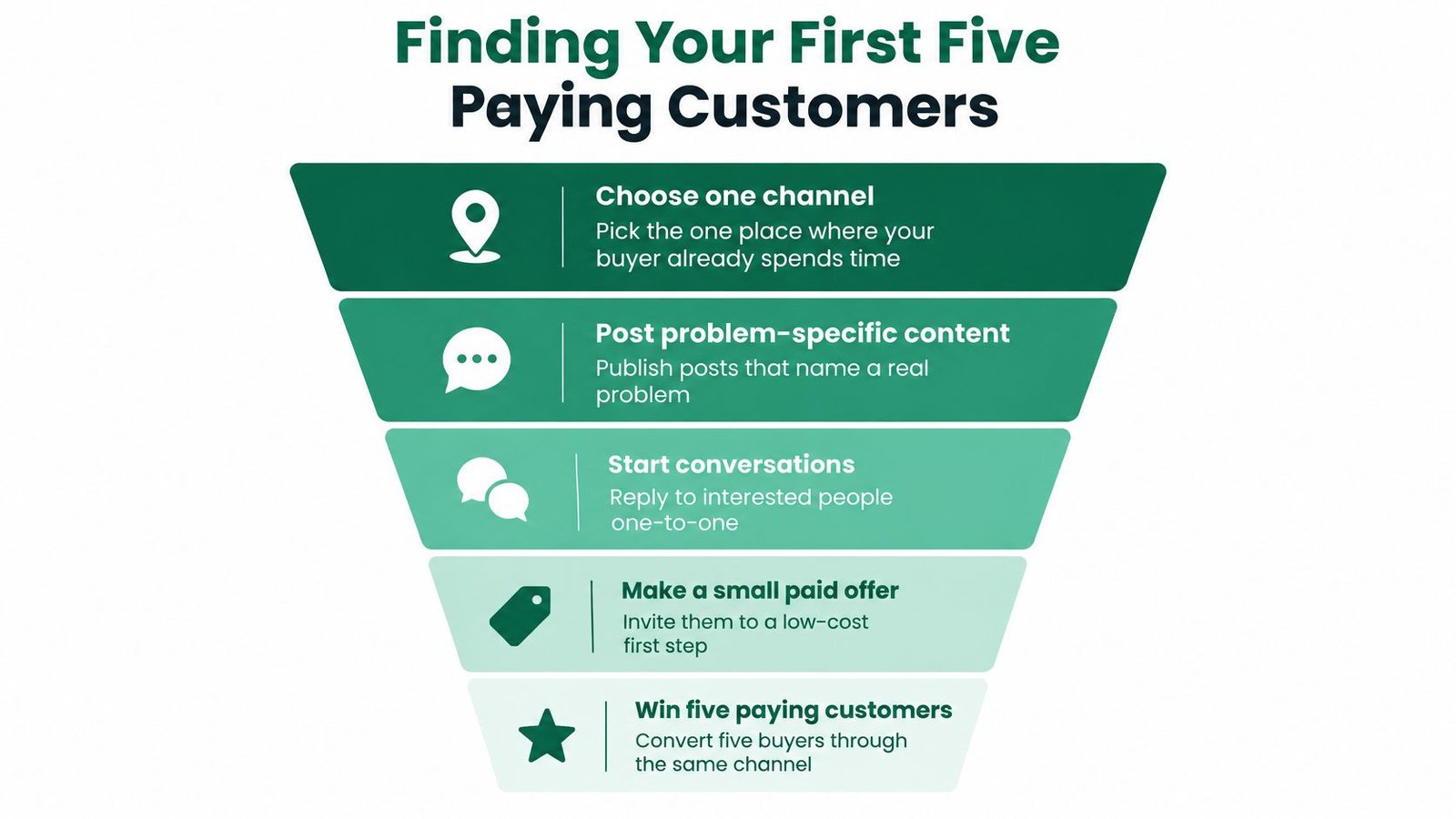
Pick one channel, and pick the one where the buyer already spends time. That's not a marketing preference; it's a measurement decision. Running three channels at once with no budget makes it impossible to tell which one produced the two orders that arrived. UK evidence reported by BT in a social commerce market databook found that 28% of small businesses identify social channels as their primary revenue driver, with a quarter using organic reach to drive sales and 22% using paid social posts.
One Channel, Read Properly
- Post problem-specific material. Short demonstrations, before-and-after examples, a quick teaching post that solves one narrow problem the buyer has this week. Generic motivational content sells nothing.
- Put one consistent offer link in the profile and in every relevant direct message. Price and scope should be one click away at all times, so a warm conversation never stalls waiting for details.
- Message people in the network who fit the segment. Ask whether they'd buy now, not whether they like the idea. The second question produces encouragement; the first produces orders.
- Answer repeated objections in public. Every question asked twice becomes an FAQ entry on the offer page.
- Review weekly by source. Link clicks, checkouts started, completed payments, average order value, and how many orders can realistically be fulfilled in the coming week.
What Counts as Evidence
A post with high impressions and zero completed checkouts has proved nothing. Completed payment is the only signal that counts. Reach, likes and comments cost nothing to give and therefore reveal nothing about willingness to pay.
Before promoting anything, set the operational guardrails: a maximum number of orders per week, a stated response time, a delivery checklist and a refund route, all carried over from the payment terms. Then keep an independent record of every buyer and their permission to follow up. Platform rules and algorithms change without notice, and a customer list held only inside someone else's app isn't a list the seller controls.
If organic channels stall, a roundup of free ways to advertise your business is worth reading, though the discipline of one channel and one measured funnel matters more than the length of the list.
Tax, VAT and Data Rules to Check Early
The trading allowance decides how much admin the first stage needs, so start there. Gross trading income of up to £1,000 in a tax year may qualify for the allowance, as GOV.UK's guidance on tax-free allowances for property and trading income sets out. Two details catch new sellers out. The test applies to gross receipts, not profit, so a seller who takes £900 and spends £600 on materials is still measuring the £900. And income from several activities, whether goods, downloads, services or paid sessions, is added together for that test, which means three small side ventures can cross the line faster than any one of them suggests.
A sole trader can begin trading without registering immediately, but must register for Self Assessment once business income exceeds £1,000 in a tax year, according to GOV.UK's guidance on becoming a sole trader. The tax year runs from 6 April to 5 April, which is the window that matters when timing a first launch. A launch in March and a launch in May can land in different tax years even though they are weeks apart.
VAT is a separate question and one that catches sellers who confuse turnover with profit. Registration becomes compulsory when taxable turnover exceeds £90,000 over the previous 12 months, or when it's expected to exceed £90,000 in the next 30 days, per GOV.UK's VAT threshold guidance. Turnover is the value of taxable supplies, not what's left after costs. Few no-money launches come close to this line, but the habit of checking monthly costs nothing and removes the risk of crossing it late.
| Rule | Threshold or fee | What it means for you |
|---|---|---|
| Trading allowance | Gross trading income up to £1,000 in a tax year | May qualify; income above this generally needs to be reported to HMRC |
| Self Assessment registration | Business income above £1,000 in a tax year | Register with HMRC once the threshold is passed |
| VAT registration (compulsory) | Taxable turnover above £90,000 over the previous 12 months, or expected above £90,000 in the next 30 days | Register for VAT; turnover is not profit |
| ICO data protection fee | £52 or £78 a year for most organisations | Check whether you must pay unless an exemption applies |
| ICO data protection fee (larger organisations) | Up to £3,763 a year | Applies to larger organisations depending on size and turnover |
Data protection is the third rule sellers tend to meet late. Anyone collecting names, email addresses or delivery details may need to pay the annual fee to the Information Commissioner's Office, which GOV.UK lists at £52 or £78 for most organisations and up to £3,763 for larger ones, unless an exemption applies. Before building a mailing list, map what's collected, why, who receives it and how long it's kept. Even a simple list of buyers with permission to follow up counts as personal data, so the mapping exercise takes minutes and settles the question.
Selling through a marketplace or social platform doesn't remove reporting duties either. GOV.UK's guidance on income from online platforms notes that income received this way may need reporting where the person is trading rather than selling unwanted possessions, and that it counts alongside other receipts. The distinction matters: clearing out a loft is one thing, making or sourcing items to sell is another.
What to Log From the First Sale
Keep one sales log with five columns: date, buyer, offer, gross amount received, and any related expense. That single sheet answers the gross-receipts test against the £1,000 allowance, feeds the VAT turnover check, and shows which offer is paying. A wider walkthrough of the first selling steps sits in this guide to how to start selling online in the UK.
Circumstances differ, cross-border sales add their own rules, and a qualified accountant is the right person to confirm a specific position once turnover starts moving. Sellers who expand beyond the UK face separate regimes entirely: the explainer on when your startup should register for VAT covers how the UAE handles registration timing, and every other destination market has its own equivalent. The practical rule for a UK launch is simpler. Record everything from day one, check the £1,000 position after every sale, and treat the admin as part of the offer's real cost rather than an afterthought.
Decide Whether to Reinvest, Pause or Scale Your First Offer
After the first ten sales, the funnel makes the decision. There are three outcomes and only one of them justifies spending money.
- Reinvest when five to ten paid orders were delivered on time, refunds were rare, and at least one buyer returned or referred someone. That's evidence, and it justifies spending on a better page, paid promotion or a small stock commitment.
- Revise when buyers keep asking the same question about scope, timing or support before they'll pay. Rewrite the offer page with the missing information and run the same test again. The demand is there; the description isn't.
- Pause when two focused weeks of outreach produce no paid orders. Keep the record. The log shows whether the problem was the channel, the price or the offer, and that's what makes the next attempt cheaper.
Before any reinvestment, check the formalities again. Confirm whether the trading allowance still covers the income or whether Self Assessment registration is now due. Track taxable turnover monthly rather than at year end, so VAT registration never arrives as a surprise.
The first concrete action is small. Publish one offer page for the validated offer showing price, inclusions, exclusions, delivery time and cancellation terms, put that single link in the profile and in direct messages, and keep every order in one record. AmaJova is one option among several for hosting that link: its OfferLink format holds the offer, price and fulfilment details, and the same link can be shared in a bio, in messages, by email or on an existing site. Check current features and fees directly before relying on any of them.
The rule that holds it together: a no-money launch works when every sale is paid for, clearly defined and recorded.
AmaJova is built for exactly this stage: one OfferLink that carries the offer, the price and the fulfilment details, with secure checkout and an order record attached to each sale, so scope and expectations sit in front of the buyer before they pay. If the plan above ends with a validated offer waiting to go live, that link is the next step. Visit AmaJova to create an OfferLink and start selling without building a website first.