
Most advice about how to create an irresistible offer starts in the wrong place. Add a bonus. Add a deadline. Stack a guarantee on top and watch the conversion rate climb. That approach assumes a buyer who is merely undecided. The buyers most sellers meet are sceptical: they've ordered something that arrived nothing like the photo, or found a monthly charge they don't remember agreeing to. Persuasion built for the undecided can lose the sceptical.
An offer becomes irresistible when a cautious person can accept it without asking a follow-up question. What exactly do I get, when, for how much, and what happens if it goes wrong? Answer those four in writing and the bonus stack becomes optional decoration. Leave them unanswered and no discount rescues it.
Table of Contents
- The Irresistible Offer Framework at a Glance
- Pin Down the Buyer, Outcome and Scope
- Price the Offer and Set Clear Expectations
- Add the Trust Layer That Removes Buyer Risk
- Present the Offer and Test Every Step
- Common Offer Problems and How to Fix Them
- Turn Your Plan into a Live Offer
The Irresistible Offer Framework at a Glance
An irresistible offer is a specific promise, fairly priced and backed by evidence, that a buyer can accept on the spot. Six components do the work, and they run in a fixed order because each one constrains the next.
- One buyer, one outcome. A narrow promise outperforms a broad one because the buyer recognises themselves in it.
- Inclusions, exclusions, fulfilment. What's in, what's out, when it lands.
- Price and terms. Total cost, revision limits, cancellation and rescheduling rules.
- Proof and trust signals. Evidence you can deliver, plus a visible route to support.
- One clear page. Everything the buyer needs sitting beside the purchase button.
- Test and refine. Measure each step of the funnel and change one variable at a time.
Here is the blueprint filled in for a single offer, a £250 VAT consultation aimed at sole traders registering for VAT for the first time. Copy the structure into a planning document and complete every row for your own offer before writing a word of sales copy.
| Offer component | What to specify | Worked example |
|---|---|---|
| Promise | One specific outcome with a timeframe | 60-minute VAT consultation plus a written action plan within 24 hours |
| Buyer | Who the offer is for and their situation | Sole traders registering for VAT for the first time |
| Inclusions | Everything the buyer receives | Live call, session recording, action plan, five-day email follow-up |
| Exclusions | What is not covered | Ongoing tax filing, overseas registrations, extra revision rounds |
| Price | Total cost and what it covers | £250 in total, covering the call, recording, action plan and five-day follow-up |
| Delivery or booking | When and how fulfilment happens | Bookable slots Tuesday to Thursday, plan emailed by the next day |
| Proof | Evidence the seller can deliver | Three named client results, visible seller identity, reviews from genuine buyers, visible support route |
| If it goes wrong | Remedy and response time | Reply within one working day, rewrite or refund of the plan fee |
A blank row is a question the buyer will ask at checkout, and most answer it by leaving. Fill it in now, even roughly. A crude answer beats a missing one.
Pin Down the Buyer, Outcome and Scope
Six actions take the offer from idea to specification.
1. Describe one buyer in a single sentence. Not "small businesses" but "new Etsy sellers who freeze when pricing their first product". The sentence should be specific enough that a reader either thinks "that's me" or knows the offer isn't for them. Both outcomes save time.
2. Name a verifiable outcome, not an activity. "Pricing help" is an activity. "A priced product catalogue with a margin per item" is something the buyer can hold at the end. If you can't describe what physically exists after delivery, the offer isn't finished.
3. Split the promise into three layers. The seller-controlled deliverable, the buyer's responsibility, and the milestone that proves progress. A coaching offer can promise a completed 90-day plan and a feedback call, not a guaranteed income increase. A live workshop can promise the curriculum, the recording and a Q&A, not a specific business result. Keeping the layers separate is also how you stay honest: GOV.UK's explanation of the Consumer Rights Act 2015 sets out that services must match what was agreed and be performed with reasonable care and skill, so promise what you control and label the rest as the buyer's part.
4. Write inclusions in the buyer's language. Item by item, in the words they'd use. "The recording of the call" rather than "access to resources". A structured way to draft that section is covered in this guide to writing a service description that buyers understand.
5. Write the exclusions before the marketing copy. Boundaries are what make a promise believable. Say what you won't do, what isn't covered, and what happens if the buyer misses a deadline you've set.
6. State fulfilment concretely. Format, dates or booking windows, access length, delivery method. "Bookable slots Tuesday to Thursday, plan emailed by the next day" leaves nothing to interpretation.
Practical rule: if the buyer has to ask what happens after payment, the scope isn't finished.
Buyers are warier than they were a decade ago, and vague access is now a liability. Barclays' research into the subscription economy reported that UK consumers held 155 million active subscriptions by the end of 2024, with nearly 10 million considered unwanted and costing £1.6 billion annually. More included is not automatically more attractive. Unnecessary bonuses and fuzzy access terms add perceived risk.
Written as a reusable spec, any offer reads like this. For [buyer] who [situation], the offer delivers [deliverable] by [date or window]. The buyer supplies [inputs] by [deadline]. Progress shows up as [milestone or artefact]. Excluded: [items]. Price is [total, plus unit], with [revision limits] and [cancellation terms]. That paragraph works for a service, a physical product, a download or a live session. If coaching is the offer you're filling in, filling your coaching calendar consistently handles demand; the spec handles what happens once someone arrives.
Price the Offer and Set Clear Expectations
Anchor the price to the outcome, not to your hours. If a registration mistake costs a sole trader a penalty and a week of admin, a £250 consultation is priced against that cost, not against the two hours it takes to prepare. Look at what buyers already pay for the alternatives: an accountant's hourly rate, a bookkeeping subscription, a course they never finish. The number you can defend out loud is the one that survives comparison. If you're still deciding between hourly, project and outcome-based fees, this guide to how to price your services sets out the trade-offs.
Build three versions of the same promise.
| Tier | What it adds | Best for | Pricing logic |
|---|---|---|---|
| Entry | Shorter scope or self-serve format | Cautious first-time buyers | Low ticket that covers delivery cost and filters for intent |
| Core | The full promised outcome at standard timing | Most of your audience | Target margin at a price the outcome plainly justifies |
| Premium | Speed, priority access, extra review, risk reduction | Buyers with deadlines or high stakes | Priced above core where speed or lower risk is worth more to the buyer; test against real demand |
Express price as a comparable unit wherever the offer allows it: per session, per deliverable, per licence, per participant. The GOV.UK analysis of unit pricing and consumer research found that unit pricing helps shoppers compare relative value across differently sized products, which is exactly what a buyer is trying to do with your tiers. The same source reports UK pricing research from the British Retail Consortium finding that 73% of surveyed UK shoppers were more influenced by price than brand names, and that one-third of UK retailers sat outside their pricing sweet spot. Positioning is a testable decision, not an instinct.
Diagnostic: if visitors reach checkout and don't pay, test clearer inclusions, proof, timing and total-cost disclosure before you touch the price.
Then set the terms in plain English: the total payable amount and what it covers, delivery or booking timing, revision limits, cancellation and rescheduling rules. Digital offers need format, access duration and compatibility stated before payment. A comparison of how to price SaaS products is useful for tier logic, though the principle transfers: separate what buyers pay for from what it costs you to deliver.
What the Legal and Tax Note Should Say
Under the Consumer Rights Act 2015, the trader's description forms part of the contract, so a digital product must match what you said it would be; the legislation.gov.uk text of the Act is the primary reference. Avoid "complete access" when you mean selected modules.
VAT depends on the buyer's location and the nature of the supply. HMRC's guidance on VAT for digital services to private consumers explains that supplies to UK consumers are generally liable to UK VAT, supplies to consumers outside the UK may be liable in the customer's country, and a marketplace may account for the VAT instead of the seller. Don't print "VAT included" until you've confirmed your own position.
Add the Trust Layer That Removes Buyer Risk
Most offer frameworks treat trust as a closing technique: a guarantee, a badge, a row of stars. For UK buyers it's closer to infrastructure. A promise is only as persuasive as the buyer's belief that you'll deliver it, and belief comes from specifics rather than enthusiasm.
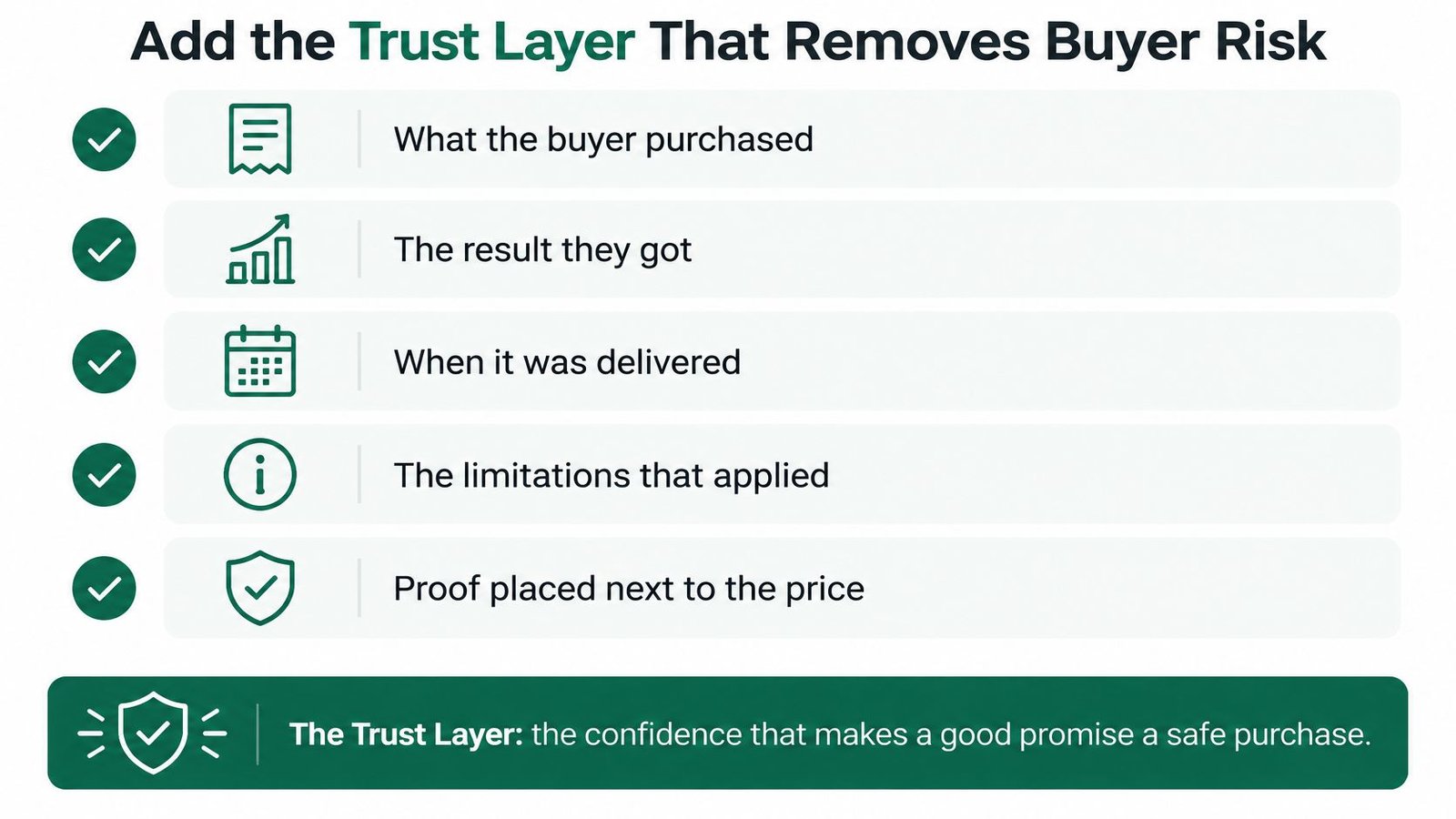
1. Make the proof specific. A five-star rating says someone was happy. A useful testimonial says what the buyer purchased, what result they got, when it was delivered and which limitations applied. "The VAT registration went through in nine days and the action plan flagged two things I'd have missed" beats "great service" every time.
2. Show who you are. Seller identity, any verification signals, and a support route that doesn't disappear after payment. Buyers check.
3. State what happens when something goes wrong. How to report a problem, how fast you reply, and what remedy you'll offer. "Reply within one working day, rewrite or refund the plan fee" is a confidence layer in one line. The buyer protection resources that sit behind a structured checkout explain how a problem is reported and what happens next.
4. Put FAQs and recurring-payment status on the offer page. Not in a policy document three clicks away. A structured offer page carries inclusions, terms, seller details, reviews and support links in one place, which is the design AmaJova uses: buyers can review what's included, delivery information and relevant terms before paying, and an OfferLink can show seller details, customer reviews where available and support information.
5. Drop the pressure tactics. Fake countdowns, hidden subscriptions and vague access claims read as concealment. The evidence is blunt: National Trading Standards reported in 2025 that 38% of surveyed UK adults had unknowingly signed up to a subscription, with 23% of that group still paying for one, and 44% had ordered an online item that turned out to be poor quality or fake.
Proof has to be authentic, and it has to say where it came from. In the Competition and Markets Authority's review of online reviews and endorsements, between 76% and 80% of consumers across six sectors who had used reviews before purchasing said it was very or fairly likely those reviews came from genuine consumers. Publish only reviews from real buyers, and state how they were collected.
A checklist for the draft in front of you:
- Say what was bought. The item, session or licence, named plainly.
- Show the result. Specific, with the timeframe attached.
- Date the delivery. When it arrived.
- State the limits. What the buyer's situation didn't cover.
- Put proof next to the price. Not at the bottom of a page buyers scroll past.
Present the Offer and Test Every Step
An offer isn't live until a stranger can act on it in under two minutes on a phone. Assemble the promise, inclusions, price, timing, proof and FAQ on one page, then put the money details where the decision happens.
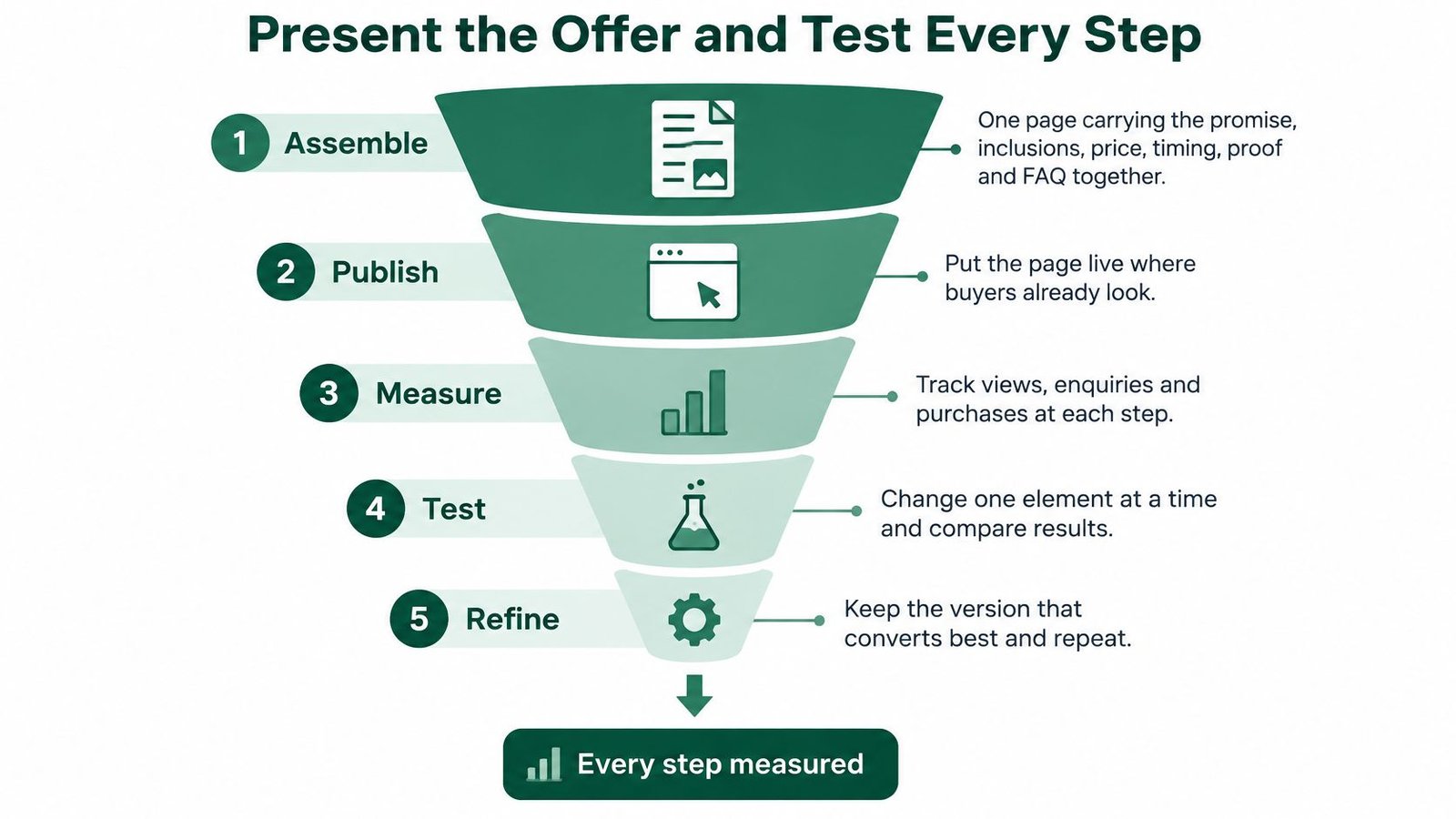
1. Assemble one page, not five. A buyer who has to open a policy tab to find the delivery window closes both tabs. Publishing doesn't require a website build either: an OfferLink can be created without a website and go live in minutes, so a first version can be tested this week rather than next quarter.
2. Put total cost, timing and payment methods beside the buy button. The final amount, any taxes or fees, accepted payment methods, delivery or access timing and the support route belong next to the purchase action. Baymard's cart abandonment research reports that roughly 7 in 10 online carts are abandoned, with extra costs too high (40%), slow delivery (20%) and distrust of card security (19%) among the stated causes.
3. Cut the friction you've added yourself. No forced account creation, minimum required fields, and a checkout that works on a phone. Every extra field is a small tax on a decision the buyer is already unsure about.
4. Track five stages. Offer views, checkout starts, payment attempts, successful payments, fulfilment completion, plus refunds and disputes. Segment by device, traffic source, offer type, price band and payment method. A rising checkout-start rate with rising payment failures isn't progress.
5. Change one variable at a time, in this order. Disclose fees and timing first. Then widen payment options: PayPal's UK research with the British Retail Consortium found that 24% of UK consumers have abandoned an online purchase or payment because their preferred payment method wasn't available. Then simplify fields and tighten the reassurance copy.
Working loop: publish, measure, change one thing, compare. The funnel is the feedback mechanism, and the diagnosis is the next step.
The terms you set in the previous stage belong beside the button, in the same words: a timezone and rescheduling window for a live session, a file format and access duration for a download.
Common Offer Problems and How to Fix Them
Read the draft as a sceptical buyer who has been disappointed before, then work through the symptoms below. Each one points at a specific element to change.
| Symptom | Likely cause | Fix |
|---|---|---|
| Views but no checkout starts | Promise too vague or proof missing | Rewrite the headline as one outcome and add a specific named result |
| Checkout starts but no payment | Cost surprise or weak trust | Show total price, fees and payment methods beside the buy button |
| Same questions before every sale | Inclusions or timing unclear | Move the answers into FAQs and boundaries on the offer page |
| Refunds or disputes after delivery | Expectation gap | Restate scope before payment and confirm buyer responsibilities in writing |
| Offer feels ignored | Price-to-value mismatch | Test a smaller entry tier and a comparable unit price |
| Buyers hesitate at the price | No risk reduction | Add specific proof and a clear remedy if delivery fails |
Checkout friction does real damage. 77% of UK consumers surveyed in 2024 said they were likely to abandon a purchase if checkout was too difficult or time-consuming, according to Forter's 2024 Consumer Trust Premium Report.
Three habits shorten the repair cycle. Sell one outcome per offer, because bundled extras dilute the promise and give the buyer more to evaluate. Write the exclusion line before the marketing copy, since boundaries are what make the promise credible. Re-test after every meaningful change rather than rewriting the whole page at once, or you'll never know which edit did the work.
Every symptom is feedback about clarity, not a verdict on the product.
Turn Your Plan into a Live Offer
- Fill in the blueprint table for your main offer, one row at a time.
- Draft the entry, core and premium versions, and set the unit price for each.
- Add proof, FAQs, boundaries and the remedy if delivery fails.
- Publish on a single page that shows price, inclusions, fulfilment and payment together.
- Share the link where your audience already gathers: your bio, messages, email, an existing site.
- After the first 20 to 30 visits, find the weakest funnel step and fix only that one.
The structure holds whatever you sell. AmaJova lets sellers offer services, physical products, digital products and live sessions through one OfferLink, and an OfferLink brings the offer, price, seller information, fulfilment details and a secure way to pay into one place. If a funnel needs more than a single page behind it, this guide to step-by-step sales funnel setup covers the surrounding sequence.
Run the repeat-back test before you publish. Ask someone unfamiliar with your business to read the page once, then tell you what they get, when they get it, how much it costs and what happens if it goes wrong. Four clean answers mean the offer is ready.
AmaJova turns a service, physical product, digital product or live session into a single OfferLink that holds the promise, the inclusions, the price, the fulfilment details and a secure checkout in one place. If working through the blueprint has exposed gaps in your offer, the fastest way to close them is to build the page exactly as described and watch where buyers stop. Visit AmaJova to create your first OfferLink and publish it without building a website.