

A seller has finished a service listing, added an image and set a price. Then a buyer sends a message asking whether the offer includes a call, when the work arrives and how many changes are allowed. The description sounds professional, but it hasn't answered the questions needed to buy.
Learning how to write a service description starts with treating it as a pre-purchase specification, not a sales pitch. Buyers need to compare the deliverables, effort, timing and total cost. The same discipline helps sellers describe physical products, downloads and live sessions, although each needs different delivery and access details.
Table of Contents
- Build the Service Description in Eight Steps
- Replace Vague Wording with Checkable Details
- Spell Out Boundaries, Extras and Price
- Fix Common Problems Before Buyers Notice
- Test and Publish the Description
- Set Cancellation, Consent and Complaint Wording
Build the Service Description in Eight Steps
OfferLink fields and what to write in each
| Field | Limit or format | What to write | Example |
|---|---|---|---|
| Title | Short and plain, within the current 51-character limit | Outcome and format | 60-minute listing review for candle makers |
| Short description | One or two sentences, within the current 80-character limit | Who it is for and the result | For small candle makers who want clearer product pages |
| Full description | Short paragraphs | The eight steps below, in order | Outcome, audience, problem, inclusions, timing, responsibilities, boundaries, price and next action |
| Inclusions | Quantified list | Deliverables with counts and formats | One 60-minute video call; written review of up to 10 listings; five rewritten titles |
| Boundaries | Named exclusions | What is not covered | Photography, paid advertising, account setup |
| Optional extras | Priced add-ons | Each extra with its price and trigger | Rush delivery at a stated additional fee, requested before the first call |
| FAQs | Three to five questions | Questions already answered in messages | Booking process and material needed before the call |
| Price | Single price, stated with tax status | Price and what it covers | One price in pounds, stating whether VAT is included |
AmaJova's current seller offer builder limits titles to 51 characters and short descriptions to 80 characters. In step one, sellers add images, a description, their price and the details the buyer needs; the table gives a practical writing structure rather than a reason to fill every field with promotional language.
The Government Statistical Service's user-engagement guidance recommends simple, conversational language and concise messages without jargon. A task-first description applies that principle by explaining the purchase before selling its benefits.
A worked candle-maker offer
The following is a hypothetical listing review, with example quantities and deadlines rather than recommended industry standards.
Start with the outcome. The buyer receives a rewritten product page and five priority changes. That promise must appear in the deliverables too, otherwise the opening offers work that the detailed specification never includes.
Name the buyer. The service suits independent candle makers with fewer than 50 listings. A clear fit statement helps larger shops recognise that their catalogue needs a different scope.
Describe the problem plainly. The maker's product pages receive few clicks, or shoppers struggle to distinguish the candles. The service addresses listing clarity, without promising a particular sales result.
Count the inclusions. The package includes one 60-minute video call, a written review of up to 10 listings, five rewritten titles and one rewritten product page. Written work arrives in a shared document.
Give the delivery sequence. The call takes place within 10 working days of payment, and the written review arrives within three working days after the call. Separating those milestones prevents confusion about whether the whole package arrives before the meeting.
State the buyer's responsibilities. The maker sends listing links and the last three months of sales figures 48 hours before the call. The description must also explain what happens if those materials arrive late.
Draw the boundary. Photography, paid advertising and account setup aren't included. The seller reviews and rewrites the agreed material, rather than taking over the shop.
Finish with price and action. The offer shows one total price and a booking button, followed by instructions explaining how the buyer arranges the call after payment. Any response deadline belongs beside those instructions.
Keep the promise consistent
A buyer should be able to explain what arrives and when without contacting the seller. For services, the seller completes the agreed work and submits delivery or completion details through the order.
The practical guide to selling services online helps connect this written specification to the wider selling process. The description should still stand on its own, without requiring buyers to follow another page to understand the purchase.
Replace Vague Wording with Checkable Details
Bespoke strategic support sounds substantial, but buyers can interpret it as anything from a brief conversation to ongoing implementation. The replacement needs to identify something a buyer can picture, count or check after delivery.
Plain wording also makes an offer more accessible. GOV.UK's clear-language guidance reports that 1 in 6 adults in England have very poor literacy skills, supporting the use of everyday language rather than unexplained specialist terms.
Replace impressions with commitments
The following are illustrative rewrites, not default service levels. Each seller needs to choose commitments that fit the actual work.
Vague phrases and checkable rewrites
| Vague phrase | Checkable version | What the buyer can confirm |
|---|---|---|
| Bespoke strategic support | 60-minute video consultation plus a two-page action plan within three working days | Number of sessions, length and deadline |
| Fast turnaround | First draft within five working days of receiving the files | A date the buyer can plan around |
| Unlimited revisions | Two revision rounds, requested within seven days of delivery | The limit on changes |
| Premium support | Email replies within one working day, Monday to Friday | The response time |
| Comprehensive guide | 24-page PDF with six worksheets | The size and contents of the deliverable |
| Expert feedback | Written review of up to 10 listings within three working days of the call | The scope and deadline of the review |
A checkable rewrite isn't necessarily longer. Email support until handover gives a clearer boundary than dedicated ongoing assistance, even though both are short.
Sellers often retain vague wording because they want an offer to sound premium, or because they haven't decided where the work ends. Neither problem can be solved by adding stronger adjectives. The seller must decide what gets delivered before polishing the sentence.
Practical rule: If a buyer can't identify the deliverable, deadline or limit, the wording still needs work.
Specificity needs judgement too. Page count can describe a download's size, but it doesn't establish its usefulness; the description should also name the tasks the worksheets help complete. Similarly, a call duration explains the time purchased, not the outcome guaranteed.
Every rewrite becomes a promise. A seller who can't reliably provide the example revision allowance should choose a narrower limit, explain what constitutes a revision and distinguish corrections from a new brief. Clear limits are more useful than impressive commitments that won't survive delivery.
Spell Out Boundaries, Extras and Price
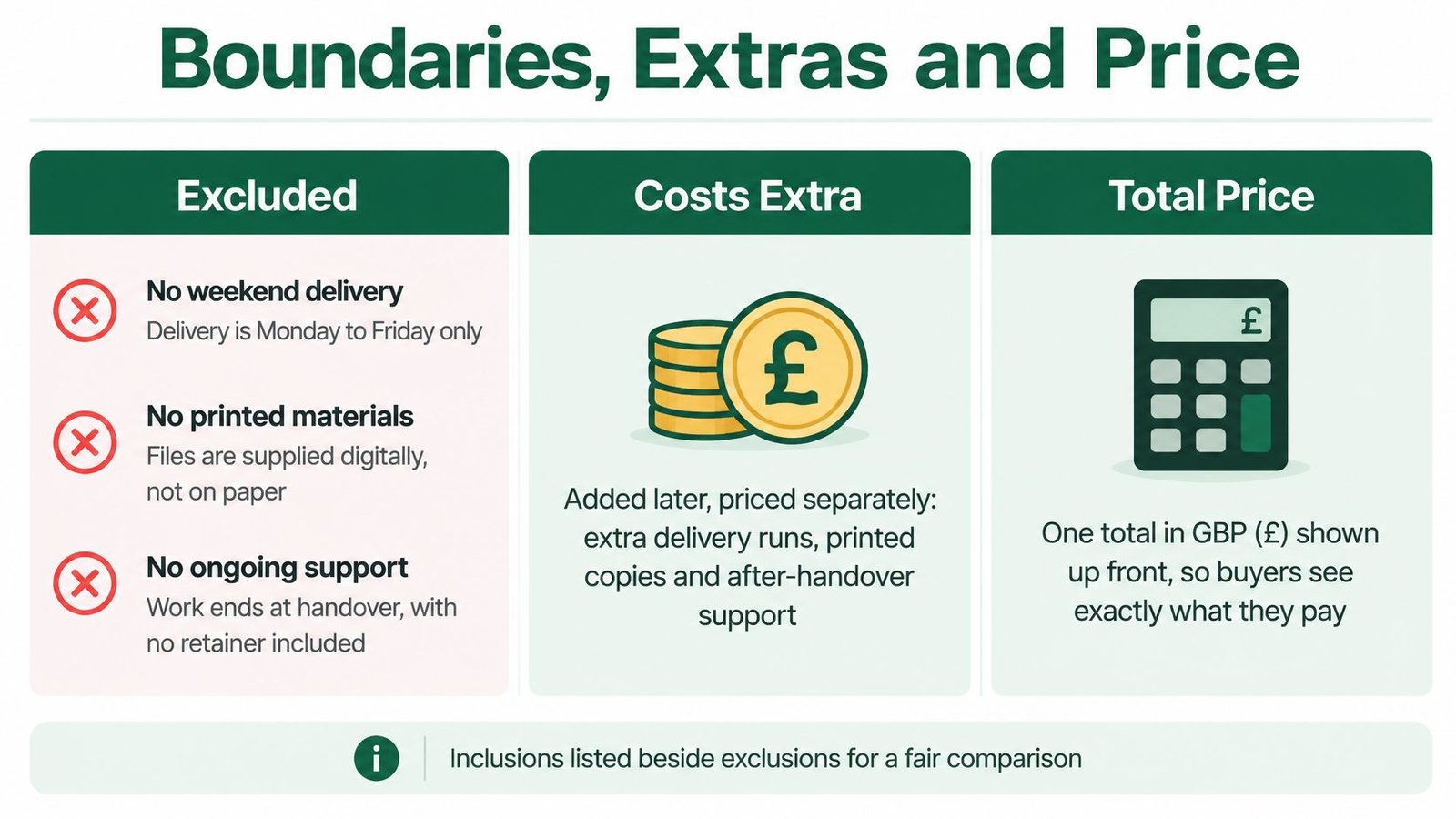
Put exclusions beside inclusions, not in a message sent after payment. For the candle-maker review, the boundaries list should explicitly exclude photography, paid advertising and account setup.
A buyer comparing providers needs to see what each price covers. A cheaper review without implementation isn't directly equivalent to a package that includes uploading the finished copy.
Make extras separate decisions
Each optional extra needs its own price and trigger. Rush delivery, for example, should state that it must be requested before the first call, with availability confirmed before the buyer pays for it.
- Extra scope: Identify the additional deliverable rather than describing it as more support.
- Trigger: Explain which request moves the work outside the original package.
- Approval: Obtain agreement to the extra charge before starting that work.
For site-dependent work, a quotation may be more honest than a fixed package. A business comparing cleaning proposals could request a free commercial cleaning quote from Sweet Home Cleaning Service, then compare the proposed tasks, exclusions and schedule rather than the headline alone.
Show the amount payable
For UK online sales, GOV.UK's distance-selling guidance says sellers must provide clear information including their business identity, contact details and address, the service description, tax-inclusive price and payment arrangements. Relevant contract length, billing and termination details also need to be clear, with information supplied in a format the customer can save.
Show one offer price in pounds and state its tax treatment accurately. The guide to pricing services can help sellers assess the commercial side without disguising extra work inside an ambiguous package.
With AmaJova's seller absorbing the Buyer Service Fee, a £100.00 offer costs the buyer £100.00. When the seller passes that fee on, it is shown clearly before the buyer confirms payment.
Applicable fees can change, so sellers should check their current account terms before publishing. The final comparison should place the inclusions, exclusions, extras and total side by side, with no contradictory promises.
Fix Common Problems Before Buyers Notice
A message asking how delivery works is a useful diagnostic: the buyer hasn't found a complete sequence on the offer page. Replying resolves that enquiry, but editing the description prevents the same gap affecting the next buyer.
The causes are often small. A missing handover step or an extra mentioned only in conversation can change how a buyer understands the entire purchase.
Common problems, causes and fixes
| Problem | Likely cause | Fix |
|---|---|---|
| Buyers keep asking how delivery works | No step-by-step delivery or completion details | Add a What happens after purchase block with each step and its timing |
| Scope disputes after payment | Exclusions never written down | List at least three named exclusions beside the inclusions |
| Surprise charges | Extras mentioned only in conversation | Price every extra on the offer page with its trigger |
| Buyers hesitate at the booking form | No privacy information near the form | Link a service-specific privacy notice next to the form |
| Turnaround misread | Vague words such as fast or soon | Give a number of working days from a named start point |
Explain personal information at collection
Privacy needs more than a reassuring sentence about taking security seriously. Buyers should understand why a booking form requests information and what happens after submission.
GOV.UK's guidance on collecting personal information recommends a service-specific privacy notice, available throughout the service rather than hidden inside general terms. It should explain the processing steps, purpose, legal basis, retention period or how it is decided, controller identity and relevant sharing with other organisations.
For the candle-maker review, the form should explain why sales figures are requested. The seller should request only relevant material and make clear whether aggregated figures are sufficient, rather than encouraging unnecessary customer-level information.
A privacy summary should explain the actual process, not make broader promises than the seller can substantiate.
Place the privacy link beside the form and summarise the relevant use in plain English on the offer page. The summary doesn't replace the full notice.
After publication, sellers can keep a simple enquiry log organised by delivery, scope, price, access and changes. A useful editorial rule is to move a question into the main description once it has appeared repeatedly, rather than letting essential information accumulate in private replies.
Test and Publish the Description
A seller knows the offer too well to spot every ambiguity. A reader who hasn't helped create it is better placed to reveal missing assumptions, particularly when viewing the page on a phone.
The test should examine comprehension, not whether the reader likes the wording. A polished description can still leave the buyer unsure about the purchase.

Run a practical reading test
A useful small test involves five prospective buyers, treated as a working exercise rather than a statistically representative sample. Each reads the offer without help, then explains:
- Deliverables: What the purchase includes.
- Timing: When the work or access arrives.
- Preparation: What the buyer must supply.
- Exclusions: What the seller won't provide.
- Changes: What happens if plans change.
Record incorrect interpretations and information that takes too long to locate. Disagreement between readers usually calls for a wording change, not an explanation from the seller during the test.
Check the published version
The final review should compare the title, summary, full description and confirmation wording. Session lengths must match, deadlines need the same starting point and optional extras must remain visibly separate from the base offer.
For physical products, the equivalent check covers the item, quantity and delivery arrangements. For digital products it covers format and access; for live sessions it covers booking instructions and the scheduled service.
AmaJova requires the seller to review a completed draft before publication. In step two, sellers share their OfferLink, a single link, on social profiles, in messages or wherever customers find them.
A concrete task for this week is to select a live offer, rewrite its title, inclusions and boundaries, and test the result with prospective buyers before sharing the revised page.
Set Cancellation, Consent and Complaint Wording
Cancellation and complaint terms need to describe what happens, not just state that terms apply. The offer, purchasing process and saved confirmation should agree about the customer's route to cancel, any applicable rights and the handling of complaints.
Under the Consumer Contracts Regulations 2013, traders must provide the required pre-contract information clearly and comprehensibly before a UK consumer is bound by a distance contract, provide the prescribed cancellation form where a cancellation right exists, and confirm the contract within a reasonable time after it is concluded. The precise requirements depend on the transaction and applicable exceptions.
Separate service cancellation from digital consent
A service description should identify the cancellation method and explain the applicable position if work begins before cancellation. It should also distinguish cancellation from rescheduling, since changing a session date isn't necessarily the same request as ending the contract.
Digital content needs particular care. GOV.UK's online-selling guidance explains that supplying downloadable or streamed digital content during the 14-day cancellation period requires the customer's express agreement and acknowledgement that starting supply causes the cancellation right to be lost, with those details included in the confirmation.
A sentence on the offer page isn't a substitute for recording the required consent. Sellers should check that their actual checkout and confirmation process support the wording, without assuming that immediate access automatically removes cancellation rights.
Give complaints a usable route
A clear complaint process identifies where the customer should write, what order information helps locate the purchase and the response commitment the seller can maintain.
- Contact route: Name the monitored email address or order-support channel.
- Response commitment: Distinguish acknowledgement from a completed investigation.
- Record: Preserve the complaint and agreed resolution alongside the order information.
Tools described as AI chat answering leads in seconds, from Expressify AI, may be relevant when evaluating enquiry handling. Any automated answer about cancellation or refunds still needs to match the seller's actual terms and provide a route for unresolved cases.
A UK service agreement template can help organise contractual wording, but it needs adapting to the actual service. These points are general information, not definitive legal advice: consumer status, product type and jurisdiction can change the position, and complex contracts warrant professional advice.
AmaJova offers structured OfferLinks for services, physical products, digital products and live sessions, helping sellers present the purchase and its expectations before payment. Visit AmaJova to build an offer around clear inclusions, realistic delivery details and a price buyers can understand.