
The track is finished. The artwork is sitting in a folder, the distributor has given you a release date three weeks out, and then a message arrives from someone who heard the set at a small venue asking where they can buy the track. That question is where most music businesses start, and it's also where a lot of releases stall, because streaming platforms have a play button and no checkout.
Working out how to sell your music online is less about choosing a storefront than about deciding what a buyer receives, when they receive it, and what they're allowed to do with it afterwards. The sales page, the consent step, the delivery terms and the order record are one continuous system. Get the sequence right and every part of it makes the next part easier.
Table of Contents
- Choose What You Sell Before You Pick a Platform
- Clear Your Rights and Prepare Files Buyers Can Use
- Price Your Offer and Check the UK Tax Position
- Build a Sales Page and Secure Checkout
- Deliver Files, Physical Orders and Refund Requests
- Promote One Link Without Chasing Streams
- Keep Records That Prove Each Sale
Choose What You Sell Before You Pick a Platform
Five formats cover most first releases, and each one changes what has to be written down before anything goes live. A download is a file transfer. A licence is a permission. A physical release is a manufacturing and shipping job. A session is booked time. A commission is a piece of work with an end date. Mixing those promises on one page without separating them is how refund arguments begin.
| Offer | What the buyer receives | Delivery | Rights to clear |
|---|---|---|---|
| Digital download (track or album) | Audio file, with optional lossless upgrade | Automatic download or access link | Your masters and every co-writer's share |
| Beat or instrumental licence | Audio file plus written licence terms | Download after payment | Sample clearance and the scope of the licence |
| Physical release (CD or vinyl) | Manufactured item | Shipped, with timing stated before ordering | Manufacturing, distribution and label rights |
| Live or online session | Booked time such as a lesson, Q&A or performance | Scheduled session link | Any platform or venue terms that apply |
| Custom commission (personalised song) | Written or recorded piece | Delivered by an agreed date | Who owns the composition after delivery |
The market context narrows the choice. BPI's recorded music market report puts UK recorded-music revenue at £1.49 billion in 2024, up 4.8% on 2023, with streaming taking 68.1% of the total. Digital-download revenue fell 6.6% to £24.3 million, the second consecutive annual decline.
Read that correctly and it isn't an argument against selling files. It's an argument against selling files as the only move. Streaming does the discovery work, because that's where listeners already are. The paid offer does the earning, because a stream pays a fraction of a penny while a WAV download, a signed vinyl copy or a paid lesson pays a price you set.
Practical rule: Streams buy attention. Owned products and services buy groceries.
Say a songwriter has one finished single plus an alternate stripped-back version. The streaming release goes to every platform with a pre-save link. The paid offer is one bundle: the WAV master of both versions, a lyric sheet PDF and a short production note, delivered as an immediate download after payment. Same audience, two jobs. The streaming links stay on the page as the free option, so nobody leaves with nothing. Where those listeners come from is a separate decision, and 10 discovery options for artists is a useful shortlist of playlists, blogs and sync routes to work through before the release date.
Before publishing anything, write down three things. The one promise the buyer is paying for. The date and method of delivery. The rights you hold. If any of the three is missing, the format isn't ready, however good the music is.
Clear Your Rights and Prepare Files Buyers Can Use
Nothing else is safe to sell until ownership is settled. A checkout does not create rights, and a platform page does not prove you own the recording you've uploaded. Work through these in order.
- Confirm ownership in writing. Who owns the sound recording and who owns the composition, agreed with every collaborator before distribution rather than after the first payment.
- Deal with samples. Anything borrowed needs permission or a licence, cleared before release. An uncleared four-bar loop can unravel an entire catalogue later.
- Get identifiers right. Obtain or verify ISRC codes for recordings, and register works with the relevant UK collection and neighbouring-rights organisations.
- Export the master properly. WAV at 24-bit, 44.1 kHz or higher, with an untouched archive copy stored somewhere that isn't your working drive.
- Make a preview. MP3 at 320 kbps, trimmed to a section that sells the track without giving away the whole thing.
- Prepare artwork. Square, 3000 x 3000 pixels, RGB, no transparency.
- Build a rights sheet. One version-controlled spreadsheet with writers, percentages, territory, start date and samples, and the artist name spelled identically everywhere it appears.
Licensing sits alongside ownership. The GOV.UK licence finder notes that selling copyright music online can require permission from rights holders and licences from bodies such as PRS for Music or PPL, with fees that vary by licence type and licensing body. If another writer, performer, producer or label owns part of a release, written permission or an appropriate licence may be needed before it goes on sale. AmaJova's intellectual property guidance is a reasonable starting point for sellers who want a plain-language overview before taking advice on a specific release.
| Asset | Format | Specification | Purpose |
|---|---|---|---|
| Master for sale | WAV | 24-bit, 44.1 kHz or higher | Source file for every paid download |
| Lossless upgrade | FLAC or WAV | Same master, exported without re-encoding | Premium tier for buyers who want the best quality |
| Preview clip | MP3 | 320 kbps | Sample on the sales page before purchase |
| Cover artwork | JPG or PNG | 3000 x 3000 pixels, RGB | Product image, thumbnail and streaming artwork |
| Rights and metadata sheet | Spreadsheet (CSV or similar), version-controlled | Writers, percentages, territory, start date, samples | Proof of ownership and dispute evidence |
Most first-release disputes trace back to three boring failures: the artist name is spelled one way on the file and another on the listing, a featured vocalist was never added to the splits, and the metadata in the delivered release doesn't match what the page promises. Re-encoding a lossy file to WAV doesn't make it lossless either, and buyers who know the difference will ask for a refund.
Check the delivered release field by field against your rights sheet before launch week. Fixing metadata after release is possible; fixing a damaged first impression isn't.
Price Your Offer and Check the UK Tax Position
A licence isn't paperwork bolted onto a sale. It is the product, and its wording decides what the buyer can legally do with the file. One price for everything leaves money on the table and invites disputes at the same time, so set a price per tier and say what each tier permits.
| Licence | Typical use | Terms to state |
|---|---|---|
| Personal use | Private listening, non-commercial use | No public performance and no resale |
| Commercial use | Monetised videos, streams and online content | Credit wording, permitted platforms and any usage limits |
| Sync | Film, advert, game or broadcast | Separate fee and a written agreement before use |
| Exclusive | Buyer holds sole rights for a period | Price, start and end dates, and whether you can still sell non-exclusively |
Pricing discipline matters more than pricing cleverness. Set the personal-use tier at a level that converts casual listeners, price commercial use for the value it creates, and treat sync and exclusive deals as negotiated agreements rather than list items. State whether a price includes VAT where that applies, so the number at checkout matches the number on the page. AmaJova's guide to selling digital products in the UK covers the packaging side of that process.
Then the part most music guides skip. HMRC's guidance on digital services supplied to private consumers treats supplies of music, films and games as digital services and confirms that digital services supplied to UK consumers are liable to UK VAT. A musician selling downloads, streamed access or downloadable bundles needs to consider whether registration, invoicing and accounting obligations apply to their own circumstances. Those rules can turn on the customer's location, the seller's business status, the type of supply and any applicable thresholds or schemes. A download is not automatically treated like a CD or a vinyl record, and assuming otherwise is an expensive way to learn.
Self-employment brings its own bookkeeping. The Musicians' Union's tax guidance lists Self Assessment, National Insurance, VAT, allowable expenses and royalties as recurring responsibilities for working musicians in the UK. Income and expenses need separating from the start, not reconstructed from bank statements in January.
Order of operations: publish a price only after checking the VAT position, never before. Changing a displayed price after sales have started creates refund conversations you don't want.
Payouts, fees and refunds all need reconciling, and reconciling marketplace payouts and VAT sets out how to keep those figures straight once orders start arriving. Take HMRC guidance plus a qualified adviser's view on the specific release before the first price goes live, particularly where bundles mix digital files with physical items.
Build a Sales Page and Secure Checkout
The page a buyer lands on has one job: remove every question between curiosity and payment. That means one product, one price and one clear next step, not a shop front with fourteen options.
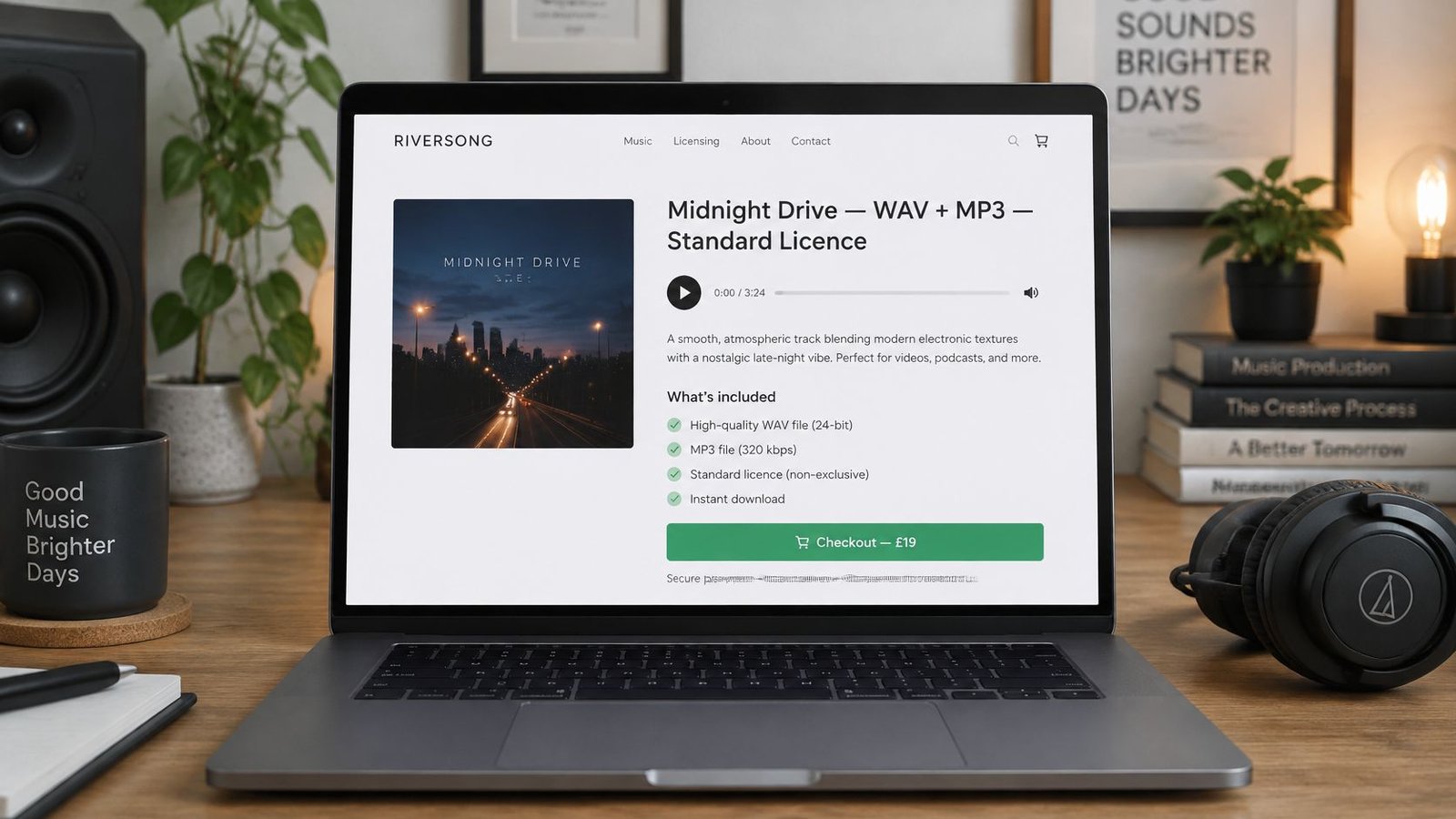
Build it in the order a buyer reads it.
- Title. Product name first, then format and licence tier, so nobody has to guess whether they're buying a stream, a WAV or a commercial licence.
- Preview and artwork. The 320 kbps clip and the square cover, above the fold on a phone.
- What's included. File types, bonus items, stems, lyrics, session files. Be exhaustive here; vagueness is why people abandon a page.
- Price. State whether VAT is included where relevant, and whether a buyer service fee applies at checkout.
- Delivery. How and when the buyer receives the item, in plain words.
- Licence terms in plain language. Two or three sentences summarising permitted use, linked to the full terms.
- Checkout button. A single, obvious action with an order summary beside it.
AmaJova's OfferLink approach compresses those seven elements onto one page. In the first step a seller adds images, a description, the price and the details the buyer needs to make a decision, and buyers complete checkout through AmaJova rather than a separate payment tool. Offer, price and fulfilment details sit together, and the seller can publish without building a website first.
One element isn't optional for a download. Under regulation 37 of the Consumer Contracts Regulations, supply of digital content during the cancellation period can begin only after the consumer gives express consent and acknowledges that starting supply means losing the right to cancel. The cancellation right is lost only where supply begins after that consent and acknowledgement. A separate, unticked box before payment does the job, and the acknowledgement must be stored against the order. Acceptance of the general terms, or the payment itself, is not the same thing.
Practical rule: the consent box is a record, not a formality. If it can't be produced months later against a specific order, it may as well not exist.
Check the page on a phone before sharing it, at the smallest screen size your analytics show. Creating a payment link that holds the offer, price and delivery details covers the mechanical side of getting a single sellable link live.
Deliver Files, Physical Orders and Refund Requests
Fulfilment is where a good page either earns trust or loses it. Two fulfilment paths run in parallel, and the order record is what holds both together.
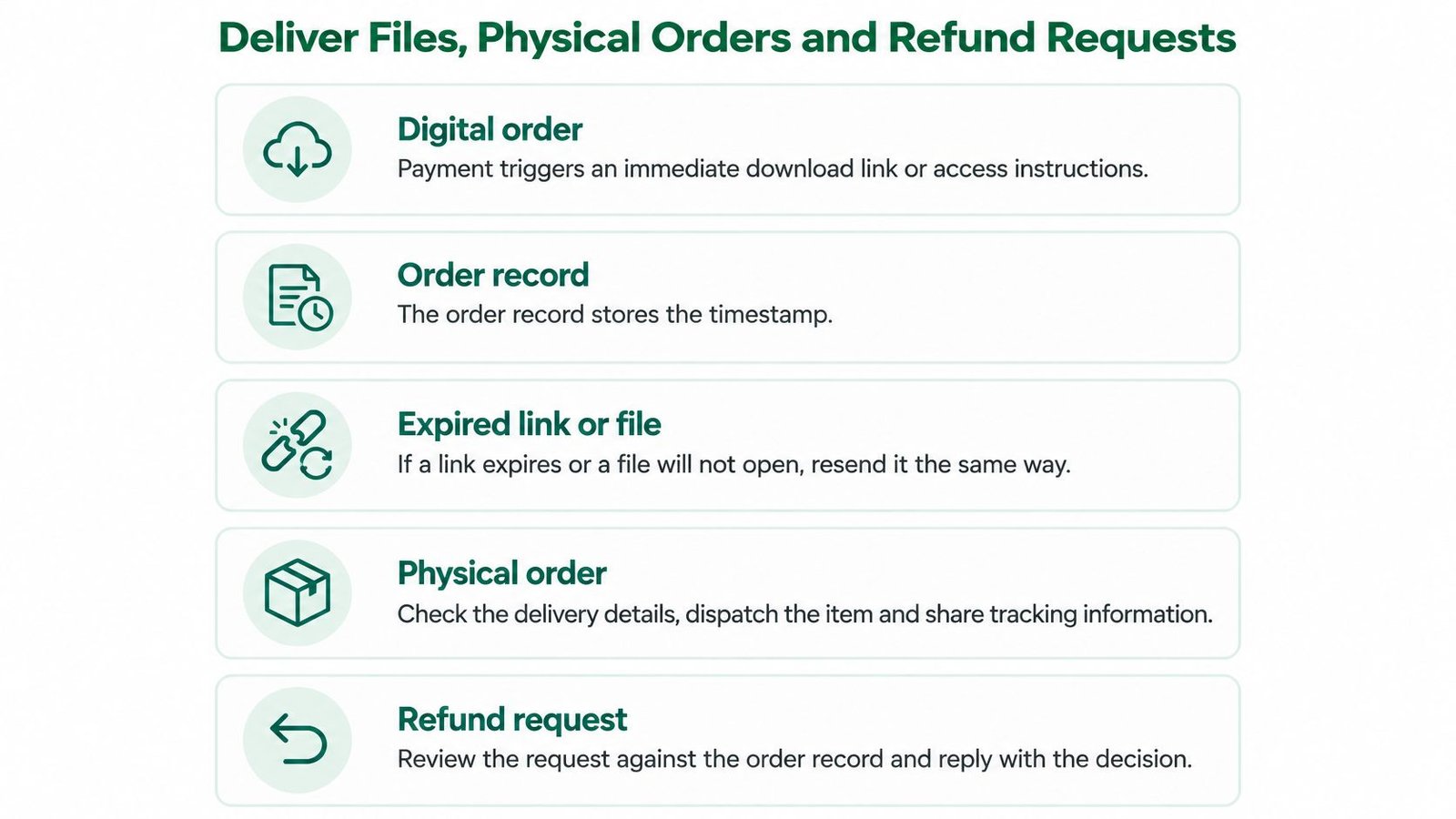
For a digital order, payment triggers the access link or download immediately, and the seller provides the files or access through the buyer's order record. If a link expires or a file won't open, resend it the same working day. Buyers rarely complain about the fault; they complain about silence after it.
Physical orders need more written down before payment. GOV.UK's guidance on online and distance selling requires sellers to give delivery arrangements, delivery costs and expected delivery time before the buyer orders, and states that goods must be delivered within 30 days unless a different period was agreed. Customers generally have the right to cancel up to 14 days after delivery, while faulty, misdescribed or undelivered goods follow separate refund rules. Format, edition, condition, contents and dispatch date belong on the page, not in a reply after checkout.
| Order type | State before the buyer orders | Cancellation position | Delivery timing |
|---|---|---|---|
| Digital download or album | File formats, bit depth, access method, licence tier | Right to cancel is lost once supply begins, but only after express consent and acknowledgement | Access link issued immediately after payment |
| Physical CD, vinyl, cassette or merchandise | Format, edition, condition, contents, delivery cost, dispatch date | Generally 14 days after delivery | Within 30 days unless a different period was agreed |
| Faulty, misdescribed or undelivered goods | How to report the problem and how it will be resolved | Separate refund rules apply, not the 14-day cancellation window | Replacement or refund once the fault is confirmed |
Run every order through the same five steps. Confirm the payment cleared. Send the access link or dispatch the item. Log the date and any tracking number. Answer "where is my order" queries from that log rather than from memory. Record any refund with its reason and date. Sessions and commissions follow the same discipline: complete the agreed work, then submit the delivery or completion details through the order so the timeline is documented.
Cash flow note: payout clearance timing varies by seller level and offer type, whether physical product, digital product, service or live session, so the money isn't in the bank the moment a card clears.
Keep the refund wording on the page short and specific: what qualifies, how to ask, and how quickly a reply arrives. Three sentences beat a page of policy language that nobody reads before clicking buy.
Promote One Link Without Chasing Streams
Promotion splits into two jobs, and confusing them wastes both. Streaming and social media generate attention. One conversion destination turns a small share of that attention into income. Everything shared during launch week should point at that single destination.
A sequence that works for a release:
- Deliver the release early. Get the master and metadata to the distributor at least three to four weeks before release, re-check the artist name, ISRC, songwriter, producer, featured-artist and copyright fields in the delivered release, and pitch it through the platform tools while the window is open. That release workflow, along with the finding that UK audio streams reached 199.6 billion in 2024, is set out in the UK music industry's annual report.
- Publish one page. Listening links, an email signup, merchandise and the paid offer together, with the offer at the top.
- Share the one link everywhere. Social bios, direct messages, email signature, any existing site. A different link per platform fragments the data.
- Follow up with a specific offer. "The WAV bundle with the vocal-free mix is here" converts better than "please support my music".
- Track what produced each sale. Link and message, recorded against the order, so the next release starts from evidence rather than instinct.
Launch week should be spent converting attention, not fixing metadata that should have been checked a fortnight earlier. That's the argument for the early handoff in step one.
Contrarian point: a dozen high-intent fans buying a clearly described product usually matters more for this income than a large streaming number does.
Growth in the streaming economy is slowing relative to its size. Music Business Worldwide reported that UK music streaming subscription revenue grew only 3.2% year on year in 2025, which is a useful reality check for anyone expecting platform income alone to scale. Direct-to-fan conversion is where the marginal pound sits. Send the paid offer to people who have already engaged, a playlist save, a gig ticket, an email open, rather than to a cold audience. For the wider picture on where to spend promotional effort, marketing tips for creators covers channels and content cadence without the storefront detour.
Keep Records That Prove Each Sale
After the first sale, the paperwork is the product. One log, one row per order, and the business becomes legible to an accountant, a tax inspector and to you six months later.
Record the order reference, product name, format and licence tier, price shown and whether VAT was included, the date payment cleared, the date access was granted or the item dispatched, the stored download consent acknowledgement, and any refund request with its reason and outcome. Keep the log with your business records for as long as the tax authority requires, and keep the rights sheet beside it so both tell the same story.
Review the log monthly against four questions. Which offer sold? Which link and message produced each sale? How many orders needed a resend or a refund? Did dispatch match the date the page promised? Answers to those four decide the next release, not guesswork about what the algorithm likes.
Expansion rule: add a new tier only after the first offer has run a full month without a delivery or refund problem. One tier at a time, a lossless upgrade first, then a bundle, then a paid session.
Before the next release, update the rights sheet for any new collaborator, sample or territory change, then set the release date at least four weeks out. That gap is what makes the metadata check, the pitch window and the page build possible without a scramble. Sellers who run this loop twice find the third release takes a fraction of the effort, because the offer template, the licence wording and the order log already exist.
AmaJova puts the offer, the price and the delivery details onto a single OfferLink, with checkout, the order record and buyer messages in one place, so a download, a signed bundle or a paid session can go live without building a storefront first. That structure keeps the consent acknowledgement, the delivery date and any refund conversation attached to the order rather than scattered across inboxes. Start with one release at AmaJova and add the next tier once the first month of orders has run clean.