
You've made the piece. It sold at a fair last month. Now someone messages asking whether you can post it, and you realise you've never costed the parcel, worked out a dispatch time you can stick to, or checked where you stand on the £1,000 trading allowance. The making was the easy part.
That gap between a finished object and a finished sale is where most first online listings fall apart. The admin isn't separate from the product, it's part of what you're selling: the promise of what arrives, when it arrives, what it costs, and what happens if something goes wrong. Get that right and everything else, pricing, photos, taxes, gets easier to hold together.
Table of Contents
- Choose What You Sell and How It Ships
- Work Out a Price That Covers Your Real Costs
- Write Listings and Photos That Earn Trust
- Tax, VAT and Consumer Rules for UK Makers
- Set Up Checkout, Dispatch and Order Records
- Reach Buyers Beyond One Marketplace
- Confirm Your Offer and Publish This Week
Choose What You Sell and How It Ships
Sort your range by how you make and send things, not by craft discipline. A single shop can hold several models at once: physical products can include handmade items, branded products, merch and more, each with a different fulfilment rhythm. What changes between models is what the listing must promise, and the timing line that has to sit directly under the price.
| Model | Dispatch or access | Cancellation position | Best starting point |
|---|---|---|---|
| Ready-to-ship stock | Quote dispatch time from the stock you hold | Standard 14-day cancellation applies after delivery | Pieces you can make in batches and post quickly |
| Made-to-order | Quote production time separately from courier transit | Made-to-order exception may apply, so describe it accurately | Makers with a steady queue and a clear production calendar |
| Personalised | Confirm specification and wording before work starts | Personalisation exception may apply, so state the limits in the listing | Names, dates or custom colour pieces with defined limits |
| Digital download | Access or file delivery on purchase | Faulty content can be rejected for a full refund within 30 days | Patterns, templates and printables you can supply as usable files |
| Service or live session | Confirm date, time zone, format and booking window | Depends on the service and timing; check GOV.UK guidance before setting terms | Workshops, consultations or classes with a fixed slot |
What each row means for the listing
Ready-to-ship pieces are the simplest to describe, because you're writing about a physical object already sitting on a shelf. You know exactly how long it takes to wrap, box and drop off, so quote that number and hold yourself to it.
Made-to-order is where beginners overpromise. The buyer's clock starts when they picture it in transit, and if you've quoted a single figure that folds making time into courier time, every late parcel becomes a complaint. Split the two numbers: "made in 7 to 10 days, then 2 to 3 days in transit."
Personalised pieces need a written limit. How many characters, which fonts, whether you'll send a proof, and how many revision rounds before the spec locks. Agree the wording in writing before the first cut.
Digital downloads live or die on file usability: a clear contents list, correct formats and instructions the buyer can follow without emailing you.
Launch with one or two of these models, not all four. Give each its own listing so the timing and cancellation terms stay clean. If you're still deciding what to make, this guide to choosing a product to sell is a sensible starting point.
For shipping specifically, buy boxes that match your actual parcel dimensions rather than over-boxing; a mug rattling in a double-size carton needs more void fill, which inflates both postage and breakage. A supplier such as Postal Boxes, Parcel & Shipping Boxes for Posting stocks sizes across the small-parcel band, which is the band most handmade items sit in.
Work Out a Price That Covers Your Real Costs
Start with the cost of one finished item, not with the price you think the market will bear. The Crafts Council's market research found the average price per craft object fell from £157 in 2006 to £124 in 2020, while the number of objects bought rose more than fourfold. More people are buying craft, and they're buying at lower average prices. That's not a reason to drop your price; it's a reason to show, in the listing, why your piece sits above the broad category.
| Cost line | What to include | How to record it |
|---|---|---|
| Materials | Every component that goes into the item, including waste | Cost per unit from purchase receipts |
| Packaging | Box, tissue, labels and protective wrap | Per order, from the packaging you actually use |
| Postage | Courier charge for the parcel size you ship | Per order, with proof of postage kept |
| Your labour | Hours per item at an hourly rate you set | Time log per batch |
| Overheads | Tools, workspace, software and platform charges | Monthly total divided by units sold |
| Returns and defects | Allowance for repairs, replacements and refunds | Percentage from the last 12 months of orders |
The five-step price calculation
- Total the cost of one finished item, materials and packaging included.
- Add labour at an hourly rate you set and are willing to defend, not the minimum you'd accept.
- Add overheads per unit: monthly tool, workspace, software and platform costs divided by the units you sold that month.
- Add the margin you need to keep the business running, cover slow months and reinvest in materials.
- Compare the result with similar handmade work, not with mass-produced equivalents, then set a single price.
Platform fees belong in overheads. Add the marketplace or payment charges from the platform's published fee schedule rather than guessing, and if you're VAT registered, decide before you publish whether your listed prices include VAT, because changing that later means rewriting every listing.
Record every figure against the batch it came from. When the next price change comes around, you want receipts and a time log, not a vague memory of what the yarn cost. For postage, work out the true cost of the box, filler and label as well as the courier charge; calculating UK parcel shipping costs covers the chargeable-weight traps that catch out irregular handmade shapes.
The simplest test: if you can't sell the piece at a price that covers materials, labour and overhead, the honest answer is to change the product or the process, not to absorb the loss quietly.
New makers tend to give away the labour line. That's the one that decides whether a craft business survives its second year.
Write Listings and Photos That Earn Trust
The buyer can't pick the piece up. Every question they'd ask at a stall, they now have to answer from your page or by sending you a message. Crafts Council evidence to Parliament reported that 33% of craft buyers were purchasing online, and those buyers said what they missed most was seeing and handling the item. Your listing exists to close that gap.

Photos in the order a buyer looks
Shoot on a plain background in natural, indirect light, and cover these frames:
- Three-quarter view against a clean backdrop, so the shape reads clearly.
- Close-up of texture and finish, because that's what separates handmade from factory.
- A scale shot with a hand or a ruler beside the piece.
- The reverse or underside, especially for ceramics and metalwork.
- In-context, used once or twice, showing the item where it'll live.
Get the lighting and setup right before you shoot; Display Guru garment photography tips is a decent checklist for a home shooting space without a studio.
Listing fields that answer questions before they're asked
Write the title with the material and the object, plus a dimension: "Hand-thrown stoneware mug, 300 ml, glazed inside". Then give dimensions in centimetres and millimetres, list every material, add care instructions, and state production or dispatch time alongside postage costs. Say what's in the box, and what isn't.
Tell your maker story in two or three honest sentences. Where the clay comes from, why you switched to a particular glaze, what you make and what you don't. Long biographies go unread; specifics get remembered.
A listing with a scale photo and a materials list gets fewer messages and more orders, because the buyer has already done the deciding.
Before publishing, read the page as though you're a buyer who can't touch the piece. Size, weight, materials, care, timing, cost. Any gap becomes a message you'll answer later, and a question you'll answer for the fifth time.
Tax, VAT and Consumer Rules for UK Makers
Small sales do count. HMRC generally treats making or buying handmade goods with the intention of selling them for profit as trading, rather than selling off personal possessions, and once trading starts the record-keeping starts with it.
The practical threshold is the £1,000 trading allowance. As HMRC's guidance on reporting online platform income sets out, if total trading income is more than £1,000 in a tax year (6 April to 5 April), the seller usually needs to tell HMRC. It's measured before expenses, and it applies across all your trading rather than separately to each shop, product type or platform. Two stalls and an online shop count as one trading activity, not three.
| Rule | Threshold or period | What it means for you | Where to check |
|---|---|---|---|
| Trading allowance | £1,000 total trading income per tax year (6 April to 5 April) | Usually tell HMRC when income is above this, measured before expenses | HMRC guidance on reporting online platform income |
| VAT registration | £90,000 taxable turnover over 12 months, or expected within 30 days | Turnover counts, not profit; postage and materials are not deducted | GOV.UK VAT thresholds |
| Cancellation right | 14 days after delivery | Standard for online sales; made-to-order and personalised exceptions must be described accurately | GOV.UK online and distance selling for businesses |
| Faulty digital content | 30 days to reject for a full refund | Applies to downloads such as patterns, templates and tutorials | GOV.UK digital content rights guidance |
VAT is the trap that surprises makers who've had a good year. The £90,000 threshold is taxable turnover, not profit, so your material bills, packaging and postage don't reduce the figure you measure against it. Watch a rolling 12-month total monthly, not a calendar-year one, and check current HMRC guidance because treatment can depend on what you sell, where your customers are, and whether special rules apply.
Your terms and listings have to state the cancellation position accurately. The made-to-order and personalised exceptions exist, but they apply to bespoke goods, not to everything in your shop. Treat all of this as general information and confirm your own position with an accountant if it's unclear.
Set Up Checkout, Dispatch and Order Records
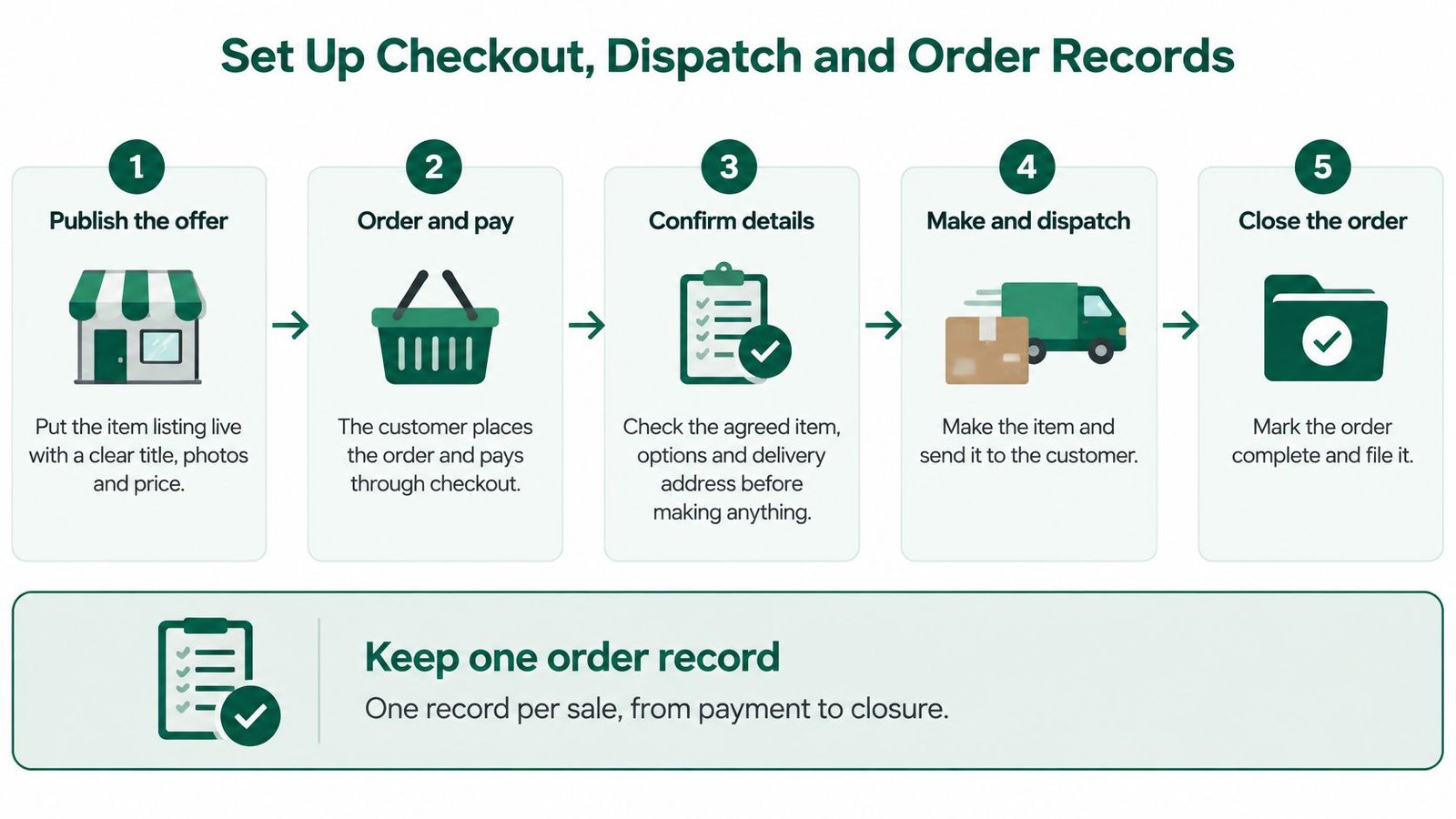
A sale moves through a fixed sequence, and if you keep one record as the single home for the agreed specification, the messages and the proof of dispatch, most disputes never start. AmaJova's order journey follows four stages: create the offer, share the OfferLink, customers order and pay, then manage and fulfil the order.
The dispatch sequence
- Publish a complete offer. Images, description, price and every detail the buyer needs sit in the same place, so there's nothing to clarify after payment.
- Quote dispatch and production separately from courier transit. Production time is your clock; transit is the courier's.
- Send an order confirmation that repeats the agreed specification, price and any optional charges. Once the buyer pays, an order record is created and fulfilment can begin.
- Make the item and photograph it before it leaves your workspace. That photo is your evidence if a damage claim arrives.
- Dispatch and keep the postage receipt and tracking, then mark the order complete only once it's gone.
What goes wrong is predictable. Promising fast delivery without a production capacity figure. Failing to disclose that the wood grain or glaze colour varies. Adding charges without clear consent. Treating handmade status as an exemption from quality obligations rather than a description of method. None of these are hard to fix, but each one costs you a refund or a review if it slips through.
Keeping good records across orders is easier with a single place to look; this guide to tracking customer orders sets out what to log.
Weekly review: late-dispatch rate, refund rate, cancellation rate, questions per order, and profit after packaging and postage. Track these rather than follower counts. They show whether demand can actually be fulfilled.
Those five numbers tell you more than any analytics dashboard. If questions per order are climbing, the listing is missing detail. If late dispatch is rising, the production queue is oversold.
Reach Buyers Beyond One Marketplace
Online selling should feed off the interest you generate in person, not replace it. The Crafts Council's 2025 Makers Survey reports that only 16.6% of makers' sales came through digital channels, against 66.2% through physical channels, and it names algorithmic visibility, difficulty standing out and rising operating costs as the main barriers. That's a resilience problem, not a channel problem.
The UK picture on tools is uneven. In 2024, 25% of UK businesses with no employees used technologies or web-based software to sell to customers online, according to the Department for Business and Trade's small business survey. Many sole traders still don't have a structured online route to buyers.
Turn a fair into a tracked link
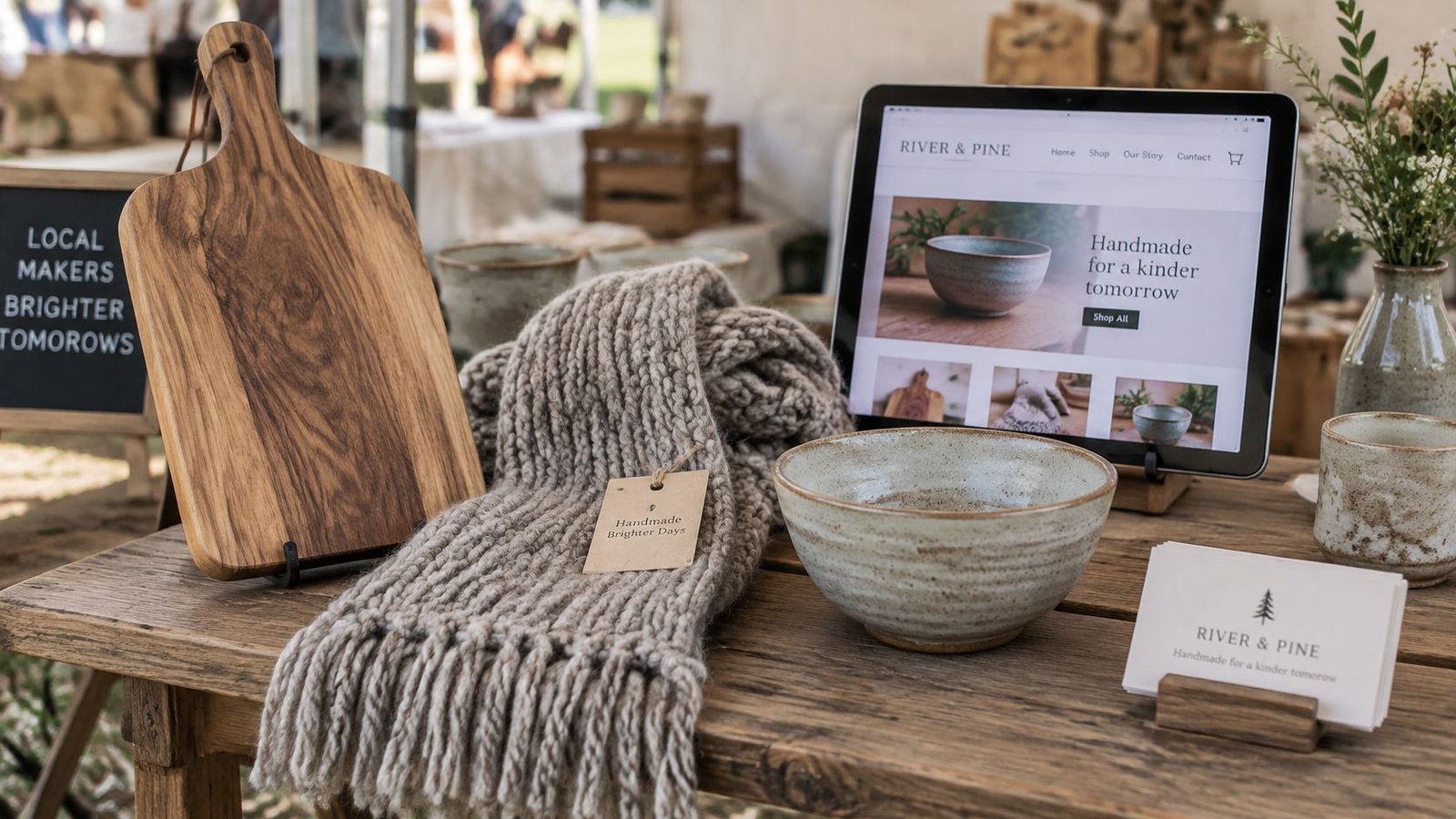
Print a QR code that opens one offer page and stand it on the table beside your card reader. Someone who admires a bowl but doesn't buy has a way to follow up without hunting for you on social media later. The same link goes in your profile bio, in direct messages, in emails, and on any website you already have. AmaJova sellers share one OfferLink across bios, socials, messages, email and paid campaigns, which means every route lands on the same specification, price and delivery details.
Pick one channel to test for 30 days, track where orders come from, and drop anything that generates questions but no sales. If social is where your buyers are, this guide to selling on Instagram covers the practical setup.
A link you control keeps working when an algorithm changes. That's the whole case for building it early, before you need it.
Confirm Your Offer and Publish This Week
Pick one product from the first table and treat it as your launch piece. Write its full specification: materials, size, production or dispatch time, delivery method and total price. Take five photos in the order above, then fill in the listing fields.
Set the price from your cost lines, and settle two things before you publish: whether the £1,000 trading allowance reporting applies to you, and whether you're anywhere near the VAT threshold. Both check out against GOV.UK in a few minutes.
Then follow the sequence AmaJova is built around: Create, Share, Sell, Fulfil, Get paid. An OfferLink can be created without a website, and sellers can start selling in minutes.
Sharing means three places, not one: your social profile, a direct message to people who've already shown interest, and a note or QR code on your website or craft-fair display. When the first order lands, check the record against your specification, dispatch with proof of postage, and mark it complete only after it's gone.
After ten orders, review the five weekly metrics, adjust the listing and the price, and only then add the next product. Each new piece starts from a process you've already tested. That's how the admin stops being an afterthought and starts doing part of the selling.
AmaJova was built for exactly this stage, where you have a product, a price and a promise to keep, but not a full storefront. An OfferLink puts your description, photos, price and fulfilment details on one shareable page, with secure checkout and an order record attached from the moment a buyer pays. When you're ready to put your first launch piece live, visit AmaJova and build the offer this week.