
Trend lists treat the best product to sell as whatever search volume jumped last month. That advice skips the part that decides whether you make money: whether you can prove someone will pay, cover your costs, and deliver the same promise next month. A spike in scalp massagers or embroidered apparel does not tell you your postage, your refunds, or how many hours the offer will eat.
The better test sits at offer level. Name one buyer, one problem, one price, and one way you will get the thing into their hands. If that page cannot be validated, priced, and fulfilled, the category is a distraction, however popular it looks.
Table of Contents
- How to Judge Which Product Is Best for You
- Find a Niche With Proven Buyer Demand
- Compare Physical, Digital, Service and Live Offers
- Validate Demand Before You Commit Stock or Build
- Price for Margin, Not Just Competition
- Package the Product Into One Clear OfferLink
- Launch Your First Offer and Review Its Numbers
How to Judge Which Product Is Best for You
No product is best for everyone. The best product to sell is the one that passes five tests against your skills, budget, and the people you can already reach. Popularity is not one of those tests.
Score each test from 1 to 5 using one piece of evidence, not a feeling. A search trend, a quote from a buyer, a cost sheet, or a trial dispatch counts. A hunch does not. Anything below 3 on demand or margin should be redesigned or dropped, even if a trend report ranks it near the top. Guides that help you validate demand before choosing products are useful only when you apply that evidence to a price you can keep.
| Test | Question to ask | Pass signal | Warning sign |
|---|---|---|---|
| Demand | Are buyers already searching for or paying for something similar? | Steady or rising search and sales for close alternatives | Interest only from friends and family |
| Margin | Does the planned price cover cost, fees, postage and returns? | Positive contribution margin at the price buyers will accept | Margin works only at a price nobody will pay |
| Deliverability | Can you fulfil it consistently? | You can state a dispatch, access or session time you can meet | Fulfilment depends on suppliers or capacity you cannot control |
| Clarity | Can the offer be understood before purchase? | Scope, inclusions and price fit on one page | Buyers need a demonstration before they understand it |
| Repeatability | Can you sell it again without rebuilding it? | The same stock line, file or session format is reused | Every sale needs custom work |
A thin margin hides inside a popular item
Say a candle maker sees steady search interest in scented candles and prices a single jar to match nearby shops. After wax, a jar, a label, a mailer, postage, and a small allowance for breakage, the contribution at that competitive price is only a few pounds. Demand passed. Margin failed. The fix is not a cheaper candle. It is a higher-value set, such as three seasonal scents with a care card, so postage is spread across a larger order.
Practical rule: Keep the candidate with the highest total only if no test scores below 3. A high total with a failed margin or demand test is still a no.
This week, write three candidates on one sheet and score each cell from a single source. Drop the two that fail a test. Build the survivor.
Find a Niche With Proven Buyer Demand
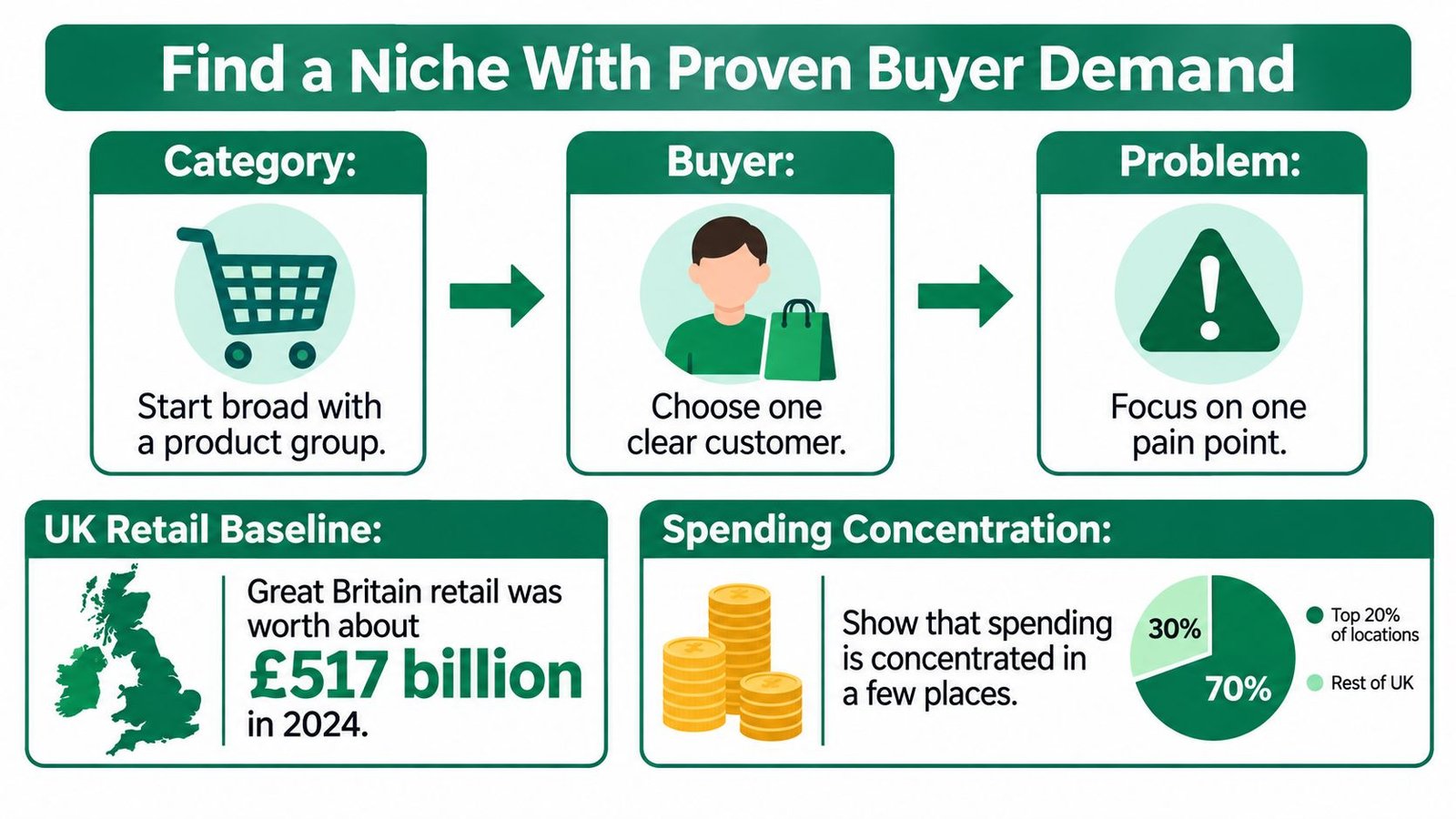
Start with a category, then cut it to one buyer and one problem. Scale alone is a poor reason to enter.
In 2024, Great Britain's retail sales were worth approximately £517 billion, up 1.4% from 2023, according to the House of Commons Library retail briefing. Food shops took 39 pence of every pound, clothing shops including textiles and footwear 11 pence, automotive fuel 9 pence, and household-goods shops including electronics and furniture 7 pence. Household-goods sales still fell 4.7% against 2023, and clothing slipped 0.1%. A large category can be under pressure. Competing as a general store inside it is a hard way to start.
Four narrowing routes usually beat a wide catalogue.
Specialist item: one material, size, or use, such as merino base layers for winter runners rather than "sportswear".
Curated bundle: a short set that solves one job, such as a desk-reset kit, instead of a shop of stationery.
Personalised version: a standard product with one named option, such as initials or a fit, with a clear lead time.
Product plus a service: the item plus a setup call or a written plan, sold as one scoped offer rather than an open-ended favour.
Where the evidence actually sits
Free sources are enough if you read them in order and write down what each one answers. Sellers who also watch marketplace data through tools such as hosted MCP access for Amazon sellers can cross-check what already sells, then still narrow to a gap rather than copying the bestseller.
| Source | What it shows | How to use it |
|---|---|---|
| Google Trends | Direction and seasonality of search interest over twelve months | Confirm a niche is steady or rising rather than a short spike |
| Your own search and site queries | Terms already reaching your website or social profiles | Copy the buyer's exact wording into your offer |
| Marketplace bestseller pages | Which items sell most within a category | Spot the gaps between the leading products |
| Recent reviews | Recurring complaints and unmet needs | Read about twenty reviews and note the problem that repeats |
| Competitor pricing and delivery promises | Price points and dispatch claims | Find where you can offer a clearer or faster promise |
- List ten niches you already know well enough to answer questions without research.
- Check each trend line across twelve months and strike anything that is only a short spike.
- Read about twenty recent reviews and note the complaint that repeats.
- Write one sentence that names the buyer and the problem.
A usable niche passes a simple sentence test. You can name the buyer, the problem, and the reason they would choose you over a general store. If that sentence needs a paragraph, the niche is still too wide.
Compare Physical, Digital, Service and Live Offers
Format decides your week more than the category does. Put the four side by side before you fall for the one that looks easiest to photograph.
| Offer type | What you must deliver | Margin pattern | Best when | Main risk |
|---|---|---|---|---|
| Physical product | Stock, packing, postage and returns | Margin shrinks after postage and stock costs | Item is compact, giftable or hard to find locally | Tied-up stock and returns |
| Digital product | Files, licence terms and updates | Very low cost per extra sale after creation | Outcome can be delivered by download or email | Weak perceived value and support load |
| Service | Your time and capacity | Revenue limited by hours unless packaged as a fixed outcome | Result is clear and repeatable | Scope creep and unclear boundaries |
| Live session | Fixed time slots, platform and cancellations | Income tied to attendance and available slots | Buyers want direct access or feedback | No-shows and timezone confusion |
The Office for National Statistics retail bulletin for September 2025 reported that online sales accounted for 28.0% of Great Britain's retail sales that month, up from 27.8% in August, with online spending values 5.6% higher than in September 2024. Remote discovery and digital payment already reach a large share of retail. The offer still has to explain itself without a shop-floor demonstration.
Honest trade-offs
Physical goods tie up cash in stock, packing, and returns. Compact, giftable, or hard-to-find items can justify that, because postage stays predictable and the buyer can judge the item from photos and measurements. Bulky, fragile, or fashion-fit products punish small sellers through returns.
Digital products cost time up front and very little per extra sale. Templates, guides, and similar downloads need a version number, file formats, licence terms, and an update policy, or buyers treat a cheap file as unfinished work. Support minutes per order are the hidden cost.
Services pay well per hour and stall when the diary fills. Package a fixed outcome with a written boundary, such as a two-week brand audit with a set number of revisions, rather than "ongoing help".
Live sessions suit buyers who want feedback in the room. State duration, timezone, platform, participant cap, whether a recording is included, and the cancellation terms before anyone pays. No-shows and mixed timezones are the usual failures, not the content.
AmaJova lets sellers offer services, physical products, digital products, and live sessions through one OfferLink. Digital products go out as downloads and digital access through one link. Live sessions are bookable time, with expectations stated before purchase. Pairing a product with a session often works better than either alone, provided the page shows what is included and what is an extra.
Choose the format you can keep delivering for twelve months, not the one that looks most attractive this month.
Validate Demand Before You Commit Stock or Build
Interest is cheap to state. Money is a stronger signal. The point of a test is to see whether buyers will pay the price you intend to keep, before you buy stock or spend weeks building a file.
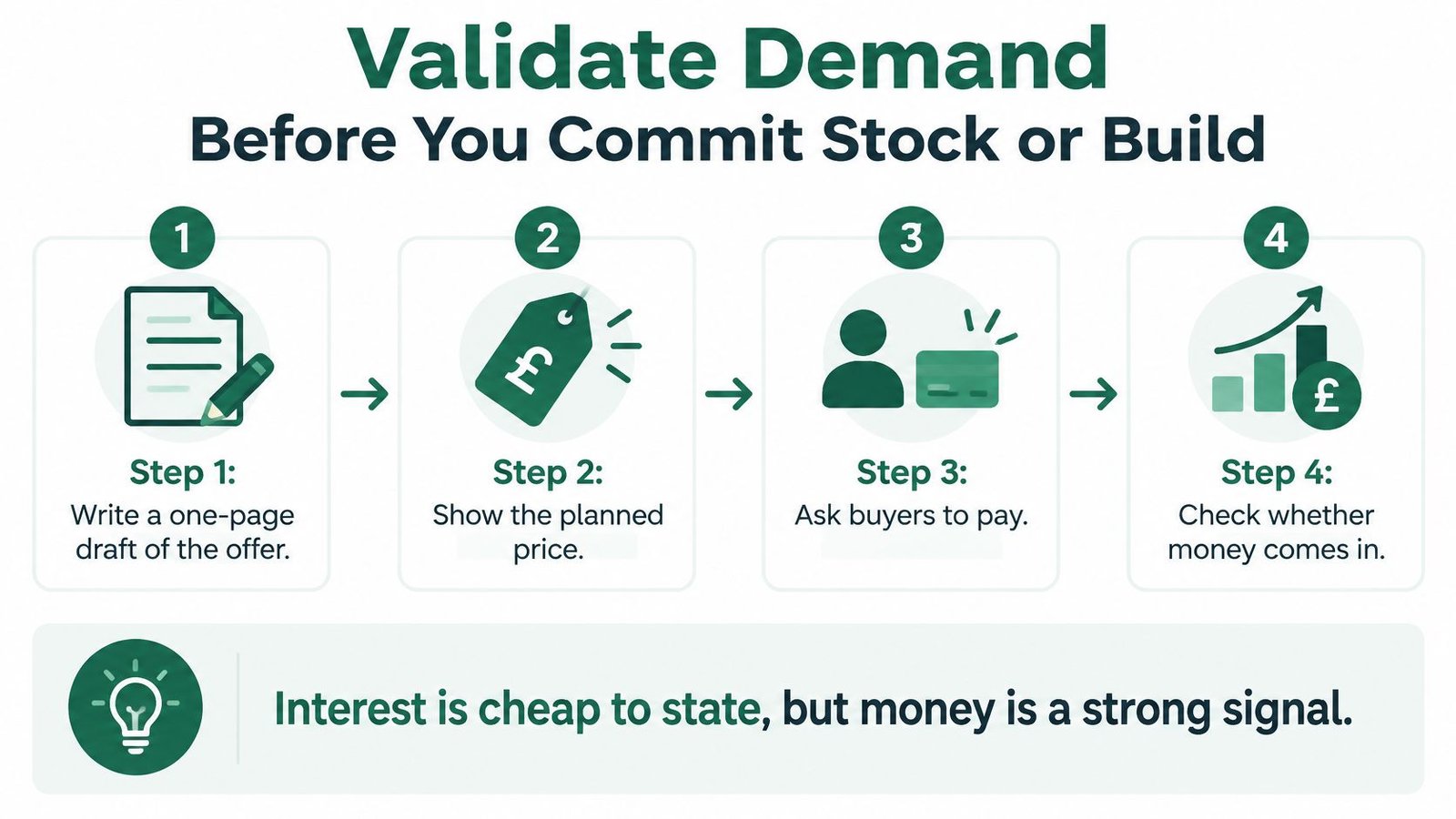
- Write a one-page draft with the price, the inclusions, and the delivery or access window. If the draft needs a call to make sense, the offer is not ready to test.
- Set a go or stop rule in writing before anyone sees the page. An example is ten paid orders in fourteen days at the full price, or the test ends.
- Collect commitment through a waitlist with a deposit, a limited preorder, or a small paid post. A like is not commitment.
- Message about twenty past customers or contacts and ask what they would buy and why. Use their words on the page, not a slogan.
- Measure views to checkout, checkout completion, preorders, refund rate, and cost per buyer. Those five numbers tell you whether the page or the product is the problem.
- Scale, change the offer, or stop. Changing the offer means a new price, a tighter scope, or a different format, not a louder headline on the same weak deal.
Match the test to the format
A physical run suits a limited preorder with a named dispatch date, so you do not hold stock for people who only said they were interested. A live session suits pre-booked dates with a cap, which shows whether the slot itself is wanted. A digital product suits a sample chapter or sample template with a buy link for the full file. A service suits a fixed-scope discovery call at a published price, not a free hour that teaches the whole job.
People building downloads can use these digital product ideas as prompts, then still run the paid test. An idea list is not demand.
A discount test proves demand for the discount. Read it separately from demand at the price you plan to keep.
Write the go or stop threshold on the draft before you publish anything. If you invent the rule after the results, you will talk yourself into a product that did not clear the bar.
Price for Margin, Not Just Competition
Contribution margin is the price minus the cost of goods or materials, payment fees, postage and packaging, and a returns allowance. If you want a full profit view, value your own time on a separate line. Do not hide it inside the product cost, or you will underprice the hours.
Worked example, not a quote from a shop: a £40 item with £14 of materials, £4 postage, £1.20 in payment fees, and a £1 returns allowance leaves £19.80. That is about half the price before your time. If making and packing it takes an hour, the hourly result may be too thin to repeat. Resale pricing guides that show how to account for shipping when pricing inventory make the same point: postage is part of the price, not a surprise after the sale.
Three ways to set the number
Competitor range. Note the prices and what each one includes, including delivery. Matching the cheapest listing usually strips the margin you need for the next test.
Value the buyer receives. Price the outcome, such as a week of meals planned or a session that replaces a costly mistake, rather than the hours you spent making the file. Service sellers can follow a structured way to price your services and still write the margin down first.
Bundle to lift the order. A set spreads postage and payment fees across more spend. A single low-priced unit often cannot.
Undercutting looks like a growth tactic and often removes the cash for ads, reprints, and refunds. Two prices, each with its margin written beside it before launch, teach you more than one heroic discount.
Tax is a monitoring job
A UK business generally must register for VAT when taxable turnover exceeds £90,000 over the previous 12 months, or when it expects to exceed £90,000 in the next 30 days, as set out in GOV.UK guidance on VAT thresholds. The threshold is total taxable turnover across offers, not profit and not one product. Treatment can vary by transaction. This is a compliance trigger, not a reason to add VAT on day one. Check current GOV.UK and HMRC guidance, and take professional advice when the position is unclear.
Sellers are responsible for lawful offers, accurate descriptions, fulfilment, required licences, verification, taxes, and cooperation with transaction reviews. AmaJova's seller platform fees may change, and the applicable fee is always shown before it applies. Read that figure in your own account before you lock a price, and test two prices with the margin written down for each.
Package the Product Into One Clear OfferLink
A buyer should understand the purchase without a call. Package the offer in this order.
- Name the outcome in the title, such as "Starter kit for new allotment growers" rather than a product code.
- List inclusions and exclusions in plain terms. Say what is in the box or the file, and what is not.
- Set the price and currency, and say whether delivery is included.
- For physical items, enter the stock quantity and a delivery time you can meet. A physical-product draft takes a price, currency, stock quantity, and delivery time.
- State the dispatch or access window in days, not "soon".
- Add FAQs, boundaries, and optional extras, kept separate from the core price. When creating an OfferLink, sellers can set boundaries, FAQs, optional extras, price, and fulfilment.
- Name the support route and what happens after payment, such as a download on the order or a booking link by email.
Why one page beats a scattered pitch
An OfferLink brings the offer, price, seller information, fulfilment details, and a secure way to pay into one place. Scope is visible before money moves, which cuts the messages that ask what is included. People selling time can use the same discipline in this guide on how to sell services online: define the result, the limit, and the next step on the page itself.
For physical goods sold online, GOV.UK guidance on online and distance selling states that goods must generally be delivered within 30 days of the order unless the seller and buyer agree a different period. Confirmation of the contract must be provided as soon as possible and no later than delivery, in a form the buyer can save, such as email or paper. A longer or shorter window is allowed only when it is stated on the offer and agreed with the buyer. Do not hide a six-week make time in a footer.
Hand the page to someone who has never seen the business. If they cannot say what they are buying, what it costs, and when it arrives, the page is not finished.
A physical bundle page can be four lines a stranger can repeat: the inclusions list, the dispatch window, the returns boundary, and the support contact. Everything else is optional.
Launch Your First Offer and Review Its Numbers
Share the link where buyers already are: a social profile, a direct message, email to people who have opted in, or a page on a site you already run. An OfferLink can be created without a website, and sellers can start selling in minutes. The same link can sit in a bio, in socials, in messages, in email, in a paid campaign, or on an existing website. Keep every message aligned with the page, so the price and the scope do not change between the post and the checkout.
Consent is separate from the sale
UK sellers using email or SMS marketing generally need the recipient's prior consent under Regulation 22(2) of the Privacy and Electronic Communications Regulations, and that consent must meet UK GDPR requirements. Government marketing guidance describes consent as active agreement and says businesses cannot rely on legitimate interests where PECR requires consent for these channels. Keep marketing permission separate from the purchase. An order is not agreement to promotional messages. Keep a record of what each person agreed to receive. Rules can differ by recipient and by message type, so check campaigns against current ICO guidance rather than treating this as a complete legal summary.
Three numbers, then one decision
After the first sales, review only three figures.
View-to-checkout rate. Low views usually mean the headline does not name the buyer or the problem. Rewrite the title before you change the product.
Margin per order after all costs. A weak margin means the packaging, the bundle, or the price is wrong. More traffic will not repair it.
Share of buyers who return or refer someone. A one-off spike with no second order and no referral is a weak offer, even if the first week looked busy.
Low checkout completion, with plenty of views, usually means the scope or the price is unclear. Tighten inclusions and delivery wording before you discount.
Run the paid demand test against the go rule you wrote before anyone saw the page. Launch wider only if that test passes at the price you intend to keep.
AmaJova turns a physical product, a digital download, a service, or a live session into one OfferLink with the price, the scope, and fulfilment details visible before payment. That is the practical way to choose a best product to sell: one clear offer you can test, price, and deliver, rather than a trend list. Visit AmaJova to set up that offer and share the link with the buyers you already reach.