
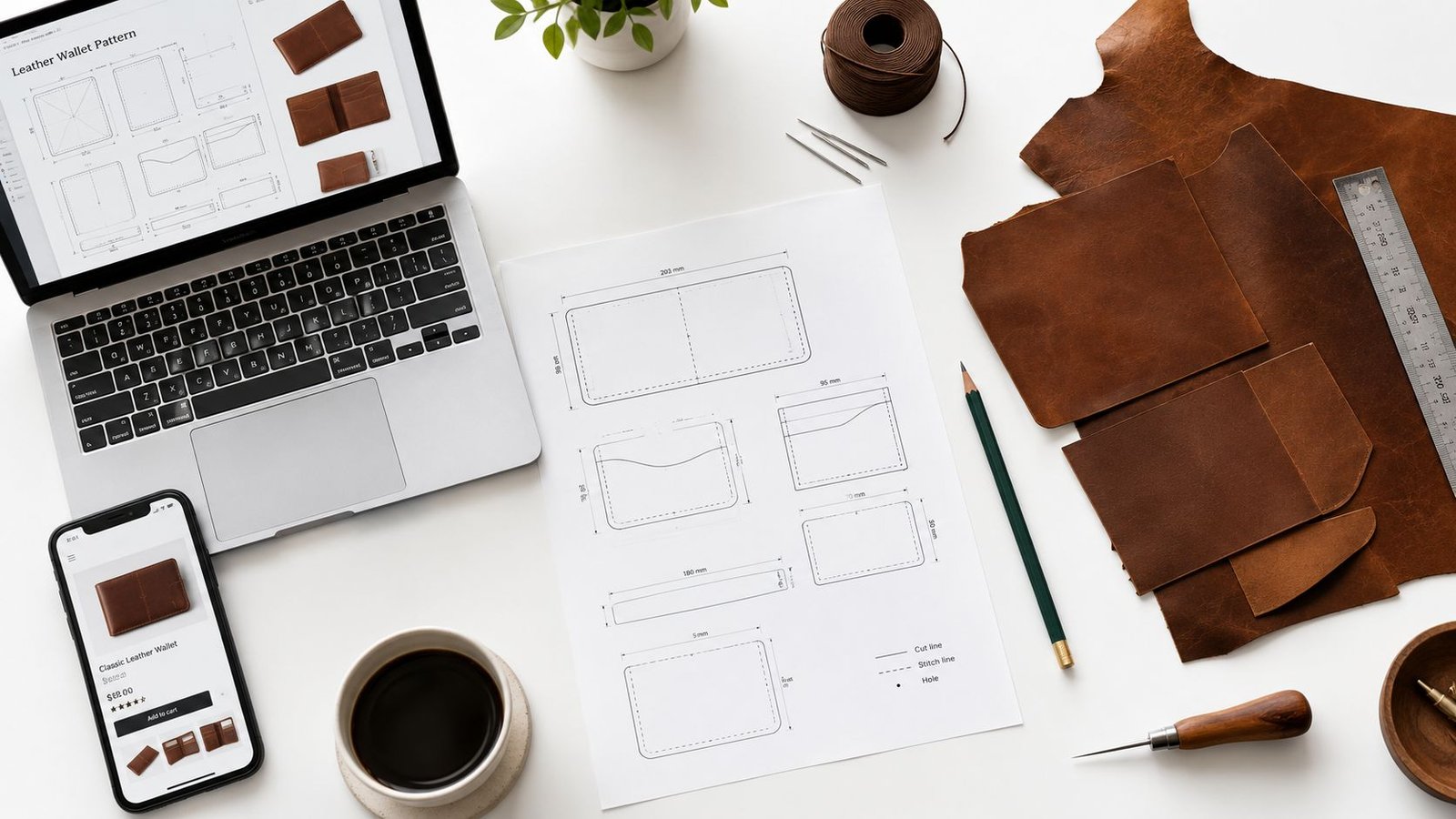
A maker has finished a clean bifold wallet, photographed the edges, exported a PDF and prepared to publish the first listing. Then the avoidable problems appear: the printed pattern is slightly too small, the pocket stack is too thick, the packaging falls outside the expected postal category, and buyers can't tell whether they're purchasing a downloadable template, a physical kit or a finished wallet.
A leather wallet pattern isn't only a drawing. It's a product with a defined format, material specification, production method, fulfilment process and buyer promise. Sellers who settle those details before publishing can reduce support messages, prevent disappointing builds and create an offer that works whether the buyer is a beginner, an experienced leatherworker or another small maker.
Table of Contents
- Choosing What You Are Actually Selling
- Building a Pattern That Works at Any Scale
- Packaging the Pattern as a Downloadable Product or Physical Kit
- Planning Fulfilment, Postage and Packaging for UK Orders
- Writing the OfferLink Page Buyers Trust
- Launch Checklist and Common Mistakes to Avoid
Choosing What You Are Actually Selling
Before drawing a single line, the seller needs to make three decisions that determine everything afterwards: format, skill level and material yield. A downloadable PDF, a printed pattern kit and a pre-cut leather kit may use the same underlying design, but they don't create the same buyer experience or workload.
A digital pattern gives the buyer the most responsibility. The listing must explain the file format, print process, required tools, leather specification and whether instructions are included. A printed and posted pattern kit removes the buyer's printing risk but adds stock, packing and dispatch work. A pre-cut leather wallet kit goes further by supplying prepared pieces, thread, needles and instructions, yet it also demands consistent cutting, edge finishing and quality control from the seller.
Practical rule: The product title should tell buyers what arrives, not merely what they can make.
The skill level must be explicit. A beginner-friendly bifold needs visible fold lines, a cutting order, stitch guidance and a test assembly. A pattern for a saddle-stitch regular can assume more workshop knowledge, but it still needs accurate dimensions and clear tolerances. If the design depends on skiving, edge paint or a particular stitch sequence, those requirements belong on the offer page rather than inside the seller's assumptions.
Set the material promise early
Leather thickness changes the finished wallet. A useful starting point for a slim card wallet is vegetable-tanned leather around 2 to 4 oz, approximately 0.8 to 1.6 mm, with thinner skived areas where pocket layers overlap, as outlined in this professional leather wallet pattern workflow. The pattern should state both thickness and temper, because chrome-tanned or heavily finished leather may fold and burnish differently from vegetable-tanned leather.
Yield also needs a hard assumption. The seller should map defects, mark usable zones and test the layout on the intended hide before promising a kit price. UK leather-product manufacturing was estimated at £1.2 billion in revenue and 698 businesses in 2025, covering footwear, handbags, luggage and accessories that include small leather goods such as wallets, according to IBISWorld's UK leather-product manufacturing data. That fragmented environment suits repeatable wallet templates, but only when the maker controls waste and tolerances.
The final offer must also reflect the seller's support capacity. A low-priced PDF can become expensive if every buyer needs individual help with printing, leather choice and assembly. Guidance on monetization for creators can help sellers think beyond a single file and decide whether support, kits or live instruction belongs in the product range. Examples of how creators structure downloadable products are also available in these digital product examples.
Building a Pattern That Works at Any Scale
A finished wallet on the bench is not yet a reliable pattern. The seller must convert its closed dimensions, fold geometry, pocket placement and allowances into an editable template that survives printing and cutting.
Start with the closed wallet. Record the outer length and height, then account for the shell thickness, fold-back space, pocket overlap, seam allowance and edge finishing. Card pockets need enough overlap to retain cards without adhesive, while the billfold section needs room to fold without forcing the shell open. Stitch-hole centres should be positioned from a consistent reference edge rather than estimated visually.
Draft the geometry, not a photograph
Vector software is the safer drafting environment because lines, curves and hole spacing remain editable. A raster screenshot can look accurate on screen but rescale unpredictably, and its stitch holes may no longer match the seam allowance after export. Each component should have a name, a grain direction, a cut quantity and a clear indication of whether it is mirrored.
The pattern should also identify the material assumption. For example, a slim bifold may use a firm outer shell and thinner pocket pieces, while a soft chrome-tanned hide may need different fold treatment from vegetable-tanned leather. A pattern that says only “leather” leaves too much room for a build that technically follows the template but cannot close comfortably.
Make calibration part of the product
Every exported PDF needs a calibration square, with the seller's chosen reference dimension printed beside it. The buyer should be told to print at 100% scale, never “Fit to Page”, then measure the square with a ruler before cutting. The practical workflow is simple:
- Print the PDF using its stated scale setting.
- Measure the reference square in both directions.
- Reject the print if either measurement is wrong.
- Assemble the paper pieces before transferring them to leather.
- Test the complete wallet in inexpensive scrap.
This check matters because a small scale change affects every fold, pocket opening and stitch position. A seller should perform the same test on common paper sizes intended for the audience, then state which pages contain the full pattern and which require joining.
Treat yield as a design constraint
A wallet pattern should be nested against a real hide, not an imaginary perfect rectangle. Large shell pieces belong away from scars, loose grain and edge damage, while smaller pockets can sometimes use areas that would be unsuitable for the outer panel. A UK industry account reported that one metric tonne of raw material yields about 200 kg of usable leather product, with substantial solid and liquid waste, as documented in this industry overview of leather material efficiency. The exact yield for an individual hide will vary, but the production lesson is consistent: defect mapping and scrap prototypes belong in quality control.
The seller should record the pattern number, revision date and compatible hide weight in the filename and instruction sheet. A revision that moves a pocket or changes a fold can alter the finished dimensions, so old and new files shouldn't share an ambiguous name. A short change log protects both the seller and buyers who return to a pattern months later.
A pattern is production documentation. If another maker can't reproduce the wallet from the file and instructions, the design isn't ready to sell.
Packaging the Pattern as a Downloadable Product or Physical Kit
The strongest format is the one the seller can fulfil consistently. A digital download looks simple, but it creates printing and interpretation questions. A physical kit reassures the buyer about materials, yet it introduces stock control, packing time and dispatch responsibility. A pre-cut kit gives the clearest starting point, but it has the highest preparation burden.
| Pattern packaging routes compared | Build time per order | Repeat order risk | Return likelihood | Main support question |
|---|---|---|---|---|
| Downloadable template | Low after preparation | Buyers may return for variations or related designs | Usually linked to unclear file contents or access expectations | “Which pages should be printed, and at what scale?” |
| Printed pattern kit | Moderate, with printing and packing | Buyers may purchase another size or design | Physical condition and undisclosed contents can create disputes | “What exactly is included in the envelope?” |
| Pre-cut leather wallet kit | High, because pieces need cutting, punching and finishing | Repeat purchases depend on material quality and available colour options | Higher if the kit differs from the photographed materials | “Which tools and skills are still required?” |
A pure digital package should contain the PDF, a material list, a stitch-length chart and a concise photo build sequence. A single compressed file is easier for the buyer to manage than scattered attachments. The listing should distinguish between a cutting template, assembly instructions and any reference photographs, because buyers shouldn't have to infer the contents from a finished-wallet image.
A printed kit can use an A4 card sleeve, a paper mock-up of the card pocket and a small leather swatch for stitch testing. The swatch is useful because it lets the buyer assess needle choice, thread tension and edge behaviour before cutting the main material. The seller should protect the paper from bending and state whether the pattern is reusable or intended as a one-time cutting guide.
The pre-cut route needs a documented inspection sequence. Pieces should be checked for matching dimensions, clean punch holes, consistent edge preparation and the correct thread and needle set. A printed booklet should identify which components are supplied and which tools remain necessary. Sellers comparing fulfilment models can use this guide to selling digital products as a reference point for deciding how much of the customer experience belongs inside the product.
The finished-wallet route is a different offer altogether. It isn't a pattern, even if the same design is used. Product photographs, measurements and material descriptions must make that distinction unmistakable.
Planning Fulfilment, Postage and Packaging for UK Orders
Dispatch planning starts with the packed order, not the wallet on the workbench. A folded paper template, an A3 sheet, a card-backed envelope and a pre-cut leather kit each create a different combination of thickness, rigidity and weight. The seller should make one packed sample for every format and record its dimensions before setting delivery options.
Royal Mail's published Small Parcel limits are 45 cm in length, 35 cm in width, 16 cm in depth and 2 kg in weight, with the longest side treated as the length, according to the Royal Mail online price guide. A typical wallet may be compact, but a rigid mailer, presentation box or multiple-kit order can change the applicable category. The seller should measure the fully packed parcel rather than estimating from the product.
| UK Postage Options for a Leather Wallet Pattern | Typical Weight | Service | Tracking | Indicative Cost |
|---|---|---|---|---|
| Digital download | No physical parcel | Electronic access | Not applicable | No postage |
| Folded printed template | Light, depending on backing | Letter or parcel service selected after weighing | Depends on service | Confirm at listing setup |
| Card-backed printed kit | Heavier and more rigid | Small parcel service where applicable | Depends on service | Confirm against packed dimensions |
| Pre-cut leather kit | Variable, based on leather and tools | Parcel service | Consider tracked service for higher-value orders | Quote after weighing and measuring |
A poly sleeve with a stiffener may protect a simple printed pattern, while a manila envelope with card backing gives a sturdier presentation for a larger kit. Pre-cut components need a bubble mailer or small box that prevents punched pieces from bending and keeps needles, thread and hardware contained.
Royal Mail's published Small Parcel information lists a 1st Class online price of £5.70 in one cited tariff and also shows £5.90 for a Small Parcel up to 2 kg on its service information, so the seller shouldn't treat either figure as a permanent universal charge. The Royal Mail Small Parcel service page advises checking the current service details, and the seller should recheck the tariff before changing a delivery price.
The offer page should state the expected picking, packing and posting window. For cross-border orders, the seller should also check the destination's customs requirements and decide whether tracking or additional protection is appropriate. A dispatch promise that reflects the actual bench schedule is more useful than a faster window that can't be maintained.
Writing the OfferLink Page Buyers Trust
The product page has one job before payment: remove uncertainty. Under the UK Consumer Contracts Regulations 2013, a distance seller must provide prescribed information clearly and comprehensibly before the consumer is bound by the contract, and required information must be clear and prominent directly before an electronic order creates an obligation to pay. The Consumer Contracts Regulations on legislation.gov.uk should be checked alongside appropriate professional advice for the seller's circumstances.
The page needs to identify the product precisely. A title such as “Slim Bifold Leather Wallet Pattern PDF” is more useful than “Wallet Project”, because it tells the buyer that the purchase is a template rather than a finished item. The description should then state the dimensions, leather type, recommended thickness, skill level, tools, stitch method and the exact files or components supplied.
Translate the disclosure into page fields
A practical listing can use the following fields:
- Title: Name the format and design, such as downloadable PDF pattern or pre-cut wallet kit.
- Description: State the finished measurements, card capacity, material requirements and assembly method.
- Inclusions: List every file, printed piece, leather component, thread, needle, hardware item and instruction.
- Exclusions: Name tools, adhesives, skiving equipment or other materials the buyer must provide.
- Price and total cost: Show the applicable price and delivery charges before payment, with any relevant tax treatment presented accurately for the seller's situation.
- Fulfilment: State whether access is immediate after payment or whether the order is packed and dispatched within a defined window.
- Delivery details: Give the packed format, delivery method and any restrictions that affect the quoted charge.
- Support contact: Explain where buyers can ask questions and what type of pattern assistance is included.
The page must distinguish a downloadable template from a physical wallet. Photographs should support that distinction rather than blur it. A finished bifold can demonstrate the result, but the description should say that the buyer receives a digital pattern, not the pictured wallet.
Digital content also needs careful wording around cancellation rights. If access to a digital download begins immediately, the seller should obtain the buyer's express agreement to that immediate access and acknowledgement of the effect on the right to cancel, using wording suitable for the transaction. Physical components require their own cancellation and return information, and custom work may involve different considerations. The page should never rely on a vague “no refunds” statement as a substitute for clear consumer information.
Write like a maker
Specific language builds confidence:
“The download contains the outer shell, card-pocket and billfold templates, assembly instructions and a calibration page. It doesn't include leather, thread, tools or a finished wallet.”
For a kit, the wording could identify the leather type, component count, thread length, needle supply, edge condition and remaining workshop steps. If colour, hide markings or grain variation can differ, the listing should say so before purchase. Buyers can then choose the format that matches their skills and expectations rather than opening a support conversation after delivery.
Launch Checklist and Common Mistakes to Avoid
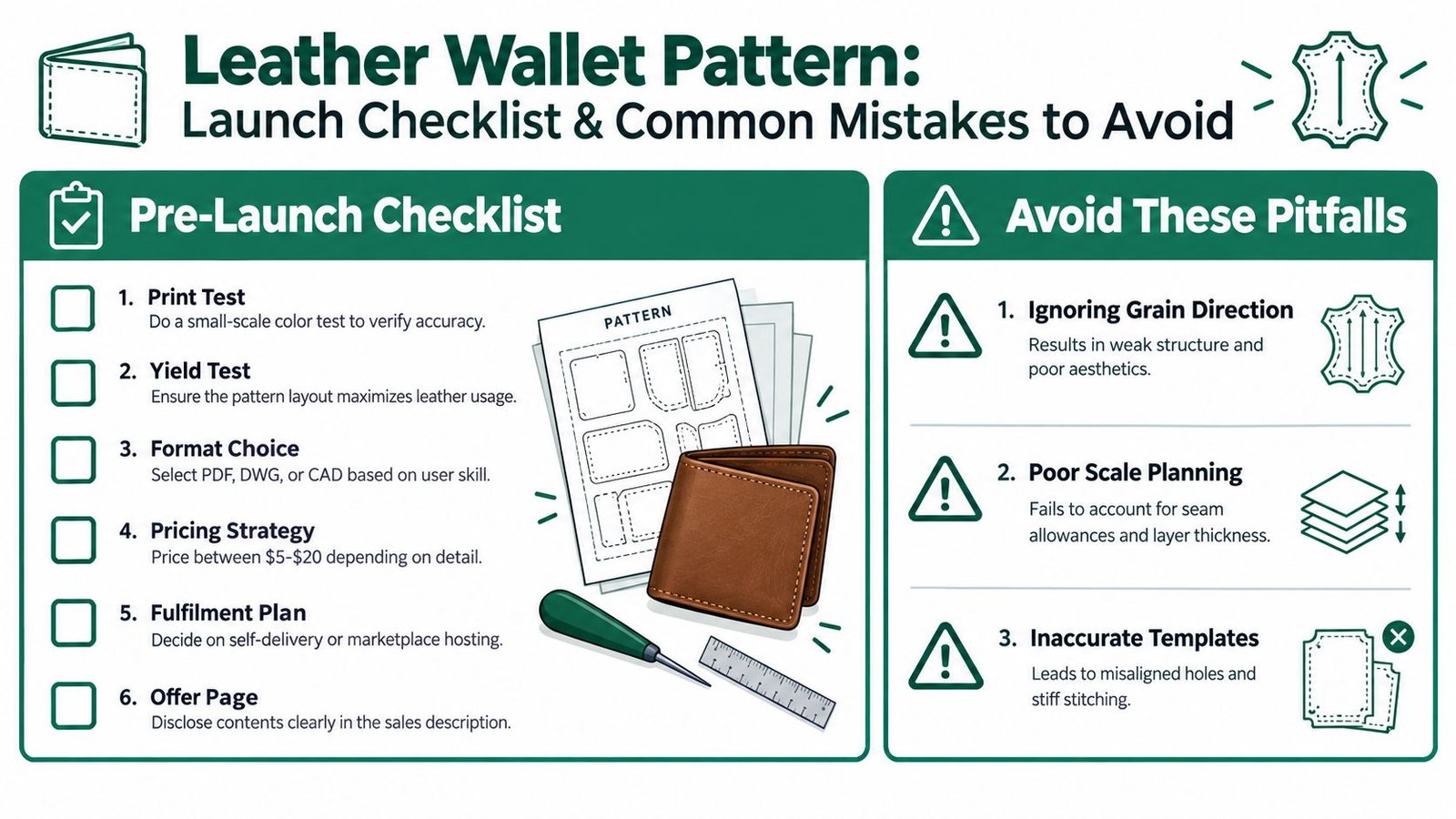
A seller should treat launch as a controlled test, not the moment a file is uploaded. The pattern needs a calibration print, a scrap assembly and a yield check. The listing needs a clear format, price, delivery method, support boundary and fulfilment window. The packaging needs to be weighed and measured in its final state.
The most common failures are practical:
- Scale omission: The PDF has no reference square, or the instructions fail to warn against “Fit to Page”.
- Yield blindness: The layout works on a clean sample sheet but wastes usable hide around defects and edge damage.
- Format confusion: A finished-wallet photograph makes a digital pattern look like a physical product.
- Missing parcel data: A physical kit has no recorded packed weight or dimensions.
- Unclear dispatch: The buyer can't tell whether the order arrives instantly or is posted later.
- Incomplete digital-content wording: Immediate access and the related cancellation-rights acknowledgement aren't handled clearly.
Before opening the listing to traffic, the seller should place one complete test order through the intended checkout and fulfilment process. The test should cover payment, file access or order confirmation, packing, delivery communication and the buyer's first support question. A friend can expose a missing instruction or unclear field without the reputational cost of leaving a stranger to discover it.
AmaJova gives sellers a single OfferLink for physical products and digital products, with space to define inclusions, pricing and fulfilment expectations before checkout. A leather wallet pattern seller can use it to connect the listing, order record and support process without building a full storefront, so visit AmaJova and prepare the complete offer before sending buyers to it.