

The buyer liked the first draft. Then a message arrived: "Just one more tweak." A week later there is a second logo, a rewritten ending and an unscheduled call. The fixed fee has not moved. The hours have.
That pattern is scope creep: work grows beyond what was agreed, without a matching change in price, time or outcome. It is not only a planning failure. It is a bargaining and cash-flow problem. Small favours feel polite in the moment and unpaid by Friday.
Knowing how to handle scope creep starts while the fee still covers the work. The guidance below covers warning signs, a change process, a written baseline, a way to classify each request, scripts that keep the relationship intact, and a short check before the next brief.
Table of Contents
- Spot Scope Creep Before It Eats Your Margin
- How to Process a Change Request Step by Step
- Write a Scope Baseline Before Work Starts
- Classify Requests as Included, Clarification or Extra
- Keep Every Approval Tied to the Order Record
- Confirm Your Scope Rules Before the Next Brief
Spot Scope Creep Before It Eats Your Margin
Say a designer delivers a homepage draft for a fixed fee. The buyer asks for a colour shift, then a new hero image, then a mobile layout that was listed as a later phase. Each ask starts with "quick" or "just". None of them has a price. By the third round the original fee is covering a different job.
Scope creep means the work has grown past the agreement and the price, the time or the outcome has not moved with it. The instinct is to treat that as a personal softness problem. The evidence points somewhere else. A peer review of optimism-bias research examined 7,043 projects and noted that significant scope changes are often cited as the main cause of substantial overruns. In the UK transport contracts it reviewed, scope change appeared in 88% of road contracts and 94% of rail contracts, and it was the primary driver in 72 of those 96 cases. The same pattern shows up on a one-person brief. Undefined edges get filled in after the price is locked.
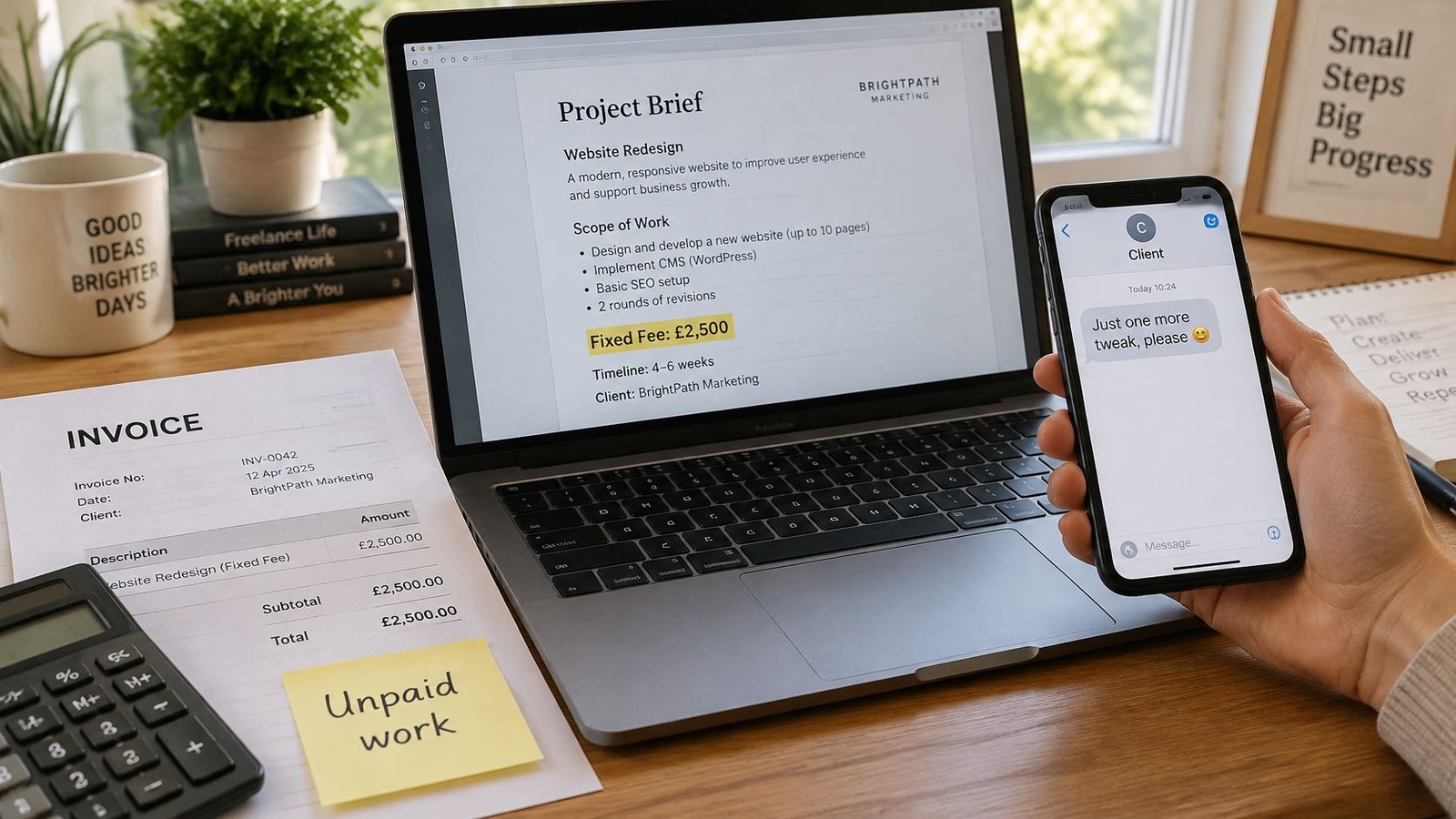
Five signals on a live job
| Warning sign | Typical example | What it usually means |
|---|---|---|
| Requests start with "quick" or "just" | "Just add a logo variation" | The scope was never written down, so each ask feels small |
| Work grows beyond the first brief | A single blog post becomes a series of five | The deliverables were never counted |
| Approvals happen only in chat | "Sounds good" sent after a call | There is no record to check against |
| Deadline moves without a new price | Launch date moved twice | The time impact has not been priced |
| Buyer expects work outside the offer | Free support call requested after delivery | Exclusions were not stated clearly |
A written list of deliverables, a named price for extras and a record of each approval stop those signals early. Pricing the boundary is part of the same job. A clear offer makes it easier to price your services before the first hour is spent, rather than discovering the gap on the invoice.
Practical rule: if the request would not have been obvious to a stranger reading the original offer, it is not included work.
Three questions for this week
On any live job, ask these before the next reply.
- Is there a written list of deliverables? Count, format and what "done" looks like.
- Has every extra been approved in writing? A call remark is not an approval.
- Has the deadline moved without a new price or date? Time is part of the fee.
A "no" to any of these is already a scope problem. Fix the record before the next favour lands.
How to Process a Change Request Step by Step
A usable change process is short enough that people follow it. Seven steps cover a logo tweak, an extra coaching call or a new file format. Each one exists because skipping it creates two versions of the promise.
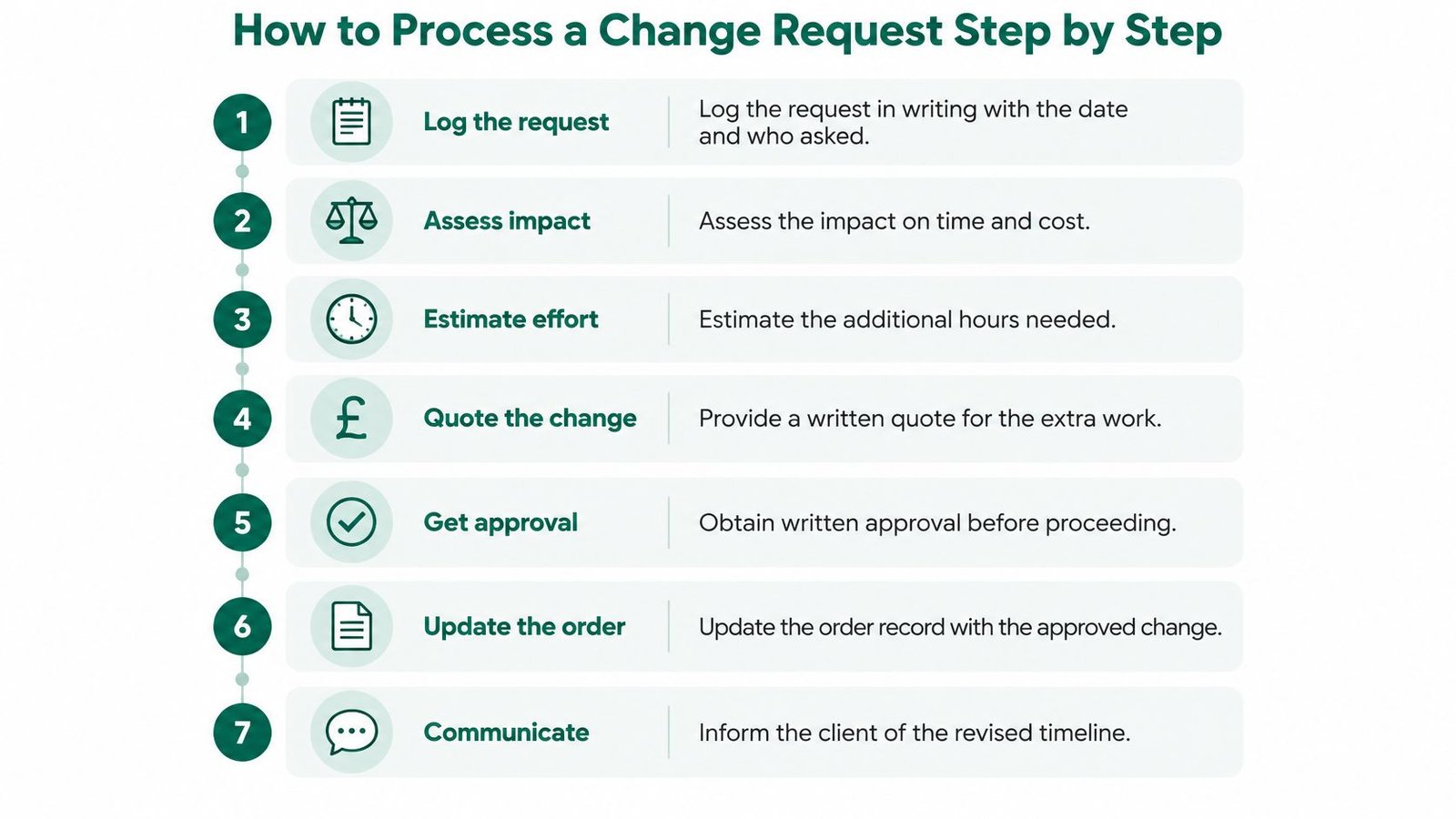
- Log the request in writing. Record the date, who asked and the words they used. A remark on a call disappears. The slip is starting the work while "I'll write it up later".
- Name the business reason. "Make it pop" often hides a launch date, a regulator or a buyer who has seen a competitor. Ask what outcome the change is meant to protect. Guessing the reason produces the wrong quote.
- Assess the effect before answering. Look at deliverables, timing, quality and price together. A new section can also push the review window and the payout date. The slip is pricing the typing and ignoring the knock-on.
- Classify the request. Mark it essential, beneficial, deferrable or outside the scope. Essential work that was already promised is not an extra. A nice-to-have can wait for a later order.
- Get approval from the person who can agree it. That is usually the contact who accepted the brief, not a colleague who "thought it would be fine". The slip is treating a forwarded chat as authority.
- Agree the revised plan. State the new deadline, the price and the acceptance test in one note. Without the test, "done" stays arguable.
- Update the original scope and confirm. Send a short note that the baseline has changed. The common slip is approving in chat and leaving the old document untouched, so two promises sit side by side.
A change note worth copying
Paste this, fill the blanks, and do not start until the buyer replies yes.
Change note
Added work: one extra homepage section, about 150 words, in the existing template.
Price: £90, payable before the section is drafted.
New delivery date: Thursday 18 June, assuming feedback within two working days.
Acceptance test: the buyer confirms the section matches the agreed outline and contains no new pages.
That note is the whole commercial boundary in four lines. Warmth can sit in the covering message. The numbers stay in the note.
Write a Scope Baseline Before Work Starts
Scope creep rarely arrives as one big ask. It arrives as small yeses, each cheap enough to feel polite, until the fixed fee has funded twice the work without anyone noticing. A scope baseline is the agreed description of what will be delivered, what will not, and how completion will be judged. Write it before the first hour of work, while goodwill is still doing the negotiating. Reconstructing it from chat after a dispute means bargaining backwards with the money already spent.
| Element | What to write | Example |
|---|---|---|
| Deliverables | Each output, with count and format | One 1,200-word article in Google Docs, plus a PDF export |
| Exclusions | What is not included, named plainly | Translation, stock images and social posts |
| Acceptance criteria | An observable test for done | Client confirms the draft meets the agreed brief outline |
| Revision limits | Number of rounds and what counts as one | Two rounds of text edits, with no new sections |
| Timeline | Start date, milestones and response window | First draft in 10 working days; feedback within 3 working days |
| Price of extras | Rate or fixed fee for add-ons, in writing | £40 for each extra revision round, agreed before that round starts |
The last row earns its keep. Pricing extras before anyone asks turns the next request into a buying decision with a number attached, instead of a favour you will resent by Friday.
The stranger test
Read the offer and the order as if you had never met the buyer. Could that stranger agree whether the work is finished? If the answer needs a phone call, the baseline is still a mood rather than a contract. Phrases such as "full support", "unlimited tweaks" and "as needed" fail the test every time: they sound generous and they have no edge. "Reasonable revisions" is just as soft until it becomes two rounds of text edits with a response window.
Could a stranger, reading only the offer and the order, say whether this job is finished?
For UK consumer sales, the description does legal work as well as marketing. The explanatory notes to the Consumer Rights Act 2015 record that traders must give specified pre-contract information, including the main characteristics of goods, services and digital content. Inclusions, deliverables and limits are therefore scope documents, and a later request that materially expands what was described is a proposed change to be priced and agreed. The Act also prevents the parties from contracting out of the consumer's statutory rights, so a baseline defines the deal without stripping those rights away.
Name exclusions in plain words. "Translation, source photography and scheduling the posts are not included" beats "other items may be extra". A clause that lets the seller vary the service at will is a weak basis for a baseline, because a scope that can change without agreement was never really agreed. When the work needs to change, propose the revision and get it accepted in writing before work continues. "The seller may vary the service as needed" is a blank cheque drawn on your own calendar.
The same clarity belongs in onboarding. Mazurly's eight steps to onboard new clients is a useful companion when the baseline has to be collected before work starts rather than remembered afterwards. Pair that checklist with a service agreement template so the baseline, the revision limit and the change route sit in one record. Attach that record to the order before payment is taken. A baseline that arrives after the money has moved is already an argument; written early, it is the machinery that turns "sure, I can do that" into "yes, and here is what it costs".
Classify Requests as Included, Clarification or Extra
A buyer sends “one quick tweak” at 4:40 on Thursday. It sounds small, so the easiest move is to absorb it and keep the goodwill. Every yes spends fee, though, and every no risks the relationship. The classification has to happen before the reply, while the request is still a choice rather than a quiet transfer of margin.
Research in construction often splits rework into two broad causes: changed orders, client changes and scope creep on one side, site conditions and unexpected challenges on the other. Service sellers meet a smaller version of that split. Some drift is sloppy boundary-setting. Some drift is the world moving after the brief was signed.
| Request type | Classification | Response |
|---|---|---|
| Typo or wording fix within the agreed text | Clarification | Absorb it and note it in the order record |
| Extra revision round beyond the agreed limit | Additional work | Quote the cost and get written approval |
| New deliverable not in the offer | Additional work | Price it separately and set a new delivery date |
| Change required by new rules or missing information | Justified change | Assess the effect and re-price if the deliverable or risk changes |
| Request that alters an approved outcome | Variation | Pause work and agree the revised scope before resuming |
| Repeated small asks that add up to more than the original brief | Cumulative creep | Total the requests, then offer a fixed-price add-on |
Included work is not an extra
There is a hard line between a genuine addition and poor performance. Government guidance on the Consumer Rights Act 2015 says a service must match what was agreed and be carried out with reasonable care and skill. Where it does not conform, the consumer may be entitled to have it put right or, where that is not practical, to a price reduction. Charging more because the original promise turned out harder than expected is a conformity problem, not a variation. Fix the typo inside the agreed text. Do not invoice it.
A justified change is different. I classify by evidence rather than tone, because a polite ask can still move cost, risk or acceptance.
- Was this reasonably foreseeable? A standard export format usually was. A rule that changed after purchase was not.
- Does it change the outcome, the risk, the acceptance test or the sequence? If yes, it sits outside clarification.
- What evidence supports it? A regulation, a missing file or a written buyer decision carries weight. A preference does not.
Keep a documented goodwill threshold, such as one small clarification per project inside the existing effort. Write that threshold on the order so the exception is a choice, not a habit. The second “tiny” ask, a new output, a moved deadline or compliance work that changes the risk becomes a formal variation.
When the small asks become a project
Five ten-minute favours are not five clarifications. Add the minutes, the new files and the extra calls before the next answer. If the total is larger than the original brief, stop absorbing and offer one fixed-price add-on. Use a reply that keeps the door open while the boundary stays visible: “I can do these as a bundle rather than five separate changes. It sits outside the agreed work, so I would add it at £X with delivery on DATE. Shall I put that on the order?” Pausing feels slower. It is cheaper than discovering the new project only when the fee is already spent.
Keep Every Approval Tied to the Order Record
Approvals scattered across email, chat threads and phone calls turn into disputed memories the moment a fee is questioned. The useful place for a yes is the order itself, next to the price and the delivery date, where both sides see the same record. The UK Big Freelancer Survey 2025 found respondents averaged 36% unpaid working hours, while 32% said more than half of their sector hours went unpaid. Most of those hours were never refused. They were agreed in places nobody could check later.

Three messages that hold the line
Do not apologise for the price. Acknowledge the request, state what is included, name the commercial effect, and ask for a yes or no.
Extra revision. "Thanks for the notes, they're clear. The offer includes two edit rounds, and both are used. A third round is £40 and moves delivery to Friday. Shall I add that to the order?"
New feature. "Happy to add the booking form. It isn't in the current pages, so it's a separate piece at £180, delivered five working days after you confirm. Want me to send that as a change on this order?"
Unplanned support call. "I can do a 30-minute call next Tuesday. Calls after delivery sit outside the original session, so this one is £60. If you reply yes on the order, I'll hold the slot."
Each script prices the request instead of refusing it, so the buyer always has a cheap way to say yes. A reduced-scope swap protects the fee the same way. "We can add the form if we drop the second landing page" keeps the total intact while the scope moves to what the buyer wants this week.
Why the order has to show the yes
A message that never reaches the order leaves two stories: the buyer remembers a promise, the seller remembers a maybe. On AmaJova, a revision request or dispute stops automatic completion of an order. If the buyer does not act, AmaJova may automatically complete the order after the applicable review period, unless a revision request or dispute has stopped completion. An agreed change that lives only in a side thread can leave that status unclear, so flag open changes before anyone treats delivery as closed.
Recording the request on the order is how both sides remember the same thing before any extra work starts.
Standard wording makes the habit cheap to keep. Teams that reuse a fixed format for change notes can browse document template strategies for reusable layouts, so the scope line, the price effect and the acceptance test are not rewritten from scratch each time. The same discipline applies on the platform. An order management workflow only protects the fee if the approval is visible on that order, not trapped in a side thread.
No work starts on a change until the buyer's acceptance is visible on the order. That single rule protects the fee and the relationship, because the buyer sees the boundary before the hours are spent, and the seller never has to argue backwards from a delivered extra.
Confirm Your Scope Rules Before the Next Brief
A weekly check beats a post-mortem. Six figures in a spreadsheet are enough. They show whether requests are priced before anyone starts, or whether the fee is subsidising the brief.
| Metric | What it shows | Act when |
|---|---|---|
| Changes handled before work starts | Share of requests approved in writing first | Any request has begun without approval |
| Open change ageing | How long requests remain unresolved | A request stays open beyond your response window |
| Approval cycle time | Days from request to decision | Decisions consistently take longer than agreed |
| Unpriced hours added | Time spent beyond the agreed scope | Any unpriced hours are recorded |
| Deadline slippage | Days moved from the agreed date | A date moves without a new one being agreed |
| Rejected-request rate | Share of requests declined | The rate rises, suggesting the baseline is unclear |
One in, one out
For a discretionary addition, use one in, one out. Every approved extra either raises the price or removes an equivalent deliverable, unless the seller knowingly accepts the cost and the schedule hit and writes that acceptance down. Silent acceptance is how a fixed fee becomes a donation.
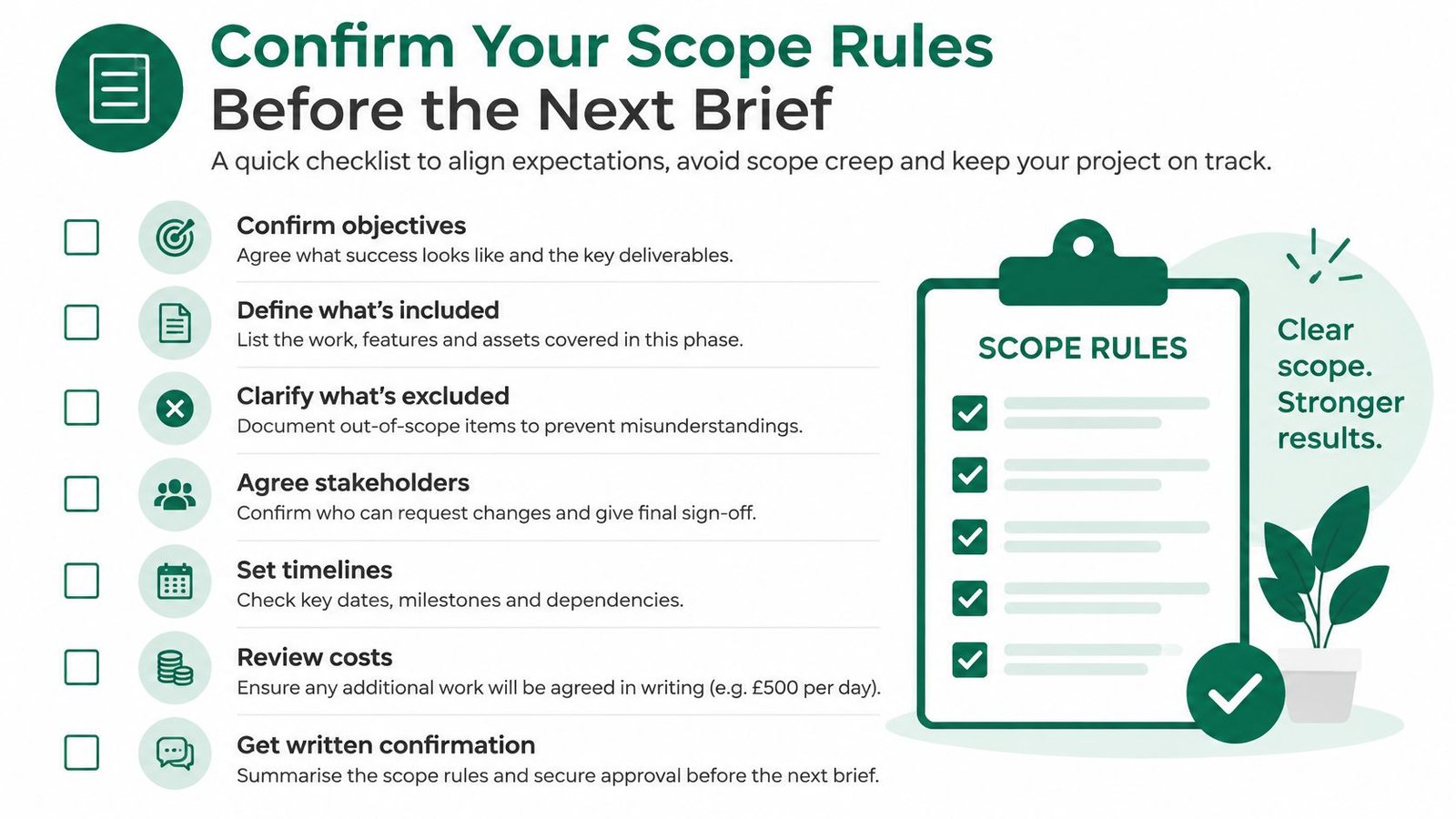
Five checks before the next brief
Run this list before payment is taken, not after the first "quick" message.
- Deliverables are counted. Number, format and file type are on the page.
- Exclusions are named. Translation, source files or extra calls are stated, not implied.
- The acceptance test is observable. A stranger could tell whether the work is finished.
- The revision limit and the extras price are stated. Rounds and pounds, not "reasonable tweaks".
- The change route is agreed. Who can approve, and that work waits for a written yes.
When creating an OfferLink, sellers can set boundaries, FAQs, optional extras, price and fulfilment on that single page, so the brief and the later order are describing the same job. Draft one change note this week and use it on a live request before answering in chat. That single note is the whole habit.
AmaJova turns a service, product, digital file or live session into one OfferLink, with the scope, the price and the fulfilment visible before anyone pays, and with messages and approvals kept on the order. That is a practical way to handle scope creep without losing the relationship or the fee. Visit AmaJova and set the boundary on the next offer before the first tweak arrives.