The most popular advice on how to start an online business with no money is to build a free website and start posting on social media. That puts the tools before the sale. A better starting point is an offer that a specific buyer wants and a seller can deliver.
No money means avoiding fixed costs, not pretending that costs disappear. An existing skill, a clearly priced result and a manageable paid test can provide a starting point. Stock, customer refunds, payment fees and delivery still need funding before promises become orders.
Table of Contents
- What Starting With No Money Really Costs
- How to Pick an Idea You Can Sell Within a Month
- How to Test Demand Before You Build Anything
- How to Package an Offer Buyers Can Trust
- How to Price Your First Offer
- Money and Admin to Sort Before Your First Sale
- Where to Find Your First Customers Without Ads
- Run Your First Paid Test This Month
What Starting With No Money Really Costs
Owner-run businesses aren't unusual. At the beginning of 2024, the UK had an estimated 5.5 million private-sector businesses, and 74% had no employees other than the owner or owners, according to the UK business population estimates.
That doesn't prove a business can launch without capital. It does show that hiring staff isn't a prerequisite. Similarly, 68% of UK businesses had a website in 2024, according to the UK Business Data Survey 2024, so a full storefront isn't universal.
Start-up costs: defer or fund
| Cost | Can it wait? | What to use at launch | When it becomes necessary |
|---|---|---|---|
| Website or online store | Yes | A single shareable offer page or an existing social profile | Once repeat orders justify a full shop |
| Software subscriptions | Yes | Free tiers of scheduling, design and document tools | When volume makes manual work costly |
| Stock for physical products | Only if unavoidable | Pre-orders or made-to-order production | Once paid orders prove demand |
| Payment processing fees | No | Built into every sale price | From the first sale |
| Insurance | Check first | Confirm cover for the activity before selling | Before taking the first paid job where cover is needed |
| Tax and record keeping | No | A simple log of sales and expenses from day one | From the first income |
| Paid advertising | Yes | Free channels and personal networks | After a tested offer converts |
Pre-orders aren't free working capital without obligations. Supplier payment dates, payment clearance and possible refunds must fit together. A seller shouldn't accept an order that requires money unavailable when delivery begins.
For someone struggling to identify an existing capability worth selling, Chicago Brandstarters' guide to bootstrap a business from existing skills offers a useful starting perspective. The practical distinction is between spending needed to deliver and spending intended to look established.
Spending rule: Fund anything necessary to protect a customer's money, delivery or promised result. Defer cosmetic improvements.
How to Pick an Idea You Can Sell Within a Month
A suitable first idea uses an existing skill, solves a problem for a named buyer and can be offered without a long development phase. A narrow service is usually easier to test than a broad business concept.
Idea types compared on cash, time and risk
The timings below are planning scenarios, not sales forecasts. They assume a seller already has the necessary skills and access to potential buyers.
| Idea type | Upfront cost | Time to first sale | Main risk |
|---|---|---|---|
| Done-for-you service | Time only if existing equipment and required cover suffice | Plan for days to a few weeks | Overpromising capacity |
| Digital download such as a template or guide | Time to create it using existing tools | Allow several days to weeks to make it; delivery can then be immediate | Low demand without an audience |
| Live session or consultation | Time only if existing equipment and required cover suffice | A days-long test is possible with reachable buyers | No-shows and gaps in the diary |
| Resale of physical goods | Stock that must be bought | Allow weeks for sourcing and testing | Unsold stock and returns |
A suitably qualified bookkeeper might offer a bounded health check for a sole trader rather than ongoing accounts support. A digital-product seller could develop a downloadable CV template for job seekers, with a preview showing its layout.
A consultant could offer a 45-minute session, as a hypothetical format, addressing a small business owner's specific decision. A physical-product seller might resell an item bought from a supplier, but must establish quality, delivery costs and purchase funding first.
Choose by constraints, not enthusiasm alone
- List three existing skills that people have paid for or requested help with.
- Name the buyer for each in a sentence, including the problem that buyer needs solved.
- Score each option from one to five for affordability, speed and manageable risk, with higher scores meaning a better fit.
- Select the highest-scoring option that could realistically be offered within a month.
AmaJova's guidance on choosing the best product to sell can help narrow the selection. Starting a fashion brand, by contrast, can involve stock, samples and audience-building before demand is clear.
Keep one idea active and park the rest.
How to Test Demand Before You Build Anything
A large online market doesn't validate an individual offer. Online sales represented 27.8% of retail sales in Great Britain in July 2024, according to the Office for National Statistics, but a new seller still needs evidence that particular buyers will pay.
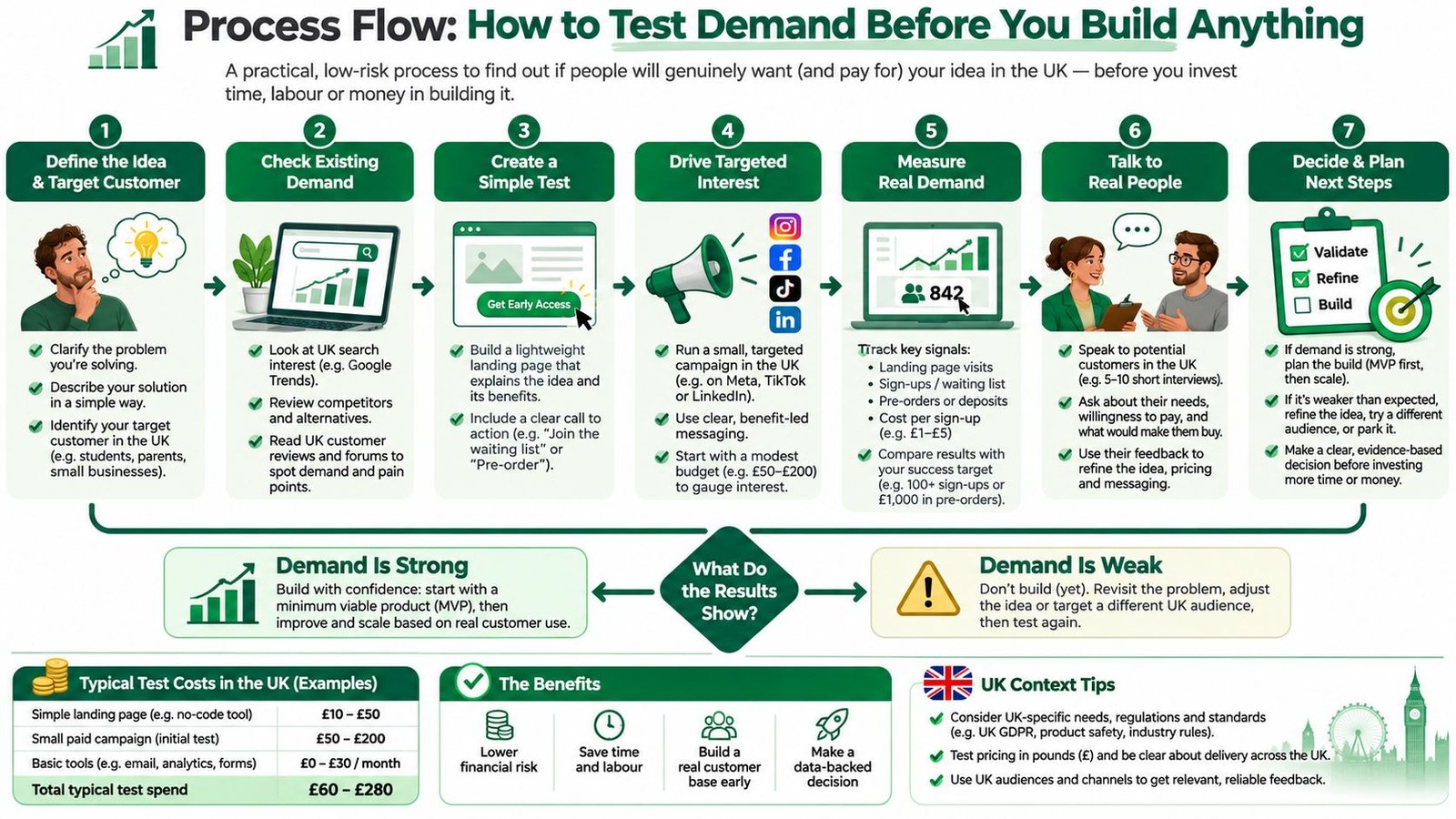
- Write the offer in two sentences. Identify the buyer and the result, rather than listing skills.
- Speak to ten relevant people as a practical test sample. Ask what they currently pay for and what repeatedly frustrates them.
- Request a concrete commitment. A paid pre-order, deposit or booked call is more informative than a compliment, although an unpaid call isn't proof of willingness to pay.
- Reach beyond friends through a relevant community. A manageable test might involve a useful post or permitted message each day, without spamming members.
- Set a target before starting. For example, a seller might aim for three paid orders within two weeks.
- Record replies, objections and price questions in a Google Sheet, including where each conversation began.
Any deposit or pre-order needs clear delivery terms and a stated refund position before payment. Find Startup Idea's budget startup ideas for 2026 can help refine an unsuitable concept, but browsing ideas shouldn't replace buyer conversations.
A passed test means paid demand arrived through a route the seller can repeat, not simply that friends liked the idea.
If people ask questions without buying, revise the offer. If nobody responds, reconsider the buyer or message; if objections consistently concern cost, investigate the price and perceived value.
How to Package an Offer Buyers Can Trust
An unfamiliar seller needs clarity more than elaborate branding. The offer should make the purchase understandable without a lengthy exchange of messages.
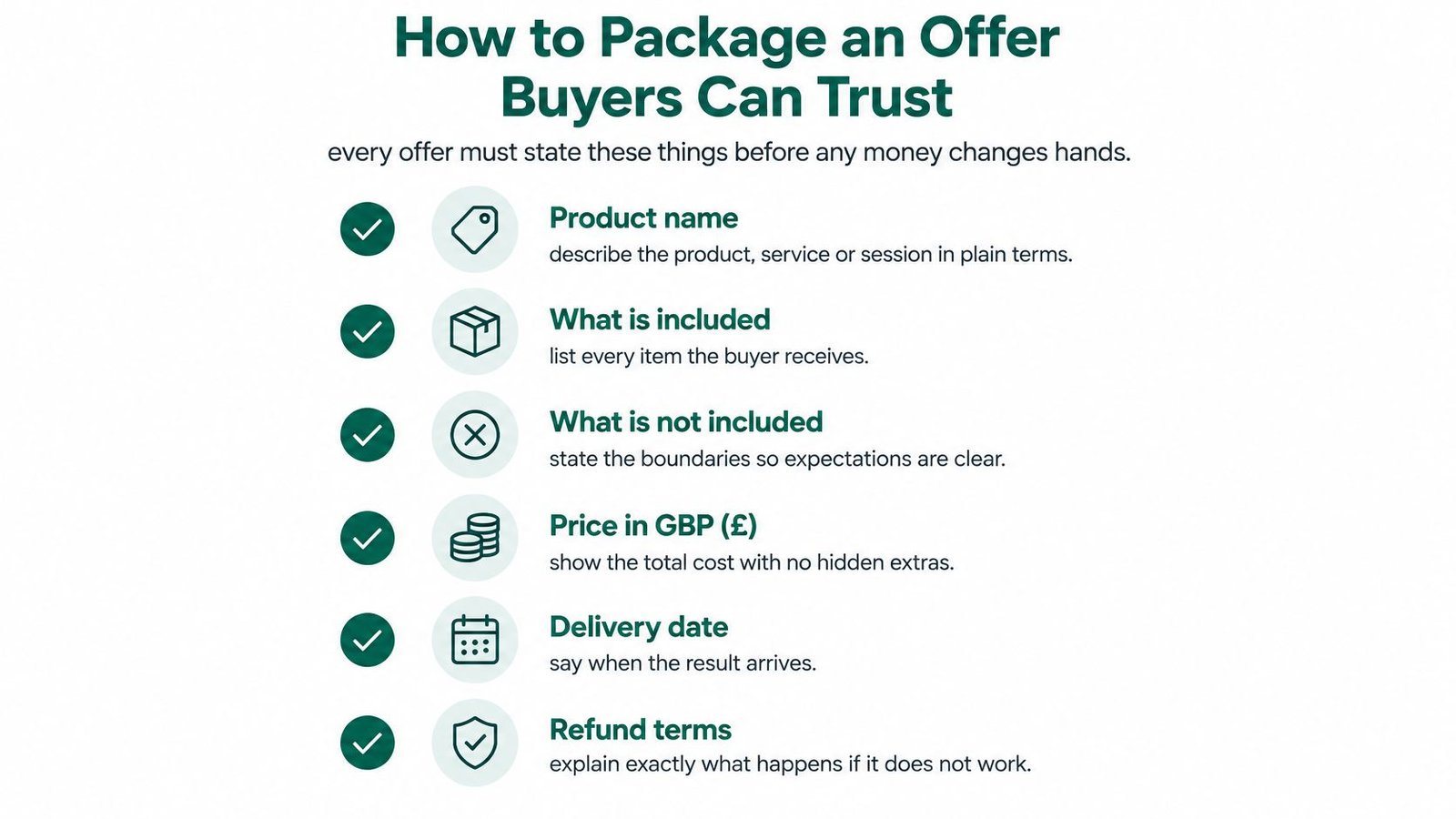
- Name the product, service or session in plain language.
- List everything included.
- State exclusions, such as travel, printing or additional research.
- Show the full price, including any fees the buyer pays.
- Specify delivery, including the date, timeframe, method or appointment.
- State the included revisions or booking changes.
- Provide a support contact and explain how buyers should raise problems.
- Add business identity details and applicable cancellation terms.
Under GOV.UK distance-selling guidance, consumers generally have 14 days to cancel, normally after physical possession for goods or contract formation for services; missing cancellation information can extend the cancellation period by up to 12 months.
For immediate digital downloads, GOV.UK online-selling guidance explains that losing the normal 14-day cancellation right requires express agreement to immediate supply and acknowledgement of that loss, alongside the required contract confirmation. Sending a file alone isn't enough.
Live sessions need appropriate booking terms, and starting services during a cancellation period requires care. Exceptions apply, so sellers should check the treatment of their particular contract rather than copying blanket no-refund wording.
AmaJova's guide to creating an irresistible offer helps organise the presentation. An AmaJova OfferLink can be created without a website, and sellers can start selling in minutes, although preparation and compliance checks still matter.
The test is straightforward: can a buyer establish what arrives, when it arrives and what happens if something goes wrong from the page alone?
How to Price Your First Offer
The first price should cover delivery before any marketing spend. Revenue isn't the same as money available to spend.
Establish a delivery floor
- Value the work. Estimate delivery time, including preparation, messages and administration, at an acceptable working rate.
- Add direct costs such as materials, stock, packaging, postage and essential software.
- Calculate transaction charges from the payment provider's published rate. If a fee is calculated as a percentage of the selling price, allow for that when setting the final price.
- Include a sensible allowance for refunds, cancellations and unpaid support.
That produces a planning floor, not a guarantee of profit. Unexpected work can still make an apparently profitable order uneconomic.
Check comparable offers across several competitor pages and listings, noting scope as well as price. A cheap template isn't a useful comparison for a customised service.
AmaJova's guide to pricing services provides further help with that comparison. During a pilot, test a sustainable price near the market range against an alternative closer to the floor, keeping the scope consistent and recording objections.
A lower price doesn't fix an unclear result or an unsuitable buyer.
Any pilot discount should have an explicit end date. As a practical review point, recalculate after the first ten orders using recorded delivery time, support work and refunds rather than the original estimates.
Money and Admin to Sort Before Your First Sale
Small-scale trading still needs records. Under HMRC's trading allowance guidance, individuals can receive up to £1,000 of gross trading income in a tax year under the allowance; above £1,000, they generally need to consider Self Assessment and choose between the allowance and actual allowable expenses, which can't normally be combined for the same income.
Gross income means receipts before expenses, not profit. The allowance applies across relevant trading income, so separate activities shouldn't each be treated as having their own allowance.
Set up a simple money routine
- Separate business receipts. Use a suitable account or sub-account whose terms permit the activity.
- Keep a monthly log of sales, processing fees, refunds and costs, with dates and order references.
- Save supporting documents. Retain receipts, invoices and evidence for costs that might be claimed.
- Set a reinvestment share only after allowing for fulfilment, potential refunds and the seller's tax position.
For service work, AurenWell's free estimate invoice template download can help distinguish an estimate from a request for payment. Each document should describe the actual scope and agreed terms, rather than relying on a template's default wording.
Collecting names, email addresses, delivery details or booking information involves personal-data processing. GOV.UK guidance on the data-protection fee states that organisations may need to pay the ICO unless exempt, with annual fees of £52 or £78 for most organisations.
Sellers should check their position with the ICO, explain how customer information is used and collect only what's needed. Customer money should remain available for the work and obligations attached to it, rather than being treated immediately as personal spending money.
Tax and data obligations depend on circumstances. The trading allowance isn't a guarantee that no tax is due; official guidance or an accountant should confirm the individual's position.
Where to Find Your First Customers Without Ads
The personal network is a practical starting point because existing contacts already know the seller. A specific request works better than a general announcement: a copywriter seeking introductions to independent retailers with unclear product descriptions gives contacts something concrete to act on.
Free and low-cost channels for first customers
| Channel | Cost | Best for | Watch out for |
|---|---|---|---|
| Personal network | Free | First buyers who already trust the seller | Vague requests get vague replies |
| Niche communities and forums | Free | Finding people with a specific problem | Breaking group rules with direct selling |
| Social profile posts | Free | Building visibility over several weeks | Slow start and inconsistent posting |
| Email to an existing list | Free to low | Repeat offers to people who opted in | Consent and unsubscribe rules must be met |
| Discounted pilot client | Reduced margin | Early testimonials and feedback | A permanent discount sets a price expectation |
Community participation should begin with reading the rules and answering relevant questions. A social profile can show useful samples over time, but posting without an offer or contact route leaves interested people without a next step.
Email needs particular care. An existing customer relationship isn't permission for unrestricted marketing; sellers should check applicable consent and electronic-marketing requirements, maintain an appropriate data-protection basis and provide an easy unsubscribe route.
Turn useful proof into a conversation
Consider a hypothetical freelance copywriter who posts three before-and-after rewrites, with permission, in a relevant group. Suppose that produces two enquiries and one paid job: the useful evidence is the completed sale and its source, not the post's popularity.
A discounted pilot can help obtain honest feedback and, with permission, a testimonial. The discount should have a clear end date and stated scope, and it shouldn't depend on receiving praise.
Record the channel against every enquiry and order in the sales sheet. Repeat channels that produce paid orders, and stop spending time on channels that generate only comments after a fair test.
Run Your First Paid Test This Month
A launch needs a calendar, not another collection of tools. A dated test keeps preparation bounded and makes the decision to continue or change less emotional.

The following is an example schedule starting on any chosen Monday:
- Week one, days one to seven: Select the strongest idea, hold the ten buyer conversations and enter actual dates in the calendar.
- Week two, days eight to fourteen: Prepare the offer page, complete the trust checklist and confirm that delivery can be funded.
- Week three, days fifteen to twenty-one: Share through three suitable channels and record replies, enquiries and orders by source.
- Week four, days twenty-two to twenty-eight: Count orders and enquiries, review delivery costs and write a single sentence identifying the next change.
AmaJova describes the seller process as Create, Share, Sell, Fulfil and Get paid. The journey to a completed order has four steps: create the offer, share the OfferLink, customers order and pay, then manage and fulfil the order.
The review rule is simple: paid orders mean repeat the productive channel; questions without payment mean adjust the offer; silence means reassess the buyer or message. One idea should remain active so the results stay interpretable.
The immediate action is to publish the first offer page and send it to the ten initial contacts before the end of the publishing week. An unpublished test produces no buying evidence.
AmaJova lets sellers present services, physical products, digital products and live sessions through a shareable OfferLink containing the offer, price and fulfilment details. For a first paid test without building a full website, sellers can visit AmaJova and create a clearly scoped offer ready to share with potential buyers.