
A release is finished, the distributor has it, and the link is sitting in a bio waiting to be clicked. Then the first month's figures arrive and nothing lines up. There's a stream count, a payout that doesn't match it, and no record of who bought what.
Selling music online gets framed as a promotion problem. Most of the difficulty is bookkeeping that should have been set up before the first sale: what the buyer was promised, when the files went out, which licence applied, and what the income was for. Build that structure and a release becomes a small, repeatable business. Skip it and every sale turns into a question answered from memory six months later.
Treat each sale as a record to keep from the first download, not a spreadsheet to reconstruct at the end of the tax year.
Table of Contents
- Choose the Route That Fits Your Music
- Prepare Your Files, Rights and Metadata
- Set Up a Direct Offer and Checkout
- Price Each Offer Type Sensibly
- Promote Releases Without Breaking Marketing Rules
- Keep Records for Tax and Fulfilment
- Launch Your First Offer and Track It
Choose the Route That Fits Your Music
The British Phonographic Industry (BPI) reported that the UK recorded music market generated £1.49 billion in revenue in 2024, up 4.8% from 2023. There is a paying audience. The trap is assuming market-level streaming revenue means streaming income for one artist: Ofcom counted 180 billion UK audio streams in 2023 (Ofcom Audio Report), and that volume flows through rights holders and platforms, not through a record the seller controls.
Five routes matter for a working musician, and they ask for different kinds of effort.
| Route | What the buyer gets | Main work for you | Best for |
|---|---|---|---|
| Streaming and distribution | Streams and playlist discovery | Metadata, licences and royalty tracking | Building audience reach |
| Direct download sales | Audio files sent by download or access link | Files, pricing, delivery and VAT records | Selling a finished release |
| Bundles and extras | Download plus stems, artwork or a limited item | Extra files and separate fulfilment | Engaged fans who want more |
| Commissions and lessons | Custom track, feedback or teaching | Scope, revisions and timelines | Musicians with time for one-to-one work |
| Live online sessions | Access to a timed session or virtual event | Booking details and scheduling | Performers and teachers |
Streaming and distribution exist to get the release heard. The other four put a transaction in front of a buyer, with a name, a date and a deliverable attached. That distinction is the one worth holding onto when a release is ready to go out.
A decision rule that holds up. With a finished release and an existing audience, start with one direct download sitting alongside the streaming release, then add a second offer only when the first produces orders without chasing. If each sale needs personal time, such as a commission, a feedback session or a lesson, cap how many are accepted each month before the diary fills and delivery slips. Where a fixed time is possible, live sessions give the fans who want interaction something a download can't match.
Three questions settle the route faster than any comparison:
- What can be delivered reliably on a bad week? A file is a promise kept in seconds. A commission is a promise kept over weeks.
- How many hours does one sale take, admin included? Count the emails, the revision, the invoice and the delivery, not just the creative work.
- Where do the existing fans already gather? A release pushed only through one platform misses the rest of the audience.
Distributors deliver releases to streaming and download stores; direct storefronts are ones the seller runs; booking tools handle sessions and lessons. Every provider sets its own fees, payout timings and terms, so read the published terms before committing a release to one. If AI-assisted tracks are part of the plan, release AI-made songs to streaming platforms properly through a distributor before building a direct offer around them, because an ownership question about the master kills a sale faster than a bad mix.
Prepare Your Files, Rights and Metadata
Files and paperwork get built once, before anything is listed. Fixing a rights problem after a sale means refunds, apologies and a dispute record.
The order matters more than the speed.
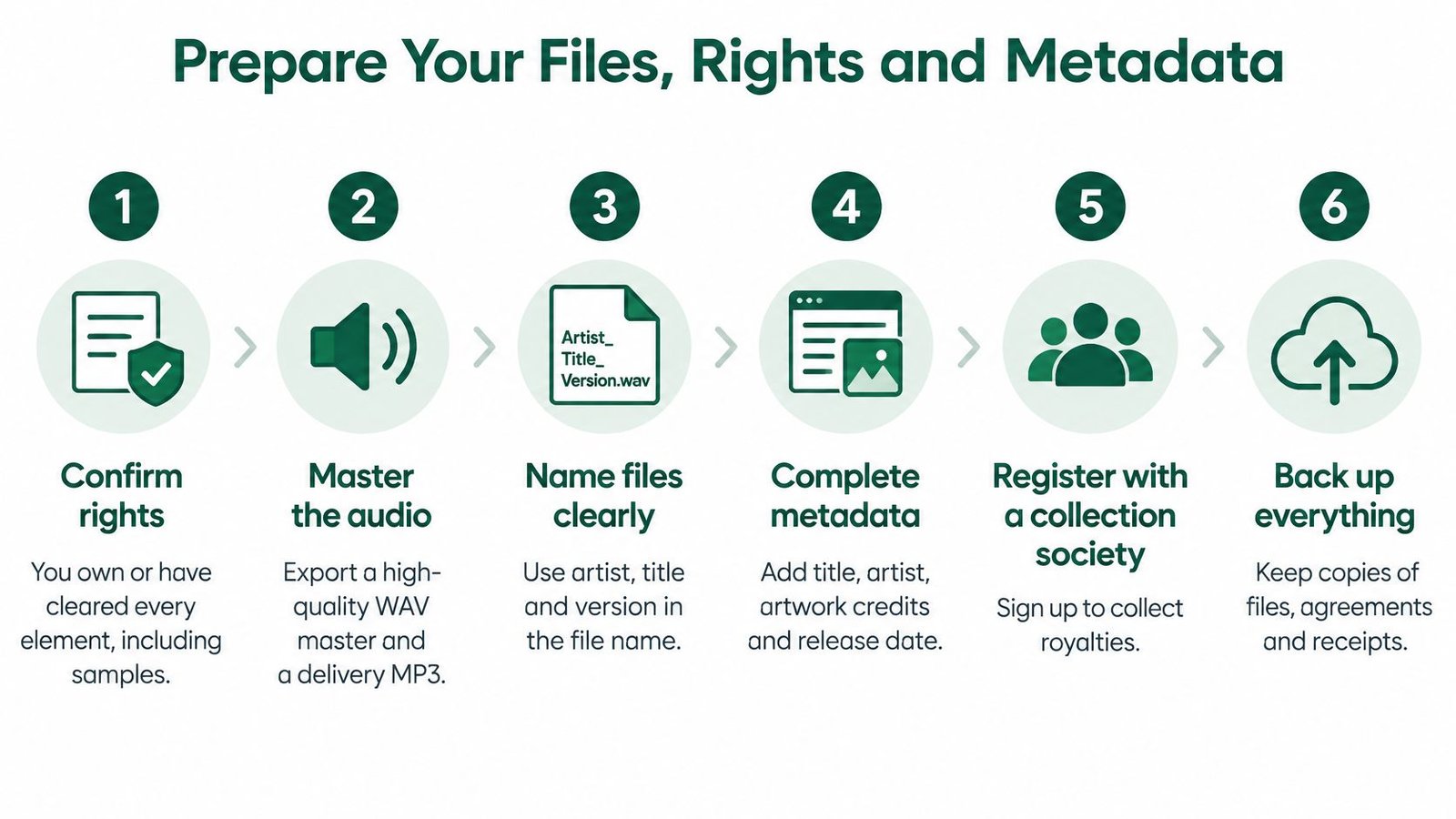
Seven things to fix before launch
- Confirm ownership of every element. Samples, featured performers, producer splits and any sample licences need to be clear before a price goes on the page. One uncleared loop can force a takedown after the money has moved.
- Export a master at the quality your distributor or store specifies, then make a 320 kbps MP3 preview for listening. Format rules change, so check the current specification rather than reusing last year's export settings.
- Name files consistently as artist, title, version and key or BPM. No buyer should ever receive two folders containing final_mix.
- Prepare square artwork at the size the store requires, with the artist name and title legible at thumbnail size. Artwork that reads well at 1,200 pixels and turns to mud at 80 pixels loses clicks.
- Write the metadata once and reuse it: artist name exactly as it should appear, track title, version, genre, release date, credits, and an ISRC if one has been assigned. House of Lyrics catalog verification steps are worth working through once a catalogue passes a handful of releases.
- Write down what the buyer may do with the audio. Personal listening, remixing and commercial use are three different products with three different prices. The licence decides what can be promised, and it belongs on the page before payment, alongside the wider intellectual property guidance covering splits and clearances.
- Build a delivery folder with one subfolder per format, so a support question about which file was sent gets answered by looking rather than guessing.
The test at the end of this stage is simple. Could a buyer who has never heard of the artist identify exactly what they're getting from the file names alone?
Responsibility for all of it sits with the seller. On a platform like AmaJova, sellers are responsible for lawful offers, accurate descriptions, fulfilment, required licences, verification, taxes and cooperation with transaction reviews, which is the same position as selling from a self-built site.
Set Up a Direct Offer and Checkout
One page, one price, one delivery method. The journey to a completed order has four steps: create the offer, share the link, the customer orders and pays, then manage and fulfil the order. In step one, the seller adds images, a description, the price and the details the buyer needs, and everything afterwards depends on those details being right. The six items below are what a working checkout needs before it goes live.
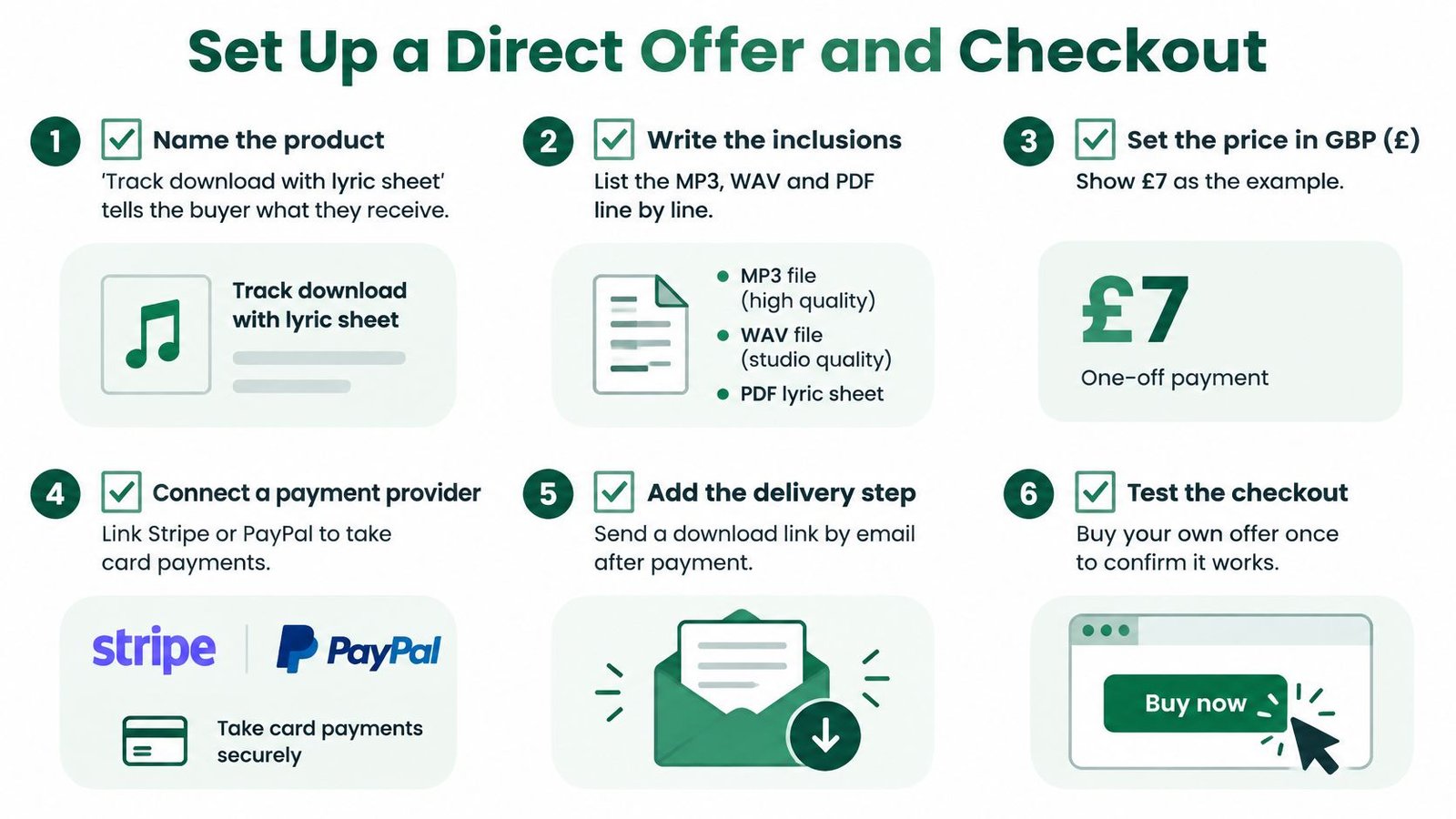
The order page in seven steps
- Name the product for what arrives. "Track download with WAV and MP3" tells a buyer something. "Music" doesn't.
- List inclusions line by line: formats, number of files, stems, artwork, and anything deliberately left out.
- State how and when the files arrive, whether through the order record, a download link or email, and what happens if the buyer's mail provider filters the message.
- Set the price and say whether VAT is included, in the currency the buyer will be charged.
- Handle the cancellation position properly, which is covered below.
- Add a support route with a realistic turnaround, such as a monitored address and a stated reply window.
- Place a test order and check the confirmation email, the file and the order status from the buyer's side before announcing anything.
Where the cancellation right bites
Under the Consumer Contracts Regulations 2013, a download supplied without a tangible medium carries a cancellation period of 14 days from the day after the contract is entered into. Supplying it immediately requires the buyer's express consent to start during that period, plus an acknowledgement that the right to cancel will be lost. Without both, the buyer keeps the cancellation right, and where supply started anyway, the buyer bears no cost for the content if the contract is cancelled.
That's why the order step needs a separate, unticked confirmation recording consent to immediate access and the loss of the right to cancel. Folding it into a general terms acceptance is the mistake.
Practical rule: before paying, the buyer should be able to answer three questions. Will I get a file, when will I get it, and what happens if it goes wrong.
Clean inclusions and delivery evidence do most of the work when a payment is disputed later. Preventing chargebacks is a page-design task before it's ever a support task.
Price Each Offer Type Sensibly
| Offer type | What the buyer receives | Work to deliver | Pricing logic |
|---|---|---|---|
| Single track download | Master audio in one or two formats | Export, file checks and delivery | Compare with similar releases on store pages |
| Album or EP bundle | Full set of tracks plus artwork | Sequencing, metadata and packaging | Price below the total of the separate tracks |
| Stems or sample pack | Separate audio elements and licence terms | Export, licence drafting and support questions | Price by value to producers, not your hours |
| Custom commission | Bespoke track to an agreed brief | Brief, drafts, revisions and delivery | Price by hours, plus a revision allowance |
| Remote feedback session | Written or recorded feedback on your track | Listening, notes and call time | Price per session with a stated length |
| Live online session | Timed access to a performance or teaching slot | Preparation, hosting and follow-up | Price per session, adjusted for group size |
A price has to come from the work behind the offer, not from a stream count. Streams measure listening. They don't reveal what a buyer will pay for a file they keep or a session they book.
Single downloads sit near comparable releases visible on store pages. A bundle should cost less than buying the parts separately, because the buyer is trading choice for convenience. Stems and sample packs get priced by what a producer can build with them, which has little to do with export time. A commission priced like a download becomes a job that pays less than minimum wage once the third draft is requested.
Mistakes repeat across almost every catalogue:
- Pricing a commission like a download. The hours are the product.
- Forgetting that revisions cost time. Build one extra round into the fee and state it.
- Treating stream counts as a sales forecast. It leads to stock, packaging or studio time bought against an audience that may never convert.
On VAT, GOV.UK states that supplies of digital services to UK consumers are liable to UK VAT (guidance on digital services to private consumers). Treatment depends on the product, the customer's location and the seller's VAT status, so a download and a vinyl LP need separating in the records, and the position should be confirmed with HMRC or a qualified adviser before a consumer price is published. The checkout should state whether the displayed price includes VAT.
The final test is a price you would still accept if every buyer asked for one extra change.
Promote Releases Without Breaking Marketing Rules
A release week often starts with one post and ends with a fan asking where to buy the file. Promotion has one job: move that listener from a platform you do not control to a page they can pay on. Posts that only collect likes do not do that.
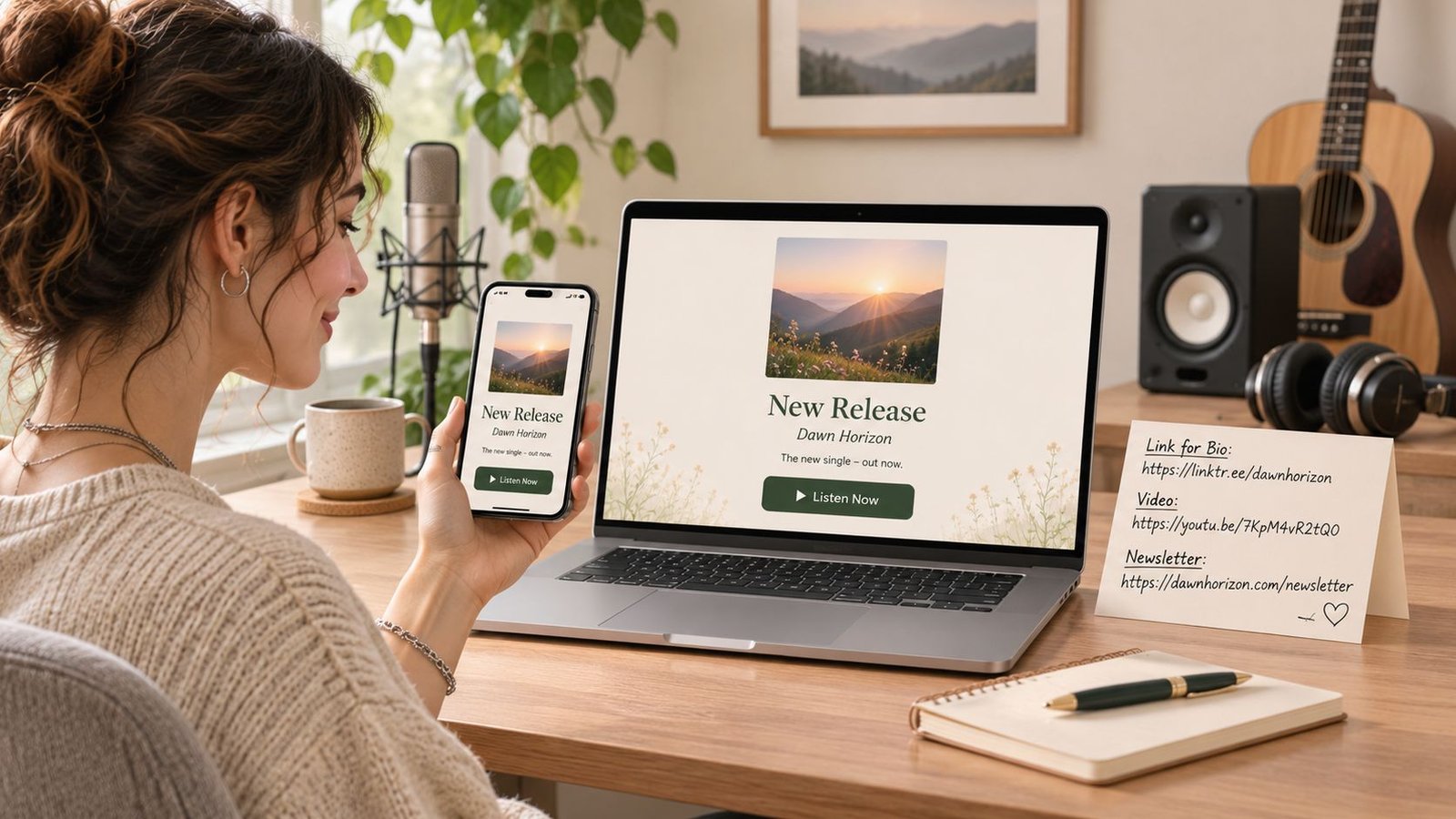
I would treat every placement as something you can later match to an order. Use one offer page per release, shared through a single link in the profile bio, a video description, a message or an email footer. Give each placement its own campaign tag, such as utm_source and utm_medium, so the order trail shows which post produced a sale. Short clips work when they play the track and name the purchase in the same breath: the download, the bundle, the session. A live session in release week gives people a second reason to come back. Put the booking instructions on that same page so the sale and the session stay on one record.
Email consent, as a checklist
Emailing fans about a release, a paid download, a ticket or a session is direct marketing. PECR stops you sending unsolicited marketing emails or SMS unless the person has already consented, and that consent must be an active, specific and informed choice (ICO guidance on electronic mail marketing). Silence is not consent. Failing to opt out is not consent either.
A list that will stand up later looks like this:
- An unticked opt-in at signup, never a pre-filled box.
- A sentence naming the sender and what will arrive, including the kind of marketing.
- A record of when and how consent was given, stored with the subscriber, the same way you keep a delivery note with an order.
- A working one-click stop, usable without logging in.
A delivery email is not a marketing email. The download confirmation or booking receipt goes out whether or not the buyer agreed to hear about anything else.
Three mistakes produce most of the complaints: pre-ticked boxes, mailing a buyer about an unrelated offer because they once bought a download, and hiding the unsubscribe route. Keep the consent log from the first signup. Reconstructing it after a complaint is the harder job.
Keep Records for Tax and Fulfilment
A download sale needs more than a payment receipt. Keep a record of what the buyer ordered, the licence terms shown before purchase, the payment, and the file or access supplied. That trail helps you reconcile income and respond if a buyer queries the order.
The rules, in the order they bite
UK guidance says that trading income above the £1,000 trading allowance generally needs to be reported to HMRC. Self-employed musicians may also owe Income Tax and National Insurance on profits. Check the current Musicians' Union guide to tax and National Insurance and GOV.UK for rules that apply to your circumstances.
Tax records and fulfilment records answer different questions. The first tracks income and allowable costs; the second shows what was sold and whether it was delivered. Keep both, and ask a qualified adviser if you are unsure how to treat a particular sale.
A monthly routine that takes an hour
- Reconcile orders and delivery. Match each paid order to its delivery evidence, such as the file or access supplied. AmaJova creates an order record after payment, and sellers provide digital files or access through that record.
- Label sales by offer type. Separate downloads, bundles, commissions, lessons and sessions so you can compare income by category when reviewing prices.
- Log costs against the same period. Record distribution and platform fees, software, studio hire, equipment and session-hosting costs.
- Set aside money for tax. Transfer an amount based on your own circumstances before the takings blend into general spending.
- Review pending payouts and disputes. Keep their status clear alongside completed orders, rather than treating every order as already paid out.
For each download, retain the licence terms the buyer saw, the order details and evidence of delivery. For a service or session, keep the agreed scope and completion details with the order. AmaJova's guide to selling digital products in the UK covers the sales process; your records should make each transaction traceable from payment to fulfilment.
Launch Your First Offer and Track It
Four weeks takes one release from files to a live offer with data behind it. These dates assume a Monday start.
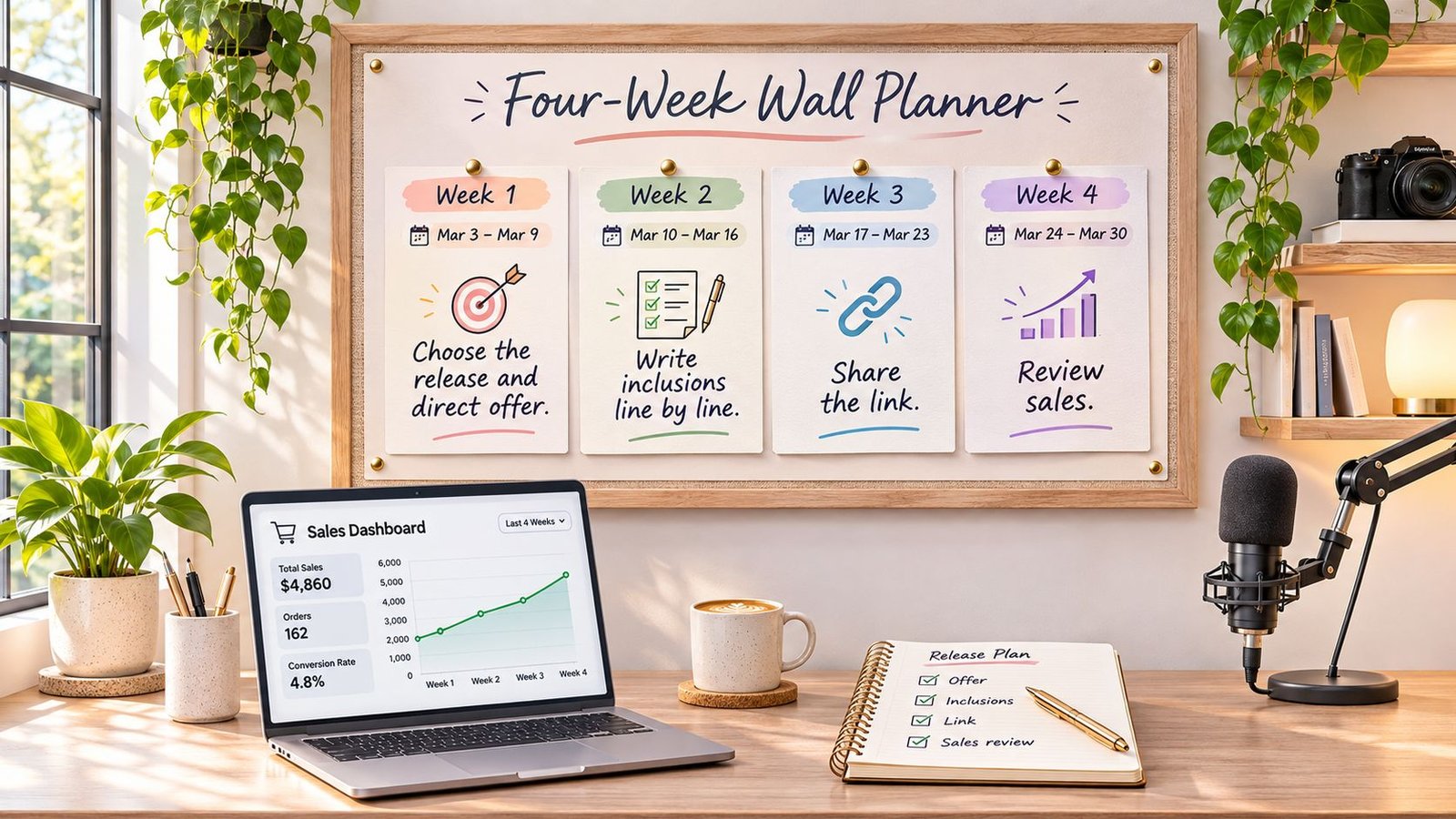
Week one. Choose one release and one direct offer. Write the inclusions line by line, then add the immediate-supply consent and cancellation acknowledgement to the order step. Nothing gets built until someone who has never heard of the artist can read the description and know what they're buying.
Week two. Build the page. An OfferLink can be created without a website, and AmaJova brings the offer, price, seller information, fulfilment details and a secure way to pay into one place; that single link then goes in a bio, on socials, in messages, in email or on an existing site. Place a test order and check the delivery email, the file and the order status from the buyer's side.
Week three. Share the one link in the profile bio, in one short video, and in one message to fans who have already opted in. Give each placement its own campaign tag so a completed order traces back to the post that produced it.
Week four. Review the period: landing-page visits, checkout starts, completed orders, refunds and average order value. Change one thing only, whether that's the price, the description or the promotion, and write down what changed.
The log matters more than any single week's result. One line per week stating what was changed and what happened turns the next launch into a decision made from evidence rather than a guess about why last time felt quiet.
AmaJova turns a digital release, a bundle or a bookable session into a single OfferLink carrying the price, the inclusions, the fulfilment details and a secure checkout on one page, with the order record kept alongside it once payment clears. If the admin behind each sale is what's been slowing releases down, that's the piece worth fixing before the next one goes out. Build the first offer at AmaJova.