

An order has been paid, the parcel dispatched or the session delivered, and a bank notification arrives saying the buyer disputes the payment. The seller now has to prove what was purchased, what the buyer agreed to and what happened, often while searching through emails, calendars and payment records.
For online sellers learning how to prevent chargebacks, the most useful change is to start that record before fulfilment. Fraud screening matters, but so do recognisable charges, precise delivery promises and evidence that answers the buyer's actual complaint.
Table of Contents
- Set Up Offers Buyers Understand Before They Pay
- How to Screen Orders Before You Fulfil
- Timing Rules for Services, Sessions and Digital Access
- Friendly Fraud, Bank Statements and Pre-Dispute Alerts
- Evidence to Keep for Each Dispute Type
- Put Your Prevention Checklist Into Practice
Set Up Offers Buyers Understand Before They Pay
A buyer who can't explain what a payment covers is already a dispute risk. A polished sales page won't help if the package name is vague, the delivery date is missing or the checkout total differs from the advertised price.
The scale makes these details worth getting right. UK-issued debit and credit cards were used for 31.4 billion transactions worth more than £1 trillion in 2024, according to figures cited by SecurityBrief's reporting on UK payment disputes.
Before payment, the offer should identify the item or service, the recognisable seller name, the total cost, the delivery or access method, and the relevant start date. Cancellation and rescheduling boundaries belong beside that information, not buried in a separate document.
Details to state before payment, by offer type
| Offer type | State before payment | Dispute it helps prevent |
|---|---|---|
| Physical product | Item, variant, total price, delivery cost, dispatch timing, returns terms | Non-receipt and not-as-described claims |
| Digital product | File format, licence scope, download or access method, consent to immediate supply | Non-delivery and unexpected digital charges |
| Service or coaching | Scope, number of sessions, start date, booking steps, cancellation and rescheduling rules | Service-not-received claims |
| Live session | Date, time zone, joining method, recording policy, attendance and no-show rules | No-show and did-not-attend disputes |
Scope needs boundaries as well as inclusions. A design service should distinguish the deliverable from optional revisions. A downloadable resource should distinguish a file purchase from personal support, future updates or permission to redistribute it.
For service sellers, AmaJova's guidance on how to write a service description provides a useful starting point for making those distinctions explicit. The description should use language the buyer understands, rather than internal package names or unexplained technical terms.
Practical rule: A buyer who only skims the page should still understand what will arrive, how it will arrive and what isn't included.
Any buyer-paid fee should appear before confirmation and be included in the checkout total, rather than introduced afterwards. On AmaJova, a Buyer Service Fee appears at checkout only when the seller passes it on, and it's shown clearly before payment confirmation.
A useful page test is to ask someone unfamiliar with the offer to describe the purchase and its next steps. Any hesitation identifies wording that needs attention before another buyer pays.
How to Screen Orders Before You Fulfil
An approved payment isn't a reason to release every order immediately. UK Finance reported that card-not-present fraud cases rose 13% to approximately 3.2 million in 2025, as cited in ExpertSure's overview of UK chargeback fraud.
Screening should happen while the seller can still stop dispatch, delay a booking or withhold digital access. The decision should combine signals rather than treating an unfamiliar address or expensive order as proof of fraud.
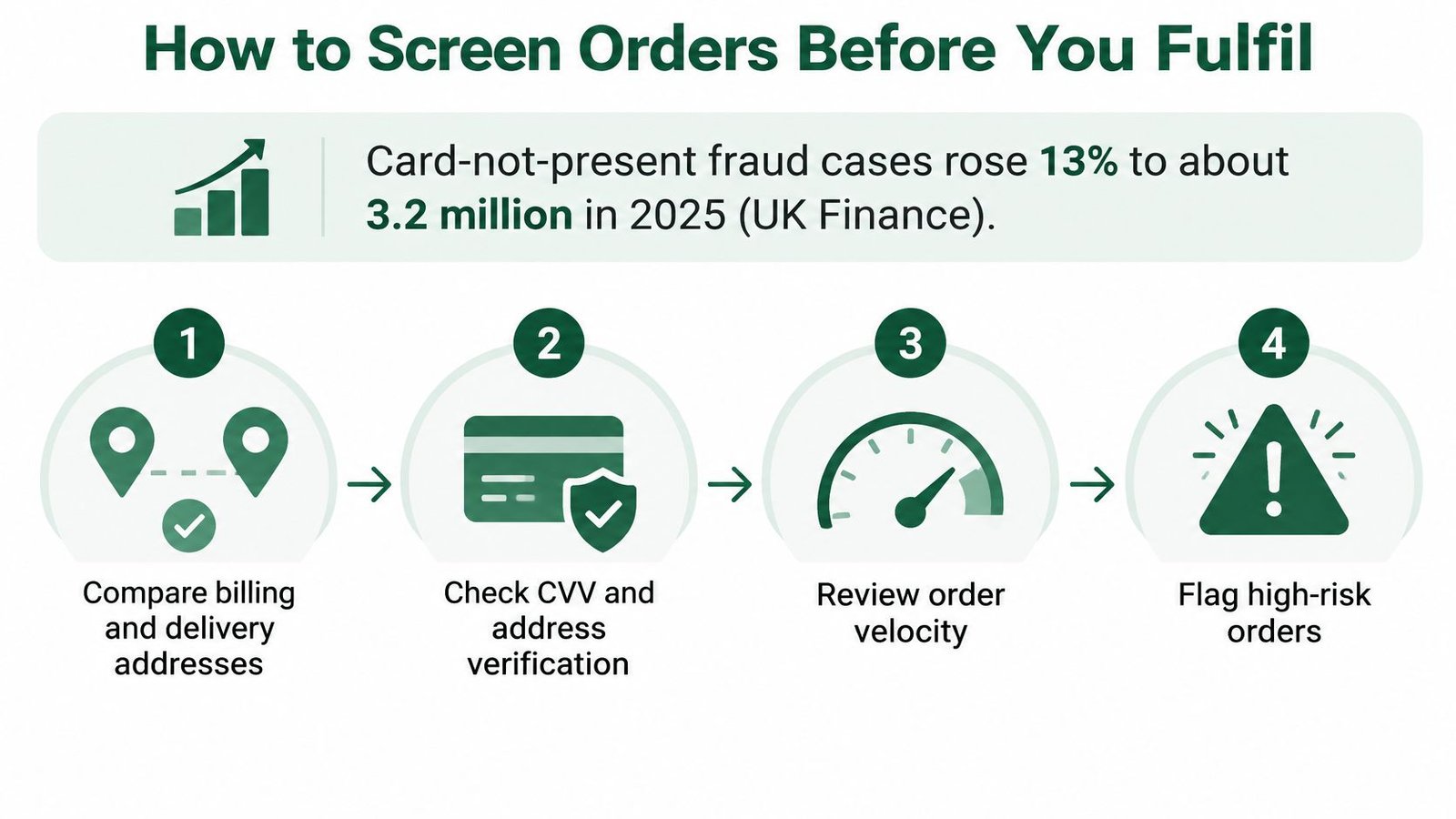
Checks that support a defensible decision
Compare the order with normal sales. An unusually large quantity, unexpected basket value or first-time purchase of a high-value offer deserves closer review. The question is what makes the order unusual, not whether the buyer is new.
Check consistency across the details. Billing information, email, delivery address and country should make sense together. Different billing and delivery addresses can be legitimate, particularly for gifts. Digital sellers have no courier handover to corroborate delivery, so account and email continuity deserve particular attention.
Review payment attempts and order velocity. Several declined cards followed by a successful payment, or repeated purchases associated with the same device, email or IP, should trigger investigation. Looking only at the final successful attempt hides useful context.
Confirm the authentication result. Strong Customer Authentication or 3-D Secure should be completed where the payment flow requires it. AVS and CVV outcomes add context, but 3-D Secure isn't complete chargeback protection: authentication doesn't establish that goods matched their description or a service was delivered.
Hold high-risk orders before fulfilment. Manual review should resolve a specific concern, such as inconsistent purchaser details or unexplained repeat attempts. A blanket hold on every unfamiliar customer creates delays for genuine buyers without making the review more intelligent.
Record the decision. The order history should explain why an order was held, released or cancelled. A reviewer's conclusion is much more useful when it identifies the signals considered.
Hold-or-release log fields
| Field | What to record |
|---|---|
| Order reference | The order the decision applies to |
| Checks triggered | Which of steps 1 to 4 flagged the order |
| Decision | Hold, release or cancel |
| Reason | One sentence explaining the decision |
| Reviewer and date | Who made the call and when |
The log should retain payment-provider results, not raw security credentials. A CVV outcome is useful evidence; asking a buyer to send full card details isn't an appropriate verification shortcut.
For appointment-based businesses, an online booking and payment system should be assessed against the practical workflow: can the seller identify a held order before preparation or service delivery begins? Screening that happens after the work is finished comes too late to prevent that loss.
Timing Rules for Services, Sessions and Digital Access
Consider a hypothetical coach taking payment on 3 March for six sessions starting on 2 June. The purchase record should capture the booking method and promised start date immediately, rather than leaving the buyer to infer when coaching begins. On 1 June, the coach sends the joining details, then records the appointment confirmation before each session and attendance or non-attendance afterwards.
Those records establish a sequence: purchase, instructions, availability and performance. A payment receipt alone can't explain whether the coach made the service available or whether the buyer knew how to attend.
Cancellation rights and performance dates are different questions
For many online service and digital-content contracts, the cancellation period ends 14 days after the contract is entered into, under the Consumer Contracts Regulations. That's a UK compliance checkpoint, not a universal no-refund rule.
Digital content supplied without a physical medium has specific requirements when supply begins during that period. The buyer must give express consent, acknowledge the loss of the cancellation right when supply starts, and receive the required contract confirmation under the digital-content provisions of the regulations.
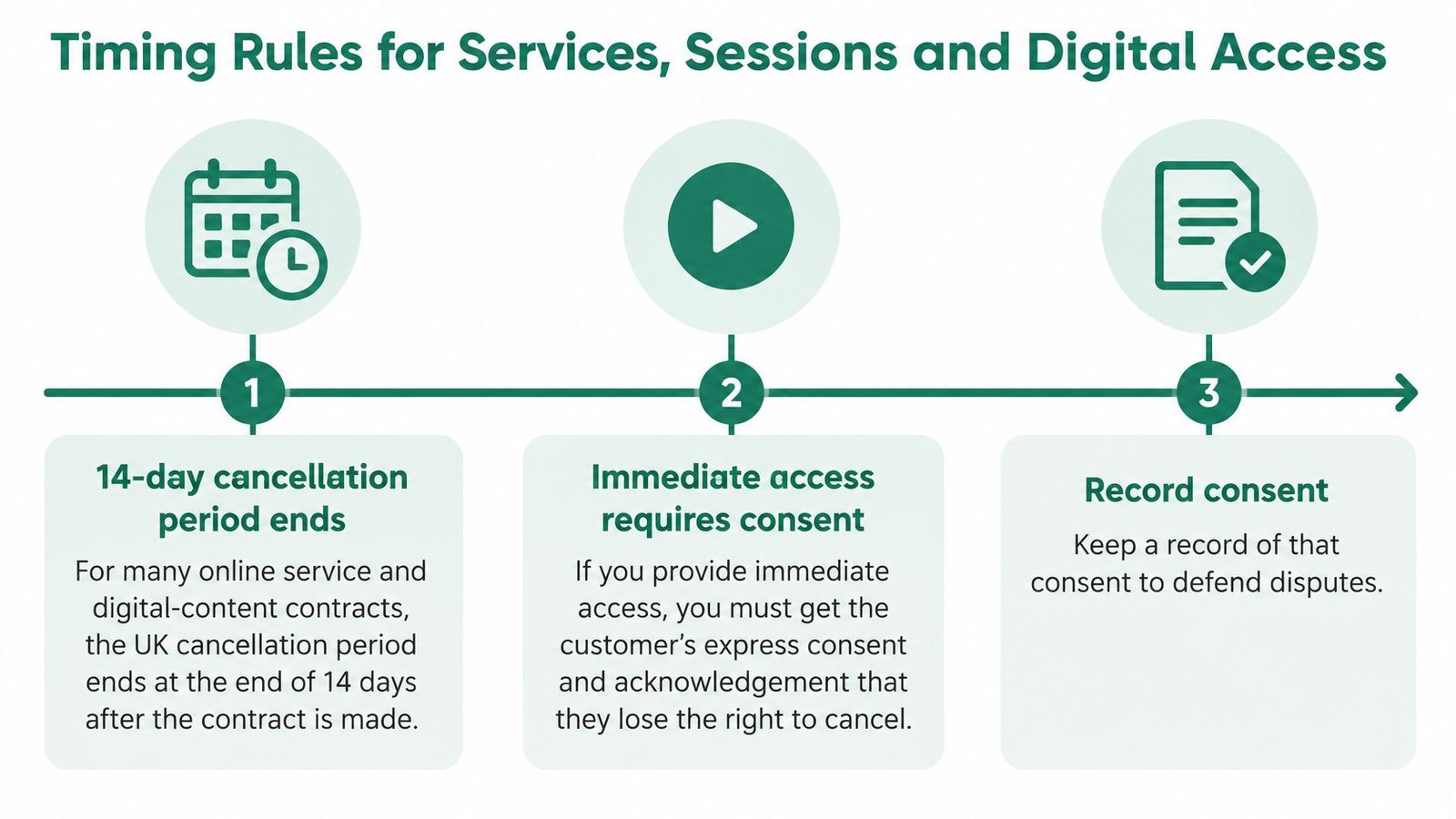
The consent wording, acknowledgement, timestamp and accepted offer version should be preserved together. A generic acceptance of terms shouldn't be treated as a substitute for the specific digital-content requirements.
Promises need measurable boundaries
For ongoing services, availability promises also need definition. Recepta.ai's discussion of uptime promises for receptionist services is a useful comparison when drafting service-level commitments: a seller should distinguish promised availability from response times, exclusions and remedies.
A promised date establishes what the buyer can expect. A dated activity record helps establish whether the seller met that promise.
On AmaJova, buyers can open a dispute during the applicable dispute window for their purchase. When a buyer doesn't act, AmaJova may automatically complete the order after the applicable review period, unless a revision request or dispute has stopped completion.
Sellers should check cancellation exceptions, early service performance and cross-border contracts against the applicable law. Where the wording affects consumer rights, a qualified adviser should review it rather than relying on a blanket cancellation clause.
Friendly Fraud, Bank Statements and Pre-Dispute Alerts
A buyer sees an unfamiliar statement entry, assumes it is fraud and contacts their bank. The purchase may be legitimate: a shared card, a forgotten order or an unclear billing descriptor can make a real transaction hard to recognize. Some buyers also dispute a charge and later recognize it as legitimate. Sellers should make the connection clear before a customer has to investigate.
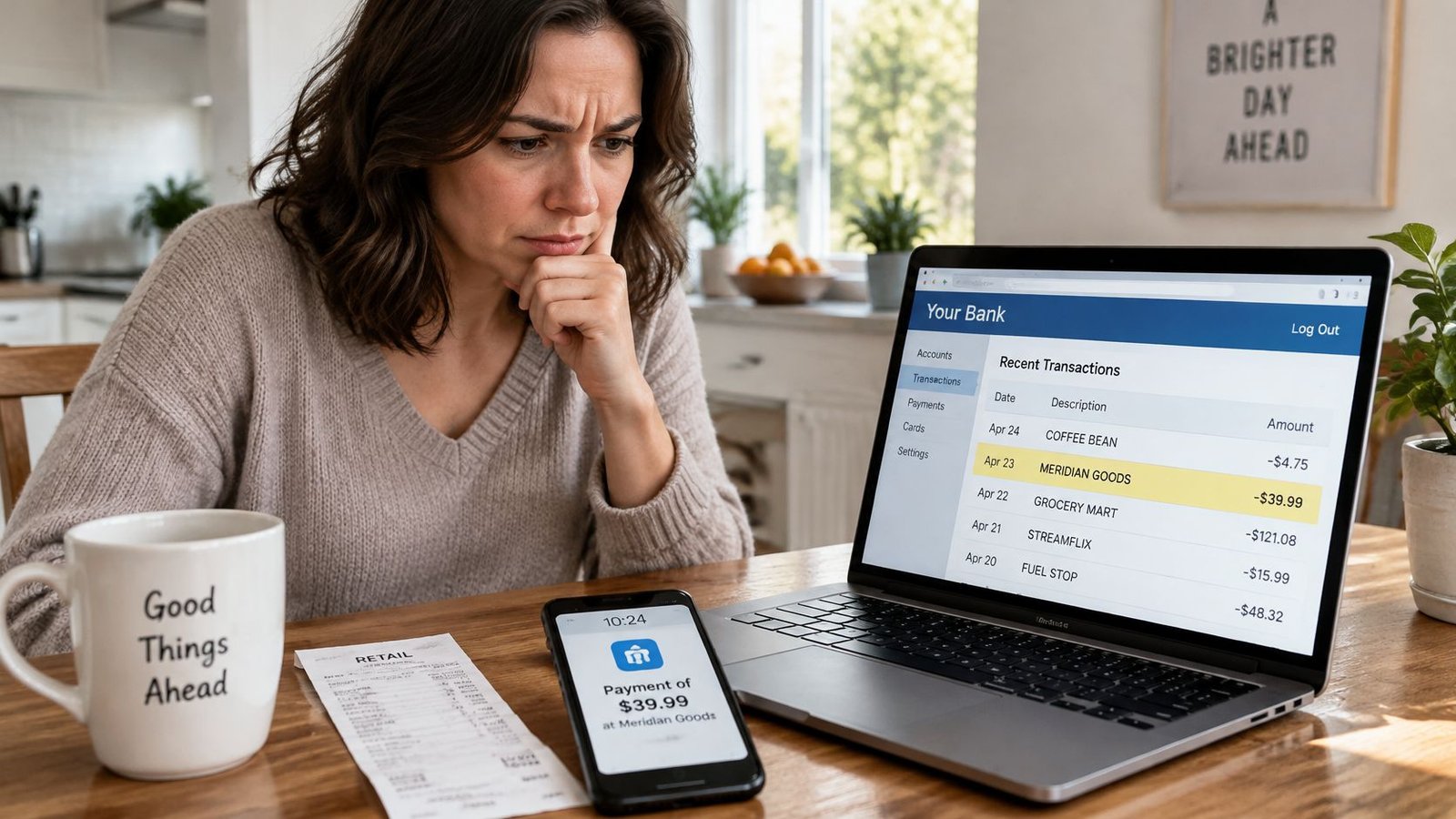
Recognition often matters more than tighter screening
Rejecting more orders does little to help a buyer identify a valid charge. Make the payment, offer and seller recognizable across the buyer's records:
- Billing descriptor: Use a trading name buyers are likely to recognize, within the payment provider's available format.
- Receipt identity: Show the seller name, offer title and transaction reference together.
- Order summary: Explain what happens next, including delivery or access instructions.
- Support route: Give buyers a clear way to ask about a charge.
For Shopify merchants, guidance on how to stop friendly fraud on Shopify addresses platform-specific considerations. Clear transaction details and criminal-fraud screening address different problems: one helps buyers recognize a purchase, the other helps sellers assess suspicious orders.
Alerts create an opportunity to act
A pre-dispute notification can give a seller time to investigate, stop an unfulfilled order or issue an appropriate refund before a dispute escalates. Mastercard reports that Ethoca Alerts helped prevent more than 39 million chargebacks globally in 2025.
Availability depends on the seller's payment arrangements. Confirm whether the acquirer offers alerts, who receives them and who can act. An alert that nobody reviews in time cannot guide a response.
A refund is not automatically the right response. Match the alert to the transaction, check whether fulfilment has started and confirm whether a refund or dispute is already in progress. Deadlines matter: an alert has value only if the seller can act within the relevant window.
Finally, compare the configured billing descriptor with the wording on an actual statement. A name that is clear in the seller's dashboard may be unfamiliar to the buyer.
Evidence to Keep for Each Dispute Type
A useful dispute response answers an allegation, not the question of whether the seller worked hard. The process should begin by classifying the reason code and end with a recorded outcome that improves future decisions.
- Classify the dispute as fraud, authorisation, processing error, fulfilment or another consumer dispute.
- Assemble the relevant evidence, selecting records that directly address the buyer's claim.
- Submit before the acquirer's deadline, allowing time to check file requirements and submission status.
- Record the outcome and update the buyer, offer or transaction risk assessment where justified.
The Financial Ombudsman's guidance on disputed transactions explains that cardholder-not-present transactions are subject to strict contractual requirements. A merchant acting innocently can still lose when stolen-card transactions don't meet the acquirer's rules.
Evidence to submit for each dispute type
| Dispute type | Evidence to submit | Where to find it |
|---|---|---|
| Fraud or unauthorised use | Authentication result, AVS and CVV outcome, device and IP history, consent timestamp | Order record and payment provider logs |
| Physical non-receipt | Delivery address, carrier tracking, delivery confirmation, product description | Carrier dashboard and order messages |
| Service not delivered | Appointment acceptance, attendance or no-show record, session timestamps, cancellation terms | Booking calendar and post-purchase messages |
| Digital access | Access logs, download or licence events, IP and device continuity, exact offer version accepted | Access records and offer history |
| Processing error | Transaction references, duplicate-charge check, receipts | Payment record |
Evidence should be specific, readable and relevant. A tracking number needs the delivery result and matching address context. A digital-access log needs enough explanation to show what the event means, rather than an unexplained technical export.
For a not-as-described allegation, the accepted offer and supplied item matter more than authentication. For a duplicate-charge allegation, the seller should reconcile transaction references rather than submit proof of attendance.
Deadlines and retention need separate controls
The overall UK chargeback window can extend to 540 days in some circumstances, with timing affected by expected delivery or service dates, as explained in Stripe's guide to UK chargeback time limits. Sellers should plan to retain relevant transaction, fulfilment and communication records for at least that long, or longer where their contract requires it, while checking applicable privacy and retention obligations.
Submission check: Every attachment should answer a part of the allegation. More screenshots don't necessarily make a stronger case.
One evidence folder per order reduces reconstruction under pressure. AmaJova's dispute resolution process is relevant to sellers preparing a platform dispute, but card-provider deadlines must also be tracked separately.
For marketplace-specific context, the chargeback strategies from LA Law Group discuss Amazon disputes. Sellers should distinguish that setting from their own UK merchant agreement rather than assuming identical rules.
Where records reveal a genuine failure or weak evidence, an early refund may be more sensible than contesting. Once a chargeback exists, the seller should follow the processor's instructions to avoid a separate refund creating duplicate reimbursement.
Put Your Prevention Checklist Into Practice
The order of implementation matters. Accurate offers give reviewers something to check, consent records establish what the buyer authorised, and dated fulfilment records make later evidence meaningful.
A practical rollout should follow this sequence:
- Clarify the offer page: Remove ambiguity about the deliverable, exclusions and next steps.
- Set the screening rule: Identify which signals trigger a hold and who can release it.
- Capture consent before supply: Configure the required acknowledgement before releasing digital content.
- Build the service timeline: Assign responsibility for booking instructions, reminders and participation records.
- Open the evidence folder: Preserve records from the initial transaction rather than collecting them only after a complaint.
- Review actual disputes: Use the allegation and outcome to identify the next operational fix.
On AmaJova, a revision request or dispute stops automatic completion of an order. Order completion and disputes don't remove applicable statutory rights or payment-provider rights, so a completed status shouldn't be treated as a reason to ignore a buyer's complaint.
The most useful starting point this week is the offer with the longest gap between payment and fulfilment, or the one generating the most clarification questions. Its description, instructions and evidence trail should be checked together, with legal wording reviewed against the applicable contract and jurisdiction where necessary.
AmaJova brings services, physical products, digital products and live sessions into a clear OfferLink with secure checkout, while keeping fulfilment, communication and support connected to the order record. Sellers can visit AmaJova to build an offer that makes expectations clear before payment and keeps the resulting transaction easier to document.