
The order shows as delivered. The buyer says the download opens to a blank page, or that the second coaching session was never booked, or that the item arrived in a different colour from the photo. The seller replied twice and then went quiet. In the middle sits a payment that neither side wants to lose.
Individuals in that position often do the first thing that comes to mind. They fire off a refund demand or ring their card provider. Both are legitimate routes, but neither is a plan. The disputes that close quickly, and in the right direction, are usually the ones where someone kept a clean record and escalated in the right order.
What follows walks through the dispute resolution process one stage at a time: where an order sits at each point, who acts, what evidence decides the outcome, and which external routes exist when the internal ones run out. It's general information about how the process works. It isn't legal advice for a specific case, and the law that applies to your transaction depends on what was bought and where.
Table of Contents
- Dispute Stages and Deadlines at a Glance
- Who Does What in a Dispute
- Evidence to Gather Before You Escalate
- How to Raise a Dispute Step by Step
- Possible Outcomes and Partly Delivered Orders
- Choosing Between Refunds, Chargebacks and Ombudsman Routes
- Cancellation Rights for Services and Digital Products
- Why Mediation Stalls and How to Improve Outcomes
- Set Up Orders to Prevent Disputes Early
Dispute Stages and Deadlines at a Glance
Every order moves through the same small set of stages. The stage matters because it decides what you can still do. A buyer who acts during the review period has options that close once the order completes. A seller who submits delivery details before that period ends has a record they won't have to reconstruct from memory three weeks later.
Here's the sequence in full.
| Stage | Who acts | Timing | Effect on the order |
|---|---|---|---|
| Order fulfilled | Seller | When completion or access details are submitted | Buyer review period begins |
| Buyer confirms completion | Buyer | Any time during the review period | Order completes immediately |
| Revision request or dispute raised | Buyer | Within the applicable dispute window for the order | Automatic completion stops while the issue is open |
| No action from buyer | AmaJova | After the applicable review period ends | Order may complete automatically |
| Order reaches Completed | AmaJova | When the order enters Completed status | Payout timing is set separately; check the current platform terms |
The one rule that changes everything
A revision request or dispute stops automatic completion. If the buyer raises an eligible issue inside the dispute window, the clock that would otherwise close the order stops. Nothing completes while the issue is open.
That cuts both ways. Buyers get time to sort out a problem instead of racing a countdown. Sellers get certainty that silence isn't being treated as a complaint. Neither side gets to ignore the order and hope it resolves itself.
What the table deliberately leaves out
The exact length of each review period and dispute window isn't fixed here, because it's set for the individual order. Check the order page for the figures that apply to yours rather than assuming a number you read somewhere else.
Order completion is not a waiver. Completion and disputes don't remove statutory rights or payment-provider rights, so a buyer who confirms an order, or loses an automatic completion, may still have routes outside the platform. That's why the next stages are about evidence rather than deadlines alone.
Check the order status at every stage. It tells you which actions are still open to you.
Who Does What in a Dispute
A dispute involves three parties, and most confusion comes from assuming one of them does more than it does. The buyer raises the issue, the seller answers it, and the platform holds the record both sides work from. On a mixed order, say a service with a digital download attached, the same split applies to each part: the platform records what happened while the parties argue the substance.
| Party | What it is responsible for | What it does during a dispute |
|---|---|---|
| Buyer | Confirms receipt or raises an eligible issue within the applicable review period | Messages the seller through the order; opens a revision request or dispute; contacts support when unresolved |
| Seller | Completes the agreed work; submits delivery or completion details; provides files or access for digital products; keeps offers accurate and lawful | Responds inside the order; supplies fulfilment evidence; answers questions about what was delivered |
| AmaJova | Holds the order record: messages, delivery or access, timeline, payment record and dispute status | Reviews support requests under the Terms & Conditions; applies the completion rules set for the order |
The buyer's side
The buyer's job is narrow: confirm receipt or raise an eligible issue during the review period, message the seller inside the order, and contact AmaJova support when direct contact stalls. What is missing from that list matters just as much. Chasing the seller by email, social media or a personal phone number produces evidence the other side never sees and support cannot review, because it sits outside the order record.
The seller's side
For services, the seller completes the agreed work and submits the delivery or completion details through the order. For digital products, that means placing the files or access into the buyer's order record rather than sending a link by message.
Sellers also carry the legal load. They are responsible for lawful offers, accurate descriptions, fulfilment, required licences, verification, taxes and cooperation with transaction reviews. An offer that overstates what is included creates the dispute it later has to defend. AmaJova publishes seller protection information alongside its reporting routes for sellers who want the platform's view of their side of a transaction.
What the platform does, and what it doesn't
AmaJova keeps messages, delivery or access, timeline, payment record and dispute status attached to a single order, and it handles support requests under the Terms & Conditions. The role is record-keeping and review: the platform sees the same file both parties see, and it guarantees no particular outcome.
Order completion and disputes do not remove applicable statutory rights or payment-provider rights. Even after the platform's side of a dispute is recorded, a buyer may still have routes outside it, and a seller may still owe obligations a platform decision does not settle.
A quick test works for all three parties. Each one should be able to point to the exact place in the order where its evidence sits. If someone cannot, that is the gap to close before anything escalates.
Evidence to Gather Before You Escalate
Most disputes stall for a boring reason. Someone escalated before they had the file in order, so the review has to start with basic questions instead of the actual disagreement. Run this list first.
- The offer description as it stood at purchase. Scope, inclusions, price, delivery or booking details. Screenshot it, because offers get edited.
- The payment record. Amount, date and the reference the payment carries.
- Delivery or access evidence. Completion details the seller submitted, files delivered for a digital product, or access records showing when the buyer could get in.
- The full message history from the order, not a selection of the most persuasive messages.
- A dated timeline of agreed milestones and what happened at each one.
- A short written statement of the issue and the remedy you want. Two or three sentences, specific about the amount or the action.
The reasoning behind the list comes from the courts. The Civil Procedure Rules' Practice Direction on Pre-Action Conduct sets out the expectation that parties exchange enough information to understand each other's position, make informed decisions and attempt settlement. It also says correspondence and information exchange should stay proportionate to the dispute where no specific pre-action protocol applies.
That proportionality point matters. A £30 download that won't open doesn't need a twenty-page chronology. It needs the offer page, the payment, the delivery record and one clear sentence.
The same discipline shows up in other industries. Tour operators facing a complaint months after a booking rely on audit trail records for tour operators to reconstruct exactly what was agreed and when, and the principle transfers neatly to a single order.
Practical rule: assemble the file before you open the dispute, not after. The order page already holds messages, delivery or access, timeline, payment record and dispute status in one place, so most of the work is checking rather than hunting.
Note these items before the order status changes. Once an order completes, some of that context stops being the live record and becomes something you have to reconstruct.
How to Raise a Dispute Step by Step
The escalation itself is short. What makes it work is doing the steps in order rather than jumping to the last one.
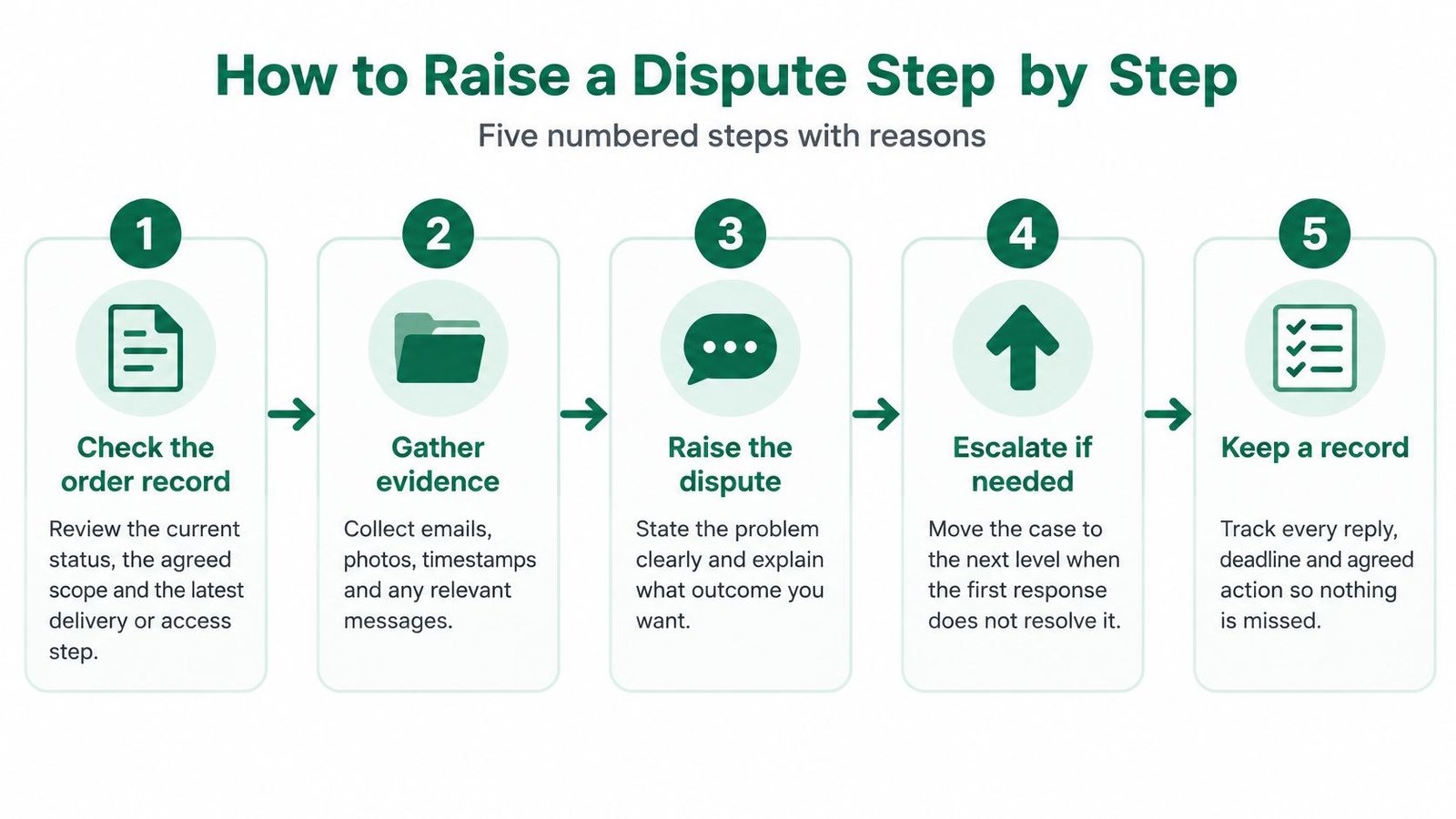
Each step below exists for a reason, and skipping one usually sends you back to it later.
- Check the order record first. Look at the current status, the agreed scope and the latest delivery or access step. A surprising number of issues are visible right there: a file attached to the order, a session booked for a date the buyer missed, a revision already delivered. Reading before writing saves a week.
- Message the seller through the order. Say what was promised, what was delivered and the outcome you want, in that order. Messages sent inside the order stay attached to the record, which means the seller can respond in the same place and support can read the whole exchange later. State the remedy plainly: a replacement file, a rebooked session, a partial refund of a specific amount.
- Raise the revision request or dispute within the applicable dispute window. This is the step that changes the order's behaviour, because raising it stops automatic completion. If the issue is still live, raise it rather than waiting for a reply that may not come.
- Submit a support request if the seller doesn't resolve it. Use the platform's support request form rather than live chat. Live chat handles general questions, while complaints, fraud reports, evidence and anything needing follow-up are handled through the form. In the seller dashboard, requests can be raised as a seller complaint, a general support request, or a fraud or safety concern, so pick the type that matches.
- Keep a copy of every message and response, and check the status until a decision is recorded. Disputes fail on gaps: a screenshot missing, a date misremembered, an agreement made verbally and never written down. Export or screenshot as you go, not at the end.
Platform handling sits alongside statutory rights rather than replacing them. If the internal route doesn't produce the outcome the law supports, the external routes are set out further on.
Possible Outcomes and Partly Delivered Orders
A decision rarely looks like the binary choice people expect. Outcomes tend to fall into four shapes, from widest to narrowest.
- The order is confirmed as complete, because the evidence shows delivery matched the offer.
- The seller supplies the missing element, redelivering the work, the file or the access that was promised, which resolves the issue without money moving.
- The parties agree a partial remedy, such as a partial refund that reflects what was delivered.
- The buyer ends the arrangement where the agreed scope wasn't delivered and no practical remedy exists, subject to the law that applies.
Mixed transactions need item-by-item reasoning
The mistake on a partly delivered order is treating it as one thing. It isn't. Break it into items and the remedy follows.
Take a coaching package. Count the sessions that took place against the number agreed, then separate the unused ones from the used ones. The remedy attaches to the unused sessions, not to the whole package. For a digital download, the question is narrower still: was the file or access delivered, and does it work as described? A live session turns on the scheduled time, the attendance record and any recording provided. A service that was half done turns on which milestones were completed and which single one wasn't.
That item-by-item approach is also how partial refunds get calculated in practice, and platforms that support them usually tie the amount to a specific line rather than a percentage of the total. Readers comparing tools can see how partial refunds work on Shopify-style stores for a useful parallel.
The outcome depends on the evidence in the order record and the remedy available under the law that applies. Assume you'll need to justify the number, and don't assume a full refund is the default.
Choosing Between Refunds, Chargebacks and Ombudsman Routes
The question is rarely "how do I escalate this?" It's "which route, in what order". UK guidance treats internal complaints, card-scheme chargeback, Section 75 credit-card claims, ombudsman complaints and court proceedings as separate routes, and it rarely explains how they interact on a mixed order such as coaching with a download attached.
| Route | Typical use | Evidence that helps | Timing or limit noted |
|---|---|---|---|
| AmaJova order dispute | Non-delivery, access failure or an offer that doesn't match its description | Order record, messages, delivery or access evidence | The dispute window and review period for the order apply |
| Card chargeback | Card payments where the scheme rules apply | Supporting evidence, which is normally required | Available only in certain circumstances; consumers usually have around 120 days to raise one |
| Section 75 credit card claim | Credit card purchases where the seller fails to deliver or the goods differ from the description | Purchase record, payment record, evidence of the claim against the seller | Limitation rules apply; check legislation.gov.uk |
| Ombudsman complaint | Regulated financial services, after a formal complaint | Complaint record and the firm's final response | An eight-week final-response period applies before escalation |
| Court proceedings | Claims unresolved after pre-action steps | Full evidence file | Limitation periods apply; check the current rules |
The Financial Ombudsman Service guidance on goods and services bought with credit confirms that chargeback is scheme-based, available only in certain circumstances, and normally needs supporting evidence. The same guidance notes that consumers usually have around 120 days to raise a chargeback, and that escalation to the Ombudsman for a regulated financial complaint generally follows a formal complaint and an eight-week final-response period.
An ombudsman isn't a substitute for an internal process
The Ombudsman route exists for regulated financial services. Its jurisdiction doesn't automatically cover every transaction on a general marketplace, so a dispute over a design commission or a workshop booking may never reach it. Treat it as one route among several, not a backstop for everything.
Refund, cancellation and return rights depend on what was bought, whether fulfilment has started and the law that applies. The refunds and cancellations policy works alongside statutory consumer rights rather than replacing them.
Start with the internal route, keep the evidence ready, and read the conditions of each external route before relying on it. Retailers such as Used Mobiles 4 U publish return and refund terms precisely so buyers can see which route applies before a problem arises, and that transparency is worth more than a "secure checkout" badge.
Which route, in what order
Work through it in this sequence. Internal dispute first, because it's fastest and produces a record other routes can use. Card route second, if the payment went through a card and the scheme rules apply. Regulated ombudsman third, and only if the seller is a regulated financial firm and a formal complaint has run its course. Court last.
The figures above are indicative of how the routes behave, not legal advice on your particular claim.
Cancellation Rights for Services and Digital Products
Cancellation rules decide a lot of disputes over services and digital content, and they're where buyers and sellers most often talk past each other.
For UK distance contracts involving a service or digital content supplied without a tangible medium, the standard cancellation period generally ends 14 days after the contract is entered into, as set out in the Consumer Contracts Regulations 2013. If the trader fails to provide the required cancellation information, that period can be extended by up to 12 months.
There's a second rule that catches sellers out. In a dispute about compliance with specified pre-contract information duties, the trader bears the burden of showing the information was provided. "It was in the terms and conditions" is not an answer if nobody can show the buyer saw it before paying.
What belongs on the offer page before payment
Three things, stated where the buyer sees them at checkout rather than buried in a linked policy.
- The cancellation process. How a buyer cancels, through what channel, and what happens next.
- The applicable deadlines. When the window opens and when it closes for this type of purchase.
- Any relevant exceptions. Cases where the right doesn't apply, described in plain terms next to the thing being sold.
Sellers should check the relevant legislation for their own trading model and jurisdiction, because these rules apply differently depending on the contract type and circumstances. A UK seller of live sessions and a seller based elsewhere serving UK buyers aren't in the identical position, and general guidance can't paper over that.
A simple test works both ways. A buyer should be able to find the cancellation terms before paying. A seller should be able to show they were displayed.
If either half of that test fails, expect the argument to be about disclosure rather than about the product.
Why Mediation Stalls and How to Improve Outcomes
Mediation has become routine in the UK for lower-value money claims. Reforms announced by the Ministry of Justice in July 2023 require many small-claim parties to access free HM Courts and Tribunals Service mediation before a case can proceed to a hearing, starting with specified money claims up to £10,000, with more than 180,000 parties a year planned for referral to a free one-hour telephone session, according to the government announcement on freeing up court capacity.
A referral tells you a case entered the system. It says nothing about whether anyone settled.

Why a referral is not a resolution
The gap appears when you track outcomes rather than intake. The small claims mediation data for March 2025 records monthly referrals of 39,385 in one period and 47,809 in another, a reminder that referral volume on its own says little about how many cases settled. Higher referral volumes do not guarantee higher settlement rates.
The reasons behind that gap are consistent: unclear remedy expectations, weak evidence, an inability to contact the other party, a power imbalance, and disputes over intangible delivery or subjective quality. Each one is an input problem, which means each one can be addressed before the session rather than during it.
A staged exchange before the live session
Mediation works like a hearing in miniature: the mediator can only weigh what both sides put in front of them. Before any live session, each party states five things: the outcome promised, what was delivered, the specific shortfall, the evidence, and an acceptable remedy. That exchange does two jobs. It gives the mediator something concrete, and it often settles the matter without a session at all.
On a marketplace order, much of that material already exists. The AmaJova order page shows messages, delivery or access, the timeline, the payment record and dispute status in one place, so "was the file sent" or "did the session happen" can be checked against the record instead of argued from memory. A dispute also stops automatic completion, which keeps the order open while the exchange runs.
The exchange separates two disputes that get muddled. A factual delivery problem can be checked against the record. Dissatisfaction with creative or advisory quality needs a different test: whether the work fell within the range the offer described. And a stalled mediation is not the end of the matter, because order completion and disputes do not remove applicable statutory rights or payment-provider rights.
Set Up Orders to Prevent Disputes Early
The cheapest dispute is the one that never opens. These actions take an afternoon and remove most of the arguments that follow.
- Define the exact scope, inclusions and exclusions. "Two 60-minute sessions plus written feedback within five working days" settles more questions than any policy page.
- State the delivery, access or booking steps and the expected timing. Buyers dispute silence more often than delay.
- State the return position clearly. The return policy field records whether returns are accepted, the number of days, and who pays return shipping, so set all three rather than leaving them implied.
- Publish cancellation terms and deadlines where buyers see them before paying. Disclosure is the seller's burden, and the offer page is the cheapest place to meet it.
- For digital products, keep a record of express consent and acknowledgement before supply starts inside the cancellation period. Under regulation 37 of the Consumer Contracts Regulations 2013, a trader must not begin supply during the 14-day period unless the consumer has given express consent to early supply and acknowledged that the cancellation right will be lost. Without both steps, the buyer may keep the cancellation right, so store that evidence with the order rather than relying on a general terms link.
- Respond inside the order and record each fulfilment step. Every message you answer in the record is one the other side can't later characterise as ignored.
Before sharing a link, compare the order management workflow with the list above, then open the OfferLink draft itself and fix any gap. The draft has to be reviewed before it can be published, which makes it the natural moment to catch an unclear scope or a missing return term.
AmaJova puts the offer, the order record, the messages and the dispute status in one place, so a disagreement over a download, a session or a delivery begins with evidence instead of a hunt through inboxes. If you sell services, products, digital files or live sessions, you can publish an OfferLink that sets scope and expectations before payment, then manage fulfilment and any issue from the same order page. Visit AmaJova to see how the order record and the dispute process work together.