A hard drive can contain years of strong images, yet still produce no income. The usual problem isn't image quality alone. Buyers need to find the files, understand what they can use them for, trust the seller, and complete a purchase without a chain of unanswered messages.
Selling photographs online is a commercial process, not an upload task. A workable system combines a focused archive, accurate metadata, legally sound licences, suitable sales channels, clear delivery, and realistic expectations about revenue.
Table of Contents
- What Selling Photos Online Really Looks Like in the UK
- Preparing Your Files and Understanding UK Copyright Basics
- Model Releases, Licensing and a Simple Copyright Assignment Template
- Choosing Between Marketplaces and Direct Sales
- Building a Direct Photo Offer That Converts
- Pricing Photos and Licensing for Real Returns
- Promoting, Fulfilling and Handling the UK Tax Side
What Selling Photos Online Really Looks Like in the UK
A photographer can upload a strong image in the morning and still make no sale by the evening. The UK market offers genuine demand, but it also contains a large supply of creators competing for attention. A parliamentary evidence submission reported 16.6 million creators in the UK, equivalent to 25% of the population. It also said that one in four people, or 23%, contribute photography, videography, creative writing or other content online (UK parliamentary evidence on the creator economy).
That scale creates opportunity and pressure. Selling photos online works best when the chosen route matches the subject, rights position and amount of selling work the photographer can handle.
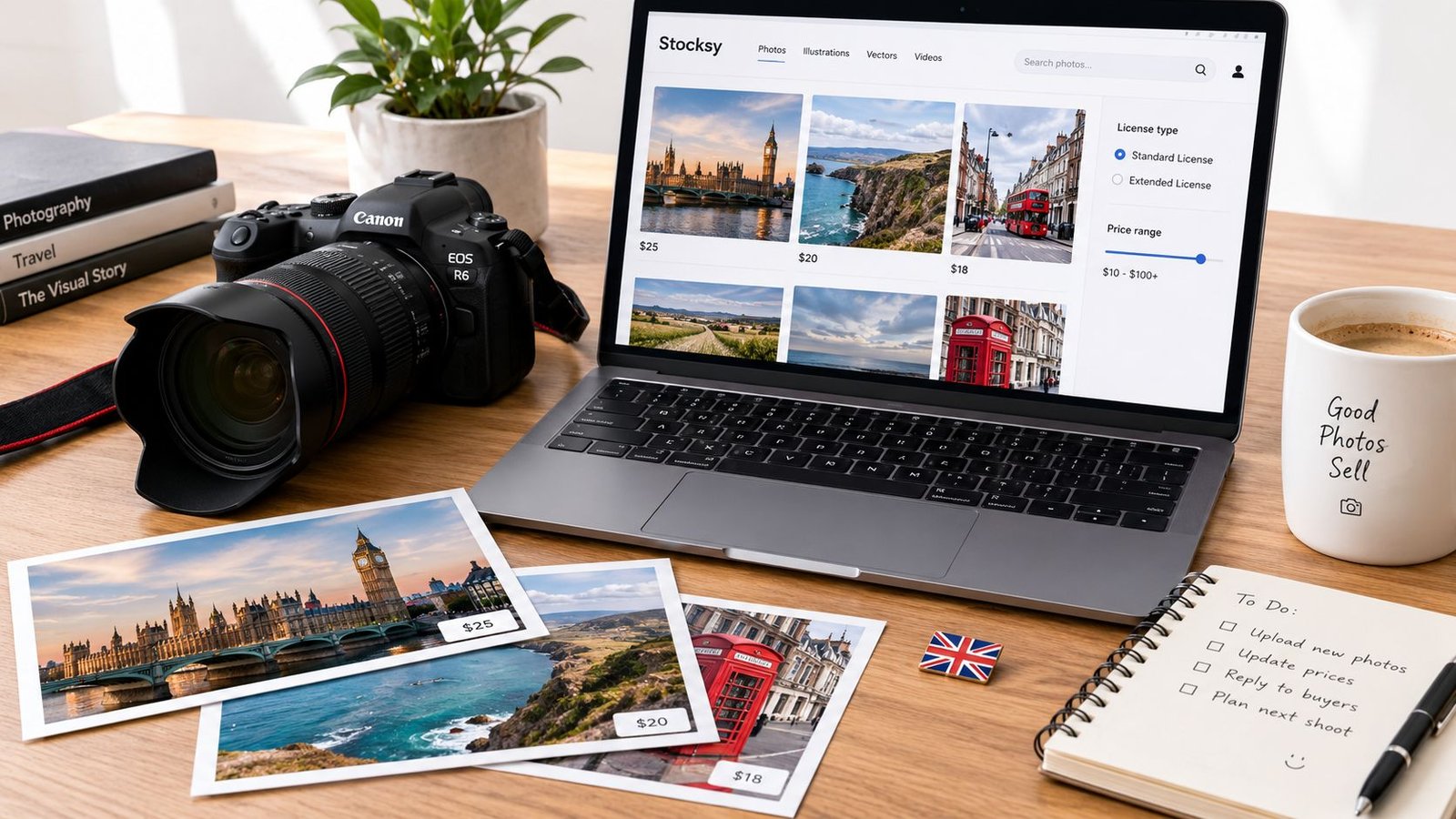
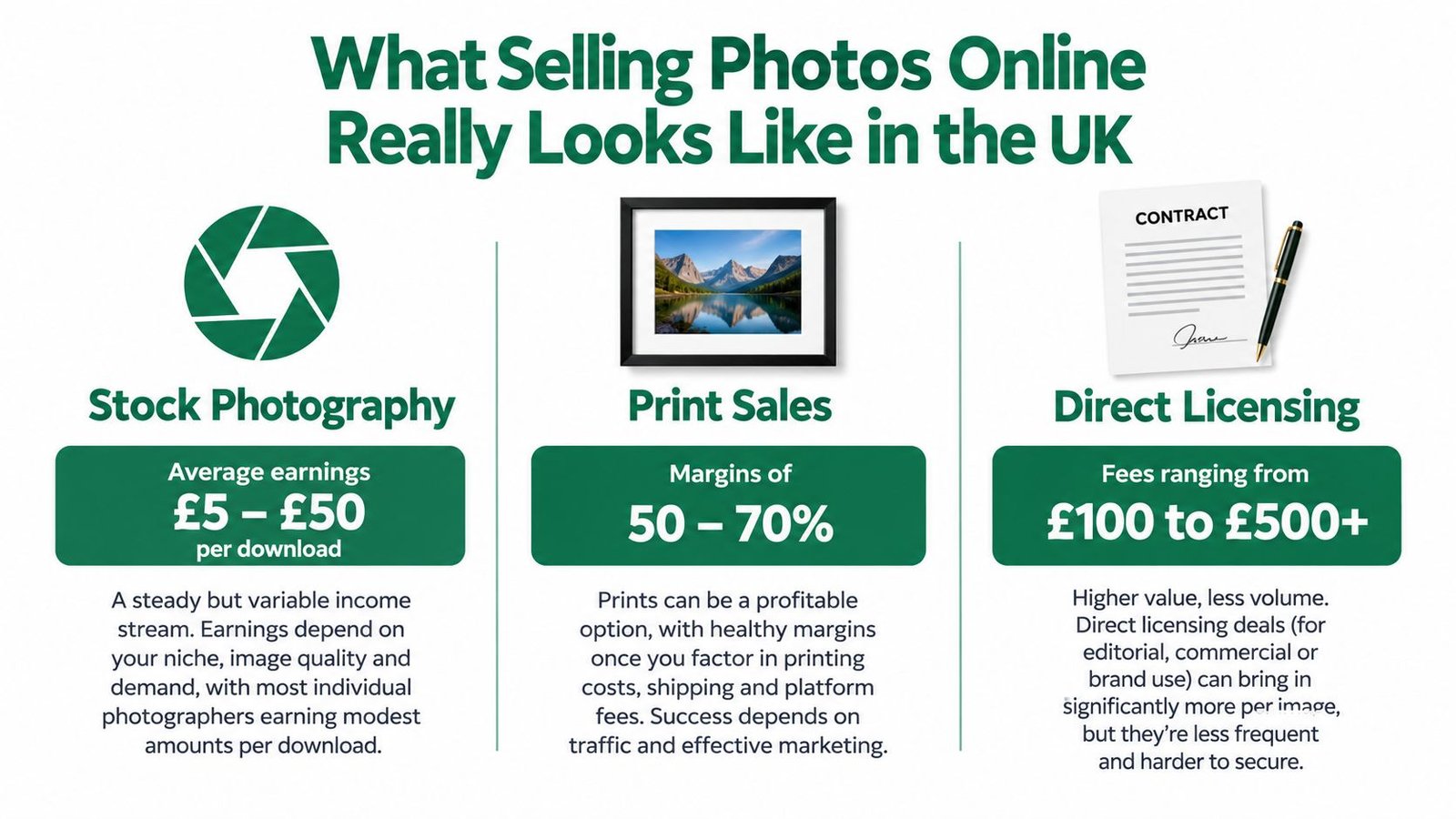
Stock libraries supply search traffic and buyer infrastructure. Shutterstock, Adobe Stock, Alamy and Getty can place images in front of agencies, publishers and businesses, although discovery remains controlled by the platform and an individual download may pay little. UK trade commentary has cited averages of about £0.60 per Shutterstock download and between £0.26 and £0.78 for Adobe Stock subscription downloads. A 1,000-image portfolio may return £80 to £300 per month, but those figures are indicative rather than guaranteed. Results depend on portfolio volume, subject niche and rights management (UK photography earnings and stock income context).
Stock can produce repeat income, but it usually rewards a focused archive and consistent uploading rather than a random collection of favourites.
Print-on-demand can suit distinctive natural scenes, architecture, abstract work and personal projects. The service may handle production and dispatch, while the photographer remains responsible for creating demand, setting a workable price and checking the finished product. Reduced fulfilment work does not remove the need for positioning or promotion.
Direct sales cover commercial licences, editorial commissions, local business packages, portraits, wall art and downloadable collections. They involve more communication and sales effort, but the buyer may pay for a defined business result rather than an isolated file.
The income question
The UK photographic industry remains substantial. IBISWorld estimated the UK Photographic Activities industry at £2.1 billion in 2026, with 9,149 businesses. Business numbers grew at a 4.1% CAGR between 2021 and 2026, while market size declined at a 2.4% CAGR over the same period. That combination supports spreading income across licensing, online sales and direct-to-buyer work instead of relying only on traditional local services (UK photographic industry context).
Two approaches regularly disappoint. Thousands of unrelated uploads create an archive without a clear buyer, and poor keywording, missing releases or slow customer replies turn sales into avoidable administration. This discussion of realistic earnings selling images provides useful context before investing heavily in stock production.
A workable plan is clear: prepare files properly, document rights, select a suitable channel, package a defined offer, price usage carefully, and keep accurate UK tax records.
Preparing Your Files and Understanding UK Copyright Basics
A reliable file workflow starts before the upload screen. Capture RAW files where the camera allows it, retain the original data, and edit non-destructively in Lightroom or Capture One. This keeps the source image available if a buyer later needs a different crop, colour treatment or output size.
Export a clean JPEG for the specific destination. Web files need a suitable colour profile and sensible compression, while print buyers may need a larger file and a different colour workflow. Stock platforms, editorial libraries and direct commercial clients can apply different technical requirements, so the seller should check the current submission rules for each channel instead of applying one export preset to every image.
Metadata that helps buyers find the work
Keywording is commercial work. A useful submission normally includes:
- A descriptive title: State the subject, location where relevant, and context without turning the title into a list of keywords.
- Specific keyword phrases: Include the visible subject, activity, setting, mood and likely use. Avoid irrelevant terms added only to increase impressions.
- A relevant category: Choose the closest available category so the image appears in the right buyer workflow.
- Release information: Record whether model or property releases exist, and keep the documents connected to the original file.
- Consistent file naming: Use a searchable project or image identifier rather than names such as “final-final-edit”.
A UK trade submission reported approximately 362.76 million images displayed online by professional photographers and about 114.76 million images licensed annually. The figures illustrate why discoverability and portfolio structure matter more than occasional uploads (UK photography marketplace and licensing context).
Copyright ownership in practice
Under UK guidance, the creator is generally the first copyright owner of a photograph. A significant exception applies to photographs made by an employee in the course of employment, where the employer usually owns the copyright. Commissioned work can require closer examination of the agreement and the date of creation, particularly where older rules apply (GOV.UK guidance on copyright ownership).
Selling a file doesn't automatically sell its copyright. A buyer normally receives a licence to use the image under stated terms. If the buyer must own the copyright, the transfer should be set out in a written assignment. Moral rights and attribution should also be addressed carefully, because a broad waiver may not operate without limits under UK law.
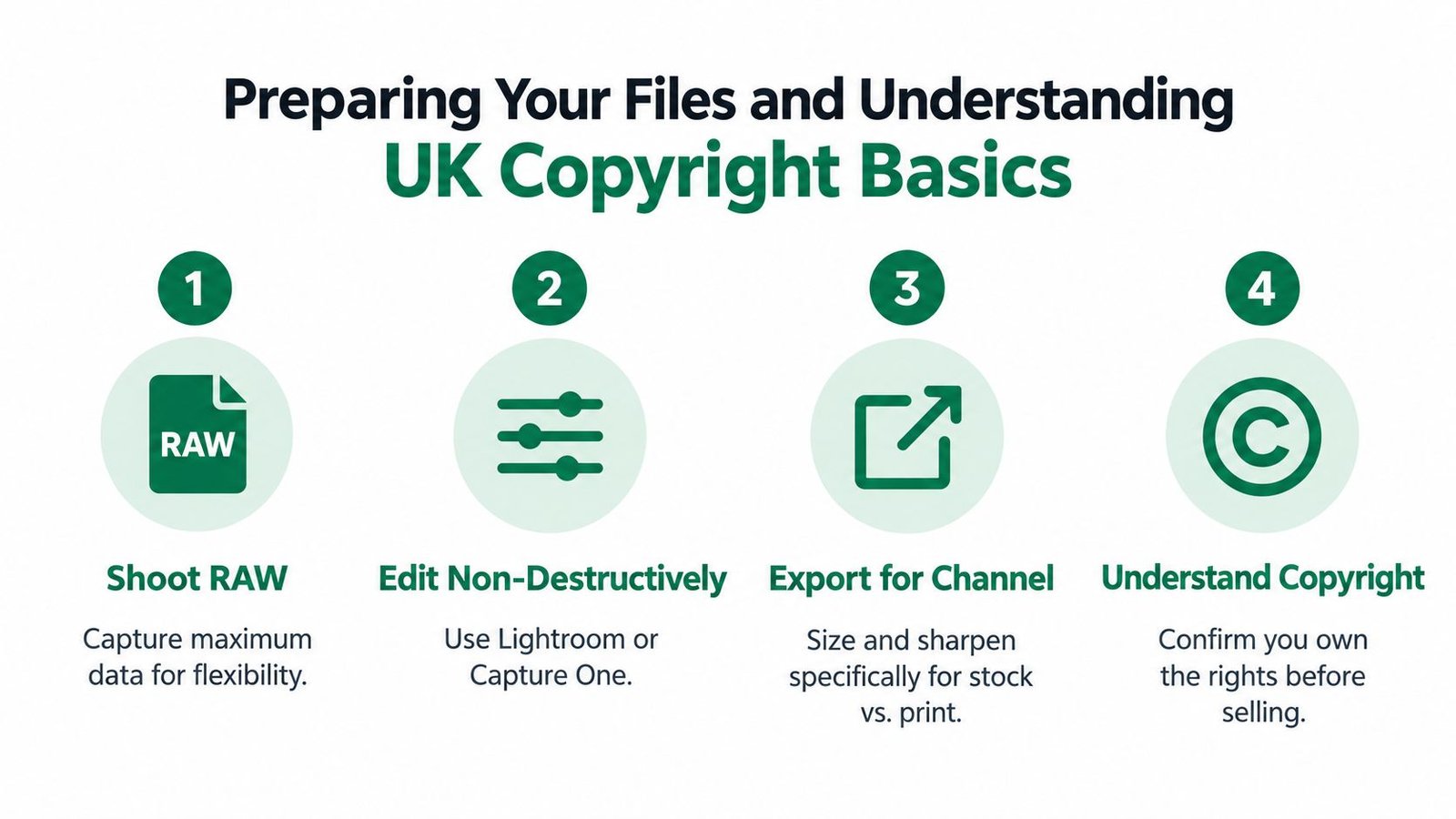
Keeping dated RAW files, export history and intact EXIF data gives the photographer useful evidence of authorship. A photo upload guide can help with the practical submission process, but no upload tool replaces a properly organised rights archive.
Model Releases, Licensing and a Simple Copyright Assignment Template
A recognisable person in a commercial image will commonly require a model release. The need can differ for editorial use, public events and crowd scenes, where the image records a newsworthy or documentary context rather than endorsing a product. Platform rules still vary, so the seller should check the destination's requirements before labelling an image for commercial use.
Property releases deserve the same attention. Private buildings, branded products, distinctive interiors and third-party artwork can create clearance issues, especially when the image is used in advertising. A release should identify the subject, grant the intended permissions, and remain connected to the relevant image files.
Licence types at a glance
| Licence type | Buyer rights | Typical use | Price band |
|---|---|---|---|
| Royalty-free | Broad repeat use within stated terms, without a separate fee for each use | Marketing, editorial support and general design work | Lower to mid-range |
| Rights-managed | Specific use, audience, territory and duration | Campaigns, publishing and controlled commercial placements | Mid to premium |
| Editorial-only | Use for reporting, commentary or documentary context | News, features and cultural coverage | Varies by use |
| Extended or commercial | Wider distribution, resale, advertising or other enhanced rights | Campaigns, products and larger commercial activity | Premium |
A short written assignment can be adapted when a buyer needs ownership rather than permission to use an image:
Copyright Assignment
Parties: [Full legal name and address of photographer] and [Full legal name and address of buyer].
Images: [File names, descriptions and any relevant identifiers].
Consideration: [Amount and payment date].
Assignment: The photographer assigns the copyright in the listed images to the buyer, subject to receipt of the agreed consideration.
Territory: [Named territory or worldwide].
Term: [Named term or the full period permitted by law].
Moral rights: The photographer waives or agrees not to assert applicable moral rights only to the extent permitted by law.
Signatures: [Signatures and dates].
This isn't a substitute for legal advice. A guide to redlining software may help compare contract versions, but the final wording should reflect the actual deal.
A direct licence might allow a local business to use one image on its website and social channels for a defined period. A full assignment gives the buyer far broader control, so it should be priced materially higher than a limited licence. The seller should never hand over all rights just because the buyer asks for “exclusive use” without defining territory, duration, media and permitted alterations.
The UK service agreement template can provide useful structural prompts for defining scope, deliverables and expectations, although a photographer should adapt any template to the specific copyright transaction.
Choosing Between Marketplaces and Direct Sales
A marketplace can put your images in front of buyers without requiring you to build the audience first. You upload files, add metadata and work within the platform's submission, pricing and licensing rules. Shutterstock and Adobe Stock suit broad commercial archives. Alamy and Getty may be a better fit for editorial, documentary or specialist work. The benefit is reach. The cost is less control over presentation, pricing and the customer relationship.
Direct sales give you control over the offer, licence, price and buyer conversation. They also make you responsible for generating demand through search, referrals, social media, networking and repeat business. A local hospitality collection, regional editorial set or bespoke business licence can perform better as a focused offer than as one item among thousands of similar stock files.
| Factor | Stock Marketplaces | Direct Sales |
|---|---|---|
| Discovery | Platform search and existing buyer traffic | Seller-generated traffic and referrals |
| Pricing | Often governed by platform licence structures | Set by the seller for the defined use |
| Administration | Submission and licensing processes are partly standardised | Seller handles scope, terms and buyer questions |
| Best fit | Larger commercial or editorial archives | Distinctive projects, commissions, prints and bespoke licences |
| Main risk | Low returns per download and intense competition | Strong work receives no sales without promotion |
UK earnings evidence supports using both routes rather than treating stock uploads as passive income. DACS found that over 80% of visual artists reported earnings sources as unstable or very unstable (UK visual artists earnings evidence). Libraries can provide long-tail discovery, while direct sales reserve distinctive work and client relationships for licences you can define and price more carefully.
Choose the channel by asking:
- Audience: Does the work solve a recognisable problem for businesses, publishers, collectors or households?
- Archive: Do you have enough coherent material for library search, or would a smaller curated collection be easier to sell?
- Niche: Can buyers describe the subject in specific commercial terms?
- Marketing tolerance: Will you publish, email, network and follow up consistently?
- Rights: Are ownership records and releases clear enough for the intended use?
The online selling platform should meet the same practical test. Check whether its checkout, file delivery and customer workflow suit the product, and whether you can present the licence clearly before payment. A marketplace reduces some selling administration, while a direct setup creates more work but gives you more control over the transaction.
Building a Direct Photo Offer That Converts
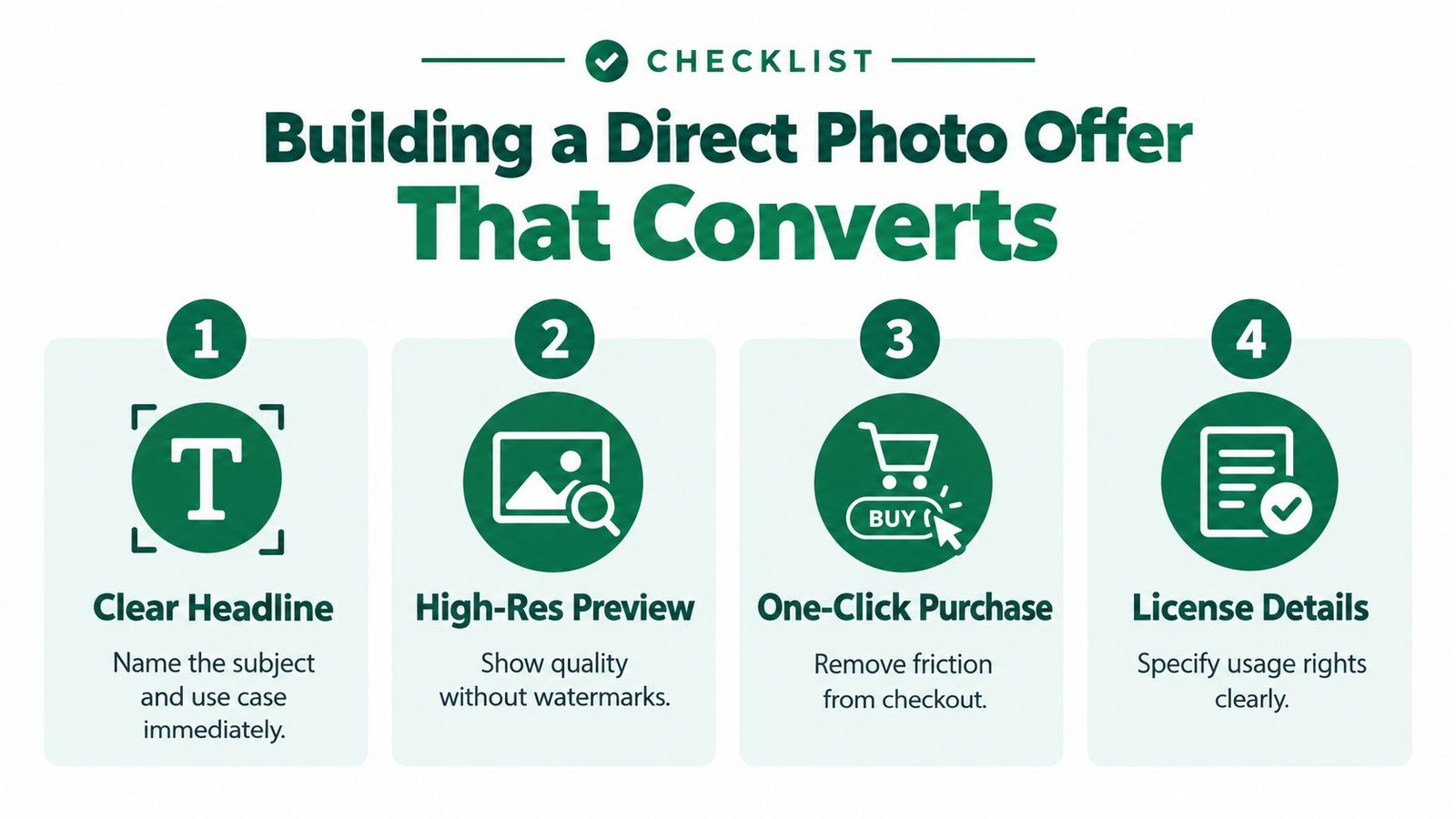
A direct photo sale should answer the buyer's practical questions before payment. The offer headline needs to name both the image and its likely use, such as a location collection for hospitality marketing or a downloadable architectural print for a home office. “Beautiful photography” is a portfolio description, not a product.
A strong page usually contains:
- A clear headline: Identify the subject and commercial or personal application.
- Context previews: Show the image in a realistic layout, such as a website banner, framed print or brochure mock-up. Watermarks can protect previews while preserving enough detail to judge the composition.
- A precise inclusions list: State the file format, available resolution, number of files, delivery method and any accompanying licence document.
- Licence tiers: Separate personal, small-business and wider commercial use. The difference should be based on permission, not arbitrary wording.
- A plain-English FAQ: Explain permitted uses, restrictions, release status, alterations, refunds and what happens after purchase.
A single-link checkout is often more suitable than a long enquiry form for a straightforward digital product. It lets an interested buyer move from a social post, email or portfolio page to a defined offer without waiting for a reply. Enquiries still make sense for commissioned shoots and complex campaigns, where the scope cannot be standardised.
Build trust before asking for payment
Sample client work shows how the image can function in context. A visible licence summary prevents the buyer from guessing whether advertising, resale, social media or internal use is allowed. Release status should be stated accurately, particularly where a recognisable person, private property or branded item appears.
Before publishing, test the complete buyer journey:
- Mobile layout: Check that previews, terms and the purchase control remain readable on a small screen.
- Delivery: Confirm that the buyer receives the correct file and any licence document after payment.
- Price display: Show whether VAT is included or whether another tax treatment applies.
- File access: Test the download link using a separate buyer account or device.
- Support route: Provide a clear method for reporting a failed download or requesting clarification.
The product page should make the transaction feel finished before the buyer pays. Ambiguous deliverables create support work and increase the risk of a rights dispute.
Pricing Photos and Licensing for Real Returns
Stock pricing is largely controlled by the library. Subscription systems pool customer payments and distribute royalties according to the platform's rules, so a single download can return very little. Editorial and rights-managed work may command more because the buyer selects a particular image for a defined use, but acceptance, demand and licensing terms still determine the result.
Direct pricing should begin with usage, not the photographer's attachment to the image. The same photograph can have very different commercial value depending on where it appears, how many people will see it, how long it will remain in use and whether competitors are excluded.
A defensible pricing method considers:
- Distribution: Website use is narrower than a broad print campaign or out-of-home placement.
- Territory: UK-only permission differs from European or worldwide use.
- Duration: A defined licence period preserves future value, while perpetual use removes a renewal opportunity.
- Exclusivity: An exclusive licence prevents competing sales and should cost more.
- Adaptation: Cropping, retouching, compositing or product packaging may require explicit permission.
- Ownership: A copyright assignment is broader than a licence and should be treated as a separate commercial product.
| Usage factor | Low | Standard | High |
|---|---|---|---|
| Distribution | Owned website or limited internal use | Website, social and ordinary marketing | Broad campaign or public advertising |
| Territory | Local or UK use | Wider regional use | Worldwide use |
| Duration | Short defined term | Standard campaign term | Perpetual use |
| Exclusivity | Non-exclusive | Category or campaign exclusivity | Broad exclusive rights |
| Ownership | Licence only | Extended licence | Copyright assignment |
A London café interior might be licensed for editorial web use at a modest fee, while a headshot for a regional business could command a higher fee for a defined commercial term. A hero image for a national campaign may justify a substantially larger price, especially where the buyer requests exclusivity or a full buyout. These are pricing scenarios, not guaranteed market rates.
The written agreement should state the image, permitted media, territory, duration, exclusivity, credit requirements, alteration rights, payment terms and whether the buyer receives a licence or ownership. Charging separately for expanded use protects the archive from being sold cheaply under vague language.
Promoting, Fulfilling and Handling the UK Tax Side
Promotion works better when every post leads to a defined offer. Pinterest can support evergreen discovery for prints and location work, while Instagram can show visual context and LinkedIn can reach business buyers, agencies and local organisations. A small mailing list of past buyers is particularly valuable because those contacts already understand the photographer's work and may need related images later.
The fulfilment process should be repeatable:
- Preview first: Send watermarked proofs when approval is needed.
- Confirm rights: Put the permitted use in writing before releasing the final files.
- Deliver accurately: Use a reliable transfer service, shared drive or checkout delivery system.
- Keep the record: Store the invoice, licence, release documents and final file reference together.
- Check the package: Confirm that the resolution, colour profile and file format match the buyer's order.
Forgotten releases, mismatched files and missing licence terms create more trouble than a weak caption. A structured order management workflow can help keep payment, delivery, messages and completion records together.
For small-scale UK sales, HMRC's trading allowance provides up to £1,000 of tax-free trading income per tax year, and the threshold applies to gross income rather than profit. If gross trading income stays at or below that amount, HMRC says the individual generally doesn't need to tell HMRC or pay tax on it, although circumstances can differ and records should still be kept (HMRC guidance on trading income allowances).
Once sales exceed the allowance, the photographer should check registration and Self Assessment responsibilities with HMRC or a qualified accountant. Records should cover every sale, platform fee, payment-processing charge, refund, expense and payout. VAT and self-employment treatment depend on the wider business position, so sellers with sustained income above the allowance should obtain personalized advice rather than rely on a generic online guide.
AmaJova lets photographers package downloadable images as a clear OfferLink with defined inclusions, pricing and fulfilment details, then manage checkout, delivery messages and the order record in one place. Photographers selling digital collections or standardised licences can visit AmaJova to assess whether that structure fits their sales workflow.