

The most popular advice about how to sell a film script is incomplete. A sharper logline, cleaner dialogue and a polished PDF matter, but none of them turns a screenplay into a film. In the UK, the practical question is whether a producer can see a route from the page to rights, talent, finance, production and an audience.
A writer who treats the screenplay as a finished literary object is presenting only one part of the proposition. A writer who supplies a compelling story and makes its scale, market, rights position and production logic clear gives industry decision-makers something they can readily develop.
Table of Contents
- The Commercial Reality of UK Film Production
- Packaging Your Screenplay for Development
- Identifying the Right Producers and Financiers
- Executing a Targeted Query and Submission Strategy
- Navigating Option Agreements and Contract Terms
- Managing Copyright Evidence and Tax Obligations
The Commercial Reality of UK Film Production
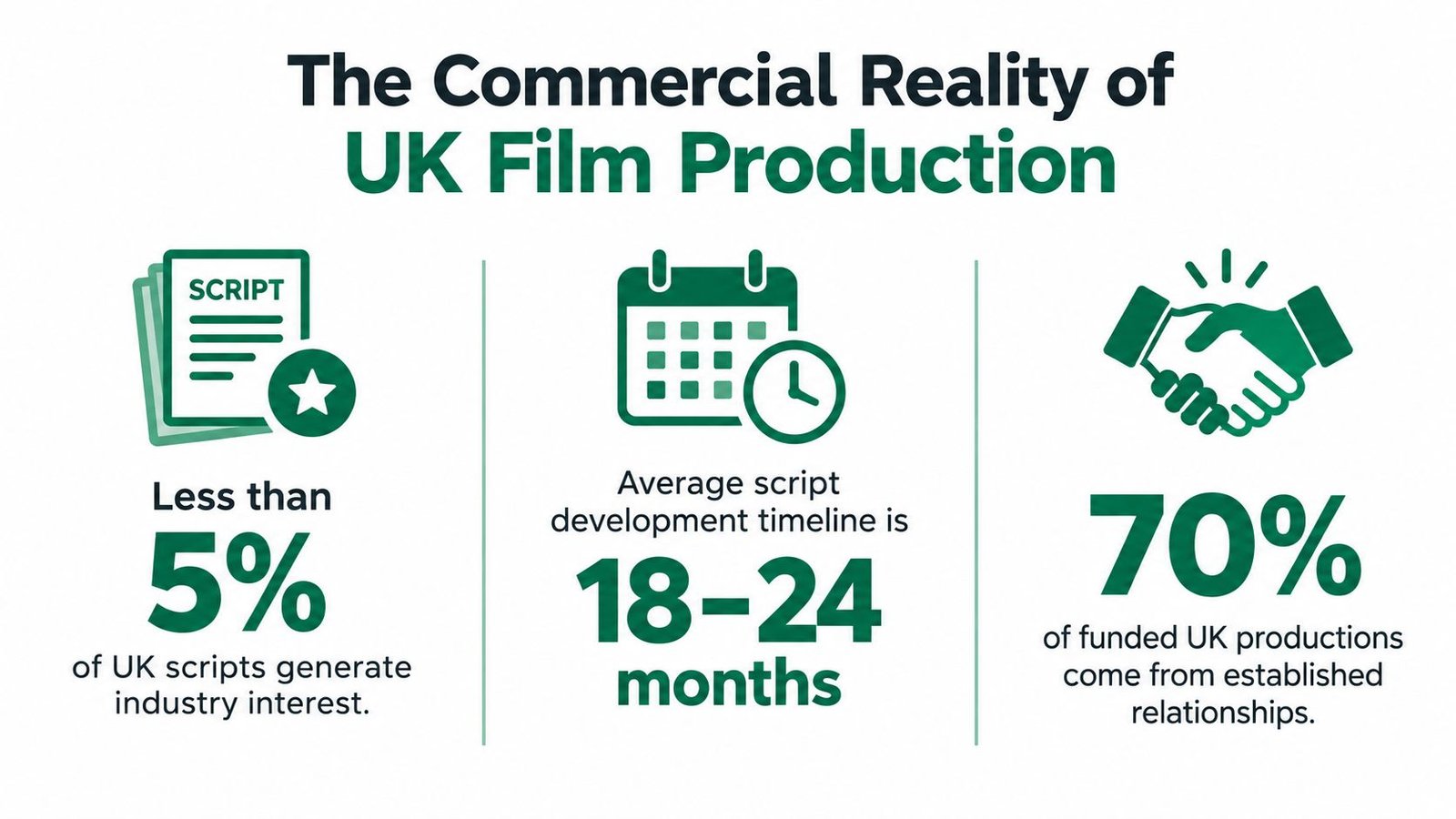
A brilliant script doesn't sell itself. It has to enter a business that selects projects according to finance, audience, packaging and production feasibility, often before anyone has read every page.
Official BFI statistics for 2024 recorded 191 films entering production in the UK, generating £2.1 billion in production spend. That spend rose from £1.36 billion in 2023, an increase of 56%, while the number of films entering production fell by 16 compared with the previous year. More money was spent, but that didn't create more opportunities for every writer.
The concentration is even clearer in the source of the money. Inward-investment films accounted for £1.9 billion, or 87%, of UK film production spend, while UK local film production contributed £186 million, or 9%. The 2025 picture points in the same direction. The BFI recorded £2.77 billion in UK feature-film production spend, with £193 million from domestic UK productions and £2.51 billion from inward-investment films, according to its official 2025 figures.
The buyer is usually assembling a package
A producer isn't normally buying a document in isolation. The producer is assessing whether the script can become part of a package involving:
- Rights: Is the material original, adapted, optioned or subject to another agreement?
- Audience: Who is likely to watch the film, and what genre promise does it make?
- Scale: Can the story be produced within a realistic budget category?
- Talent: Is there a role, director's vision or castability that could help attract finance?
- Route to market: Could the project interest a distributor, streamer, studio, broadcaster-linked partner or overseas co-producer?
The same commercial discipline applies to other forms of online selling. A writer comparing a screenplay offer with guidance on how to sell a book online should recognise the difference between presenting a creative work and presenting a proposition with a clear buyer, scope and route to delivery.
Practical rule: A screenplay should be sold as the creative core of a producible project, not as a PDF waiting for someone else to invent the business plan.
This doesn't mean reducing writing to market calculation. It means making the creative decision easier for the people responsible for development and finance. A high-concept film with controlled locations may suit a different producer from an ensemble period drama, even if both scripts are equally accomplished. Positioning determines who can act on the material.
Packaging Your Screenplay for Development
A producer's first assessment is often made from a compact set of documents, not from the full screenplay. The package should answer the commercial questions quickly while preserving the script's distinctive voice.
Build the dossier in a deliberate order
1. Start with the logline.
Write one or two sentences identifying the protagonist, the central objective, the main obstacle and the consequence of failure. Avoid describing atmosphere without conflict. A producer needs to understand what the film is about, what drives it and why an audience would choose it.
2. Prepare a one-page synopsis.
Include the ending. A synopsis isn't a teaser designed to conceal the resolution. It demonstrates control of the story, its reversals and its emotional destination. Keep the document easy to scan, with a clear title, genre and contact details.
3. Add a writer statement.
Explain why this writer is connected to the material and what the film is trying to achieve. Personal experience can be relevant, but it shouldn't become an autobiography. The statement should help a producer understand tone, theme and the creative choices that distinguish the project.
4. Define the budget category.
Don't attach a falsely precise budget without production expertise. Instead, describe the intended scale and the cost drivers, such as locations, crowd scenes, period detail, visual effects, stunts, animals or music rights. A realistic budget range helps a producer decide whether the project fits the company's slate.
5. Identify meaningful comparables.
Choose films that clarify genre, audience and scale. Explain the comparison rather than presenting a list of fashionable titles. A useful comparable might show the kind of audience, tone or production model being targeted, while acknowledging where the proposed film is different.
6. Explain feasibility.
List likely locations, production constraints and any relevant international or co-production considerations. A contained thriller, a location-heavy historical drama and a effects-led fantasy will need different development conversations.
The UK development model is intended to move a project from concept towards production. The research in Script Development: Defining the Field also describes professional development as a process involving structured feedback and multiple drafts, not a single pass.
Treat revision as commercial testing
Objective notes should test protagonist motivation, escalation, scene purpose, the page-one hook, act turns and production feasibility. A writer doesn't have to accept every note, but should be able to explain which problems were addressed and why.
The final submission set normally includes the screenplay, logline, synopsis, writer statement, selected credits or relevant experience, rights information and contact details. A resource on selling digital products illustrates a related principle, clear scope and buyer expectations make an offer easier to evaluate. The screenplay remains the main work, but the surrounding documents help the right professional decide to read it.
Identifying the Right Producers and Financiers
Mass submission is inefficient because production companies aren't interchangeable. Each has a slate, a financing history, preferred genres, budget experience and a particular appetite for original material.
The UK's wider production economy explains why international positioning matters. In 2024, combined UK film and high-end television production spend reached £5.6 billion, including £2.1 billion for feature films and £3.4 billion for high-end television. £4.8 billion came from inward investment and co-productions, meaning roughly 86% of the combined spend was connected to internationally financed or collaborative productions, according to the UK Parliament publication on film and high-end television production.
That doesn't mean every script must become an international co-production. It means a writer should understand the ecosystem in which many UK projects are financed and packaged.
Match the project to the buyer
| Buyer | What to investigate | What the writer should present |
|---|---|---|
| Independent producer | Recent credits, genre, budget scale and current slate | A producible project with clear audience and rights |
| Literary or film agent | Writing quality, career potential and commercial positioning | A polished script plus a concise professional package |
| Development fund or programme | Eligibility, remit, development priorities and application process | A project that fits the published criteria |
| Broadcaster-linked producer | Format, audience, editorial suitability and relationships | A clear concept with strong audience logic |
| International co-producer | Genre, territory, locations, language, finance and rights | A project that can be understood beyond a narrowly local market |
A company that makes contained genre films may not be the right home for a sprawling period piece. A producer with international partnerships may be more useful for a script whose story, cast or locations can support cross-border finance. The writer should study actual credits and approach the person responsible for development, not just send the script to a generic inbox.
Make finance questions easy to answer
A producer needs to know whether the project can support attachments, incentives, locations and distribution conversations. The dossier should therefore state the intended audience, genre, indicative budget band, likely certificate, production locations and relevant rights.
The writer should also distinguish between interest and financeability. A producer can admire a script and still conclude that the project is too expensive, too narrow for the proposed market or difficult to package. That response isn't necessarily a judgement on the writing. It may be a mismatch between the script and the producer's resources.
Executing a Targeted Query and Submission Strategy
A query should earn a request for the screenplay. It shouldn't attempt to close a sale in an introductory email.
Before contacting anyone, verify the company's submission policy. Some companies don't accept unsolicited material, some require a referral, and others request a logline or synopsis before considering a full script. Ignoring those rules signals that the writer hasn't researched the recipient and can close the door before the work is assessed.
Use a controlled submission system
A simple spreadsheet or document should record:
- Recipient: Company, contact and role.
- Research basis: Relevant credit, genre or stated development interest.
- Date sent: The date of the query and any follow-up.
- Material version: File name and draft date.
- Rights status: Original, adapted, optioned or otherwise encumbered.
- Response: Request, pass, referral, no response or development discussion.
- Next action: Follow-up date, requested material or no further contact.
Version control matters. Sending different drafts to overlapping contacts can create confusion about the current text and the rights being offered. The submission log also stops a writer from repeatedly contacting the same company or forgetting where an attachment has gone.
Write a short, specific query
A useful query contains the title, format, genre, logline, concise writer credentials, relevant reason for approaching that recipient and a polite request for permission to send the material. It should state whether the script is complete and clarify the rights position where relevant.
The request should be for a read or conversation, not an immediate purchase. A writer looking for broader guidance on structuring a persuasive proposal can also consult how to pitch an idea, provided the principles are adapted to screenplay development rather than copied mechanically.
Submission standard: Never mass-email unsolicited attachments. A targeted query protects the writer's reputation and gives the recipient a clear reason to respond.
A pitch document isn't a screenplay. A treatment isn't a finished draft. An adaptation requires permission or a clear rights route. These distinctions should be made explicit before material is sent. Follow-ups should remain brief and professional, with no pressure to respond or assumption that silence represents an invitation to keep emailing.
Navigating Option Agreements and Contract Terms
A producer saying that the script is exciting is a development signal, not a completed sale. The contract determines what the producer can do, how long the rights are tied up and what the writer receives if the project progresses.
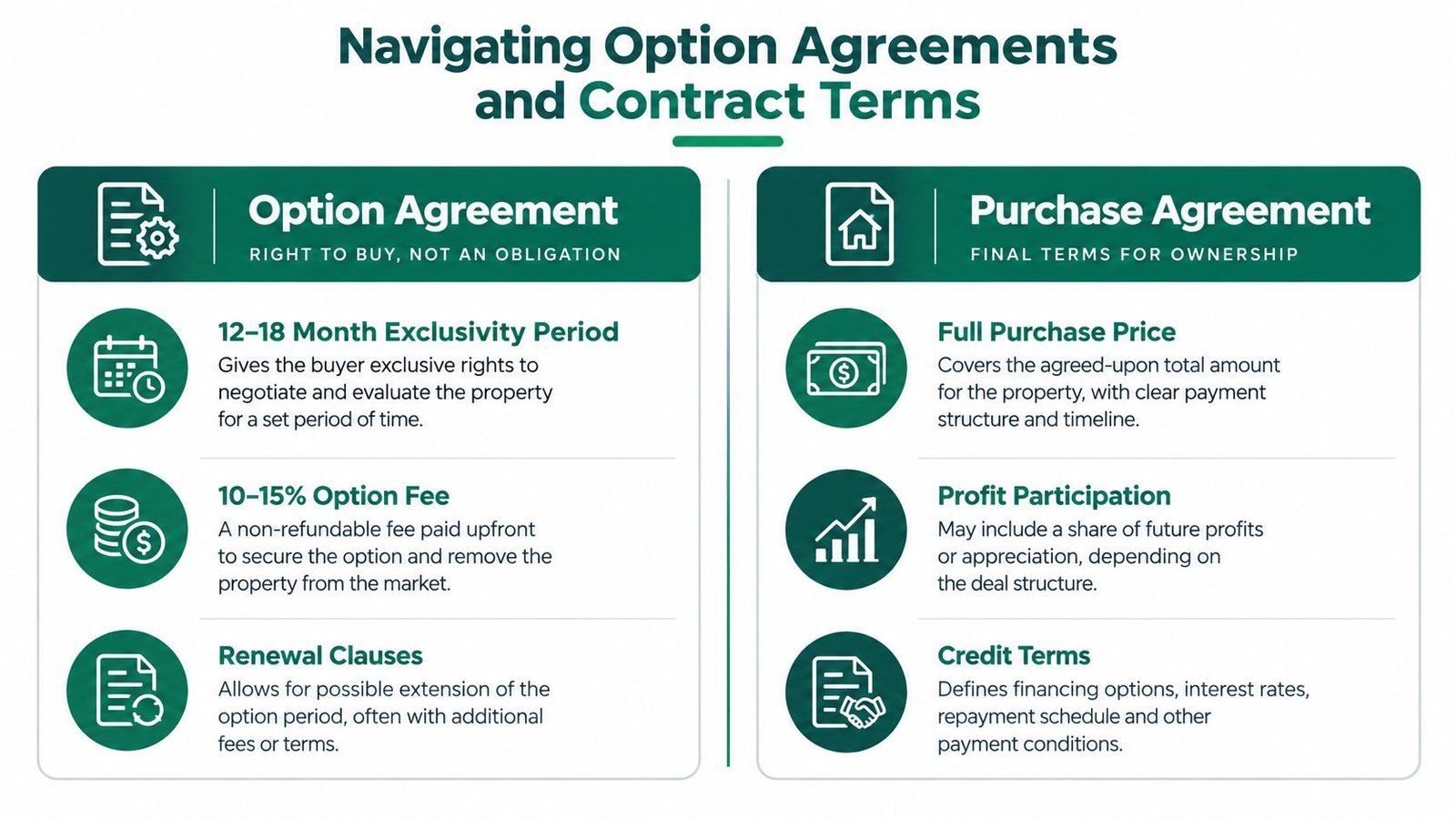
An option agreement gives the producer a period in which to acquire specified rights later. The producer may use that period to develop the script, attach talent, seek finance and assess the market. The writer usually retains ownership during the option, subject to the rights granted.
A shopping agreement generally gives a producer permission to take the project to potential partners without granting the same level of exclusivity as an option, although the exact wording controls the arrangement. An assignment transfers specified rights immediately, while an exclusive licence grants defined exploitation rights without necessarily transferring ownership. These are materially different transactions and shouldn't be treated as interchangeable labels.
Read the clauses that control the future
The agreement should identify:
- Rights granted: Film, television, remake, sequel, prequel, merchandising, publishing, interactive and other media rights.
- Territory and term: Where the rights apply and when the agreement ends.
- Option payment: What is paid for the initial exclusivity period.
- Extension mechanism: Whether extensions are automatic, what they cost and when payment is due.
- Purchase trigger: The event or notice that converts an option into a purchase or assignment.
- Reversion: When rights return if the producer doesn't exercise the option or meet agreed milestones.
- Credit: The proposed writing credit and how disputes or later rewrites are handled.
- Payments: Option fees, purchase price, writing fees, contingent sums and any royalties.
- Approvals and consultation: Any meaningful rights the writer retains over changes, attachments or title.
Finance conditions make these provisions commercially important. A recent Creative UK survey cited by ICAEW found that 60% of responding film and television firms identified access to finance as a key growth barrier. A producer may need time to assemble finance, but the writer shouldn't accept indefinite exclusivity without a defined end point and a credible extension structure.
Contract warning: Enthusiasm isn't finance. A signed option can remove the writer's ability to approach other producers while the project remains unproduced.
An entertainment solicitor should review the agreement before signature, particularly where adaptation rights, co-writing, underlying material, credit, reversion or contingent payments are involved. A general contract template, including a service agreement template for the UK, isn't a substitute for advice on a screenplay option or purchase.
Managing Copyright Evidence and Tax Obligations
UK copyright protection begins automatically when an original script is created and recorded. There isn't a government registration requirement, so a writer's practical priority is preserving reliable evidence of authorship and development history rather than paying for an unofficial registration service.
The National Archives guidance on copyright and related rights explains that copyright arises automatically and protects works resulting from the author's skill and effort. GOV.UK guidance also states that there is no formal registration procedure. Dated deposits or copies retained by a bank or solicitor may provide evidence, but they don't guarantee the outcome of a dispute.
Keep the chain of title organised
Retain the original script file, exported PDFs, dated version history and submission correspondence. If another writer contributed, record the collaboration terms. If the screenplay adapts a novel, article, life story or existing character, retain the permission or agreement that supports the claimed rights.
Copyright in the written script is separate from every right required to exploit a finished film. An agreement should state whether the buyer receives an option, assignment or licence, and should define media, territory, term, sequel and remake rights, credit, payment and reversion. The GOV.UK intellectual property guidance describes copyright control over copying, distribution and performance, while noting that film copyright can involve the director, screenplay author, dialogue author and composer.
For practical background on documenting ownership and protecting creative work, a step-by-step IP guide for small businesses can be useful. It shouldn't replace specialist advice where a chain of title or contract is disputed.
Separate contract language from tax treatment
HMRC states that profits from literary, dramatic and film copyright activities carried on by UK-resident individuals are chargeable to Income Tax either as profits from a profession or as miscellaneous income, as set out in its copyright income guidance. The treatment depends on the writer's circumstances and the nature of the activity.
Contracts, invoices, royalty statements, agent commission records and allowable-expense evidence should be retained. An option fee, writing fee, lump-sum purchase, contingent payment and continuing royalty can have different contractual and tax implications, so a UK accountant or tax adviser should assess the particular arrangement.
AmaJova can also be used once a writer has a defined related offer, such as script consultation, a digital development resource or a live session, by placing the scope, price, inclusions and fulfilment details into a single OfferLink. That is separate from selling screenplay rights, and the writer should keep the service terms distinct from any film option or purchase agreement.
AmaJova gives writers a way to package script consultations, digital resources or live sessions into one clear OfferLink with checkout and order details. Visit AmaJova to define a related offer professionally while keeping screenplay rights negotiations in a properly reviewed agreement.