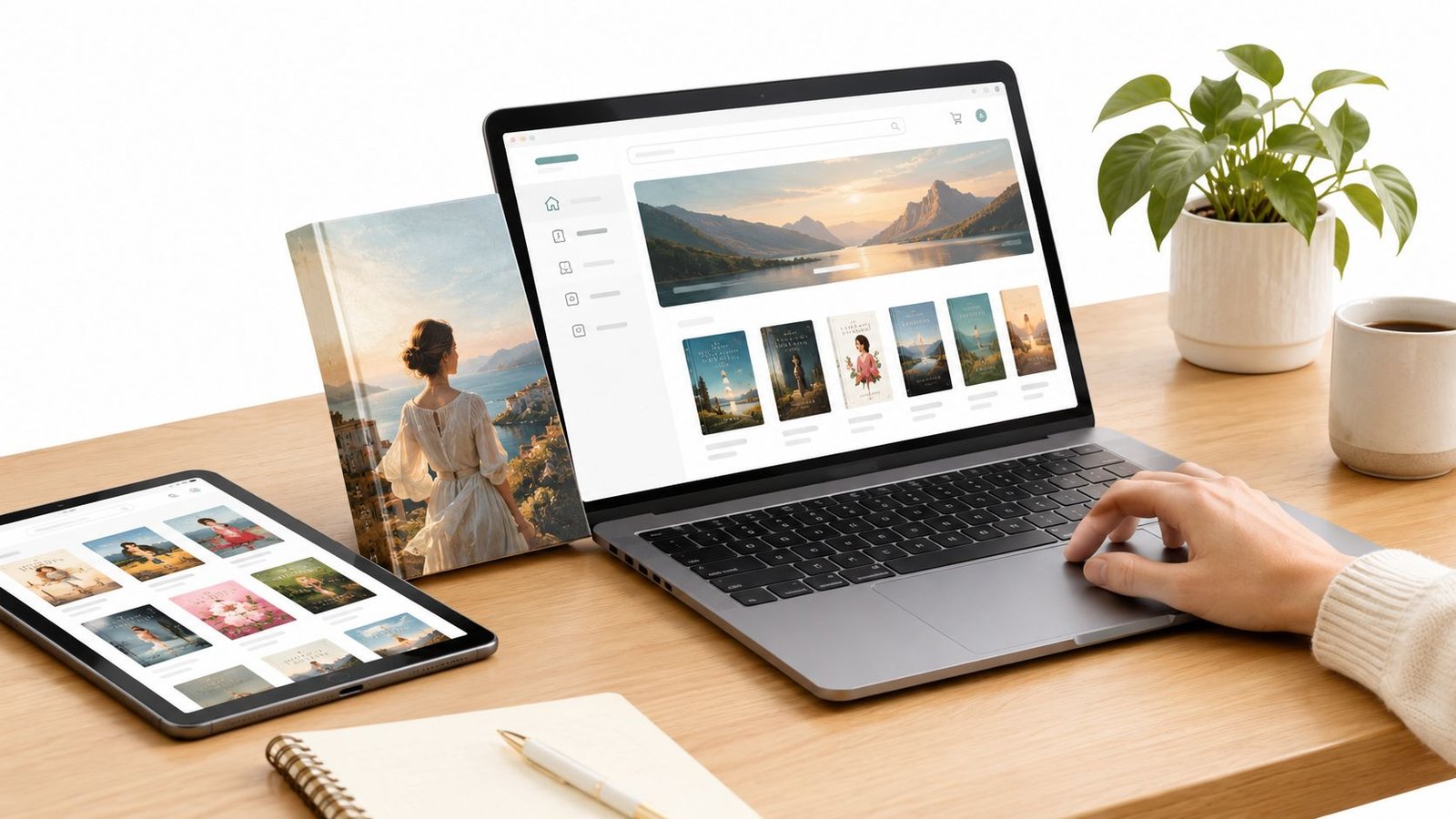
Most advice on how to sell a book online begins with the same instruction: upload the title to a major marketplace and wait for readers to find it. That approach can create access to shoppers, but it leaves too much of the business in somebody else's hands, including discovery, pricing context, customer information and the post-purchase relationship.
A stronger model treats a book as both a publication and a product. The seller needs a suitable format mix, accurate UK pricing, a listing that answers practical questions, a route for reaching new readers and a direct way to convert existing interest. Marketplaces can play a useful role, but they shouldn't be mistaken for the whole publishing strategy.
Table of Contents
- Rethinking the Online Book Sales Playbook
- Navigating Format Economics and UK VAT Rules
- Preparing Files and Structuring the OfferLink
- Choosing Between Marketplaces and Direct Channels
- Building Demand Through Social and Pre-Orders
- Managing Fulfilment and UK Consumer Rights
Rethinking the Online Book Sales Playbook
The obvious online sales strategy is often the expensive one. Sending every reader to a major marketplace may provide reach, but it also puts discovery, pricing context and the customer relationship in someone else's system. A direct OfferLink can be more valuable when the reader already has a reason to buy.
Online book buying is already established in the UK. Nielsen Book data reported that 58% of books across all formats were bought online in 2019, while online purchasing represented 42% of print book purchases during the same period. Adult fiction was especially online-led, with 72% of sales by volume taking place online, compared with 59% for adult non-fiction. These figures appear in the UK books market analysis.
The practical implication is clear. A seller does not need to persuade readers to adopt online purchasing. The listing, metadata and checkout must make an existing buying habit work for the book.
The economics also depend on where the transaction happens. Print books are zero-rated for UK VAT, while ebooks carry 20% VAT. That difference can change the amount retained from a direct sale before payment processing and other costs are deducted. A marketplace may bring unfamiliar readers, but a direct OfferLink can give an author more control over the purchase journey and the margin attached to an interested reader.
Why a marketplace-only strategy stalls
Marketplaces provide built-in search demand, which is useful for a new title without an established audience. Readers can find a book while browsing a category, searching for an author or comparing related titles. That discovery function is difficult for an independent publisher to recreate alone.
The trade-off is control. The marketplace determines ranking, related products and the customer information shared with the seller. Fees, promotional rules and discounting also affect the amount retained from each order. Sales may arrive without giving the publisher a clear way to understand the buyer or encourage a second purchase.
Practical rule: Use a marketplace to reach unfamiliar readers, then build a direct route for readers who already know the author, subject or series.
An OfferLink turns a purchase page into a conversion tool rather than a passive listing. An author can share one focused destination from a biography, newsletter, launch campaign, event follow-up or personal website. Before payment, the page can explain the format, price, contents and fulfilment expectations. That removes the ambiguity of sending an interested reader into a crowded search result.
The transaction should belong to the publishing plan
Direct selling does not replace discovery. It gives discovery a more useful destination. A marketplace may introduce a reader to the title, while an OfferLink can serve someone arriving from a podcast, social post, speaking engagement or recommendation from another author.
Authors preparing a first launch can also use this practical guide on how to promote your self-published book for audience-building and promotion ideas. Promotion and checkout should be planned together. Attention is wasted when a campaign sends interested buyers to a confusing or generic purchase journey.
For broader advice, the AmaJova guide to selling online explains how to structure an online selling process. The offer should state what the buyer receives, what happens next and who handles support. A direct purchase page makes those details explicit before payment.
Navigating Format Economics and UK VAT Rules
Format selection affects more than reader preference. It changes production cost, fulfilment effort, pricing flexibility and the amount of VAT included in the advertised price. For UK sellers, the most easily missed difference is that print books are zero-rated for VAT, while ebooks are taxed at 20%, a distinction highlighted in the UK self-publishing guidance.
That tax treatment changes the calculation for direct sales. If an ebook is sold for a VAT-inclusive price, the seller can't treat the whole amount as revenue. The VAT element reduces the net sale before payment processing, platform costs, editing, cover design and other expenses are considered. Print pricing doesn't face the same VAT charge, although printing, storage and postage can make its operational cost much heavier.
Comparing the three main formats
| Format | UK VAT Rate | Direct Margin Profile | Fulfilment Overhead |
|---|---|---|---|
| Print book | Zero-rated | Can retain a strong share of the listed price, subject to production, packaging, payment and delivery costs | Packing, stock or print-on-demand coordination, postage and damaged-item support |
| Ebook | 20% | Low marginal delivery cost, but VAT and payment costs reduce the amount retained from the displayed price | File preparation, delivery reliability, customer support and digital-content compliance |
| Audiobook | Confirm the treatment for the specific supply and business arrangement | Production can be expensive, while each additional delivery is comparatively light | Narration, editing, mastering, file delivery and compatibility support |
Audiobooks and ebooks deserve strategic attention because digital formats have become a significant part of the UK market. A 2025 NielsenIQ summary reported 345 million books bought across formats in the UK, with ebooks and audiobooks together accounting for one-third of all book purchases. It also reported consumer spending of £2.72 billion, even as volume fell 2.2% year on year. These figures appear in the UK publishing industry summary.
Pricing a direct OfferLink
A seller should calculate the net amount received rather than compare headline prices alone. For a print title, the calculation should include production, packing, postage, payment costs and any platform charge. For an ebook, it should start with the VAT-inclusive price, remove the VAT element, then account for payment and delivery costs. Audio requires a separate assessment because narration and post-production can make the initial investment substantial.
The format mix can then reflect the reader's buying situation:
- Print first: Suitable when presentation, gifting or collectability drives the purchase. The product page should make delivery timing and edition details clear.
- Ebook as an entry point: Useful for readers who value immediate access, but the price must leave room for VAT and support.
- Audio as an extension: Relevant for titles with strong listening appeal, particularly when the publisher can reuse the same audience across formats.
A direct seller shouldn't just copy the cheapest marketplace price. The direct offer can include a signed print copy, a bundle, a bonus chapter or access to a live session, provided the inclusions are stated accurately. That creates a reason to buy direct without relying on an unsustainable discount.
Preparing Files and Structuring the OfferLink
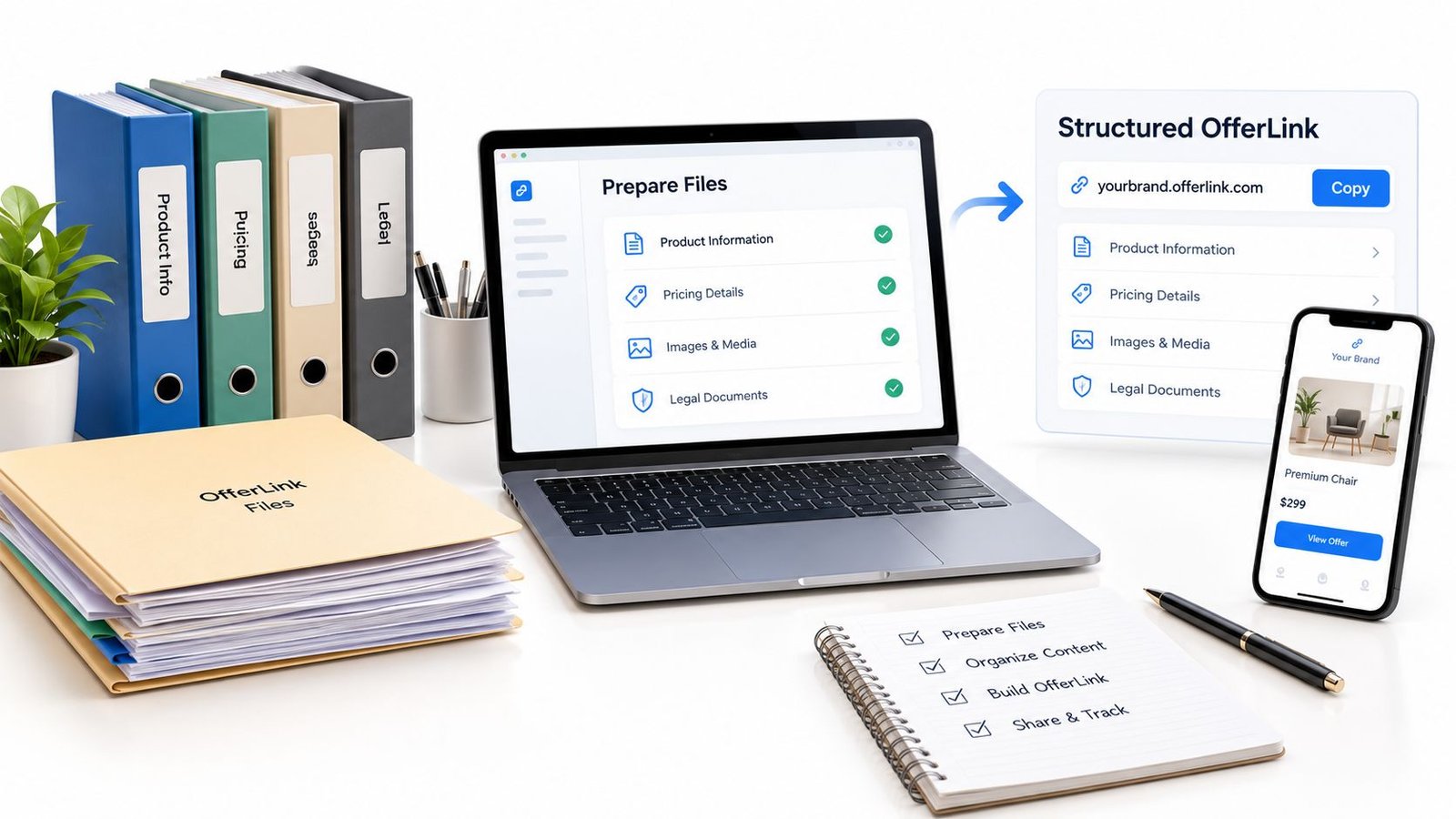
A buyer should understand the purchase before reaching the payment stage. The cover, description, format, delivery method and support expectations need to work as one sales asset. A vague page creates avoidable questions, while a precise page reduces uncertainty for both the buyer and the seller.
A practical preparation sequence
1. Finalise the manuscript file.
The ebook should be checked on the devices and applications its readers are likely to use. Headings, page breaks, contents navigation, links and special characters need inspection after conversion, not just in the source document. A PDF may suit a fixed-layout workbook, while a reflowable ebook is usually more appropriate for ordinary text.
2. Prepare the cover and previews.
The main cover should remain legible at a small size. A product page can also include selected interior pages, a contents list or a short audio sample where relevant. Previews help buyers assess the book's tone and presentation without receiving the complete product before purchase.
3. Write metadata for humans and search.
The title, subtitle, author name, edition, ISBN where applicable, genre, subject and audience should be consistent across every channel. The description should identify the reader, explain the problem or experience the book addresses and state exactly what is included. Keyword stuffing makes a listing harder to trust and harder to scan.
4. Separate the assets.
The seller should keep the final ebook, audiobook files, print-ready interior, cover artwork, bonus material and licence information in clearly named folders. A delivery file shouldn't be the same working file used for editing. This separation reduces the risk of sending an unfinished manuscript or the wrong edition.
The OfferLink page as a sales page
The page should answer five questions quickly:
- What is it? State the book title, author, format and edition.
- Who is it for? Describe the intended reader without making unsupported promises.
- What is included? List the book, files, bonuses, access details or physical components.
- When will it arrive? Give the expected digital access process or dispatch expectation.
- What happens after payment? Explain confirmation, download, shipping updates and support.
Physical sellers should state whether stock is held, made to order or supplied through another fulfilment arrangement. Digital sellers should specify the file type, access method and any device or application limitations. If a bonus is included only with a particular format, that condition needs to appear beside the price rather than in a buried paragraph.
A test purchase is essential before launch. The seller should check the mobile page, payment summary, confirmation message, file access, order record and customer-support route. A second person can review the page for questions the author has stopped noticing after working on the book for months.
Choosing Between Marketplaces and Direct Channels
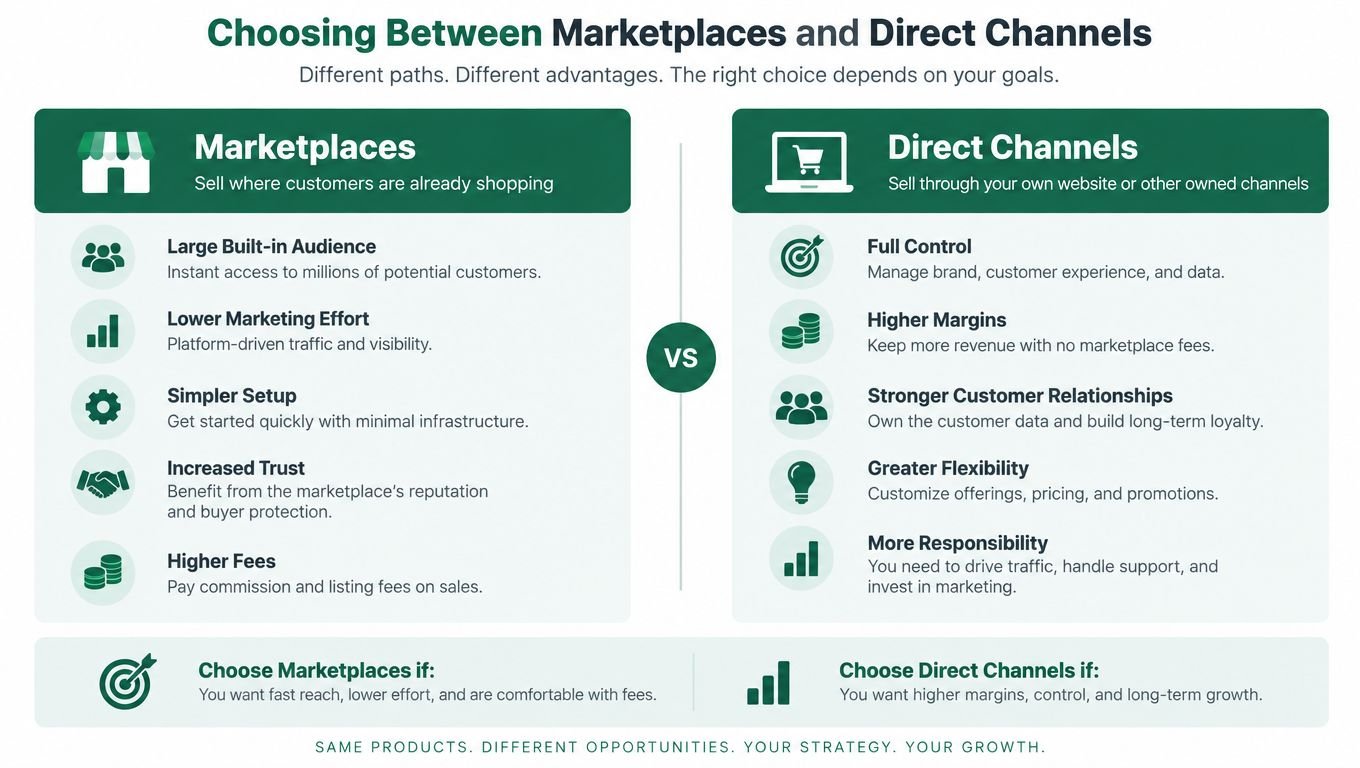
A marketplace and a direct channel solve different problems. The marketplace helps strangers find a title. The direct channel helps an interested reader complete a purchase in a controlled environment. A full online shop can do more, but it also brings more decisions around design, navigation, inventory and maintenance.
The UK online book retail channel is concentrated and volatile. IBISWorld estimated its value at £675.2 million in 2024, following a 32.4% decline that year, and forecast £738.3 million for 2025 in its market assessment. The IBISWorld online book sales data supports a cautious approach: sellers should optimise for the channels where relevant readers already search instead of assuming that broad market growth will carry a weak listing.
A decision matrix for sellers
| Selling route | Discovery | Margin control | Reader relationship | Technical workload | Suitable use |
|---|---|---|---|---|---|
| Marketplace | Stronger access to existing search demand | Restricted by fees, competition and marketplace pricing | Limited control over buyer information | Lower at the start | Reaching unfamiliar readers and testing category fit |
| Full storefront | Traffic must be generated by the seller | Greater control over price, bundles and branding | Stronger ownership of the customer journey | Higher | Building a broader publishing business with several products |
| Direct OfferLink | Depends on links, campaigns, social content and existing audiences | Clearer control over the offer and transaction route | Better suited to repeat-reader relationships | Lower than building a full shop | Converting newsletter readers, fans, event audiences and referrals |
A new author doesn't need to choose one route forever. A sensible combination might place the standard edition on a marketplace for search discovery, while a direct page handles signed copies, bundles, pre-orders or a reader bonus. The direct offer must be genuinely distinct. Sending marketplace shoppers to an identical page without a clear reason to switch creates friction rather than loyalty.
Metadata is a commercial decision
The AmaJova resource on online selling platforms is relevant to the broader channel question because a seller needs to weigh control against operational effort. For books, the same assessment should include ISBN consistency, category selection, series information, edition details and the wording of the product description.
The Booksellers' NielsenIQ BookData service is positioned around spotting bestsellers, comparing performance with the market and verifying top-selling titles by category. Sellers can use category-level evidence to validate a niche before investing heavily in stock, advertising or multiple formats. A title with a precise audience and accurate metadata has a better chance of being considered than one labelled for everyone.
A marketplace is the wrong place to hide weak positioning. It exposes the book beside competitors, so the cover, subtitle, description and preview must explain the difference quickly. A direct channel can provide more context, but it still needs a specific promise and an uncomplicated route to payment.
Building Demand Through Social and Pre-Orders
A listing can't create sustained demand on its own. Readers usually need repeated exposure before they decide that a title is relevant, especially when the author is unknown to them. Social content, email and pre-release activity give the book a context that a product page cannot provide.
Creator communities on TikTok and Instagram have become important discovery routes for romance, fantasy, thriller and YA titles, according to independent UK publishing coverage in the UK publishing marketing guide. The useful lesson isn't that every author needs to chase a particular platform. It's that genre readers often gather around conversations, recommendations, aesthetics and reactions rather than conventional advertising.
Turn attention into a launch sequence
A social-first launch works better when every post has a job. A seller can use the following sequence:
- Establish the premise. Share the subject, setting, central tension or practical outcome without revealing the entire book.
- Show the work. Present cover development, research, annotated pages, narration preparation or the physical production process.
- Invite participation. Ask readers to choose between meaningful options, join a discussion or submit questions about the topic.
- Open the pre-order. Give the audience a direct purchase route with the release date, fulfilment method and any clearly defined bonus.
- Follow through. Send confirmation, release updates and post-publication content that helps buyers use, read or discuss the book.
A pre-order is more than an early sale. It tests whether attention is converting into a commercial commitment before the seller spends heavily on stock or promotion. The page must make the delivery date and format unmistakable, particularly when the buyer pays before receiving a digital or physical product.
Build a reader-owned route
Email remains valuable because the seller can communicate with people who have chosen to hear about future work. A sign-up incentive might be a sample chapter, a related worksheet or an author note, provided the sign-up terms and future messages are clear. The list should be segmented where useful, for example by format interest, genre or whether a reader bought the earlier title.
Discount codes can support a launch without making the ordinary price look arbitrary. A seller might reserve a code for newsletter subscribers, event attendees or readers purchasing a bundle. The result should be tracked by campaign, not just by total orders, so the publisher can distinguish a popular post from a post that led to purchases.
Direct sales also make it easier to connect a pre-order with a future relationship. The buyer can receive fulfilment updates, a reading guide, an invitation to a live discussion or news about the next title. That relationship is more durable than hoping an algorithm displays the next listing to the same person.
Managing Fulfilment and UK Consumer Rights
Direct sales do not end at checkout. They transfer responsibility for the customer experience to the seller. The product page, confirmation message and support process must describe the same product, format and delivery timing. A single order record also prevents avoidable delays when a buyer asks about access, dispatch or payment.
For digital content sold at a distance, the Consumer Contracts Regulations state that supply should not begin during the 14-day cancellation period unless the consumer gives express consent and acknowledges that this removes the right to cancel. If those conditions are missing, the consumer bears no cost for supply during that period. Bromley Council on distance selling explains that, for digital content not supplied on a tangible medium, the period starts the day after the contract is made.
Build a fulfilment checklist
- Digital delivery: Test every download or access step before launch. Keep a replacement copy available and record the file version supplied to each buyer.
- Print dispatch: Check the edition, protect the book from bending or moisture, and send a clear dispatch update. Keep proof of posting where the delivery method provides it.
- Fault reports: Reply promptly. Establish whether the problem concerns access, file corruption, compatibility or an incorrect file, then offer the appropriate remedy.
- Cancellation terms: Place the digital-content consent wording beside the purchase flow, rather than hiding it on a separate policy page.
- Order communication: Keep delivery details, messages, payment status and dispute notes together in the order record. The AmaJova order management workflow provides a structured way to organise that information.
The Consumer Rights Act guidance on faulty digital content states that consumers generally have a statutory right to repair or replacement when digital content is faulty. If neither remedy is possible or appropriate, a price reduction may be available, potentially up to the full amount paid. Digital content does not generally carry the same right to reject for a full refund as physical goods, unless the trader had no legal right to supply it.
Payment disputes require their own records and response process. The Financial Ombudsman guidance on card purchases explains that chargeback can help challenge a debit or credit card transaction when goods or services were not received or were faulty. It usually needs to be raised within about 120 days. For credit-card purchases over £100, Section 75 of the Consumer Credit Act can also apply. Accurate descriptions, prompt support and delivery evidence protect revenue as well as customer trust.
AmaJova provides OfferLinks for physical and digital products, connecting offer details, pricing, fulfilment information and checkout with the order record. Sellers can use AmaJova to present a book through a focused purchase link instead of building a full storefront, then organise delivery or access communication around the transaction.