A UK seller can outgrow a spreadsheet long before the business feels “big”. One week it's Shopify and Etsy, the next it's Amazon UK and a TikTok Shop test, with physical stock, made-to-order work, and digital bundles all landing in the same inbox. The underlying issue is not just volume, but the mix of fulfilment rules, refund pressure, and customer messages that turns a simple order log into an operational risk.
| Option | Best fit | Strength | Watch-out |
|---|---|---|---|
| Brightpearl | Retailers with multi-channel selling and accounting needs | Strong back-office control | Heavy for smaller or mixed-offer sellers |
| Linnworks | Multi-channel marketplace sellers and warehouse-led operations | Good orchestration across channels | Overkill for simple link-based offers |
| Cin7 Core | Product-heavy brands with inventory and costing needs | Strong inventory discipline | Less suitable for service-led selling |
| Shopify-native stack | Shopify-first brands with simpler workflows | Lower friction and cleaner setup | Struggles once channels and exceptions multiply |
| AmaJova OfferLink model | Services, digital products, live sessions, personalised offers | Clear offer page plus order record | Not a replacement for warehouse orchestration |
Table of Contents
- Why UK Sellers Are Rethinking Their Order Stack
- What an Order Management System Actually Does in 2026
- The Evaluation Criteria That Matter for UK Operators
- Leading Order Management Systems Compared
- Matching Platforms to Seller Profiles and Use Cases
- When a Full OMS Is Overkill
- Choosing Your Shortlist and Common UK Questions
Why UK Sellers Are Rethinking Their Order Stack
A common UK setup in 2026 is already messy enough to break weak systems. A brand might sell on Shopify, Etsy, Amazon UK, and a small TikTok Shop test, while juggling stock items, made-to-order products, and digital bundles in the same week. Add a small support team and the flood of “where is my order” messages starts eating the day.
The operational pressure is not abstract. UK retailers were already deep into automation by 2024, with 60%+ using automated order processing, 40% using an inventory or order management system, and 25% still leaning on spreadsheets, according to Linnworks' State of Commerce Ops report for 2024. That mix shows why the order layer now sits at the centre of commerce operations, not at the edge of admin. Linnworks' 2024 State of Commerce Ops report
Practical rule: if stock lives in more than one place, the order record must become the single source of truth or the business will keep selling what it cannot fulfil.
The real pain points
WISMO load grows fast when tracking is fragmented. Buyers do not care whether the issue sits with stock sync, a courier scan, or a manual handoff, they just want a clear answer and a refund when something goes wrong.
Refund friction is another reason sellers are rethinking the stack. Under the Consumer Rights Act 2015, a trader who breaches the right to supply digital content must refund all money paid, or the affected portion if only part is affected, and the refund must be made without undue delay and no later than 14 days after the trader agrees it is due. That makes sloppy order records expensive, especially when partial refunds, access issues, or mixed-format bundles are involved. Consumer Rights Act 2015 refund rules
The right question is no longer “Which platform has the longest feature list?” It is “Which system fits the seller's channel mix, offer type, and fulfilment reality without creating more work than it removes?”
What an Order Management System Actually Does in 2026
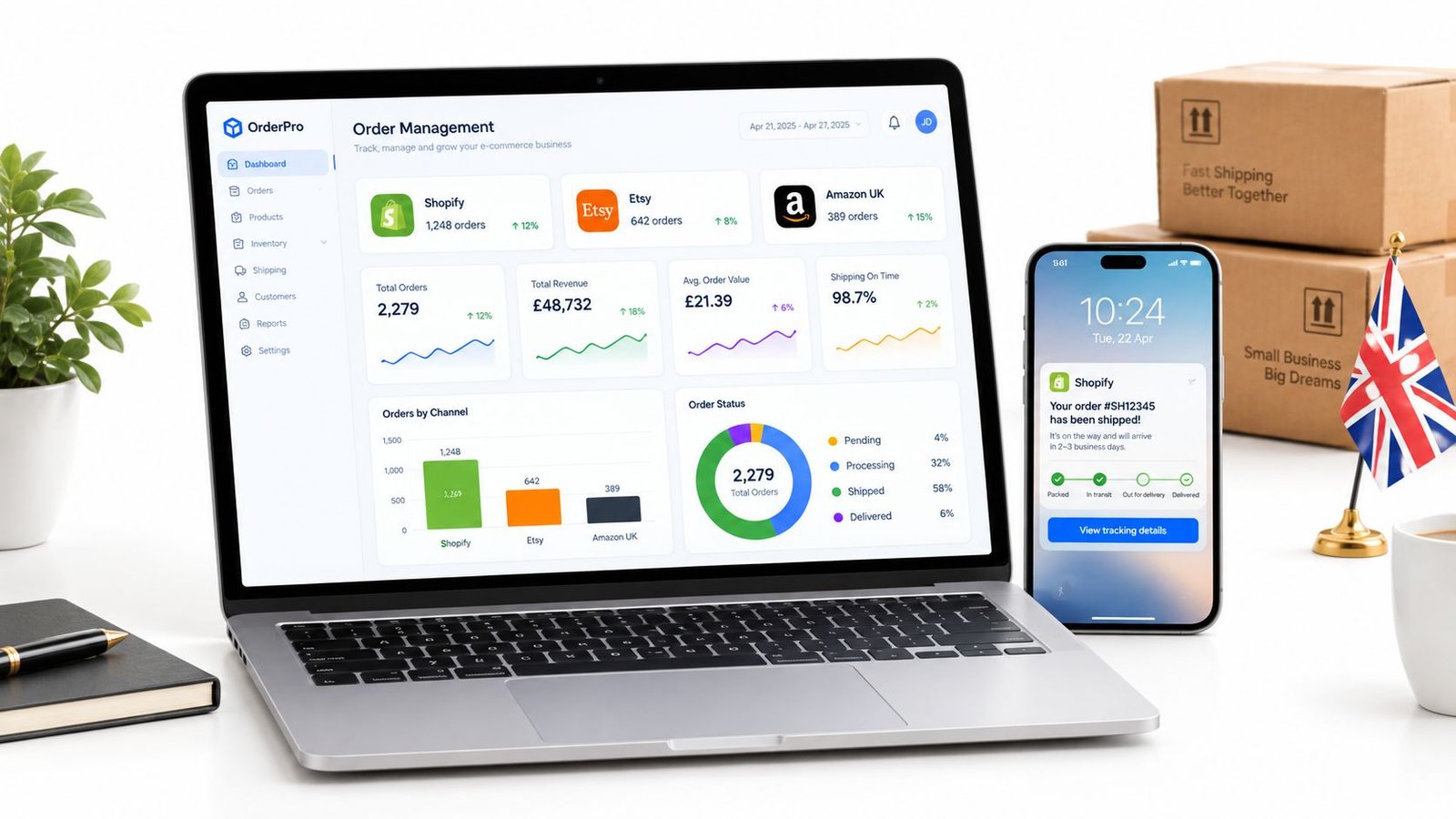
A modern OMS is not just a place to view orders. It captures orders from every active channel, decides where they should go, keeps customers informed after payment, and carries enough transaction context to support fulfilment, returns, and cross-border handoffs. In the UK, that matters because digital trade is now defined by how transactions are digitally ordered and/or digitally delivered, which makes the order record part of wider trade infrastructure, not just retail software. OECD report on digital trade in the United Kingdom
For UK sellers, that also means the system has to handle GBP pricing, order timestamps, buyer details, and carrier handoffs without forcing people to re-key data across tools. If the business sells internationally, the OMS often becomes the place where fulfilment updates, customs fields, and transaction records stop drifting apart.
Where an OMS stops
An OMS should not try to replace every adjacent system. Accounting still belongs in accounting software, CRM still belongs in CRM, and marketing automation still belongs in marketing tools. A strong OMS connects to those systems cleanly, but it should not be treated as a substitute for them.
The useful test is simple. If the platform cannot manage order capture, routing, fulfilment visibility, and post-purchase communication in one workflow, it is not doing the OMS job properly. A good primer on the workflow itself is the order management system guide, which is worth reading before anyone signs a contract.
For sellers with non-standard offers, the boundary matters even more. A live session, a service package, and a physical SKU do not need the same machinery, but they do need a clear transaction record and a clean customer journey. That is where the OMS definition starts to separate from checkout tooling and from a single-link offer system.
An internal workflow reference such as AmaJova's order management workflow is useful here because it shows how a transaction record can stay attached to fulfilment, messages, and completion steps without pretending every seller needs warehouse software.
The Evaluation Criteria That Matter for UK Operators
UK sellers should judge an OMS by where it fails first. The shortlist should be built around exception handling, stock accuracy, dispute control, and the amount of support work it removes from the team.

The seven criteria that actually matter
Exception handling. Partial fulfilments, split shipments, address changes, and back-orders need one queue with clear ownership. If the OMS cannot handle exceptions cleanly, support staff end up stitching the process together by hand.
Real-time stock sync. UK retailers selling across more than one channel need live stock visibility, not delayed snapshots. Independent UK retailer visibility reporting says only 36% of retailers believe they have full inventory visibility, while 57% report minor visibility issues, so this is a real operational weakness. UK retailer visibility reporting
Carrier integration depth. Royal Mail, DPD, Evri, and Yodel should sit inside the order flow, not as bolt-ons. Proper carrier integration means labels, tracking updates, and status changes happen in the same workflow as the order itself.
Multi-currency and landed cost support. Sellers trading into the EU need more than a currency toggle. They need order records that can handle cross-border pricing, fulfilment updates, and customs paperwork without confusing the customer or the warehouse.
Post-purchase communication. Branded tracking pages and proactive updates reduce uncertainty. UK reporting also found that 33% of retailers planned to expand AI use in 2025 to improve the post-purchase experience because WISMO pressure was rising. UK post-purchase and WISMO reporting
Reporting granularity. Senior teams do not need prettier dashboards. They need order cycle time, fulfilment accuracy, exception rates, and channel-level performance they can act on.
Total cost of ownership. Per-order fees, implementation effort, training, and workflow rework matter more than the sticker price. A cheap platform that creates re-keying costs is not cheap.
The best OMS is the one that removes rework. Anything else just moves the problem somewhere else.
Why this matters legally and operationally
Refund handling sits inside OMS selection. The Consumer Contracts guidance says the cancellation period for distance and off-premises contracts was extended to 14 calendar days, and traders must refund within 14 days of cancellation of a service contract or receipt of returned goods, or evidence of return. Consumer Contracts guidance
For digital content, traders must not begin supply before the end of the 14-day cancellation period unless the consumer gives express consent and accepts that the right to cancel is lost once supply begins. Order records, consent capture, and access status need to line up. Digital-content supply guidance
A system that cannot track those states cleanly creates disputes instead of resolving them. Exception handling, refund logic, and post-purchase clarity matter more than a long feature list. Exception states should connect to your seller protection policy so refund and evidence rules are enforced in the workflow.
Leading Order Management Systems Compared
Brightpearl
Brightpearl makes sense for retailers that want stronger back-office control without going fully enterprise. It suits businesses that sell across multiple channels and need accounting, inventory, and order flow in one retail operating system. Its core strength is operational consolidation, not lightweight setup.
Its weakness is obvious too. It can feel like too much system for sellers whose offers are mixed, personalised, or service-led. For those businesses, the platform solves the wrong problem because the pain is clarity before purchase, not warehouse orchestration.
Linnworks
Linnworks is built for multi-channel sellers that need orchestration across marketplaces, warehouses, and shipping workflows. It fits brands with a serious operational spine, especially where stock sync and channel coordination are already painful. In the UK, it also lines up well with businesses that treat marketplaces as core revenue rather than side channels.
The trade-off is complexity. Linnworks rewards teams that already think in terms of routing logic, fulfilment rules, and exceptions. It is less attractive when the seller only needs a clear offer page and a tidy transaction record.
Shopify-native order logic
A Shopify-native stack works best for sellers who are still close to one core storefront and one operating rhythm. It keeps the setup simpler and avoids stitching together too many systems too early. That can be the right move when the main problem is process discipline, not platform sprawl.
The limit appears once the business starts mixing wholesale, marketplaces, or non-physical offers. At that point, native logic becomes a compromise, because the order layer has to do more than Shopify alone was designed to do.
Cin7 Core
Cin7 Core is a strong fit for product-heavy brands that care about inventory discipline, costing, and stock control. It suits businesses that manufacture, assemble, or carry enough SKU complexity to make spreadsheet logic brittle. For those operators, inventory correctness is the main game.
The downside is that it is still a product-first system. If a seller's offer mix includes services, digital delivery, or live sessions, the platform can feel like a harder fit than it looks on paper.
ChannelEngine-adjacent stacks
Marketplace-first brands that are scaling internationally often build around marketplace orchestration tools and connect those to inventory or fulfilment systems. That route works when Amazon, eBay, and other marketplaces are the centre of gravity. It is the most practical path for sellers whose growth comes from channel expansion rather than direct relationship building.
A useful caution sits alongside customs and cross-border complexity. The ecommerce customs compliance guide is worth reviewing for any seller moving stock between markets, because the order stack only works if customs and order data do not fight each other.
For international sellers, the stack has to support both operational accuracy and regulatory clarity. If the system hides where orders are going, what was charged, or what needs to be declared, it becomes a liability.
Matching Platforms to Seller Profiles and Use Cases
The cleanest way to choose is to stop asking which platform is “best” in the abstract. The better question is which one fits the seller's profile, order rhythm, and offer mix without forcing workarounds.
| Seller Profile | Order Volume | Offer Mix | Recommended OMS |
|---|---|---|---|
| Single-channel Shopify brand hitting growth friction | Moderate and rising | Mostly physical products | Shopify-native stack or Cin7 Core |
| Multi-channel marketplace seller juggling Amazon, eBay and TikTok Shop | Moderate to high | Physical products across channels | Linnworks |
| Wholesale-plus-DTC hybrid needing B2B order capture | Moderate to high | Physical products with wholesale orders | Brightpearl or Cin7 Core |
| Cross-border brand moving stock between UK, EU and US fulfilment centres | High | Physical products with customs complexity | ChannelEngine-adjacent stack plus inventory system |
| Service-led or offer-led seller using links, sessions or digital bundles | Low to moderate | Services, digital products, live sessions | AmaJova-style OfferLink approach |
A Shopify-first brand usually starts with the simplest viable stack, then adds OMS depth only when stock sync or fulfilment exceptions become painful. If the seller still has one core catalogue and one fulfilment rhythm, there is no prize for buying enterprise process too early.
Marketplace-heavy sellers are different. They need channel orchestration because the channel itself creates the complexity. Linnworks or a similar stack makes sense there because order routing and inventory sync are the main bottlenecks.
Wholesale-plus-DTC hybrids need a system that can keep B2B and B2C order states from colliding. Brightpearl often fits that mixed retail reality better than lighter tools because the back office and the order layer are treated as one operation.
Cross-border sellers should treat customs and fulfilment as part of the OMS decision, not a separate project. If the order stack cannot carry the right commercial data through the fulfilment chain, the international side of the business will stay fragile.
When a Full OMS Is Overkill
A lot of UK independents do not need an OMS at all, at least not in the full sense. Creators, consultants, educators, and small DTC sellers often buy complexity they will never use, then spend months stitching together setup, integrations, and process training for a problem they do not have.
That is especially true when the bottleneck is not warehouse orchestration. If the seller is offering a paid session, a digital product, a personalised service, or a simple physical offer with clear fulfilment steps, an OfferLink-style model can be the better fit. AmaJova is built around that logic, with one clear offer page, checkout, and an order record that keeps fulfilment, messages, support, and transaction history together.
Where the cutoff usually sits
A spreadsheet plus a checkout tool is still enough when the business has:
- One or two channels, not a channel sprawl.
- Low exception volume, with few partials or split shipments.
- Simple fulfilment rules, such as fixed delivery, fixed access, or a booked session.
- No warehouse routing problem, because stock or delivery steps stay easy to manage.
Once the business starts needing routing logic, stock reservations, and courier automation, a full OMS earns its keep. Before that point, it is just another recurring cost with a setup burden attached.
The important distinction is not “cheap versus expensive”. It is orchestration versus clarity. Brightpearl, Linnworks, and Cin7 Core solve orchestration. AmaJova's OfferLink approach solves clarity before payment and keeps the order record attached to fulfilment after purchase.
For sellers who package offers rather than run a warehouse, that difference matters more than feature depth. A service business with a long list of manual touchpoints needs a clean transaction journey, not retail infrastructure.
Choosing Your Shortlist and Common UK Questions
The shortest route to a sane decision is to pick two or three platforms that match the actual business model, not the future fantasy. Then run a 14-day pilot on one SKU range or one offer line, and test stock sync, exception handling, and support workload before anyone signs a long contract.
A useful support document for service-led sellers is the service agreement template for the UK, because the order system only works cleanly when the offer terms are just as clear as the checkout flow.
Common questions
How do refund timelines affect OMS selection?
The OMS must make it easy to see order state, cancellation state, and refund state together. Under UK consumer rules, delays and partial failures turn into service load fast, so systems that bury those details create more manual work.
How should a seller migrate off spreadsheets?
Start with one channel, one SKU group, or one offer type. Import the cleanest order history first, then keep legacy records in read-only form while the new workflow proves itself.
Where does AI help post-purchase?
It helps with repetitive WISMO replies, triage, and status classification when the underlying order data is already clean. It is mostly marketing fluff when the business still has broken stock sync, unclear fulfilment, or no reliable exception queue.
Pick the platform that matches the mess that exists. Anything else is a procurement exercise, not an operations decision.
AmaJova helps sellers package services, physical products, digital products, and live sessions into one clear OfferLink with checkout and a connected order record. If the business needs clarity before payment more than warehouse orchestration, visit AmaJova and see whether that model fits the way orders are sold and fulfilled.