

A creator may already have a camera, a folder of unused portraits and a few people asking whether personalised images are available to buy. The commercial opportunity is real, but so is the unease. A seller has to decide what can be shared, who may buy it, how the file will be delivered and what happens if the buyer ignores the agreed boundaries.
Selling pictures of yourself online for money is therefore not just a photography exercise. It combines digital product design, customer service, privacy, copyright, tax record-keeping and personal safety. The sellers who last tend to treat each image offer as a small trading operation, not as an informal favour handled through direct messages.
Table of Contents
- The Seller's Dilemma – Earning Money While Staying Safe
- Choosing Where and How to Sell Images Online
- Creating Your First Structured OfferLink
- Understanding the Real Economics of Selling Images
- Starting Small and Scaling with Confidence
- Navigating Consent, Copyright and UK Law
- When Higher Prices Are Safer Than Higher Volume
The Seller's Dilemma – Earning Money While Staying Safe
A UK creator considering paid self-portraits often starts with a simple calculation. A few existing images could become downloads, a themed set or a personalised commission, perhaps creating useful supplementary income without a shop, stockroom or physical delivery process. At the same time, the creator may worry about recognition, unwanted contact, copying and the possibility that a buyer will share an image beyond the agreed audience.
Those concerns aren't excessive. Ofcom records complaints to the UK Revenge Porn Helpline, including complaints involving non-consensual intimate-image sharing, rising from 521 in 2015 to 18,426 in 2024. The same Ofcom register of online safety risks records more than 28,000 police reports of sexual-image disclosure without consent between 2015 and 2021, while offences involving intimate-image abuse rose by 40% between 2020 and 2021. Among UK internet users aged 18 to 24, 7% had seen or experienced intimate images being shared, or threatened with sharing, without consent, according to that source.

Those figures don't measure legitimate paid image sales. They do show why a seller should build consent, ownership, controlled delivery and reporting routes into the process before accepting payment. A listing should identify exactly what the buyer receives, prohibit redistribution where appropriate, preserve the transaction record and explain how misuse can be reported.
Boundaries belong in the offer
A seller doesn't need to disclose a home address, personal telephone number or legal name publicly just to sell a digital product. Separate business contact details, a consistent creator name and careful image metadata can reduce unnecessary exposure. Watermarks may deter casual copying, although they can't prevent every form of misuse.
A practical protection policy should explain acceptable requests, prohibited conduct, delivery expectations and the evidence the seller will retain. A defined seller protection policy can help organise those decisions, but the seller still needs to read the applicable terms and choose boundaries that feel personally safe.
Practical rule: If the terms would be awkward to explain after a dispute, they aren't clear enough before checkout.
Choosing Where and How to Sell Images Online
The selling method affects more than appearance. A social-media direct message can generate interest quickly, but it often leaves the price, file specification, usage rights and delivery promise scattered across several conversations. A traditional ecommerce shop gives more control, yet it can require product pages, payment configuration, customer support and ongoing technical administration.
A structured OfferLink sits between those approaches. It can present a title, description, inclusions, price and fulfilment details on one page, then connect the payment, messages and completion evidence to the relevant order. For a seller offering a standard download, that structure is usually clearer than negotiating every detail in private messages.
Comparing the practical trade-offs
| Approach | What works | What can go wrong |
|---|---|---|
| Direct messages | Fast conversations and a low barrier to starting | Scope, payment evidence and delivery promises become difficult to track |
| Full ecommerce storefront | More control over branding, catalogue and customer journey | More setup, maintenance and operational decisions |
| Structured OfferLink | One shareable page with defined scope and connected order information | The seller still has to write precise terms and check the platform's current policies |
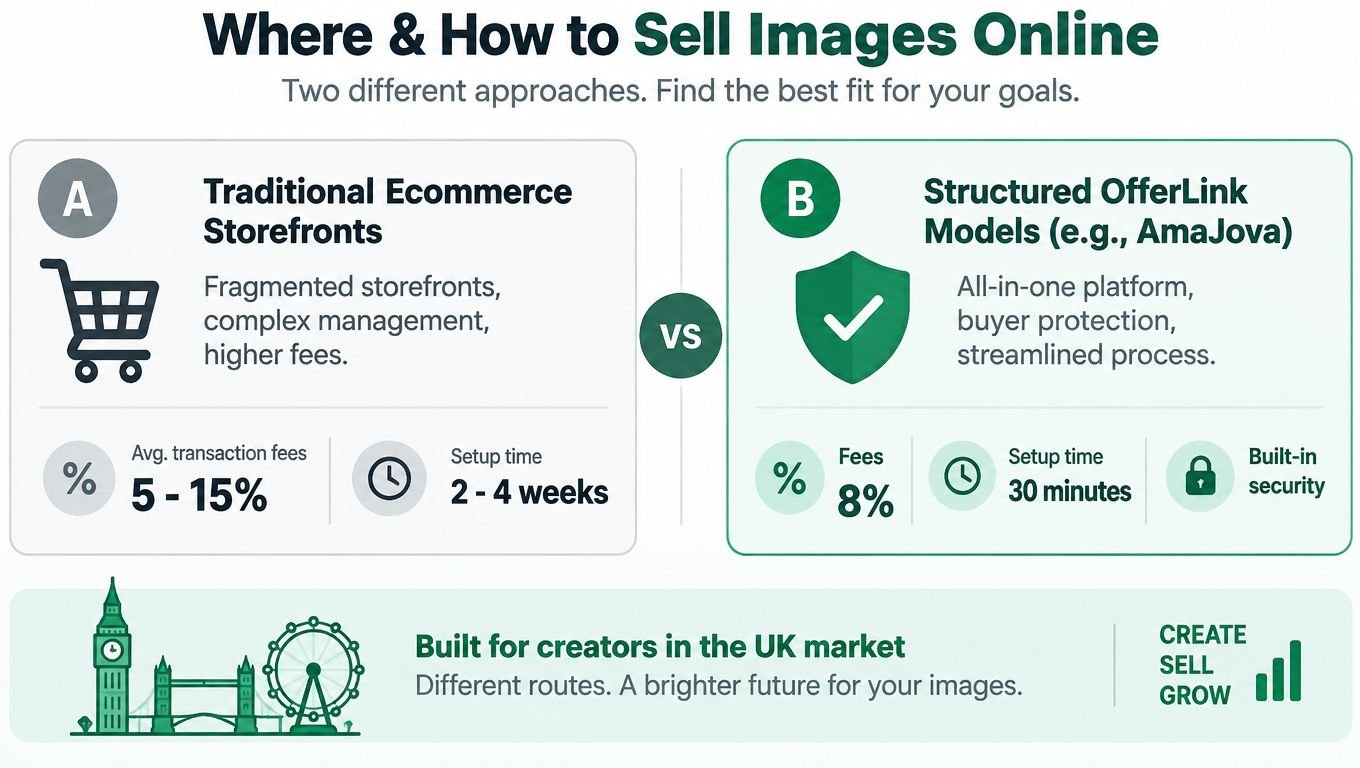
The supplied comparison visual presents traditional storefronts with average transaction fees of 5% to 15% and setup time of 2 to 4 weeks, while its structured OfferLink comparison presents 8% fees and 30 minutes of setup. Those figures belong to the visual's stated comparison and shouldn't be treated as a universal market benchmark. Actual costs, payout timing and protection depend on the provider and the seller's circumstances.
A platform offering secure checkout, a clear order summary, seller verification and protection information can reduce ambiguity before a buyer pays. Global selling also requires attention to supported currencies, payout clearance and customer communication. The publisher's platform overview states that its system supports 150+ currencies and includes a Seller Growth Program with progression tiers, but sellers should check current terms rather than assume identical availability for every offer.
Sellers promoting through Instagram or similar channels still need a content and conversion plan. A practical guide to shoppable posts and ads can help with the promotional side, while the offer page should handle the more important commercial detail. The online selling platform resource is another place to compare the operational model before choosing how to publish an offer.
Creating Your First Structured OfferLink
The first offer should be deliberately narrow. A seller who publishes “custom pictures for any request” invites negotiation, boundary-testing and arguments about what the price includes. A clearer starting point is one defined product, service or session with a known delivery process.
Build the offer around the buyer's outcome
A useful setup sequence looks like this:
Choose the format. Decide whether the buyer receives a standard digital download, a personalised image, a physical print, a live session or another service. Each format creates different expectations about delivery and evidence of completion.
Name the inclusions. State the number of images or the type of deliverable, file format where relevant, permitted personal use and whether any editing is included. Avoid vague phrases such as “bespoke content” unless the boundaries appear immediately afterwards.
Set timing and revisions. Give a realistic turnaround description, explain whether the buyer can request changes and state what counts as a revision. A seller shouldn't promise unlimited alterations when the price only covers one defined deliverable.
Write the boundaries. List unacceptable requests, prohibited redistribution, commercial-use restrictions and any identity or privacy limits. Keep the wording calm and professional.
Attach supporting details. Use FAQs for common questions, optional extras for separate work and media uploads that show the style without revealing unnecessary private information.
A guided setup can make these fields easier to organise, but the seller remains responsible for accuracy. The order record should show the agreed scope, payment, messages, delivery step and completion evidence in one place.
A usable first-offer template
Title: Personalised portrait download
Description: One original digital portrait created from an agreed brief. The buyer receives a personal-use file and may not resell, redistribute or use it for advertising without written permission.
Includes: One image, basic editing, digital delivery and one clearly defined correction request.
Doesn't include: Additional images, unlimited revisions, live interaction or commercial licensing.
Delivery: The seller states the expected delivery window before checkout.
Buyer brief: The buyer supplies colour, mood and general composition preferences without requesting prohibited or unsafe content.
Usage: Personal viewing only unless a separate written licence is agreed.
Support: The order record holds relevant messages and delivery evidence.
A standard download should be treated differently from a bespoke service. A download has a prepared file and a straightforward access event. A personalised image requires a brief, production time and a record showing that the agreed work was completed. A live session needs booking details, attendance expectations and a clear cancellation position.
The point isn't to make a simple sale bureaucratic. It's to ensure both parties can answer the same question: what exactly was purchased?
Understanding the Real Economics of Selling Images
Gross sales can look encouraging while cleared earnings remain disappointing. The seller needs to price the whole job, including preparation, messages, editing, payment charges, currency conversion, taxes, replacement work and the risk of a buyer disputing or failing to complete payment.
A practical worksheet starts with the minimum amount the seller needs to retain:
| Cost or requirement | Question to answer |
|---|---|
| Production time | How long will planning, shooting, editing and delivery take? |
| Communication | How much time will the brief, questions and revisions consume? |
| Platform and payment charges | What is deducted before the payout clears? |
| Equipment and software | Which reasonable business costs support the work? |
| Replacement work | What happens if a file is corrupted, lost or delivered incorrectly? |
| Risk allowance | What time or money could be lost through cancellation, dispute or non-payment? |
| Tax position | What records and potential liabilities apply to the seller's circumstances? |
The minimum viable price should cover the required time and costs before any hoped-for profit. A standard download may justify a lower handling burden because the asset is prepared once. A personalised request should command more because the seller is selling judgement, communication and production time, not merely a file.
Keep the UK records together
HMRC guidance says the £1,000 trading allowance applies to combined gross income from side hustles, not separately to each activity. Once gross trading income exceeds £1,000 in a tax year, the seller generally needs to tell HMRC and may need to register for Self Assessment. The tax year runs from 6 April to 5 April, and the allowance concerns gross trading income rather than just the amount withdrawn from a platform, as explained in HMRC guidance for income from online platforms.
That means picture sales, subscriptions, paid requests, downloads and related services may need to be considered together. HMRC's research on social media content creators also identifies earnings records, filing procedures and threshold awareness as recurring information needs.
A sensible routine records the order value before fees, saves fee and equipment evidence, reconciles payouts monthly and reviews the threshold before adding more commissions. Sellers may need to choose between claiming the trading allowance and deducting allowable expenses. Personal Allowance is separate and applies to total income, so individual circumstances matter.
Starting Small and Scaling with Confidence
A launch doesn't need a large catalogue. One narrow offer gives the seller a manageable way to test demand, delivery time and personal comfort before public visibility increases.
The first phase should define the core product and its boundaries. The seller can then share it with a small, relevant audience, observe the questions buyers ask and identify where the wording creates confusion. Feedback should improve the offer, not pressure the seller into accepting requests that feel unsafe.

A readiness check before expanding
- Offer clarity: The page states the deliverable, price, timing, usage limits and revision position.
- Operational capacity: The seller can answer enquiries, complete fulfilment and retain records without disrupting existing work.
- Safety confidence: The creator has separated public contact details where appropriate and knows how to report misuse.
- Technical reliability: Files can be stored, delivered and replaced without exposing unrelated personal information.
- Financial control: Gross income, fees, expenses and refunds are entered into a contemporaneous ledger.
- Emotional boundaries: The seller can decline a request without feeling obliged to justify a personal limit.
Once the process works, expansion can happen in controlled steps. A seller might add a second file type, then a clearly defined personalised option, then a physical product or live session if the support workload remains manageable. Each new offer should have its own inclusions and fulfilment expectations.
A structured seller progression programme may offer optional verification badges or priority growth placement, but those features shouldn't replace independent judgement. Gradual scaling protects reputation and gives the seller time to discover which requests create hidden labour.
Navigating Consent, Copyright and UK Law
Consent isn't a single checkbox. A seller should record what was agreed, who may access the image, whether the image is intimate, how it may be used and what happens if the buyer requests a change in scope. The seller should also separate ordinary likeness concerns from intimate-image abuse, which can involve different legal and reporting considerations.
The UK government states that, since 6 February 2026, creating or requesting the creation of a purported intimate image of an adult without consent is a criminal offence under the Data (Use and Access) Act 2025. The government has also announced measures requiring regulated services to remove reported non-consensual intimate images within 48 hours, while reforms concerning AI nudification tools and deepfakes continue to develop. Sellers shouldn't assume that every copied image will be removed automatically. Current official reporting routes remain important.
A practical compliance checklist
- Record consent and scope. Keep the agreed brief, permitted use and relevant buyer acknowledgements with the order.
- Separate identity where needed. Don't disclose a legal name, location or identifying background details unless there's a clear reason.
- Control distribution. Use watermarks, lower-resolution previews or controlled delivery where appropriate, recognising that none is perfect protection.
- Define copyright terms. State whether the buyer receives a licence or an assignment, and specify personal use, commercial use, editing, resale and portfolio rights.
- Preserve evidence. Keep payment records, messages, delivery confirmation and screenshots of the original listing.
- Escalate misuse. Identify the platform reporting route, preserve the copied URL and avoid deleting evidence before documenting it.
The Copyright, Designs and Patents Act 1988 contains specific transitional wording concerning commissioned photographs, portraits and engravings. Paying for a picture doesn't automatically settle every copyright question, especially where commercial exploitation is involved. Clear written terms and specialist advice may be necessary.
Sellers should also consider how easily a public image can be connected to other accounts. A resource on how face recognition impacts privacy can help creators think through discoverability before publishing. The intellectual property resource offers another place to organise ownership and usage questions, but it isn't a substitute for specific legal advice.
When Higher Prices Are Safer Than Higher Volume
More orders don't automatically produce better earnings. High volume can increase message handling, unpaid customisation, refund requests, chargebacks, disputes and replacement work. Those costs reduce the value of every sale even when the headline revenue looks healthy.
A smaller number of clearly scoped orders can be safer because the seller has time to review each brief, deliver correctly and preserve completion evidence. The price should reflect whether the buyer is receiving a standard digital product, a personalised service or a live interaction. Those categories require different amounts of preparation and create different evidence of fulfilment.
An offer page should state inclusions, turnaround, revisions, acceptable requests, delivery method and refund boundaries before checkout. The resulting messages and completion record can then support a clearer resolution if the buyer disputes what was delivered. Consumer rules can differ between physical products, services and digital content. Government guidance on the Consumer Contracts Regulations generally describes a 14-calendar-day cancellation period for many distance contracts, with exemptions and different rules applying in some circumstances, so sellers should read the official cancellation guidance for consumer contracts before writing a blanket “no refunds” statement.
Common questions
Should a nervous seller lower the price? Not automatically. A lower price can attract more negotiation and make custom work uneconomic. Clear scope and a viable minimum price matter more than appearing cheap.
When should the catalogue expand? Only after the seller can fulfil the existing offer comfortably and respond to misuse or disputes without losing control of personal boundaries.
When is professional advice sensible? Tax, copyright, consumer-contract and intimate-image issues can depend on the facts. Specialist legal or tax advice is appropriate when the activity becomes substantial, commercial rights are involved or a dispute has already started.
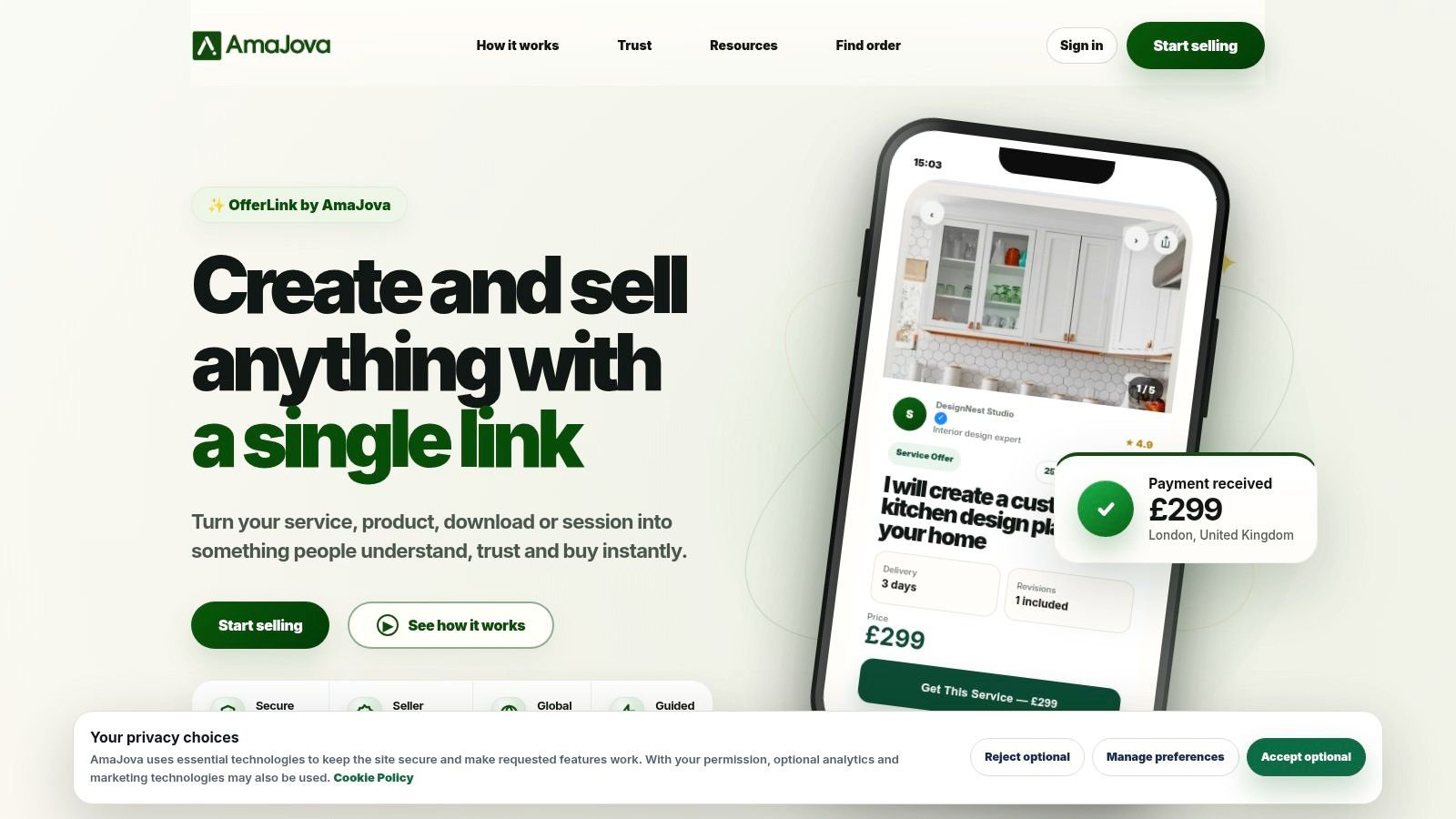
AmaJova provides a single OfferLink for services, physical products, digital products and live sessions, with checkout, offer details and order communication connected in one selling journey. Sellers who want a structured way to present image inclusions, delivery expectations and usage boundaries can visit AmaJova and review the current platform terms before publishing an offer.