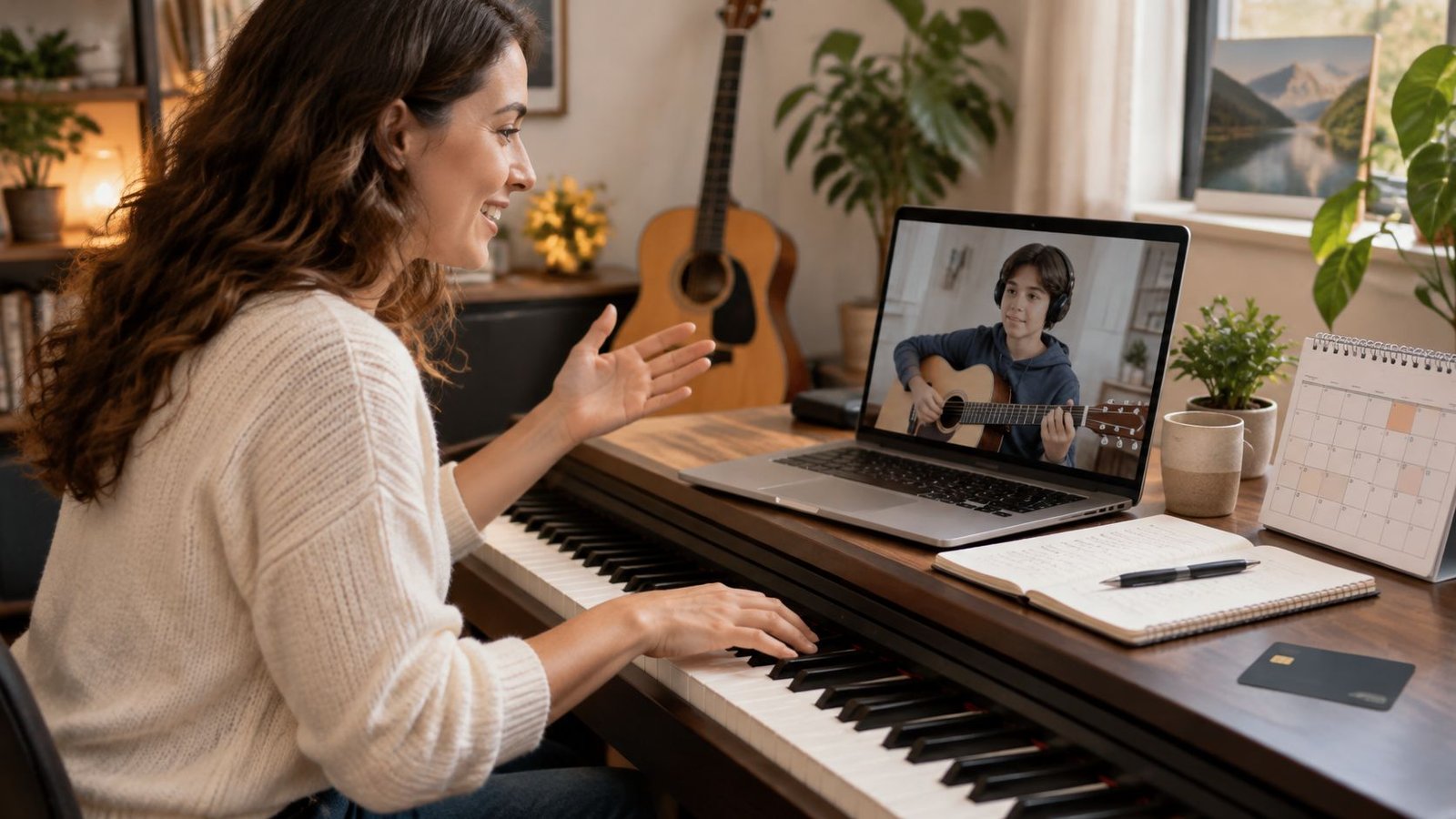
A teacher has a lesson slot available, a folder of exercises and a parent asking whether their child can learn from home. Before the booking comes a string of practical questions: will the instrument sound clear enough, what happens if the connection fails, and does the fee include feedback between lessons?
Selling music classes online means answering those questions before payment. The strongest offer connects a realistic musical goal with a workable teaching format, predictable costs and clear boundaries. A polished video alone won't compensate for an unclear booking process or a lesson that relies on technology doing something it can't.
Table of Contents
- Choose the Format That Fits Your Teaching
- Set Up Tech and Run Each Live Lesson
- How to Price, Book and Set Cancellation Terms
- Make Costs Predictable for Families
- Check Music Rights and VAT Before You Publish
- Promote Classes to Learners Who Will Book
- Publish Your First Class Offer This Week
Choose the Format That Fits Your Teaching
Online music class formats compared
| Format | Best for | Typical structure | Main constraint |
|---|---|---|---|
| One-to-one live lesson | Learners who need close feedback on technique | A recurring individual session with guided practice between lessons | Your teaching hours cap your income |
| Small group live class | Beginners, ensembles and theory | A suggested group of three to six learners, using demonstrations and individual turns | Mixed levels and sound clashes |
| Live workshop or masterclass | One-off topics such as improvisation or sight-reading | A focused event with demonstrations, exercises and questions | Needs enough sign-ups to run |
| Recorded course | Self-paced learners and repeatable content | Modules with practice tracks | Upfront production and licensing checks |
| Hybrid | Learners who need accountability without weekly lessons | For example, live feedback every two to four weeks with recorded practice between | Requires a submission and turnaround system |
The group sizes and hybrid intervals above are planning examples, not universal teaching standards. A group studying chord construction needs a different structure from beginners learning violin bow control. Ensemble preparation can work online, but ordinary video calls shouldn't be sold as a substitute for synchronised ensemble rehearsal.
Questions that determine the format
- How much individual feedback does the learner need? Sound is particularly difficult to judge through compressed call audio. A learner struggling with tone production needs individual assessment, not more videos.
- How many learners can receive useful attention in one slot? Group capacity should follow the time needed to hear each participant. Muting everyone makes a demonstration manageable, but doesn't establish whether anyone can perform the task.
- Which explanations can be reused? Notation basics, practice demonstrations and equipment setup often suit recorded material. Diagnosis and correction still require a response to the individual learner.
For reusable demonstrations, teachers can choose training video formats with VideoLearningAI, considering whether a short reference clip or a fuller lesson better supports the task. A tuning demonstration should be easy to revisit; a connected explanation of harmonic movement may need more space.
Online tuition also has roots beyond emergency lockdown provision. ABRSM's Making Music UK report found that children taking online music lessons increased from 4% in 2014 to 7% in 2020, adults increased from 3% to 5%, and 55% of teachers said they were likely to continue offering online classes afterwards.
Those findings support treating remote teaching as an established complement to face-to-face lessons, rather than promising that either format suits everyone. Practical choices still turn on the instrument, the learner's independence and the feedback required.
Planning exercise: the teacher writes a sentence naming the learner, the chosen format and the weekly teaching hours available, then uses it as the starting point for the offer headline.
Set Up Tech and Run Each Live Lesson
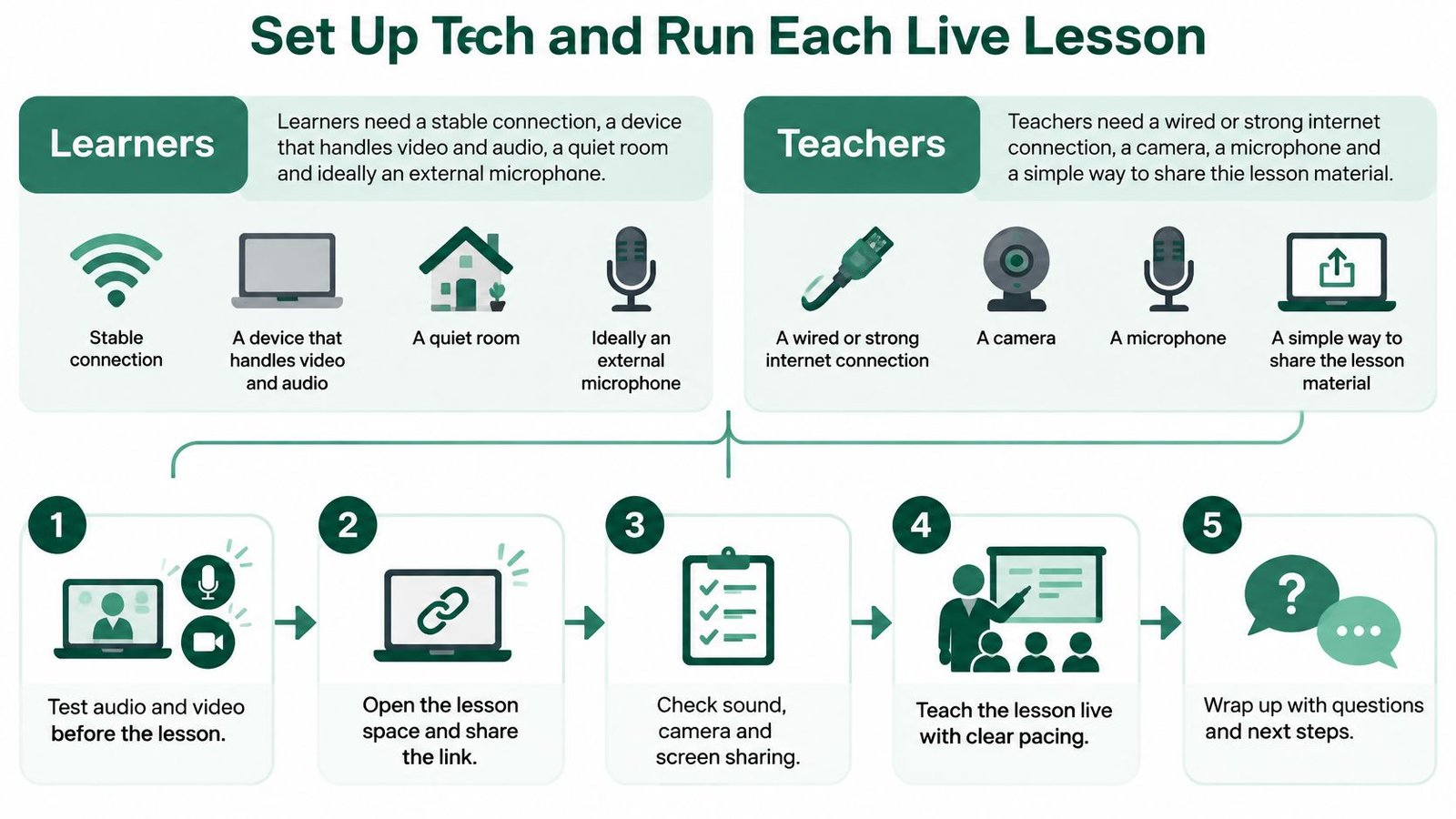
Learners need a stable connection, a device that handles video and audio, a quiet room and ideally an external microphone. Teachers need a wired or strong internet connection, an external microphone, a metronome and a camera position that reveals posture and hand movement. A laptop running Zoom or Microsoft Teams can work, but its default speech settings need testing with the actual instrument.
The setup and delivery sequence should be visible to both sides.
Test the instrument, not just the conversation
A sensible starting procedure is a ten-minute trial call before any paid booking. That suggested trial should test sustained notes, quiet playing, louder passages, camera framing and screen sharing, not merely whether both people can hear speech.
Published requirements should identify a supported video-call application, working camera and microphone, a device positioned independently of the instrument, and access to lesson materials. An external microphone won't fix a weak connection, so the cheapest useful correction may be moving nearer the router or using Ethernet.
A UK Parliament evidence submission hosted by the University of Edinburgh, based on approximately 300 music teachers and examiners, reported that 93% found online teaching more difficult than face-to-face instruction, 41% identified unstable learner internet, and 25% said learners lacked suitable devices. These are practitioner survey warnings, not proof that a particular setup produces better learning outcomes.
Practical rule: when call audio obscures the sound, the teacher should change the assessment method rather than confidently diagnose what cannot be heard.
Headphones can reduce echo, while music-oriented audio settings may preserve more musical detail. Teacher and learner should take turns playing because latency makes simultaneous performance unreliable on ordinary conferencing calls.
A usable live lesson run sheet
The following is a sample 45-minute lesson, with preparation outside the paid teaching time:
- Before the session: send joining instructions, a device check and a materials list at least 24 hours ahead. The learner brings the instrument, stand, pencil and sheet music.
- Before the clock starts: open five minutes early for sound and camera checks. A connection problem shouldn't consume the musical warm-up.
- Opening five minutes: check tuning, breathing or physical readiness, then use a scale suited to the instrument and level.
- Next ten minutes: review the last submitted recording and identify a measurable correction, such as consistent fingering through a passage.
- Middle 15 to 20 minutes: demonstrate new material slowly, then listen to the learner attempt it. Instructions should name an action rather than offer vague encouragement.
- Remaining practice-planning time: assign a narrow task, for example eight bars at an agreed metronome marking, with clear criteria for a successful attempt.
- Closing minutes: confirm the submission deadline, invite questions and write brief progress notes.
Before new teaching begins, the teacher should confirm who may message, whether recording is permitted and who may access recordings. For children, that also means a named adult contact, appropriate supervision arrangements and a clear route for raising concerns.
Between lessons, the learner submits a short scale, technical exercise and repertoire excerpt using a consistent microphone position and room setup. The teacher returns timestamped feedback, then checks whether the correction transfers into the next live performance. If the call becomes unusable, this asynchronous route provides a defined fallback rather than an improvised replacement.
ABRSM's music and wellbeing briefing reports that 84% of children and young people recognise music engagement as beneficial to mental health and wellbeing. That isn't a clinical claim about lessons, but it reinforces the importance of respectful feedback, safe communication and a response plan when a learner becomes distressed or disengages.
How to Price, Book and Set Cancellation Terms
Pricing models for online music classes
| Pricing model | How it works | Best for | Watch for |
|---|---|---|---|
| Pay per lesson | Each booked session is priced separately | One-to-one teaching with variable attendance | No-shows and late cancellations |
| Block of sessions | A set number of lessons paid upfront | Learners committing to a term | Expiry dates and how unused sessions are handled |
| Monthly membership | A recurring fee for group classes or a library of content | Ongoing groups and long-term learners | Recurring billing disclosure and cancellation steps |
| One-off recorded course | A fixed price for recorded modules | Self-paced beginners | Access period and digital content consent |
| Workshop ticket | A fixed fee per live event | One-off masterclass topics | Minimum numbers needed to run the event |
The right model reflects how teaching is delivered, not just how predictable the teacher wants revenue to be. A membership needs a continuing reason to remain enrolled; a block needs enough scheduling flexibility for the learner to use it.
Pricing should account for preparation, recording review, administration and delivery time. AmaJova's guide to pricing services provides a useful starting framework for defining paid scope rather than charging only for the visible call.
Booking terms belong before checkout
The offer should show the session structure, booking instructions, time zone, rescheduling process and teacher-cancellation arrangements. For live sessions on AmaJova, the seller shares the booking instructions and completes the scheduled session.
Teachers managing school work, private tuition and workshops can use calendar coordination tips for busy consultants from SyncThemCalendars to examine double-booking risks. Availability should leave room for preparation and notes, rather than treating every apparent calendar gap as sellable.
For UK consumers, a service contract normally carries a 14-day cancellation period starting the day after the contract is entered into, under regulation 30 of the Consumer Contracts Regulations 2013. Where teaching starts within that period, the seller should obtain an express request for early performance and explain the circumstances in which cancellation rights may be lost after full performance; the exact treatment depends on the contract and booking structure.
Downloadable notation, backing tracks and recordings require separate attention. Regulation 37 requires express consent to early supply of non-tangible digital content and acknowledgement that the cancellation right will be lost, rather than relying solely on general acceptance of terms.
A late-cancellation policy for reserved teaching time isn't the same thing as a consumer's statutory cancellation rights.
These points are general information, not legal advice. Teachers should check current GOV.UK guidance and obtain advice on their contract wording where needed, particularly for mixed live-and-digital packages or potentially exempt bookings. A blanket no-refunds statement isn't a substitute for that assessment.
Make Costs Predictable for Families
A family comparing a subscription with private tuition needs more than the headline fee. The useful question is whether the total commitment provides enough suitable teaching to support the learner's goal.
Cost deserves explicit attention: ABRSM's Making Music 2025 report found that 29% of children who don't learn an instrument identify tuition cost as a barrier, up from 25% in 2020. Online delivery doesn't automatically remove that barrier.
Establish the minimum useful commitment
The teacher should start with the learner's goal and independence. A returning adult who can practise reliably may suit periodic live feedback, while a beginner struggling to establish basic technique may need closer contact.
A self-paced app or course reaches its limit when the learner needs an individual explanation, reliable sound assessment or help identifying why an attempted correction hasn't worked. The offer should state that limit clearly, without treating every learner as a candidate for a more expensive package.
A practical cost comparison follows this sequence:
- Choose the review period. Compare membership and lesson blocks across the same period, including what happens during holidays.
- List the complete teaching cost. Include live instruction, required subscriptions, feedback charges and any assessment fees relevant to the chosen goal.
- Separate equipment from recurring spending. Identify the instrument, stand, microphone, suitable device and reliable internet access, distinguishing essentials from upgrades.
- Check the cost of disruption. Account for a missed lesson, an expired block or an unused membership period under the stated terms.
Make value visible
A family-facing comparison should show total payable, teaching included, feedback included and required extras. A lower-priced library may offer more material but less individual correction; a lesson block may provide closer assessment but fewer flexible practice resources.
Budget check: optional purchases should stay optional. Equipment described as essential should have a clear teaching purpose.
Teachers can reduce uncertainty by naming the point at which progress will be reviewed and the package reconsidered. Serious performance goals may call for more intensive or in-person support, and that possibility belongs in the cost conversation before a family commits.
Check Music Rights and VAT Before You Publish
A recording isn't automatically cleared for a course because the teacher legally owns or streams the track. Playing music during a private lesson, embedding it in a video and distributing it as a download are different uses that need separate consideration.
GOV.UK's online music licensing guidance explains that PRS for Music administers rights connected with composers, lyricists and music publishers, while PPL administers rights relating to record companies and performers. It identifies online radio, streaming, download, subscription and webcast services as activities that may require licensing, with the licence depending on the operation.
Check the composition and the recording
A teacher should keep a rights record for each piece of third-party material: what it is, who controls it, which use is permitted and any audience or platform restrictions. A licence for a live event shouldn't be assumed to cover a reusable course or promotional clip.
Practical alternatives include original compositions, appropriately licensed backing tracks and public-domain repertoire. However, a public-domain composition doesn't automatically make a modern recording or published edition free to reuse, and an original arrangement doesn't necessarily clear the underlying composition.
- Original material: establish ownership and permission from collaborators.
- Licensed tracks: check commercial teaching, video use, distribution and promotional permissions.
- Public-domain repertoire: check the status of the particular composition, edition and recording in the relevant jurisdiction.
Uncertain rights should be resolved with the rights holder, licensing body or a qualified adviser before publication. Removing a track after launch doesn't undo the disruption to learners who bought access to the original material.
Monitor taxable turnover separately
According to GOV.UK's VAT registration guidance, registration is required when taxable turnover exceeds £90,000 over the previous 12 months, or is expected to exceed £90,000 in the next 30 days. The test concerns turnover, not profit, and the historic test uses a rolling period.
Teachers should therefore monitor cumulative sales regularly rather than waiting for annual accounts. Lesson fees, enrolments, recorded courses and related supplies may need consideration together, but their VAT treatment depends on the supply and the seller's circumstances; not every education-related receipt should be assumed taxable or exempt.
Cross-border selling introduces further questions, particularly for digital content. An accountant or tax adviser should assess the actual business model rather than applying the domestic threshold as a complete answer.
Before a recorded product goes live, the seller should complete this check:
- Rights: every composition, recording, image and extract has a documented basis for use.
- Supply: the product description accurately distinguishes teaching, digital access and any physical materials.
- Tax: the seller has reviewed turnover and obtained advice where the treatment or customer location creates uncertainty.
Promote Classes to Learners Who Will Book
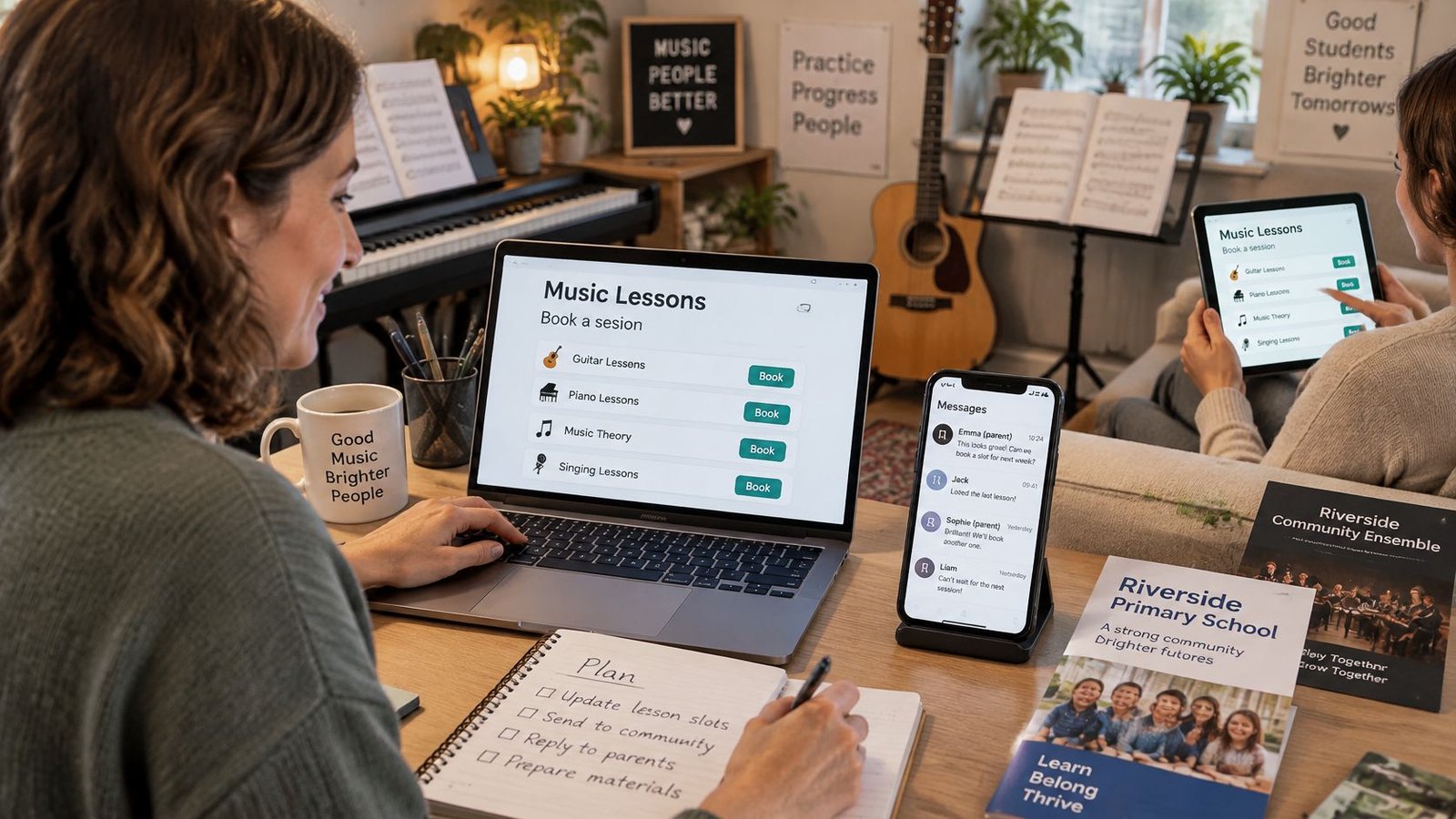
The most useful first audience is often already close to the teacher: former students, parents in the school community, local ensembles and groups familiar with the teaching. These people need a precise reason to enquire, not a broad announcement that lessons are available.
A focused offer might help beginner pianists work towards a short piece with a consistent left-hand pattern. That describes a teaching target without guaranteeing that every learner will reach it on the same schedule.
Show the teaching before asking for commitment
A short discovery call can establish fit, while a sample of timestamped feedback demonstrates how the teacher explains corrections. A teacher-made demonstration is often more useful than a heavily edited performance because it shows the pace and clarity a learner can expect.
Student clips and testimonials require appropriate consent and careful handling, particularly where children are involved. A specific observation about improved rhythm or practice confidence is more credible than an unsupported claim about exam success or career prospects.
For a practical approach to build customer trust through social content, SleekPost offers guidance that can support a consistent posting routine. Musical demonstrations should still use cleared audio, not commercial recordings added merely to make a clip more engaging.
Make the next step obvious
The offer link belongs in the teacher's bio, newsletter and follow-up message after a relevant conversation. AmaJova's guide to selling services online can help organise the transition from an enquiry to a clearly defined purchase.
An initial group should have a genuine capacity limit based on teaching attention. A booking deadline is useful when it supports a real start date, not when the same supposedly final opportunity reappears indefinitely.
Every promotional message should communicate these points:
- Who the class serves: adult beginners, returning singers or another clearly defined learner.
- What the class works towards: an observable skill rather than a guaranteed grade.
- How booking works: where the offer can be reviewed and what happens after purchase.
Consistency matters more than inventing a different promise for every post. Learners should encounter the same scope in the demonstration, booking page and delivered lesson.
Publish Your First Class Offer This Week
A first offer doesn't need a complete course library. It needs a defined learner, a deliverable teaching experience and enough information for a buyer to decide whether it fits.
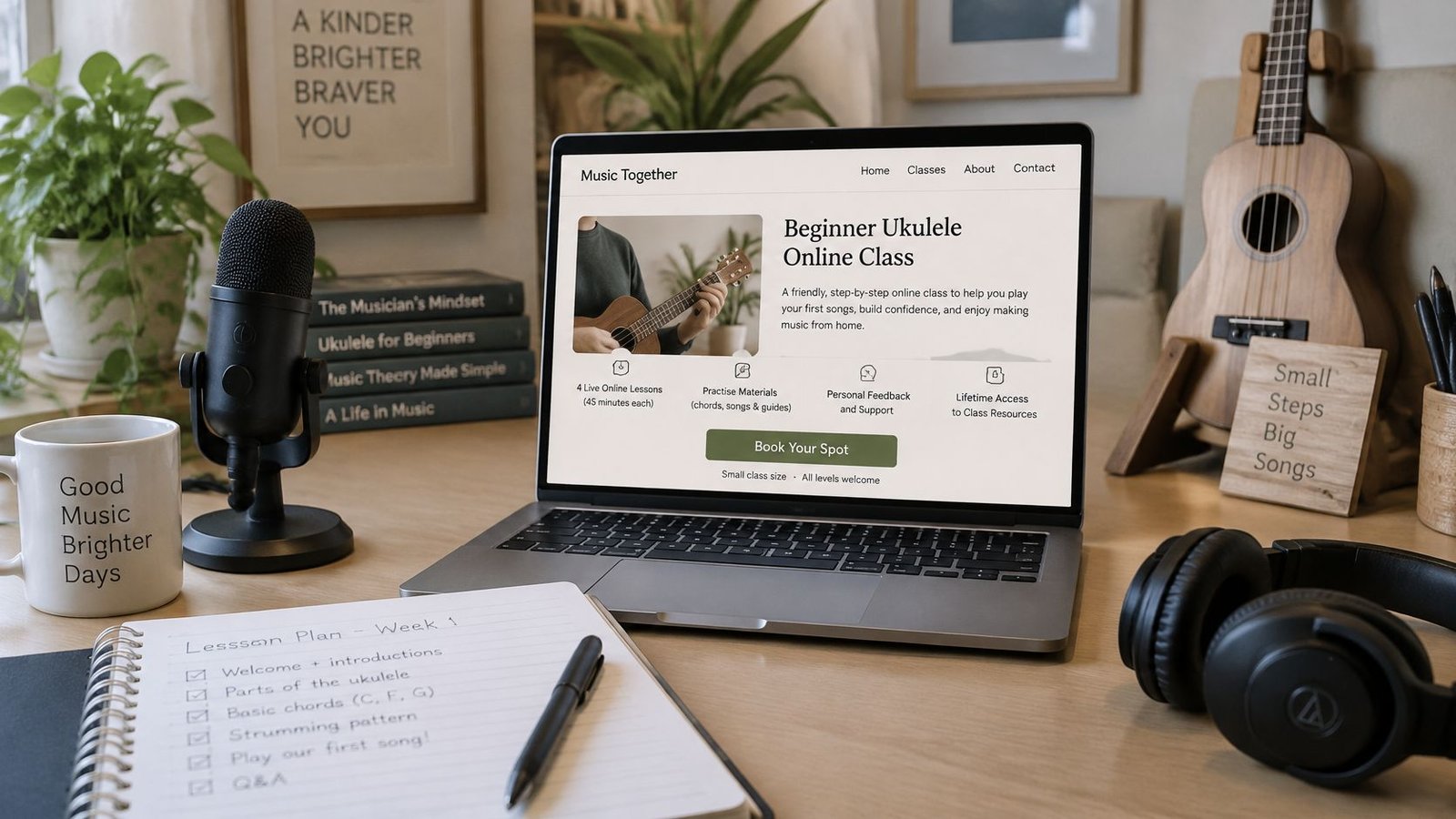
The headline should grow from the opening planning exercise, with availability translated into a manageable commitment. A teacher offering beginner ukulele feedback, for example, should describe the actual teaching format rather than advertising unlimited support.
Complete the buyer-facing checklist
The draft offer should contain:
- Scope and price: title, plain description, inclusions, lesson length and number of sessions.
- Practical requirements: device setup, materials, booking details and what happens after purchase.
- Boundaries: cancellation terms, communication arrangements, recording permissions and recording-access period.
- Delivery sequence: preparation instructions, the lesson structure and the agreed follow-up.
AmaJova supports services including coaching, design, consulting and classes, alongside live sessions such as 1-to-1 calls, group sessions and workshops. Live sessions let sellers offer bookable time with expectations stated before purchase, which suits a clearly bounded teaching offer.
Test before promotion
A friend should review the offer as a buyer and test the booking and payment journey through the appropriate available process. AmaJova's guide to accepting payments online provides additional preparation for that stage.
The teacher should also run the trial call and fix a concrete problem it reveals, whether that's an obscured hand position, missing sheet music or unclear joining instructions. Successful payment alone doesn't establish that the class is ready to teach.
The first action is to write the offer headline from the learner-format-availability sentence, then publish that offer this week and test it before promotion.
AmaJova turns services, physical products, digital products and live sessions into a clear OfferLink with secure checkout and expectations stated before payment. Teachers ready to package a defined music class can visit AmaJova to create an offer that sets out the teaching, price and booking details before sharing it with prospective learners.