A photographer has a folder of finished images, an illustrator has artwork ready to download, and a potential buyer has asked for a price. The awkward part isn't uploading the files. It's deciding whether that price covers a personal print, a business website, paid advertising or ownership of the work itself.
Learning how to sell images online starts with making those differences explicit. A sale needs a usable file, a defined licence and an offer page that explains what happens after payment. Everyday buyers need straightforward choices; brand clients need permissions that match their intended use.
Table of Contents
- What You Are Actually Selling When You Sell an Image
- Defining a UK Licence Buyers Can Understand
- Building the Offer Page Step by Step
- Pricing Your Images Without Leaving Money on the Table
- Accepting Payments and Delivering Files Securely
- UK Consumer Law Touchpoints Image Sellers Must Handle
- Your Image Selling Action Plan and Common Questions
What You Are Actually Selling When You Sell an Image
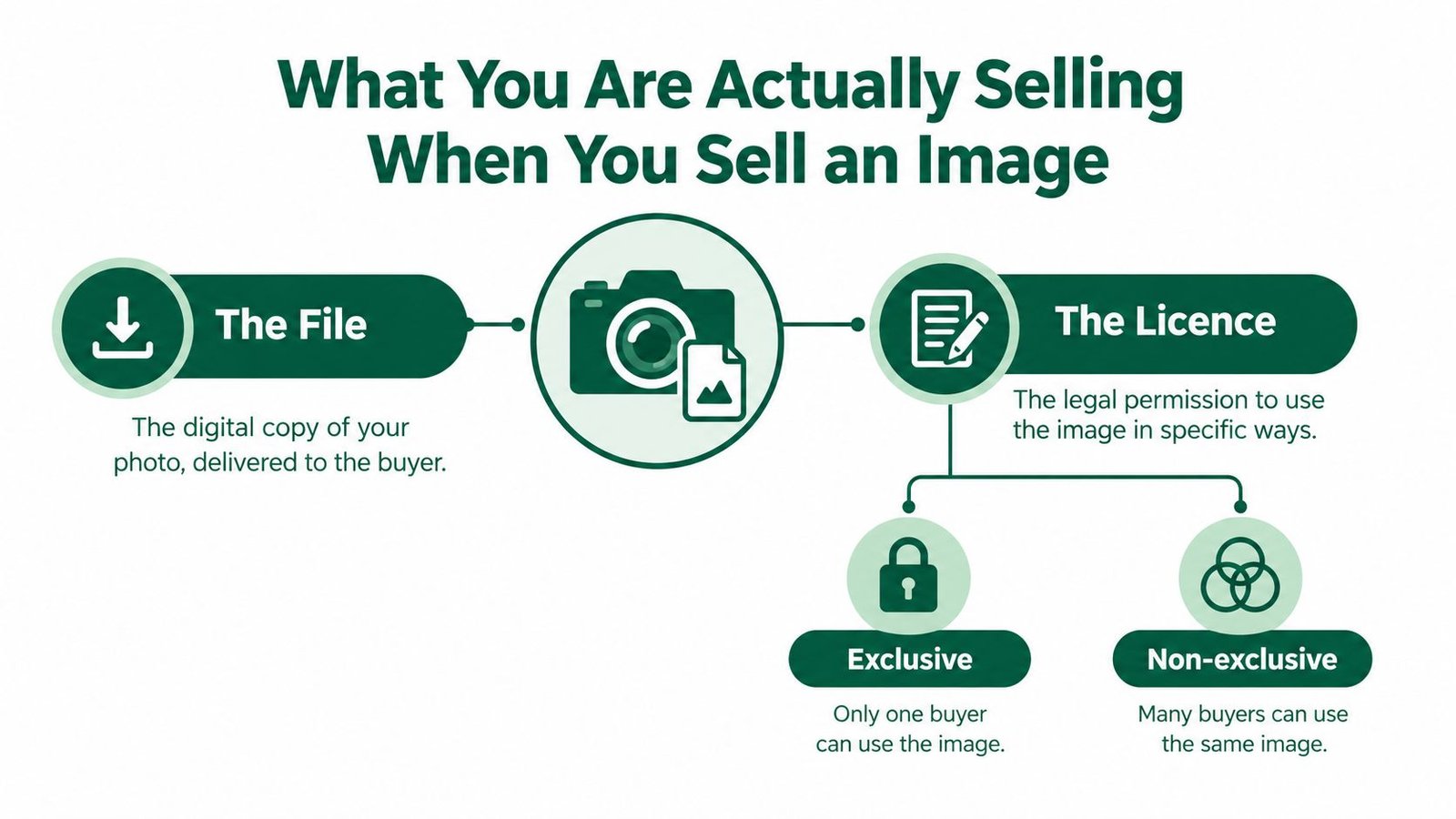
The file and the licence are different parts of the purchase. A JPEG delivers the image. A licence defines what the buyer may do with it. Sending a full-resolution photograph shouldn't leave either party guessing about advertising, resale or exclusivity.
In the UK, copyright generally arises automatically, there's no copyright register, and professional photographers commonly license their work rather than transfer copyright outright. These distinctions are described in Holloway Davies' guidance for UK photographers. Sellers should therefore decide what rights they intend to offer before setting a download price.
Separate ownership from permission
Consider an illustrator offering the same composition to different buyers. A non-exclusive licence can accommodate that arrangement, subject to its wording. An exclusive agreement needs a carefully defined boundary: exclusivity for a particular campaign isn't the same commercial commitment as exclusivity across every possible use.
A wedding portrait raises another question. The client's permission to print the photograph and the photographer's proposed use of it in marketing should be addressed separately. Sellers shouldn't assume that retaining copyright resolves every question about identifiable people, privacy or promotional use.
Online selling deserves a proper commercial setup. Online sales accounted for 27.8% of Great Britain retail sales in June 2025, according to the Office for National Statistics retail sales bulletin. That's context for taking online offers seriously, not evidence of guaranteed demand for photography.
For creators still organising a portfolio into saleable work, The Online College of Art & Design (OCAD) offers a complementary introduction to start selling your art online. The practical recommendation remains simple: choose a buyer need before choosing a selling channel.
Prepare files against the promised use
A polished preview can conceal an unsuitable deliverable. Sellers should prepare exports against the buyer's application, rather than advertise every file as suitable for everything.
- Format: Offer JPEG for flattened photographs, PNG where transparency is needed, and TIFF when the buyer's production workflow calls for it. Name the included format explicitly.
- Colour: Use an sRGB export for a screen-focused offer. For print, confirm the printer's requirements before supplying Adobe RGB or ProPhoto files; don't promise universal compatibility.
- Dimensions: State actual pixel dimensions and any tested print-size recommendations. Avoid relying on “high resolution” without explaining what the buyer receives.
- Previews: Prepare a lower-resolution public preview and a separate purchase deliverable. A watermark can distinguish the preview, but it shouldn't obscure the details needed to evaluate the image.
- Metadata: Review location and personal information before export. Keep useful attribution information where appropriate.
- Source files: Treat layered files as a separate inclusion. Check linked assets, fonts and third-party elements before promising an editable package.
Lightroom or Capture One export presets are sensible tools for maintaining consistent filenames and delivery settings. Sellers should inspect the exported files, retain backed-up originals and keep a record connecting each delivered version to its licence.
Practical rule: A buyer should be able to identify both the supplied file and the permitted use without sending a follow-up message.
Defining a UK Licence Buyers Can Understand
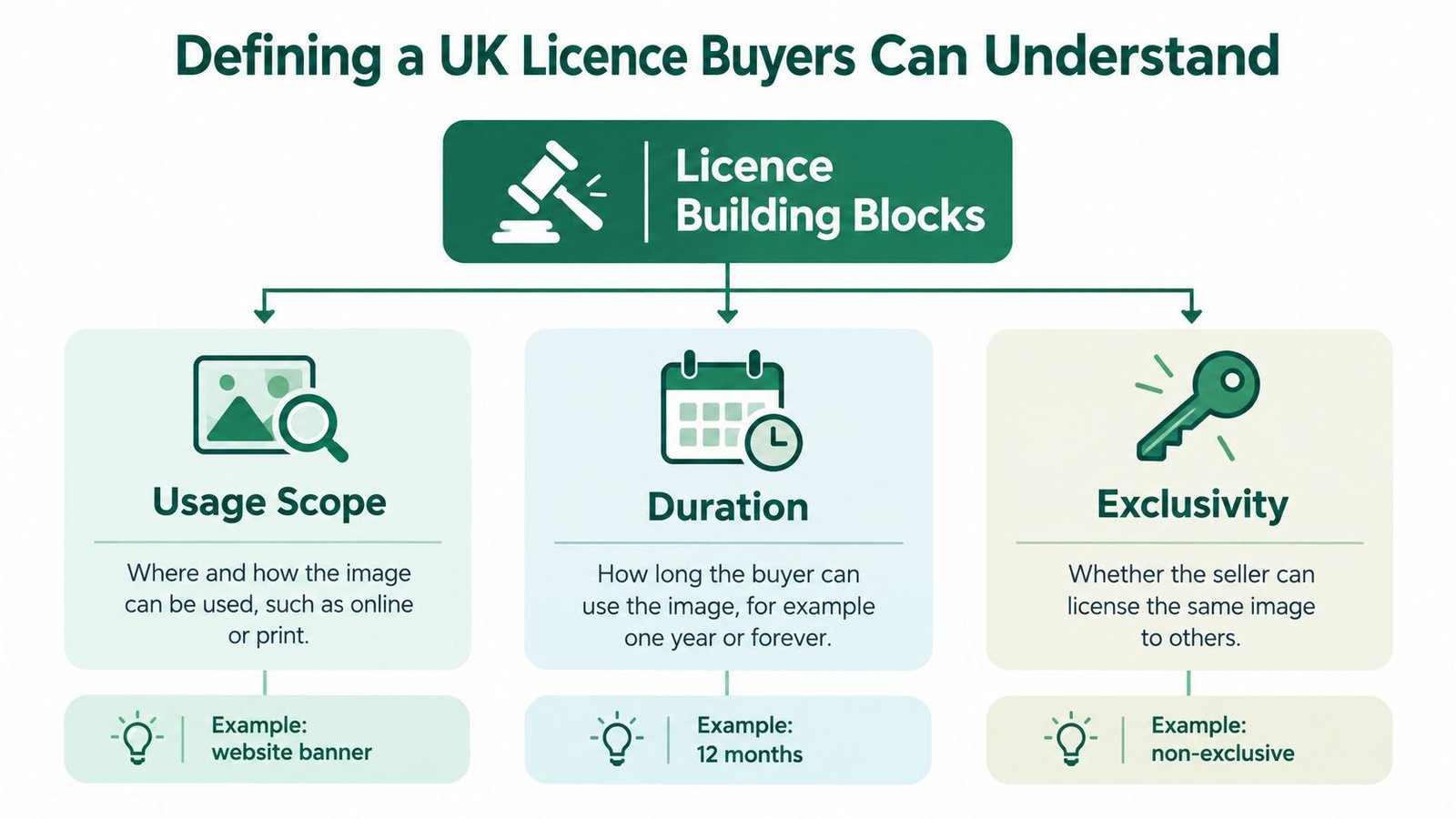
“Commercial use included” is too vague for a serious offer. A buyer needs to know which business activities are covered, which channels are permitted and when additional permission is required. The seller needs the same clarity when quoting an upgrade.
Specify the boundaries
Each licence should identify purpose, media, territory, duration and exclusivity, then address sublicensing, attribution and permitted editing. Bracketed fields should be completed before publication, not left for the buyer to interpret.
Adapt these plain-English starting points
These are offer-description starting points, not solicitor-drafted agreements. Assignment wording and unusual uses need professional review.
- Personal use: “The named buyer receives a non-exclusive licence to display this image privately and print it for personal enjoyment. Business promotion, resale and redistribution of the digital file are excluded. Permission applies in [territory] for [duration].”
- Small-business marketing: “The named business may use this image on its own website and organic social accounts in [territory] for [duration]. Paid advertising, merchandise and resale are excluded. Contractors may handle the file only to produce those approved materials.”
- Editorial use: “The named publisher may reproduce this image with factual coverage of [subject] in [named publication and channels], for [duration] in [territory]. Advertising and implied endorsement are excluded. Credit must appear as [credit wording].”
- Full buyout proposal: “The quoted fee covers a proposed assignment of the copyright rights identified in a separate agreement. The parties must agree its scope, effective date, any retained rights and third-party exclusions before delivery.”
A photograph intended for a wedding album, website header or billboard should receive different permissions, even when the underlying file is identical. Any exclusivity promise must also account for licences already granted.
Bulk Image Generation provides another resource to browse commercial license checklist. Sellers using an offer-based platform should also review its intellectual property information, while separately checking whether model or property permissions are needed for the proposed use.
Building the Offer Page Step by Step
A gallery shows the work. An offer page explains the purchase. Sellers should organise the page around the buyer's decision, not around the order in which the photographs were taken.
A UK consumer survey reported that 60% of shoppers consider product images and videos when evaluating online purchases, as described in Salsify's UK consumer shopping research. For an image seller, the recommendation is obvious: previews should show the product clearly, with mock-ups labelled as illustrative rather than supplied items.
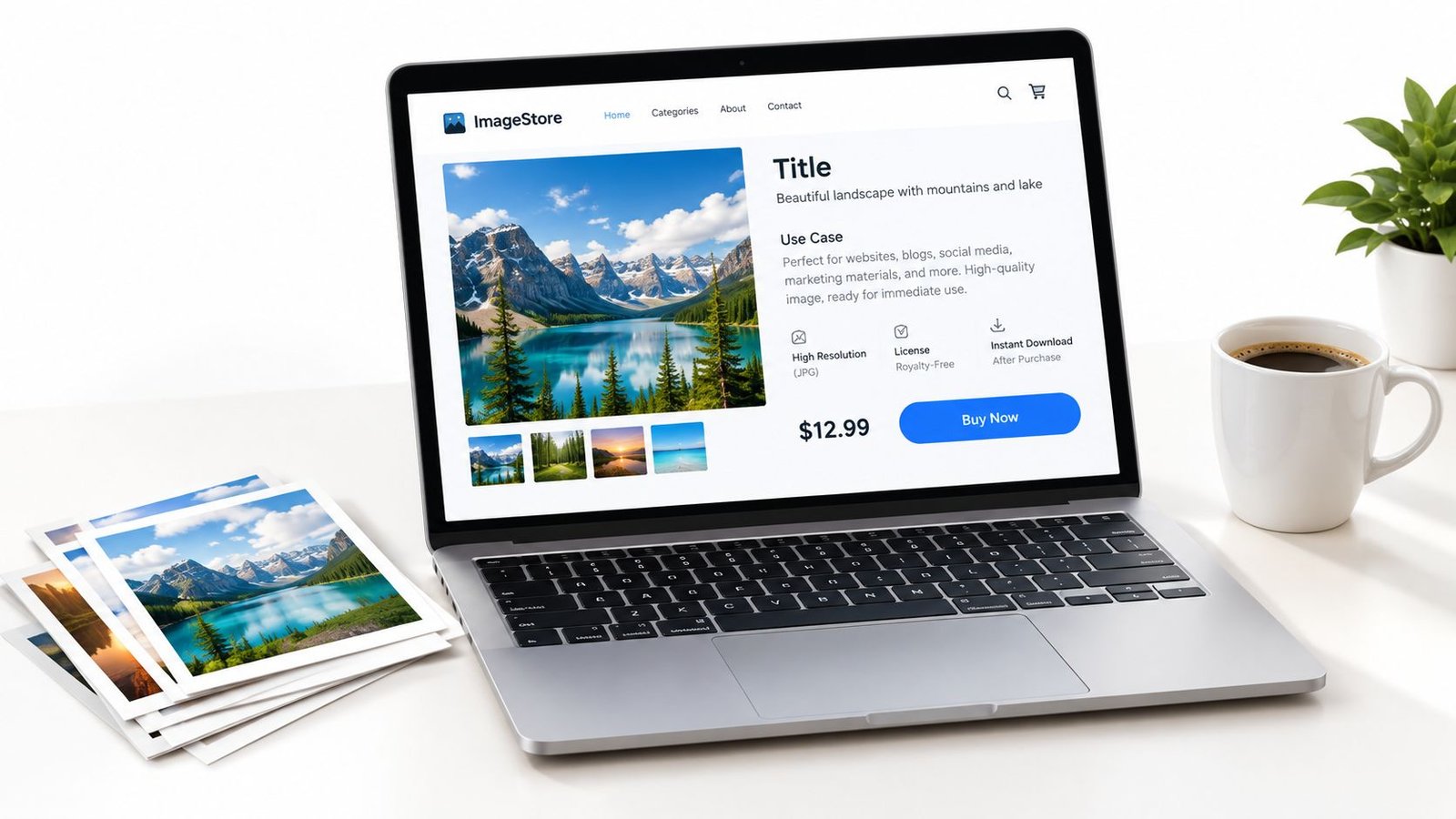
Write the purchase details in decision order
- Title: Name the subject and intended use, such as “Coastal shot photograph for personal wall art” or “City image pack for business websites”.
- Description: Describe the scene, visual style and useful applications. Suggested applications must stay within the offered licence.
- Inclusions: List the files, formats, dimensions, licence document and any supplied variants.
- Exclusions: Name what's absent, including editable originals, printing, custom retouching, advertising rights or exclusive use.
- Price and delivery: Put the total price, fulfilment method and delivery timing near the purchase decision.
- FAQs: Explain whether cropping is permitted, whether attribution is required and how broader usage can be quoted.
A mock-up should demonstrate an application, not imply that a frame, print or editable design is included.
A city-photo collection packaged for marketing should explain available crops and business permissions. An editorial collection should prioritise accurate captions, subject context and publication scope. Neither needs a vague promise of “unlimited possibilities”.
For physical prints, specify material, size, framing and dispatch arrangements. Commissioned photography needs a brief, deliverables and revision boundaries; a live critique needs booking details, preparation requirements and any recording arrangements.
AmaJova is one option alongside a dedicated website or marketplace: its OfferLink pages provide titles, descriptions, inclusions, pricing, media, FAQs and fulfilment or booking details with secure checkout. Sellers still need to write accurate permissions and verify the requirements of their particular offer.
Pricing Your Images Without Leaving Money on the Table
Price the permitted use, not just the export. Personal wall art and national advertising shouldn't receive identical quotes merely because both buyers request the same portrait.
A practical pricing method starts with the seller's cost floor: creation time, editing, administration, delivery and any production or distribution expenses. The next decision is the licence scope. Broader media, longer duration and restrictions on future licensing should influence the quote, without pretending there's a universal multiplier.
Pricing Variables by Use Case
The bands below describe a relative pricing structure, not published market rates.
| Use case | Permitted scope | Starting price band | Key price driver |
|---|---|---|---|
| Personal wall art | Private display under a personal-use licence | Entry band | Print production or personal-use file |
| Organic social content | Named business accounts, excluding paid promotion | Standard commercial band | Business purpose and permitted channels |
| Small-business website | Named website and agreed supporting uses | Defined commercial band | Duration, placement and permitted adaptation |
| National advertising | Specified campaign, media and territory | Bespoke campaign quote | Campaign breadth and exclusivity |
| Agency bundle | Named client projects with controlled contractor access | Negotiated bundle | Project scope and redistribution boundaries |
For the same portrait, personal display could receive the narrowest offer. Organic business social use adds promotional value; website use may require different crops and a longer commitment. A national campaign needs a bespoke quote that identifies the media, territory and any exclusivity rather than a generic download upgrade.
Resolution tiers can be useful when deliverables differ. They shouldn't conceal licence differences: a small file used in advertising still needs appropriate advertising permission.
Pricing discipline: A discount should reduce something identifiable, such as scope or administration, rather than silently grant broader rights.
Sellers can test a focused starter pack before expanding the catalogue. Record enquiries, accepted quotes and requests for upgrades, then adjust the packaging. If buyers repeatedly ask for paid advertising, an extended licence may be more useful than cutting the basic price.
Accepting Payments and Delivering Files Securely
Payment and delivery should create a traceable transaction. Before releasing a master file, the seller should confirm payment through the chosen checkout or payment provider, not rely on a screenshot supplied by the buyer.
Keep the purchase and fulfilment connected
The order record should preserve the image identifier, licence version, price, buyer details and promised delivery. Sellers comparing systems should look for an order summary, payment record, connected messages and visible delivery progress. Where international sales matter, supported currencies and applicable charges should be checked rather than assumed.
- Small deliverables: An email attachment may suit a manageable file, provided the recipient and attachment are checked.
- Large masters: Consider a restricted or signed cloud download, with access instructions and any expiry stated clearly.
- Physical prints: Record the production specification, dispatch information and delivery communications.
- Services and sessions: Attach agreed milestones, booking instructions and any access details to the same transaction.
A single delivery message should identify the purchased files, include the agreed licence and explain the support route. Sellers should retain that message and keep corrections or replacement files connected to the order.
AurenWell's photographer invoice templates can provide a starting layout for describing photography charges. The invoice should distinguish creation work, print production and licensed usage where those are separately priced; applicable accounting requirements need their own check.
Check the workflow before publishing
Sellers can use this guide to accepting payments online when planning the purchase process. A test order should confirm that the buyer sees the correct offer, receives clear instructions and can reach support.
Immediate downloads also require a suitable consumer-consent process. Fast fulfilment shouldn't bypass the legal checks described below.
UK Consumer Law Touchpoints Image Sellers Must Handle
A blanket “no refunds” statement isn't a substitute for handling consumer cancellation rights. The rules depend on whether the sale involves digital content, a service or physical goods, and whether the customer is buying as a consumer.
Under regulation 30 of the Consumer Contracts Regulations, consumers generally have a 14-day cancellation period for relevant service and digital-content contracts, starting when the contract is entered into. Physical-goods periods are generally calculated from delivery; missing required cancellation information can extend the period by up to 12 months, subject to the regulations.
Obtain consent before immediate digital supply
Under regulation 37 governing early digital-content supply, supply without a tangible medium must not begin during the normal cancellation period unless the consumer expressly consents and acknowledges that cancellation rights will be lost.
A separate, unticked acknowledgement could use wording along these lines, subject to review for the actual checkout:
“The customer expressly consents to immediate supply of the digital content and acknowledges that beginning supply causes the statutory right to cancel to be lost.”
The process must obtain and record the required agreement before supply begins. Acceptance of general terms alone shouldn't be treated as that acknowledgement.
Publish the pre-contract essentials
- Trader identity: Provide the seller's business identity and contact details.
- Supply arrangements: Explain delivery, download access or booking and service timing.
- Complaint handling: Identify the contact route and any applicable complaints policy.
- Cancellation terms: State the rules relevant to that particular product or service.
The regulations' explanatory note describes the distinctions between contract types and information requirements. This is general UK information, not a definitive legal assessment of an individual offer.
The UK online-selling setup guide provides a broader starting point, but bespoke commissions, mixed packages and overseas consumer sales deserve context-specific advice.
Your Image Selling Action Plan and Common Questions
A workable image business needs a repeatable offer, not an ever-growing collection of unclear listings. The strongest starting point is a focused selection aimed at a recognisable buyer, with documented permissions and a tested purchase route.
Complete a launch checklist
- Select the offer: Choose images that serve the same buyer need, rather than bundle unrelated favourites.
- Finish the licence: Complete every variable and remove permissions that the seller can't confidently grant.
- Inspect the exports: Match the preview and delivery files to the published specification.
- Check the economics: Compare the proposed price with creation, fulfilment and administration costs.
- Test the transaction: Review checkout, consent, delivery messages and support access before sharing the page.
Common questions
Is exclusivity worth offering?
Only when the fee justifies the specific restriction. The seller should identify what future work or licensing would become unavailable and quote against that commitment.
How should model and property releases be handled?
Keep any relevant permissions connected to the image record and check them against the intended use. Identifiable people, private locations and brand-sensitive campaigns warrant a careful assessment; copyright permission alone shouldn't be treated as a complete clearance.
What if a buyer raises an unfair refund claim?
Respond with the order summary, agreed scope and fulfilment record, then use the payment provider's or platform's dispute route. A calm explanation is more useful than accusing the buyer, and a dispute record doesn't override applicable consumer rights.
How can a seller expand beyond individual images?
Follow actual enquiries. Coherent image packs, presets, commissioned photography and live editing sessions need distinct inclusions and fulfilment terms, not a copied download description.
AmaJova offers clear OfferLink pages with secure checkout and connected order communication for digital products, physical products, services and live sessions. Sellers ready to turn a photograph, print collection or commission into a defined offer can visit AmaJova and start with the files, licence boundaries and delivery details already prepared.