

Order management is the complete workflow from customer intent to fulfilled delivery and post-sales support. In the UK, 357 permanent vacancies cited order management in the six months to 28 September 2026, representing 0.30% of all permanent jobs and 0.42% of the Processes & Methodologies category.
Why, then, do so many sellers still treat it as nothing more than the few minutes after a buyer clicks checkout?
That assumption creates the hidden cost of fragmented handling. A product description sits in one place, payment details in another, delivery promises in a message thread, and the eventual dispute in somebody's inbox. The sale may be complete, but nobody has a dependable account of what was promised, what happened, and what remains outstanding.
Table of Contents
- Understanding the Order Management Process
- The Complete Order Lifecycle Stages
- How Data Flows Between Stakeholders
- Adapting Order Management Across Offer Types
- Key Performance Indicators and Metrics
- Common Pain Points and Misconceptions
- Why Unified Order Records Matter More Than Ever
Understanding the Order Management Process
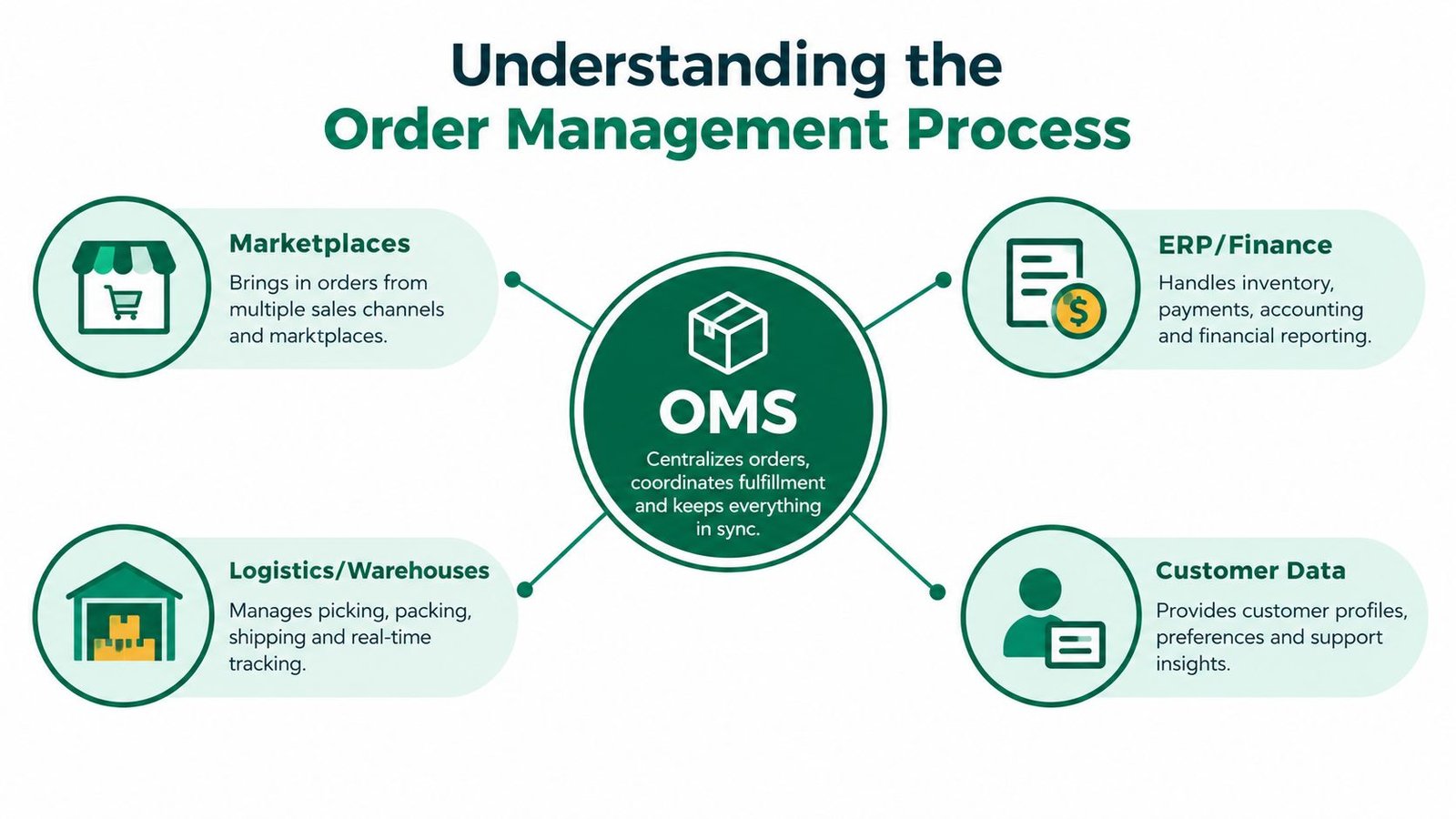
Order management isn't just the act of accepting payment. It starts when a buyer responds to an offer and continues through confirmation, validation, fulfilment, delivery or access, support, returns, disputes, and completion. For a freelancer, that could mean recording the agreed scope and booking details. For a product seller, it includes stock checks, dispatch, tracking, and after-sales handling.
A useful definition is the controlled movement of one order record from customer intent to resolution. That record should preserve the offer, price, buyer details, fulfilment expectation, payment event, status changes, messages, and any exception that affects completion.
The part most sellers overlook
Suppose a buyer purchases a live session after discussing timing through direct messages. The seller remembers the conversation, but the booking confirmation contains less detail. Later, the buyer expects preparation materials that were never included in the final offer. Neither party necessarily acted improperly. The failure came from splitting the order's meaning across informal channels.
A unified record gives both sides a reference point. It can show what the buyer selected, what the seller agreed to provide, which step is next, and whether the order is waiting for information or action. That clarity matters just as much for a download or service as it does for a parcel.
Practical rule: If a promise can change the buyer's expectations, it belongs in the order record before fulfilment begins.
The distinction between order management and order processing is useful here. Processing handles the immediate work of receiving and preparing an order. Management governs the broader workflow, including communication, exceptions, completion, and improvement. Businesses documenting the financial side can also benefit from this explanation of sales order in ERP workflows, particularly where an accepted customer request needs to become a controlled business record.
In the UK labour market, the role is treated as a specialist capability rather than an undefined administrative task. The same IT Jobs Watch data places the median annual salary for cited roles at £32,500, with the 10th percentile at £26,000 and the 90th percentile at £96,000. That range reflects the difference between routine coordination and higher-value process leadership.
The Complete Order Lifecycle Stages
A reliable process follows a sequence, but it shouldn't become a rigid script. Each stage answers a practical question: what was requested, can it be accepted, how will it be fulfilled, what has happened, and what needs to happen if the result is disputed?
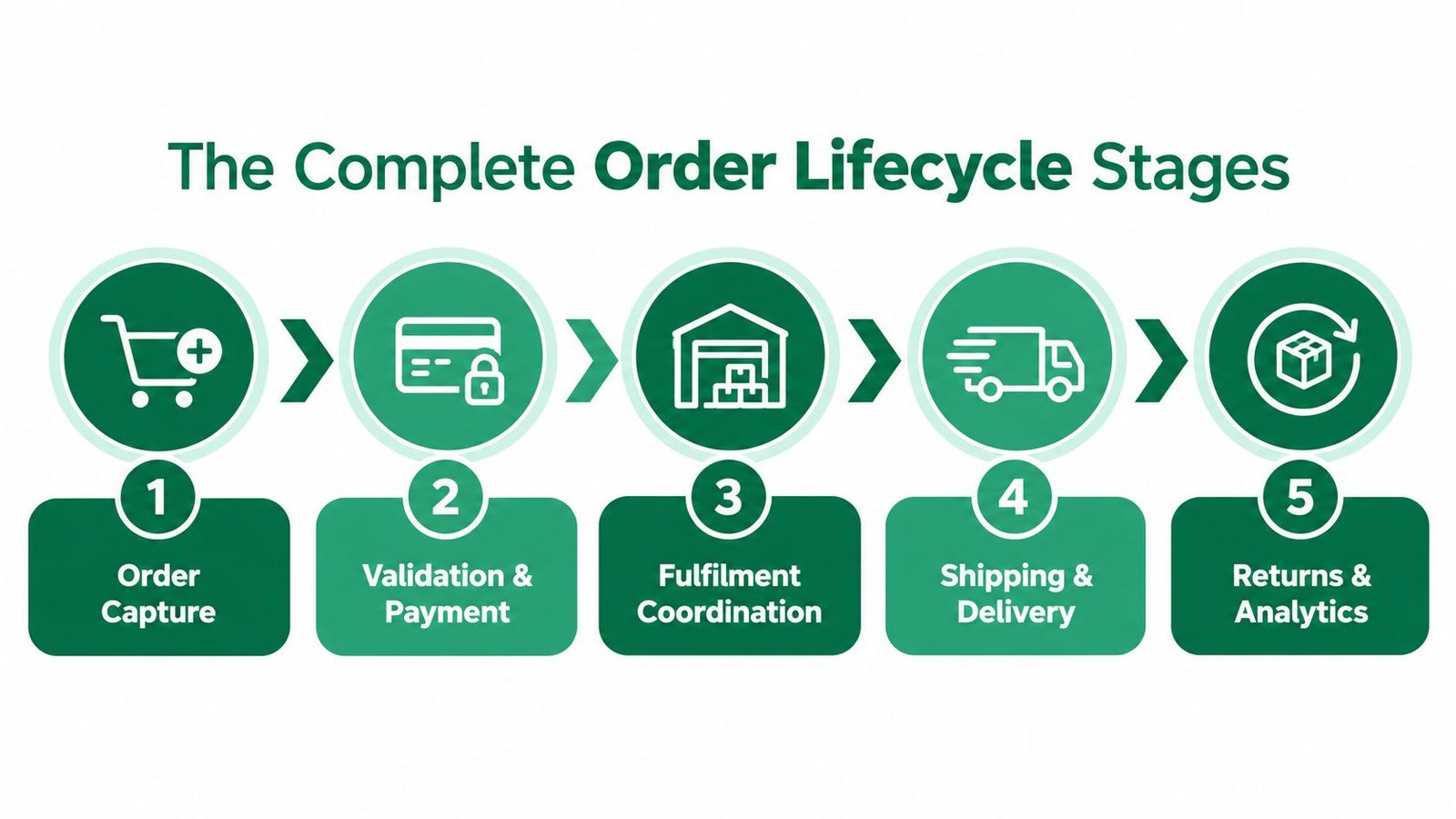
1. Capture the order
Turn customer intent into a complete record. Capture the selected offer, quantity or scope, price, buyer information, fulfilment method, dates, and relevant instructions. Missing information at this point becomes a follow-up message, a delay, or an avoidable disagreement later.
2. Validate payment and expectations
Check that the price, inclusions, availability, approval requirements, and payment status are consistent. For a service, validation may involve confirming the scope and schedule. For a physical item, it may involve stock and delivery details. The purpose is to avoid promising something the seller can't deliver.
3. Coordinate fulfilment
Assign the work to the person, supplier, warehouse, booking calendar, or delivery route responsible for completion. A service order needs an owner and a due point. A download needs controlled access and a record of access commencement. A physical order needs picking, packing, and dispatch instructions.
4. Track delivery or completion
Status should describe reality, not create the appearance of progress. Useful states might include awaiting information, confirmed, in fulfilment, dispatched, delivered, access started, session booked, completed, or issue raised. Each change should be understandable to the buyer and the person handling support.
5. Handle returns, disputes, and learning
An order isn't finished merely because something was sent. The seller may need to process a return, answer a support question, correct a missing item, or record why a delivery failed. Reviewing these exceptions reveals whether the original offer, validation, or fulfilment process needs adjustment.
The same logic applies when orders cross borders, although delivery partners, currencies, documentation, and local requirements add coordination work. A practical international supply chain management guide can help sellers think through those extra hand-offs without reducing the process to warehouse activity.
For a compact workflow reference, the order management workflow resource can sit alongside a seller's own process map. The important point isn't the number of software screens. It's whether every stage leaves a clear record and a named next action.
HMRC research describes how UK traders and intermediaries use IT systems to manage supply-chain data, reflecting the move from manual records towards digital coordination. That shift matters in an economy where the total value of UK trade in goods and services approached £1.8 trillion in 2024, as reported in a GOV.UK foresight report.
How Data Flows Between Stakeholders
The order record acts as a shared document between buyer, seller, fulfilment partner, finance, and support. Each stakeholder needs a different view, but the underlying facts must remain consistent. The buyer needs the promise and current status. The seller needs the scope, payment state, and next action. Support needs the history rather than a request to reconstruct it from scattered messages.

A fragmented flow usually looks like this:
- The buyer submits details: The offer, selected option, address, dates, and instructions enter the process.
- The seller confirms the promise: The seller checks what was purchased and whether the stated fulfilment expectation is achievable.
- Finance records the transaction: Payment status and invoice information need to match the accepted order.
- Fulfilment updates progress: Dispatch, delivery, access, booking, or completion events change the order's status.
- Support handles exceptions: Questions and disputes remain attached to the original context rather than becoming a separate case with no history.
The risk appears at the hand-offs. If a seller changes a delivery date in a message but fails to update the main record, support may quote the old date. If payment is marked complete in one system but not another, the seller may ask a buyer to pay again. If a supplier confirms a quantity that differs from the original request, the discrepancy can surface only after delivery.
UK purchasing guidance uses three-way matching as a control: the purchase order, goods receipt note, and invoice should agree before payment is finalised. The purchase order management guidance explains why each document provides a different check against quantity, price, and receipt discrepancies. Customer-facing sellers can apply the same principle by keeping the offer, fulfilment evidence, and payment record connected.
The trade-off is straightforward. A single record requires disciplined capture at the start, but fragmented handling shifts that effort into repeated searching, clarification, and dispute resolution. The latter feels easier during a quiet week and becomes expensive when several orders need attention at once.
Adapting Order Management Across Offer Types
The process should stay unified even when fulfilment differs. A seller shouldn't force a parcel workflow onto a consultancy booking, or treat a digital download as complete without tracking when access began.
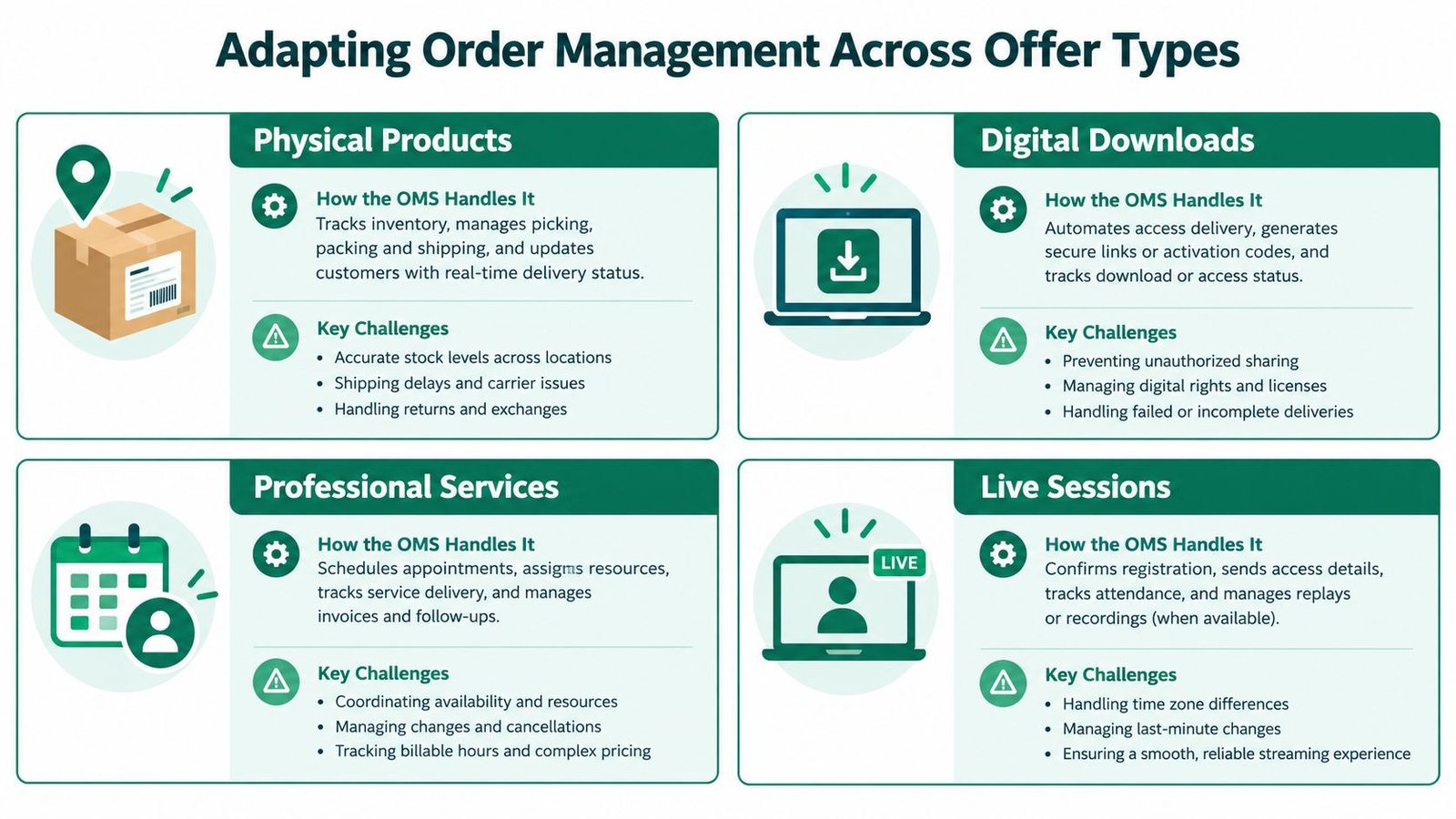
| Offer type | Record needs to capture | Main operational risk |
|---|---|---|
| Physical products | Item, quantity, stock decision, delivery details, dispatch and receipt | Overselling, wrong items, damaged delivery, or unclear returns |
| Digital downloads | Version, access instructions, access commencement, support route, and refund status | Confusion over access, defective content, or missed cancellation conditions |
| Professional services | Scope, inclusions, dates, deliverables, client inputs, and completion approval | Scope drift, missed deadlines, and disagreements about what was included |
| Live sessions | Date, time, attendance details, preparation requirements, and follow-up materials | Booking confusion, missed attendance, and unclear rescheduling expectations |
Physical products need movement through a location. Digital products need a controlled relationship between payment, access, and content quality. Services need a definition of completion. Live sessions need a dependable booking and attendance trail.
Digital content has a specific legal consideration in the UK. Under section 45 of the Consumer Rights Act 2015, where a refund is due for digital content, it must cover all money paid except where the breach affects only part of the content, and the refund must be made without undue delay and within 14 days once the trader agrees it is due. The same source states that the original payment method should be used unless the consumer agrees otherwise, and that no refund fee may be charged.
For online and distance sales, traders must tell customers about the right to cancel within 14 days after delivery. If that information isn't provided, the period can extend to 12 months, subject to the later notice rules described by GOV.UK's online and distance selling guidance. Digital access also needs careful tracking because a consumer can generally lose the cancellation right when they ask for supply to begin during the cancellation period and the required information has been provided, as explained in GOV.UK's online selling guidance.
Sellers working across these categories can use a structured guide to selling digital products as a planning reference. The practical test is whether the same order record can show what was promised, what event counts as fulfilment, and how support or cancellation is handled.
Key Performance Indicators and Metrics
Metrics should expose uncertainty, not decorate a dashboard. A small seller doesn't need every possible measurement. The useful set connects an operational event to a buyer or financial consequence.
| Metric | What it reveals | Manual-record warning sign |
|---|---|---|
| Order accuracy | Whether the delivered or completed result matches the accepted order | Frequent corrections after fulfilment |
| Fulfilment speed | How long the seller takes to move from confirmed order to delivery or completion | Orders waiting for someone to remember the next step |
| On-time completion | Whether the stated expectation is being met | Buyers asking for updates before the promised point |
| Exception rate | How often an order needs human intervention | Staff repeatedly fixing the same preventable issue |
| Dispute resolution time | How quickly the seller can establish facts and agree next action | Support searching through messages and payment records |
A unified system makes these measures easier to interpret because the events share one timeline. Manual records can sometimes produce the same information, but only when staff update every source consistently. That discipline often fails when a seller is handling customers, fulfilment, and administration at the same time.
The better approach is to review exceptions rather than chase impressive averages. A delayed order may reflect an unclear offer, missing customer information, a supplier issue, or a poor status rule. Recording the cause helps the seller improve the process instead of only urging faster responses.
A metric becomes useful when it changes the next operational decision.
Common Pain Points and Misconceptions
Order management isn't only for large warehouses. A consultant with a busy calendar, an educator selling a live session, and a creator delivering downloads all manage orders, even if no box leaves a warehouse.
The common mistake is to optimise the visible transaction while ignoring the hidden coordination. Sellers focus on taking payment, then discover that the offer didn't define inclusions, the fulfilment instruction was in a private chat, or support can't tell whether the buyer received the result.
Typical warning signs include:
- Unclear descriptions: Buyers and sellers remember different versions of the promise.
- Disconnected support: A new support conversation lacks the payment and fulfilment history.
- Manual status updates: Nobody knows whether an order is waiting, active, delayed, or complete.
- Uncontrolled exceptions: Returns, missed sessions, and access problems are handled case by case.
- Poor document matching: The accepted order, delivery evidence, and payment record don't agree.
The hidden cost isn't limited to staff time. Confusion can lead to duplicate work, unnecessary refunds, delayed fulfilment, and disputes that would have been avoided by recording the expectation before payment.
Why Unified Order Records Matter More Than Ever
For independent sellers, a unified order record is often a higher-value improvement than adding another sales channel. It reduces the distance between what the buyer purchased, what the seller must do, and what support can verify.
The record also creates a fairer conversation during a dispute. Instead of relying on memory, screenshots, or separate inboxes, both sides can work from the same sequence of offer, payment, fulfilment, communication, and completion events. That doesn't remove every disagreement, but it reduces avoidable confusion.
The practical case for order management software for small businesses is therefore less about warehouse sophistication and more about control. A modest operation can gain clarity by standardising the offer, recording the next action, and keeping exceptions attached to the original order.
AmaJova gives sellers a structured OfferLink for services, physical products, digital products, and live sessions, with checkout and an order record that connects fulfilment details, messages, payment information, disputes, and completion tracking. Sellers who want to replace scattered instructions with one clearer transaction workflow can visit AmaJova and review how it fits their offer.