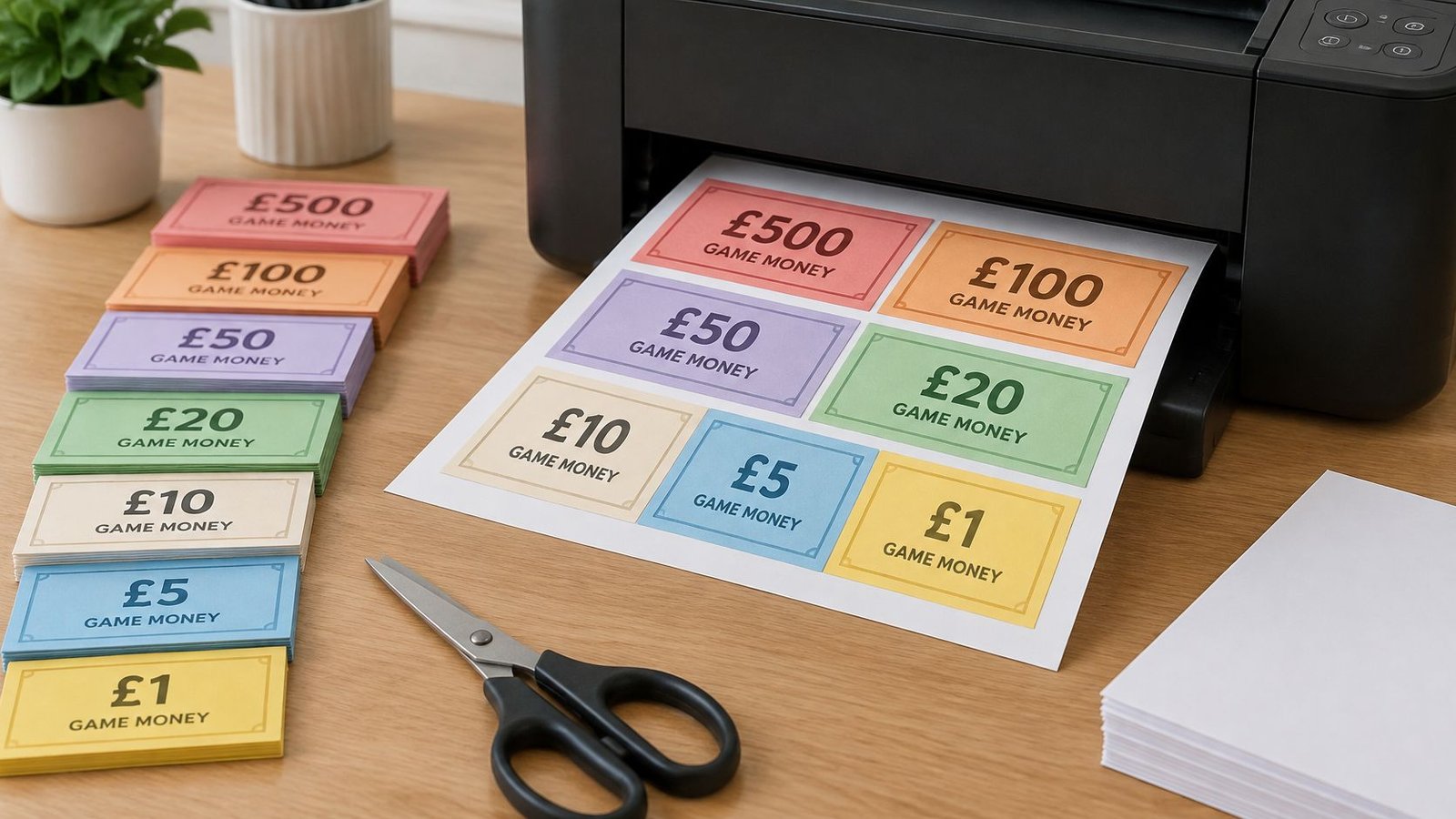
The most tempting advice about Monopoly printable money is also the least useful: find a realistic-looking template and print plenty of it. A better replacement set matches British play values, makes change easy and stays unmistakably fictional. Copying official artwork or making notes resemble sterling adds risk without improving the game.
For an educator or seller, the useful product is an original, readable file with sensible quantities and tested printing instructions. The distinction matters whether the finished offer is a classroom download, a printed pack, a custom design service or a live money-skills session.
Table of Contents
- UK Denominations and Starting Cash
- Designs That Stay Clearly Fictional
- Paper Sizes Contrast and Class Sets
- How to Lay Out and Print the Notes
- Sell an Original Download Clearly
UK Denominations and Starting Cash
A British-style set runs on seven denominations: £500, £100, £50, £20, £10, £5 and £1. A page of identical high-value slips looks generous and plays badly. The colour cues below are recorded for an English Waddingtons set manufactured between 1940 and 1945, as described in the Monopoly reference entry); treat them as a design reference for an original palette rather than a promise that every edition uses identical shades.
UK-style notes per player
| Denomination | Colour cue | Notes per player | Value of that row |
|---|---|---|---|
| £500 | Red | 2 | £1,000 |
| £100 | Orange | 4 | £400 |
| £50 | Lilac | 1 | £50 |
| £20 | Green | 1 | £20 |
| £10 | Cream | 2 | £20 |
| £5 | Blue | 1 | £5 |
| £1 | Yellow | 5 | £5 |
| Player total | Seven colours | 16 | £1,500 |
The £1,500 starting allocation and its 16-note split follow the Hasbro Monopoly instructions. The table doubles as a cutting checklist: each finished player bundle should contain the listed denominations, not merely an equivalent face value.
Count bundles before filling pages
Build the allocation into the file before deciding how many notes fit on a sheet. An attractive page of repeated high-value notes can leave the buyer short of change before play has properly started.
Multiply the table by four players and you get 64 notes with a face value of £6,000. That covers player allocations only, calculated from the standard starting bundle. The bank still needs its own reserve on top, so the total print count is higher than the dealt cash alone.
The practical cutting routine is straightforward:
- Sort by denomination. Separate the cut notes into labelled piles before assembling player bundles.
- Deal against the table. Count each value into a bundle, checking the row rather than estimating stack thickness.
- Keep the bank separate. Place additional notes in a different tray or envelope so they aren't accidentally distributed as starting cash.
Plan for transactions, not just starting balances
A pile of large notes cannot conveniently pay a small rent. It also makes the banker's job awkward when players need change during routine transactions.
Every circuit of the board and every rent payment pushes money back through the bank, so a practical reserve needs useful mid-value notes, particularly the orange, lilac, green and cream denominations, alongside smaller change. A bank stocked only with red and orange notes will stall the first time a player is owed an awkward amount.
Counting rule: A correct total doesn't guarantee a usable bundle. The denomination split matters just as much as the face value.
For replacement components, the designer should copy the counts into an original layout, not scan an official set. The download description should also carry a short compatibility statement identifying the intended rules convention, since themed editions and house rules may use different arrangements. Buyers who can see the denomination split and the convention it follows know exactly what the file contains before they print.
Designs That Stay Clearly Fictional
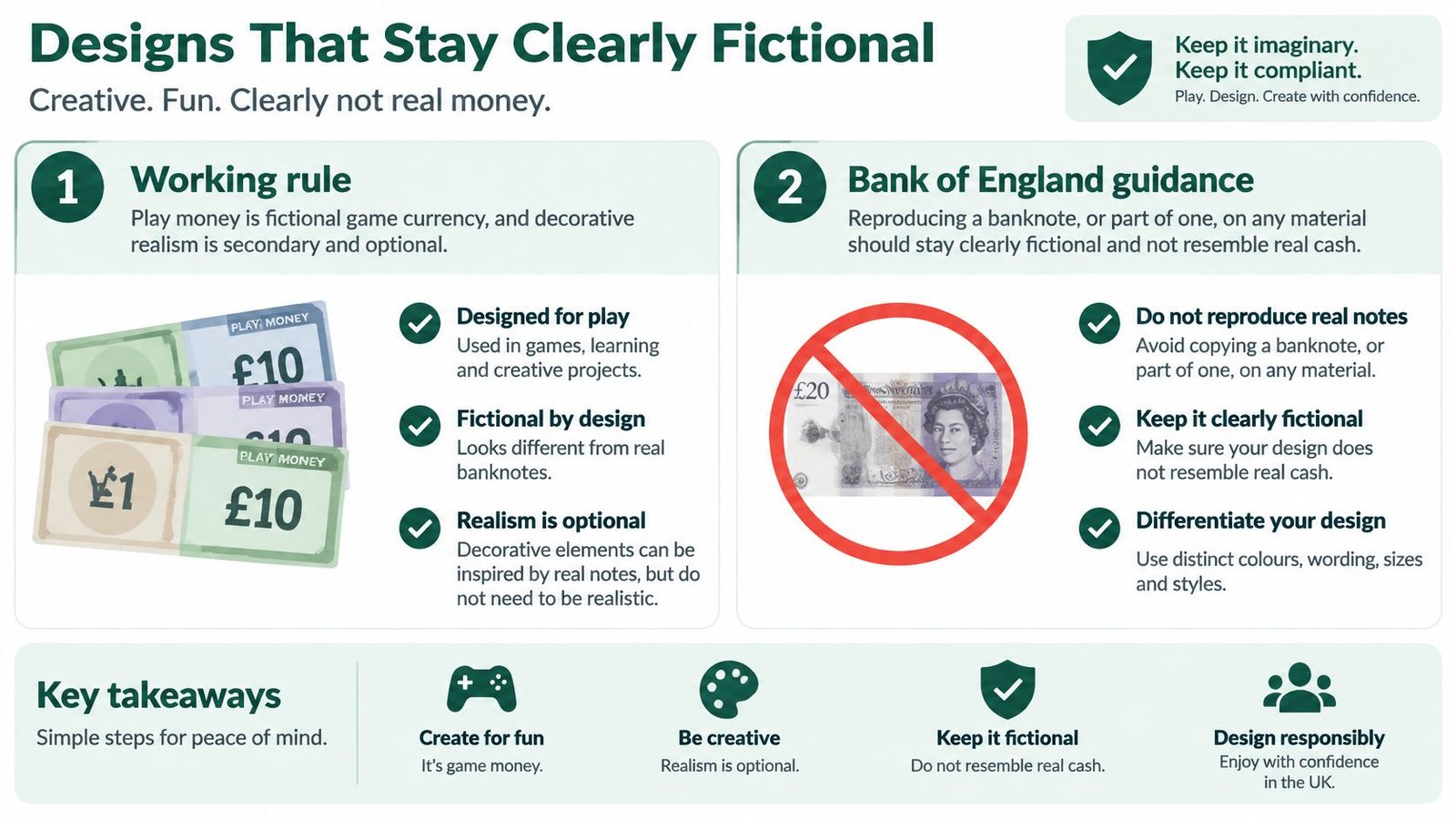
A small prop label doesn't make a realistic banknote replica safe. Play money is fictional game currency, and the safest designs announce that fact at a glance rather than relying on decorative realism.
The Bank of England's counterfeit-banknote guidance states that reproducing a banknote, or part of one, on any substance or at any scale requires consent; labels such as prop, movie or training don't automatically make a reproduction lawful. Its safeguards include making reproductions at least 25% smaller or larger than the relevant note, avoiding double-sided banknote images and observing restrictions on similar materials.
Those conditions govern reproductions of real notes. They are not a licence to shrink a genuine note design and call the result original.
Make the fictional identity obvious
A stronger design starts with invented frames, simple geometric ornaments and an original game title. Large pound values preserve the gameplay function without borrowing the visual language of genuine sterling.
Safe play-money choices
| Decision | Safer choice | Leave out |
|---|---|---|
| Branding | Original game title and plain ornaments | Monopoly, Hasbro and recognisable artwork |
| Currency look | Invented frames and symbols | Portraits, windows, holograms and royal imagery |
| Denomination style | Large £ game values from £1 to £500 | Layouts close to current Bank of England notes |
| Print form | Single-sided ordinary paper or card | Double-sided note images or security-feature effects |
| Wording | Prominent game currency or not legal tender | A small prop line used as the only safeguard |
The designer should place game currency or not legal tender where it remains readable after cutting. A label hidden inside a decorative border communicates nothing, even when the surrounding artwork is original.
Colour works best as a sorting cue. The familiar orange, lilac, green and cream bands from the classic game palette can sit inside plain panels or corner strips, so players recognise each value instantly while the composition stays clearly distinct from current sterling notes. Matching the play colours buyers already know is what makes the file useful; matching real banknote artwork is what makes it risky.
Check both kinds of copying risk
Currency reproduction and commercial branding are separate issues. A design can avoid real-banknote imagery while still borrowing a game publisher's logo, character or distinctive artwork.
AmaJova's intellectual-property guidance provides a relevant checkpoint before a seller publishes a file. Asset provenance should also be recorded, including the source and permitted use of fonts, illustrations and decorative elements.
A fictional label supports an original design. It doesn't repair a copied one.
Harmless intentions don't settle the legal position. Reproductions can engage UK counterfeiting law, so classroom or party use shouldn't be treated as an automatic exemption. This is general guidance rather than an assessment of a particular file, and a seller proposing anything close to real currency should resolve permission and compliance questions before production.
Paper Sizes Contrast and Class Sets
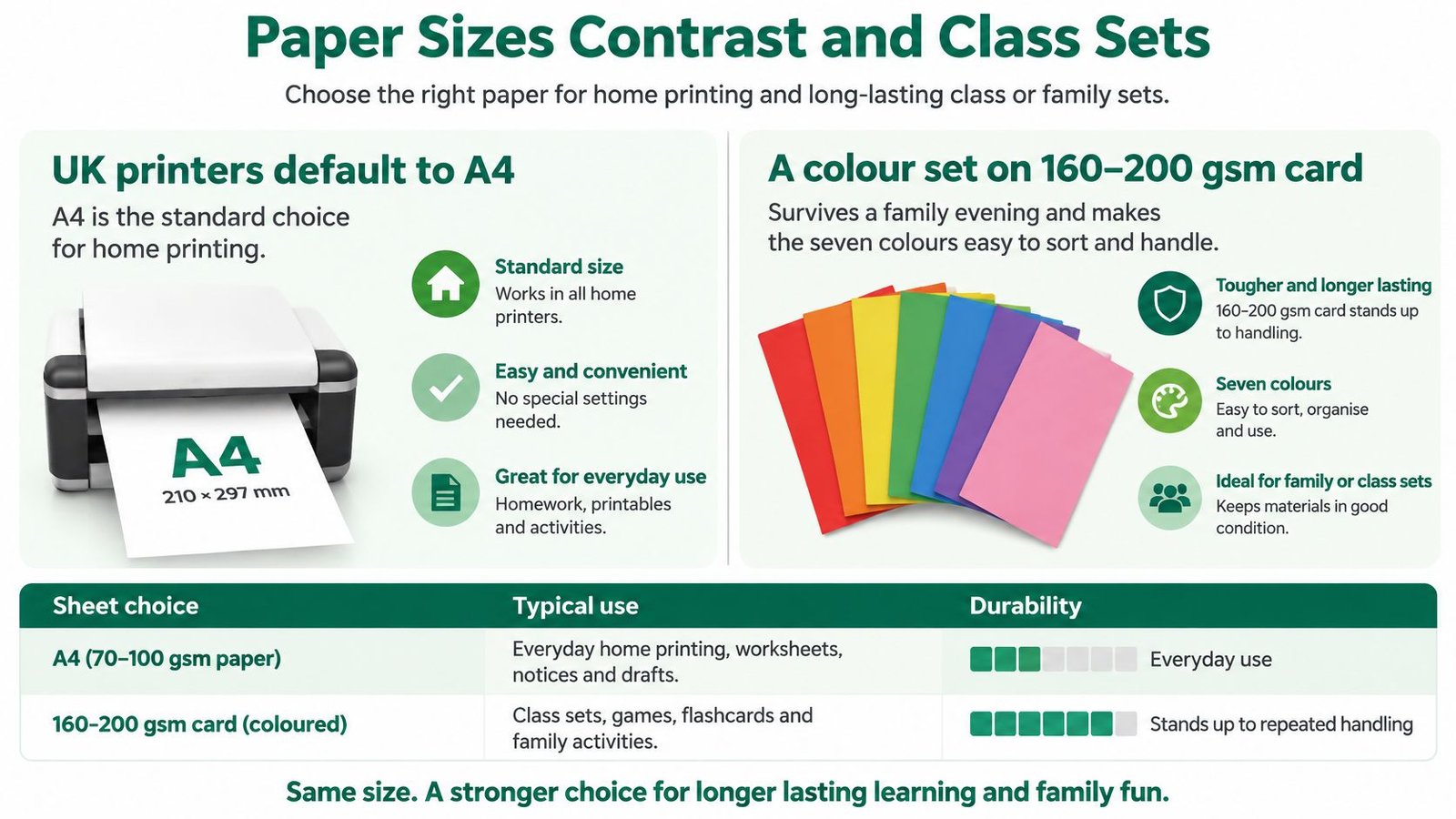
A family replacement pack, a classroom counting activity and a disposable party prop each wear the notes differently. Paper and layout should match the hands that will handle them, because a setup that suits one group will frustrate the others.
Choose a setup for the actual use
The setups below are starting points for testing, and the seller should check the chosen stock against the printer's supported paper weight before committing to a class set.
Print setups by use
| Use | A4 setup | Paper | Trade-off |
|---|---|---|---|
| Family game night | Six notes, full colour bands | Suggested 160–200 gsm printable card | More ink, easier sorting |
| Classroom groups | Six notes, black plus one spot colour | Suggested 120 gsm paper | Cheaper, still distinct values |
| Low vision or young players | Four large notes, suggested 24 pt numerals | High-contrast card | More sheets per player |
| Repeated club use | Either grid, then laminate after cutting | Printable card plus pouches | Durable, not reprintable once pouched |
A4 is a sensible default for UK home printing, and the document and printer settings still need checking. An ink-saving version should use black outlines with a restrained denomination accent rather than a full-page coloured background, since a heavy background wash costs ink on every sheet without helping players sort values.
For larger batches, a trade printer may arrange several copies on one parent sheet before trimming. Sellers weighing that route can browse unfinished SRA1 print sheets to see the sheet format a commercial run would be planned around, while keeping the customer-facing download in A4 for home printers.
Make values readable without colour
Colour helps sorting, but it should never carry the whole message. A note that only reads through its colour fails the moment someone prints it in greyscale or a player struggles to tell two shades apart.
Large numerals, clear spacing and a familiar sans-serif typeface are sensible starting choices for younger players and readers who find crowded layouts difficult. They shouldn't be described as a universal accessibility solution without testing with the intended users.
- Add contrast. Pale yellow needs dark text, while cream notes benefit from a visible border.
- Repeat the value. A corner numeral helps when notes overlap in a hand or tray.
- Separate cutting guides. Light, clearly distinguishable cut lines prevent confusion with the note border.
- Explain lamination. Notes should be printed and cut before pouching; laminated pieces shouldn't go back through a home printer.
A party prop can use thinner stock when it only needs to survive a short activity. The listing should state that intended use rather than imply a classroom PDF produces a premium printed component.
For a worked four-player example, the starting bundles require 64 notes. Adding a suggested 32-note mid-value reserve gives 96 notes, requiring 16 six-note sheets or 24 four-note sheets, provided the layout is balanced across the full batch; denomination-specific pages may create spare notes.
How to Lay Out and Print the Notes
Start with the sheet the buyer can print. A handsome note rectangle fails if six copies cannot sit inside the A4 safe area, so choose the grid before styling borders, colour bands or the fictional crest.
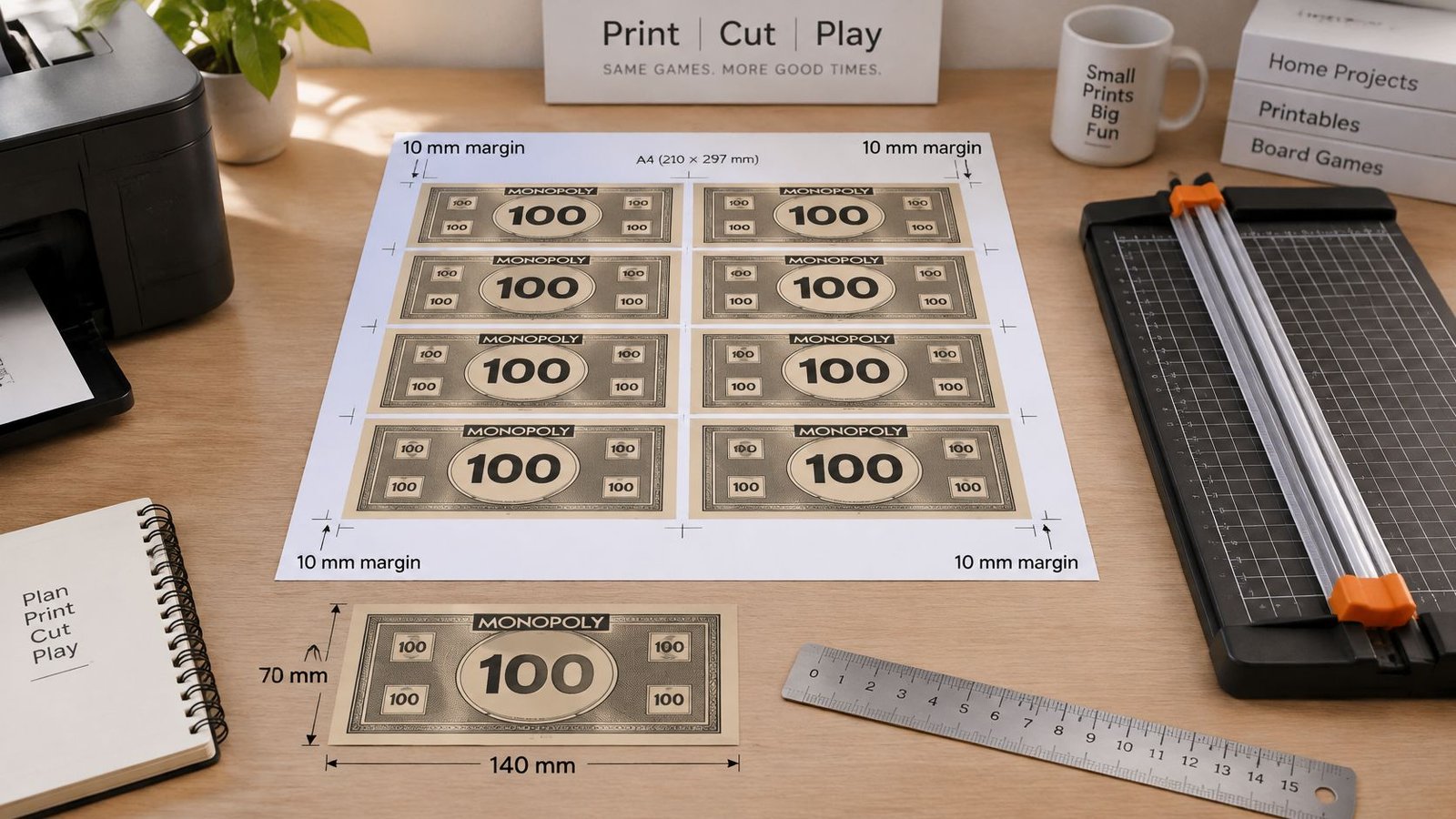
A practical workflow in Affinity Publisher, Adobe InDesign or Inkscape starts with one controlled master and ends with a physical proof. The dimensions below are a worked production example for original British-style play money, not specifications for official game components.
Build and export the master
Set the page before drawing. Use A4, 210 × 297 mm, with a suggested 10 mm margin and clear cutting guides. Printer hardware may need a different safe area, so the proof must confirm that nothing clips.
Choose a grid that fits. For example, 90 × 75 mm notes can occupy two columns and three rows with room for gaps. A 140 × 70 mm master cannot fit that same six-note arrangement on A4; the designer must reduce the note or change the grid.
Give the value priority. A suggested starting size is 18 pt or larger for the main figure, increasing it for children's or large-print versions. The pound sign, value and game-currency line should remain legible without zooming in.
Duplicate a controlled master. Create denomination layers, symbols or artboards from the same component. Change the value, colour band and corner numeral while keeping borders, spacing and wording consistent, so the set feels related without imitating real banknotes.
Export a print-ready PDF. Embed fonts where licensing permits, check for missing glyphs and avoid metallic effects or transparent panels that resemble security features. Separate filenames should identify colour, ink-saving and large-print versions.
A large-print layout needs its own page design, not only an enlarged export. For example, a 90 × 125 mm note can be arranged in a four-note A4 grid with suitable gaps and margins.
Proof the product buyers will receive
Inspect every exported denomination. Suggested checks at 100% and 200% zoom help expose clipped labels, inconsistent digits and unintended visual effects. This is also the point to reject artwork that looks convincingly like real cash.
Print a proof at actual size. Select 100% scale or Actual size, not Fit, and use the paper described in the instructions. The proof should be checked for edge clipping, weak contrast and colour changes.
Cut and assemble a complete player bundle. Follow the chosen starting-cash allocation while stacking the notes. This catches missing denominations and quantity errors that a screen inspection will not reveal.
Approve and retain the master. Record the printer model, paper and relevant settings. Any artwork change should trigger another proof before the revised file replaces the approved version.
Bank of England banknote statistics and guidance reinforce the need to keep printable game money clearly distinct from genuine currency. Keep the artwork original, the denominations readable and the description honest about what the download contains.
Proofing standard: A realistic-looking result is a failed game-money proof, even when its print quality is excellent.
The same file-testing discipline applies to other printable resources. AmaJova's digital colouring-book guide is a related reference for creators packaging printable artwork with clear customer instructions.
Sell an Original Download Clearly
A closer copy of official artwork isn't a stronger product. An original set with readable values, tested layouts and clear permissions gives buyers something useful without relying on borrowed visual identity.
Monopoly is a licensed commercial property, and Euromonitor's UK toys-and-games overview discusses the importance of licensed products in that market. That commercial context matters, but it isn't a substitute for checking rights in the specific names, artwork and assets a seller intends to use.
Sell the function without copying the identity
The cautious route is original, generic play money with a plain product name, such as Pound Play Money Classroom Pack. The description can explain the counting activities and included denominations without presenting the download as an official replacement product.
Private home use and commercial distribution are different contexts. Neither should be treated as blanket permission to reproduce protected material, and a disclaimer doesn't grant rights to artwork or branding.
A seller should obtain appropriate permission before commercial use of protected names or artwork. Property titles can raise contextual questions too, particularly when they're presented in a recognisable game arrangement alongside copied graphics.
- Keep asset records. Save font licences, illustration licences and evidence of original creation.
- Avoid implied affiliation. Product titles, preview images and descriptions shouldn't suggest endorsement by a rights holder.
- Review commissioned work. A customer's request for familiar branding doesn't establish permission to reproduce it.
- Get specific advice when needed. General guidance cannot determine whether a particular commercial design is lawful.
Put the actual contents in the offer
A buyer should be able to distinguish a complete download from a single preview sheet before payment. The approved files belong on a clearly described digital-product offer, not in an unexplained message attachment.
For a pack containing the versions described below, the seller can use this numbered inclusion checklist directly:
- Print-ready PDF of all seven denominations. Original pound-value game notes, supplied as a digital download rather than printed money.
- One-page A4 instruction sheet. Paper recommendations, actual-size printing guidance, cutting instructions and the player-allocation checklist.
- Preview images of the included layouts. A colour-set preview and a separate large-print preview showing the actual design.
- Originality and affiliation statement. Original artwork, with no affiliation to or endorsement by a game publisher or currency issuer.
- Permitted-use statement. Printing for the purchaser's own classroom or party, with resale and redistribution excluded unless separately licensed.
- Clearly identified alternative files. An ink-saving version and a large-print version, each named separately in the download contents.
This checklist should describe files that exist and have been tested. If an alternative version isn't included, the listing should say so rather than use a preview that suggests otherwise.
A concise product description could read:
Original fictional pound-value play money for counting activities and tabletop play. Digital PDF files only; no printed notes are supplied. The pack includes colour, ink-saving and large-print layouts, printing instructions and a player-allocation checklist.
The listing still needs its own price, delivery details and licence terms. AmaJova's guide to selling PDFs online provides a relevant reference for organising those details around the downloadable product.
State printing expectations before payment
The offer should identify A4, single-sided printing at actual size, alongside the tested paper recommendation. It should also explain that screen colours and home-printer results can differ, without using that warning to excuse unreadable artwork.
The allocation follows the standard starting convention rather than every possible edition or house rule. That qualification belongs near the compatibility description, where buyers can assess it before purchase.
A useful FAQ should answer practical questions directly:
- Printed or digital? State whether the buyer receives files, finished notes or both.
- Colour printing required? Identify whether the ink-saving file works in greyscale.
- Cutting required? Explain whether the buyer trims individual notes.
- Editable artwork included? Distinguish a printable PDF from a customisable source file.
- Repeated classroom printing allowed? State the licence scope rather than leaving teachers to infer it.
Terms should be readable and consistent across the listing and instruction sheet. A permitted-use statement describes the seller's licence; it shouldn't be presented as overriding applicable consumer rights.
Separate downloads, printed packs and teaching time
A physical pack needs fulfilment details covering what arrives, whether notes are cut and how they're packed. A custom design service needs revision boundaries and an approval stage, while a live classroom session needs its own timing, format and access arrangements.
These shouldn't be blurred into a download description. Buyers shouldn't have to discover after payment that printing, customisation or teaching support costs extra.
On AmaJova, buyers explore the offer and check out using supported payment options. The payout-clearance period varies by seller level and offer type: physical product, digital product, service or live session.
Delivery instructions and questions should stay connected to the order record rather than being scattered across unrelated inboxes. A missing PDF, an incorrect version and a printing question need different responses, so clear filenames and a retained approved master make support more straightforward.
The final product check is simple: the preview matches the download, the instructions match the tested stock, and the licence matches the intended audience. That's a more defensible selling proposition than promising the most authentic-looking notes.
AmaJova offers clear OfferLink pages for digital products, physical products, services and live sessions, with secure checkout and order-connected communication. Sellers ready to package an original play-money download can visit AmaJova and present the tested files, printing instructions and permitted uses together before buyers pay.