
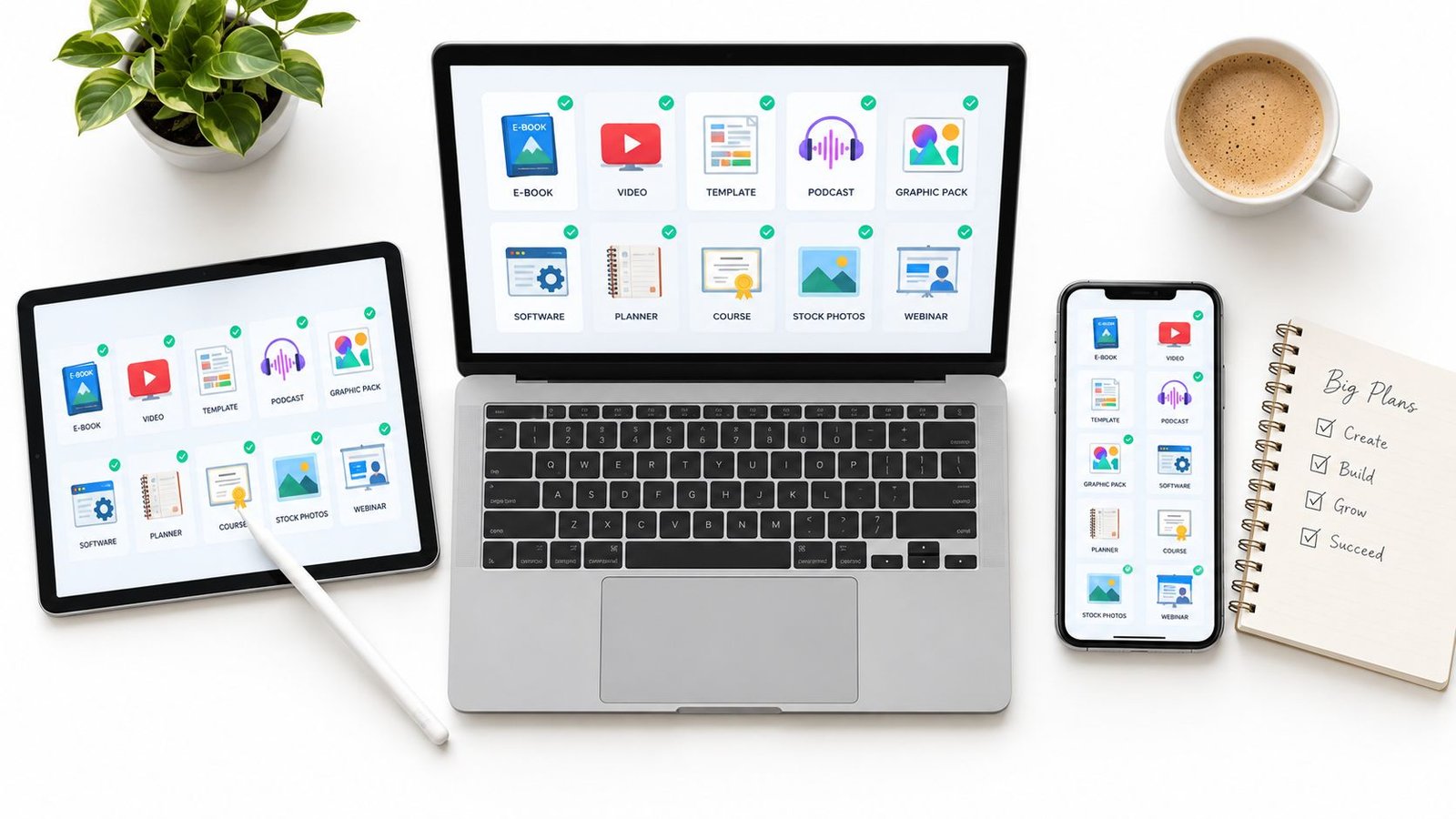
A freelancer who answers the same client question for the fifth time in a month is sitting on a product. The answer might become a spreadsheet, a guide, a recorded lesson, a workshop, or a small tool. The useful starting point isn't a list of fashionable niches. It's the repeated problem the audience already recognises and may already pay to solve.
This guide ranks digital products to sell from lower production effort to higher. Each format is judged by what the seller must produce, what the buyer receives, and which packaging details make the offer easier to understand and buy. That gives creators, freelancers and small businesses a practical way to match a product with their existing skills, available time and audience.
The UK already has a mature online-selling environment. The Office for National Statistics recorded £693 billion in total e-commerce sales by UK businesses in 2019, equal to 18% of total business turnover. The opportunity is real, but a digital product still needs a clear buyer, useful delivery and dependable support.
Table of Contents
- 1. Templates, Frameworks and Spreadsheets
- 2. E-books and Written Guides
- 3. Stock Photography, Graphics and Design Assets
- 4. Video Content and Masterclasses
- 5. Live Group Sessions, Workshops and Virtual Events
- 6. Online Courses and Educational Content
- 7. Coaching and Consulting Packages
- 8. Memberships and Exclusive Communities
- 9. Niche Researchable Content and Industry Reports
- 10. Software Tools, Plugins and SaaS Lite Products
- Top 10 Digital Products Comparison
- Choose One Format and Ship a First Version
1. Templates, Frameworks and Spreadsheets
Templates are often the cleanest first product because buyers can use them immediately. A project board for Notion, Asana or Monday, a pricing calculator, an invoice template, a content calendar or a launch checklist can turn a familiar process into a repeatable asset.
The strongest templates solve one narrow problem. “Business planner” is vague. “Client onboarding workspace for freelance brand designers” tells the buyer who it serves and what changes after purchase. A freelancer who has rebuilt the same proposal, reporting sheet or workflow for several clients has a useful starting point.
Test every formula, permission setting and instruction before publishing. A broken calculation or missing field creates support work and damages trust. The product should also explain required software, editable elements, file formats and what the buyer is allowed to do with the finished document.
A useful package can include:
- Core template: Deliver the working spreadsheet, document, workspace or framework in a clearly labelled folder.
- Quick-start guide: Explain the first action, the customisation steps and the expected result.
- Walkthrough: Add a short screen recording showing the template in a realistic workflow.
- Bundle option: Combine three to five related assets when they solve connected stages of the same problem.
Practical rule: Sell the time saved and the decision made easier, not the number of tabs or pages inside the file.
Templates also work well as an entry product for a service business. A social media planner can lead to content strategy, while a project dashboard can lead to implementation support. Photo editing presets follow the same principle: the buyer isn't paying for a file alone, but for a faster route to a desired result.
2. E-books and Written Guides
An e-book works when it gives a focused reader a complete route through a defined problem. A guide for preparing for a particular interview, pricing a freelance service, planning a first launch or cooking for a specific dietary need is easier to position than a broad book about “success”.
The seller must produce more than a document. Research, structure, editing, proofreading, layout and a useful cover all affect the buying decision. Typos reduce confidence, while a clear contents page and sample section help buyers assess the depth before paying.
PDF is practical for designed guides, while EPUB suits readers who want adjustable text and ebook-reader compatibility. A guide may also include worksheets, examples, resource links or a short implementation plan. Those additions should be listed explicitly rather than hidden behind a vague promise of “bonus content”.
The sales page should answer four questions quickly:
- Who is it for: Name the reader and their current situation.
- What problem does it address: State the outcome in plain language.
- What will the buyer receive: List the file formats, chapters, worksheets and updates.
- What happens after payment: Explain access instructions and the support route.
A specialist industry report can command more than a short consumer guide because the buyer may use it in a professional decision. That doesn't make longer automatically better. A concise guide with strong examples often beats a padded document.
Creators preparing a first title can use AmaJova's guide to selling a book online alongside a clear sample chapter and fulfilment plan. A 2026 ebook publishing guide can also help with the publishing workflow, but the product still needs an audience-specific promise.
3. Stock Photography, Graphics and Design Assets
Design assets sell when they remove a visual production task. A collection of images for independent cafés, icons for education software, Canva-compatible social templates, hand-lettered graphics or illustrations for a cultural calendar can help a buyer produce work without commissioning every element.
Generic stock photography is difficult to distinguish. A narrow collection with a consistent visual style gives the buyer a reason to choose one library over a large general marketplace. The seller should show the actual assets in realistic previews, not only display a few polished examples that hide the rest of the pack.
Licensing needs careful wording. State whether the buyer can use an asset commercially, modify it, use it for client work or include it in a product for resale. Clarify restrictions on redistribution, trademark registration and resale of the original files. If third-party fonts, photographs or illustrations appear in the pack, the seller must have the rights needed for the proposed licence.
Buyers don't want to decode a licence after checkout. Put permitted uses, prohibited uses and file formats beside the previews.
A strong asset offer includes a consistent naming system, useful file organisation and a short licence document. Updates can keep a collection relevant, but the seller shouldn't promise ongoing additions unless that work is clearly planned. A static pack can be more trustworthy when its contents are complete and clearly described.
Photographers can find practical positioning ideas in this guide to selling photos online. The same packaging logic applies to presets, icons, mock-ups, fonts and illustrations. The buyer should know exactly what can be downloaded, edited and used.
4. Video Content and Masterclasses
Video is useful when demonstration matters more than explanation. A music producer can show a mixing workflow, a chef can demonstrate a technique, and a software trainer can record the exact sequence of clicks. The format becomes expensive when the creator records too much material before testing whether the audience wants it.
Sound quality deserves priority. A viewer may tolerate a simple camera setup, but unclear speech, echo and inconsistent volume make instruction difficult to follow. A short outline keeps the presenter focused, while screen recordings, close-ups or alternate angles can show the relevant detail without adding unnecessary production.
A masterclass should have a specific promise rather than a broad topic. “Build a first client reporting dashboard” is easier to judge than “learn marketing”. The offer page should show a preview clip, state the intended skill level and list the equipment, software or materials required.
Captions and transcripts serve several purposes. They make the lesson more accessible, give learners a way to search or revisit a point, and create written material that can support discovery. The transcript should be checked rather than published as an unedited automatic output.
Video can be sold as a standalone class, a short series or a recorded live event. The trade-off is clear. A recorded product can be delivered repeatedly, but it needs stronger self-service instructions. A live masterclass allows questions and feedback, but the seller must manage scheduling, reminders and attendance.
The best first version is often one tightly edited lesson with a workbook, rather than a large library that takes months to complete. A buyer should know what they can do after watching it.
5. Live Group Sessions, Workshops and Virtual Events
A live session sells access to a scheduled experience. Participants may attend a workshop, group coaching call, expert panel, Q&A or virtual conference. The value comes from explanation, interaction and the ability to ask questions in context, so this format can suit experts who aren't ready to build a full course.
The offer page needs more detail than a simple event title. Include the learning outcomes, session length, date, time zone, intended audience, participation format and what happens if someone can't attend. Speaker credibility matters, but a recognisable name doesn't replace a clear result.
Promotion should start early enough for the audience to understand the topic and decide whether the timing works. Reminder messages close to the event reduce forgotten registrations. If the session is recorded, state how and when attendees will receive the recording. Don't describe access as instant if delivery happens later.
A practical event structure might include:
- Opening context: Define the problem and the result participants should reach.
- Teaching segment: Present the method with a worked example.
- Participant activity: Give attendees a task that turns explanation into practice.
- Questions: Reserve time for issues that need individual clarification.
- Follow-up: Send the recording, resources and next action through the stated route.
Capacity limits should reflect the quality of interaction the seller can provide. A small group may justify a more hands-on format, while a larger webinar needs moderated questions and stronger preparation. Artificial scarcity creates disappointment if the event can easily accommodate everyone.
Live sessions can also become future assets. A recording may support a later workshop package, but attendees should be told what is recorded and how it will be used.
6. Online Courses and Educational Content
An online course combines several product types: video lessons, written explanations, exercises, files, quizzes and sometimes live support. That makes it more valuable when the learning path is coherent, but it also creates more production and maintenance work than a single guide or template.
Demand should be tested before extensive recording. A creator can describe the proposed outcome, speak with potential buyers, run a small live class or accept early interest for a defined first version. If nobody can explain why they need the course, better filming won't solve the positioning problem.
Each module should move the learner towards a practical result. Short lessons are easier to revisit than marathon recordings, while assignments reveal whether the learner can apply the material. The offer page should state prerequisites, expected effort, learning outcomes and any software or equipment required.
A course may contain:
- Core lessons: Teach one connected skill in a logical sequence.
- Practice files: Let learners repeat the method with realistic material.
- Progress checks: Use questions or tasks to expose gaps.
- Support boundaries: State whether questions receive written answers, live discussion or no individual feedback.
- Completion path: Show what the learner should build, submit or understand at the end.
An educator who wants a fuller planning process can use this resource on selling online courses. The important operational issue is not just hosting lessons. It is making access, support, updates and technical requirements clear before purchase.
A money-back promise, where offered, needs defined terms and should reflect the seller's actual policy. No guarantee should be added casually. Course buyers need an accurate picture of what the product includes.
7. Coaching and Consulting Packages
Coaching and consulting are higher-effort offers because the buyer receives access to a person, not only a file. The seller diagnoses a situation, adapts the work and manages communication. That can create strong value, but vague scope quickly turns a defined package into unlimited support.
“Business coaching” is too broad to guide a buying decision. A clearer offer might help a particular kind of service provider improve a specific planning process, prepare for a career transition or create a workable sales system. The seller should describe the starting point, activities, deliverables and boundaries without promising an outcome that depends on the buyer's actions or circumstances.
A fixed package is easier to buy than an open-ended arrangement. It might contain several sessions, asynchronous document feedback or a written action plan. The offer should state session length, scheduling method, response expectations, cancellation terms and what isn't included.
A coaching package should have an end point. Without one, both sides can hold different ideas about what “support” means.
Health, career and financial topics can carry additional professional and legal considerations. The seller should use accurate qualifications, avoid unsupported guarantees and check the relevant rules for the location and service. A testimonial may show a client's experience, but it doesn't prove that every buyer will achieve the same result.
This format often starts well as a service before becoming a digital product. Repeated questions from clients can later become a workbook, course or toolkit. That sequence helps the seller identify the parts that can be standardised without removing the human judgement buyers value.
8. Memberships and Exclusive Communities
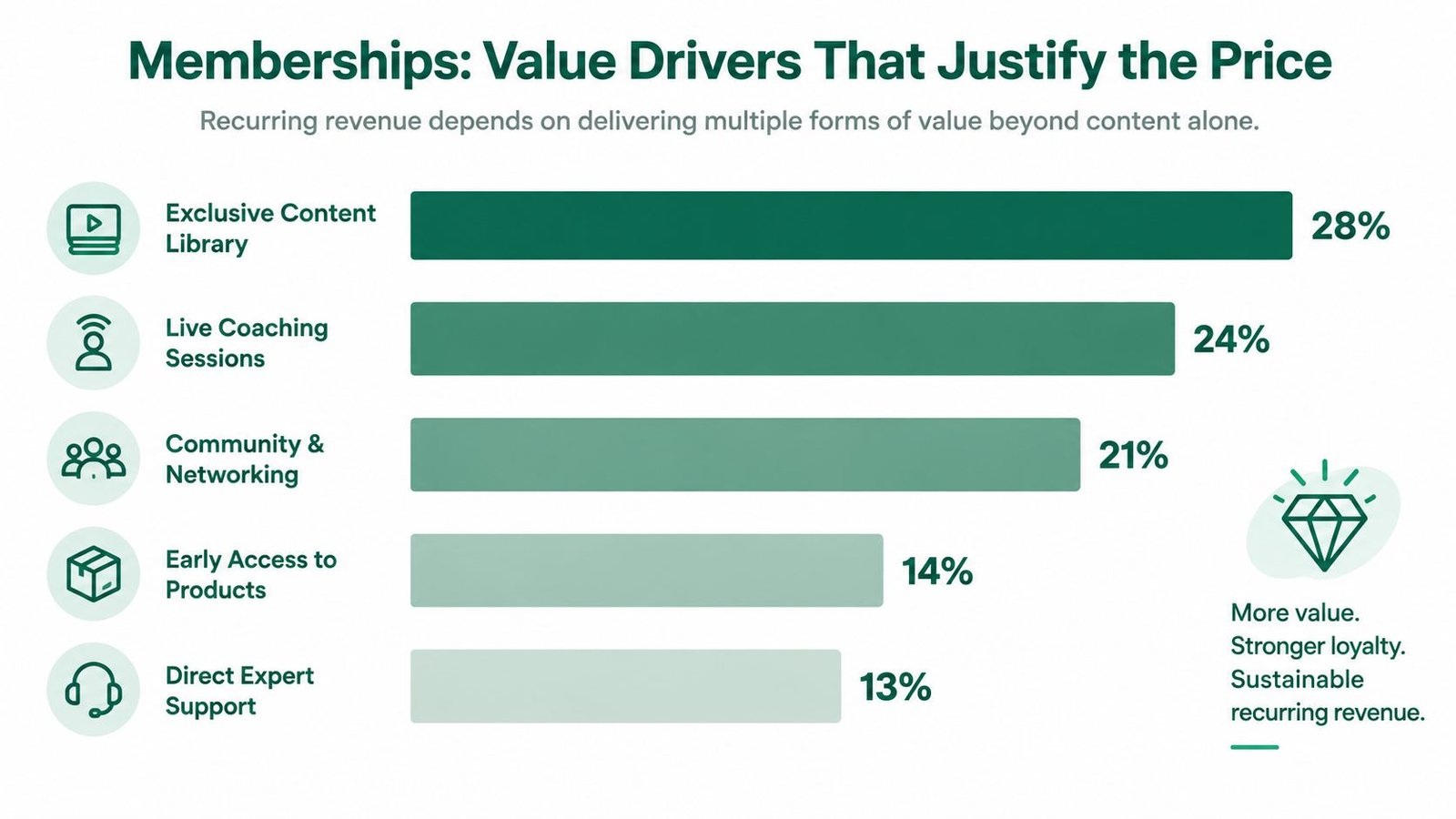
A membership is not just a folder of files behind a recurring payment. Buyers stay for ongoing value, which may include regular sessions, peer discussion, critiques, new resources or access to an expert. If the seller can't describe the next useful member experience, the recurring model is probably premature.
The first-week experience matters. New members should quickly find the promised resources, understand where to ask questions and know when the next activity happens. A simple welcome path can reduce confusion:
- Start here page: Explain the community purpose, rules and first action.
- Resource map: Organise existing material by outcome, not upload date.
- Event calendar: Show recurring sessions and how members participate.
- Support boundary: State response times, moderation and what isn't included.
- Feedback route: Give members a clear way to report gaps or suggest topics.
Community quality depends on participation, not only on the creator's publishing schedule. A writing group with useful critique can be stronger than a library of disconnected lessons. A professional membership may need moderation, privacy rules and clear conduct expectations, especially when members discuss client or workplace information.
Recurring access also creates a maintenance obligation. The seller needs a realistic content calendar and a way to explain cancellations, access changes, updates and refunds. A low price won't compensate for a promise that becomes difficult to deliver.
For international buyers, the offer should distinguish automated digital access from live or human-supported elements. UK VAT treatment can differ by product and customer location, so sellers should check the UK Government guidance on digital services supplied to private consumers and obtain professional advice where the circumstances require it.
9. Niche Researchable Content and Industry Reports
A research report earns attention by answering a professional question that free material doesn't answer well. It might analyse software adoption in a specialist field, compare customer behaviour, document salary patterns or examine a narrow market. The product is valuable only when the evidence is credible and the buyer can understand how it was produced.
Methodology should appear near the front of the report. Explain the research question, sample or data source, collection method, limitations and interpretation. If the data is incomplete, say so. A confident tone can't compensate for unclear evidence.
The sales page should give decision-makers enough information to assess relevance. Include an executive summary, contents page, sample pages, intended audience, publication date and licence terms. A buyer who needs to share the report internally may require permission beyond an individual purchase, so site or enterprise licensing should be stated separately.
A report can be a one-off publication or part of an update cycle. Annual editions create a reason to return only when the subject changes and the research remains useful. An update promise should specify its scope, timing and delivery method rather than imply unlimited revisions.
Distribution partners can help when they have a genuine connection to the audience. An industry body, specialist publication or relevant brand may provide reach and credibility, but the report's methods and ownership should remain clear.
Research-heavy products suit sellers with access to original information, specialist interviews, internal expertise or a neglected question. They don't suit a creator who is copying public summaries and adding a polished cover. The buyer is paying for judgement, evidence and time saved during a decision.
10. Software Tools, Plugins and SaaS Lite Products
Software sits at the highest end of production effort because the seller must build, test, document, maintain and support a working product. A calculator for a narrow business decision, browser extension, reporting dashboard, file utility or workflow integration can be more realistic than an all-purpose platform.
The best first version has one job. A small tool that turns a repetitive task into a reliable output can be easier to explain and validate than a large application with many unfinished features. Real users should test the workflow before the seller invests in a broad roadmap.
Software buyers need confidence after payment. Documentation should cover setup, required accounts, supported devices, data handling, known limitations, troubleshooting and contact routes. If access depends on a licence key, account or connection to another service, the offer page should say so.
Development decisions should follow evidence:
- Define the job: State the input, process and output in one sentence.
- Test the workflow: Ask potential users to complete the task with a prototype or manual service.
- Limit the first release: Build the smallest version that delivers the promised result.
- Record usage problems: Prioritise fixes based on actual friction rather than feature requests alone.
- Plan support: Decide who answers questions and how outages or compatibility problems are communicated.
A free trial can reduce hesitation, but it also adds account, access and conversion work. A one-off tool may be simpler to operate, while a subscription can fund ongoing maintenance only if buyers continue to receive value. The seller must also review third-party software terms, privacy obligations and sector-specific requirements.
For a narrow tool, an OfferLink can present the offer details and checkout while a separate landing page may be more suitable for demonstrations, documentation or a trial. The delivery and support expectations should remain visible wherever the buyer starts.
Top 10 Digital Products Comparison
| Product type | Implementation complexity | Resource requirements | Expected outcomes | Ideal use cases | Key advantages |
|---|---|---|---|---|---|
| Templates, Frameworks and Spreadsheets | Low | Minimal, design, formulas, instructions | Immediate time savings; quick sales at low–mid price | Niche workflows, freelance proposals, financial models | Fast to market, low support overhead, high margins once created |
| E‑books and Written Guides | Low–Medium | Writing, editing, formatting, cover design | Scalable information product; modest revenue per sale | How‑to guides, industry reports, fiction, lead magnets | Low distribution cost, portable, quick to update |
| Stock Photography, Graphics and Design Assets | Medium | High‑quality production, organisation, clear licences | Passive income; scalable collections; subscription potential | Designers, marketers, content creators needing assets | Multiple pricing models, broad market appeal |
| Video Content and Masterclasses | Medium–High | Camera, audio, editing, hosting, transcripts | High engagement and premium pricing; strong brand building | Skill demonstrations, tutorials, expert masterclasses | Emotional connection, repurposable content, premium price points |
| Live Group Sessions, Workshops and Virtual Events | Medium | Platform setup, scheduling, facilitation, promotion | Real‑time engagement, lead generation, community growth | Webinars, workshops, cohort training, launches | Scarcity-driven sales, immediate feedback, networking value |
| Online Courses and Educational Content | High | Curriculum design, production, platform, ongoing support | High perceived value; scalable revenue; authority building | Professional upskilling, certification, structured skill learning | Premium pricing, passive sales after creation, bundling options |
| Coaching and Consulting Packages | Medium–High | Time, subject‑matter expertise, scheduling, client management | High‑ticket revenue; measurable client outcomes; referrals | Executive coaching, business strategy, personalised transformation | Premium pricing, close client relationships, bespoke results |
| Memberships and Exclusive Communities | Medium | Continuous content, community management, platform costs | Predictable recurring revenue; improved lifetime value | Ongoing support, peer networks, creator communities | Recurring income, deeper engagement, upsell pathways |
| Niche Researchable Content and Industry Reports | High | Research, data collection, analysis, professional design | Premium one‑off sales, thought leadership, enterprise licences | Market analysis, benchmarks, decision‑maker briefs | High price justification, credibility, PR and lead generation |
| Software Tools, Plugins and SaaS Lite Products | Very high | Development, maintenance, hosting, support, security | Recurring subscription revenue; defensible product; scalable users | Automation, analytics, niche business tools, integrations | Strong defensibility, predictable revenue, integration potential |
Choose One Format and Ship a First Version
The right product isn't necessarily the most scalable format. It is the format that matches the buyer's problem, the seller's current capability and the support burden that can be handled consistently. A template may be more commercially sensible than a course when the audience needs a working tool. A live session may be better than a membership when the audience needs one decision resolved. A small consulting package may reveal the knowledge needed for a later guide.
Start with one sentence:
This product helps [specific buyer] achieve [specific result] without [specific obstacle].
If that sentence stays vague, the product is probably still a topic rather than an offer. “A course about marketing” needs more work. “A practical programme for independent photographers who need a repeatable enquiry-to-proposal process” gives the seller a buyer, a problem and a possible delivery path.
Demand can be tested without building the final version. Use a small pre-sale, a waitlist or conversations with five potential buyers. Ask what they currently do, where the process fails, what they have already tried and what a useful result would look like. Don't ask only whether they “like the idea”. Interest is easier to state than willingness to buy or participate.
The first offer page should make the transaction understandable before payment. Include:
- The buyer: Identify who should purchase and who shouldn't.
- The result: Describe the practical change, not an inflated promise.
- The contents: List files, sessions, lessons, access or deliverables.
- The format: State whether delivery is a download, gated resource, live event or human service.
- The requirements: Name software, devices, preparation and technical limits.
- The support: Explain the contact route, response boundary and post-purchase help.
- The commercial terms: Make price, tax treatment where relevant, licences, refunds and access conditions clear.
Digital delivery still needs trust. ONS data shows that online spending represented 50.5% of total UK card spending in September 2025, compared with 43.7% in September 2019. That scale doesn't make an unclear offer acceptable. Buyers still need to know what they receive, when they receive it and what happens if access fails.
Usability deserves attention because not every customer wants a complex setup. The UK Government's DSIT Public Engagement Survey reports that 76% of adults felt able to complete most digital tasks without difficulty, which also means a meaningful minority may need clearer onboarding. A quick-start path, readable instructions, example files, captions, offline formats and a troubleshooting page can widen access without changing the core product.
International selling adds another layer. Sellers should distinguish automated digital delivery from live or human-supported work, record relevant customer-location information and check tax obligations for each market. A global audience doesn't remove the need for accurate currency, licence territory, support hours, file format and access wording.
Consumer remedies also apply to digital content. Under section 45 of the Consumer Rights Act 2015, a consumer can have a right to a refund for defective digital content or where the trader has breached the right to supply it. The exact remedy depends on the circumstances, so descriptions and technical requirements should be accurate, and complaints and refund decisions should be recorded.
Promotion needs equal care. Email marketing to individual subscribers generally requires consent unless the conditions of the soft opt-in exception are met. The Information Commissioner's Office guidance on electronic mail marketing explains the need for clear consent, sender identification and an easy opt-out route.
A simple OfferLink can suit a seller who wants one clear place for a digital product, service or live session without building a full storefront. AmaJova presents offer details, pricing, checkout and fulfilment or access information through one link, with order communication connected to the transaction record. That can be useful when the immediate goal is to publish a clear first version rather than add technical complexity.
Choose the format closest to the repeated problem. Build the smallest complete version. Put the buyer's next step in plain sight. Then improve the product from real questions, failed hand-offs and completed purchases, not from guesses about what might sell.
AmaJova lets creators and freelancers present digital products, services, physical products and live sessions through a single OfferLink with clear scope, checkout and fulfilment details. Publish a focused first offer and invite buyers to visit AmaJova to see how the platform can support the selling journey.