A strong portfolio sits on a hard drive and a social profile, praised in comments but rarely bought. Enquiries arrive as vague messages about price, size or commercial use, and each answer has to be improvised. That friction isn't a talent problem. It's an offer problem. Photographers who package each image with a defined buyer, purpose, format, rights and delivery method give customers something clear to purchase, rather than something attractive to admire.
Table of Contents
- Turn Your Photographs Into Defined Offers
- Choose the Right Photography Product
- Prepare Images and Build the Offer
- Set Prices Without Guessing
- Write Clear Licences and Sales Terms
- Promote Offers to the Right Buyers
- Fulfil Orders and Review Performance
Turn Your Photographs Into Defined Offers
A photograph displayed online isn't automatically a product. A product tells a buyer what's included, what it costs, how it will be delivered and what use is permitted. A gallery rarely answers those questions. It shows range, style and technical ability, then leaves the transaction to messages, assumptions and negotiation.
That gap matters because buyers already expect a complete online journey. The Office for National Statistics data on online card spending shows online spending represented 50.5% of total UK card spending in September 2025, compared with 43.7% in September 2019. Customers are accustomed to discovering, comparing and paying online. A photography offer should therefore work when reached from a social profile, message, campaign or personal website, without requiring a preliminary conversation to establish basic terms.
Start With the Transaction, Not the Upload
Competition makes vagueness expensive. A 2026 industry estimate placed UK photographic activities at approximately £2.1 billion, with 9,149 businesses, while business numbers grew at a 4.1% compound annual growth rate between 2021 and 2026 as market size declined, as summarised in the UK photography selling guide and market overview. More sellers chasing a contracting market doesn't reward another undifferentiated portfolio. It rewards a specific promise aimed at a recognisable buyer.
A defined offer begins with five decisions:
- Buyer: Name the collector, business, publisher, family or organisation expected to pay.
- Use: State whether the image is for display, publication, marketing, education or another purpose.
- Format: Specify print, download, licence or commissioned shoot before discussing promotion.
- Rights: Separate ownership of a copy from permission to reproduce or adapt the image.
- Fulfilment: Explain delivery format, timing, access period, dispatch or session arrangements.
A buyer shouldn't need to interrogate a seller to discover what payment actually buys.
Presentation still matters, but it serves the transaction. A beautiful preview creates desire. Clear scope creates confidence. One focused sales page can connect that preview to price, inclusions, checkout, delivery instructions and support, whether the underlying sale is a physical product, digital product, service or live session. Learning how to sell my photographs online therefore starts before channel selection. The first task is deciding exactly what's for sale and removing every avoidable uncertainty before checkout.
Choose the Right Photography Product
Prints, downloads, licences and commissions aren't interchangeable versions of the same sale. Each attracts a different buyer, carries a different pricing logic and creates different work after payment. Treating them as one activity leads to muddled listings, unrealistic prices and disputes about rights.
A print buyer usually wants an object for a wall, gift or collection. Quality depends on paper, dimensions, finish, framing and dispatch. A digital download buyer wants a usable file, often quickly. A commercial licence buyer isn't primarily buying pixels. That buyer is purchasing defined permission to use an image for business value. A commission buyer is purchasing time, judgement and a result that doesn't yet exist.
| Product | Typical buyer | Pricing logic | Key promise | Main fulfilment concern |
|---|---|---|---|---|
| Physical print | Collector, homeowner, gift buyer | Materials, size, edition, framing and delivery | A finished object ready to display | Production quality, packaging and dispatch |
| Digital download | Individual, designer, small publisher | File specification and permitted use | Fast access to a defined file | Correct format, resolution and access |
| Commercial licence | Business, publisher, campaign team | Media, territory, duration, reach and exclusivity | Legal clarity for a specified use | Precise terms and proof of permission |
| Commissioned shoot | Brand, family, organisation, individual | Time, scope, deliverables and usage rights | Images created for an agreed brief | Scheduling, revisions and final delivery |
Match the Product to the Job
A signed print of a view and a website licence can come from the same photograph, but they shouldn't share one vague listing. The print customer needs dimensions, paper type and framing choices. The business customer needs territory, duration, placement and whether resale is prohibited. Separate offers prevent each buyer from paying for irrelevant features or assuming rights that aren't included.
An editorial download creates another expectation again. Speed, caption information and publication rights may matter more than decorative presentation. A brand campaign requires tighter control because the image could appear across paid advertising, packaging or multiple territories. The broader and more valuable the intended use, the less sensible a generic download price becomes.
Commissions deserve the sharpest boundary. Sellers should define session length, location, number of finished files, retouching level, delivery deadline, revision limits and included usage before accepting payment. Without that scope, a modest portrait booking can expand into unlimited edits and unrestricted commercial use.
Selection rule: Choose the product according to the buyer's intended outcome, not according to the file that happens to be available.
One strong image can support several offers when each version is scoped separately. A collector receives a physical edition. A local business receives a limited website licence. A personal customer receives a download for private display. Separation protects value, simplifies pricing and makes promotion easier because every message can point to one relevant purchase.
Prepare Images and Build the Offer
Preparation has two jobs. It must make the photograph desirable enough to stop a buyer scrolling, and specific enough to prevent disappointment after delivery. A striking preview without technical detail creates enquiries. Technical detail without a compelling image creates indifference. Effective listings combine both.
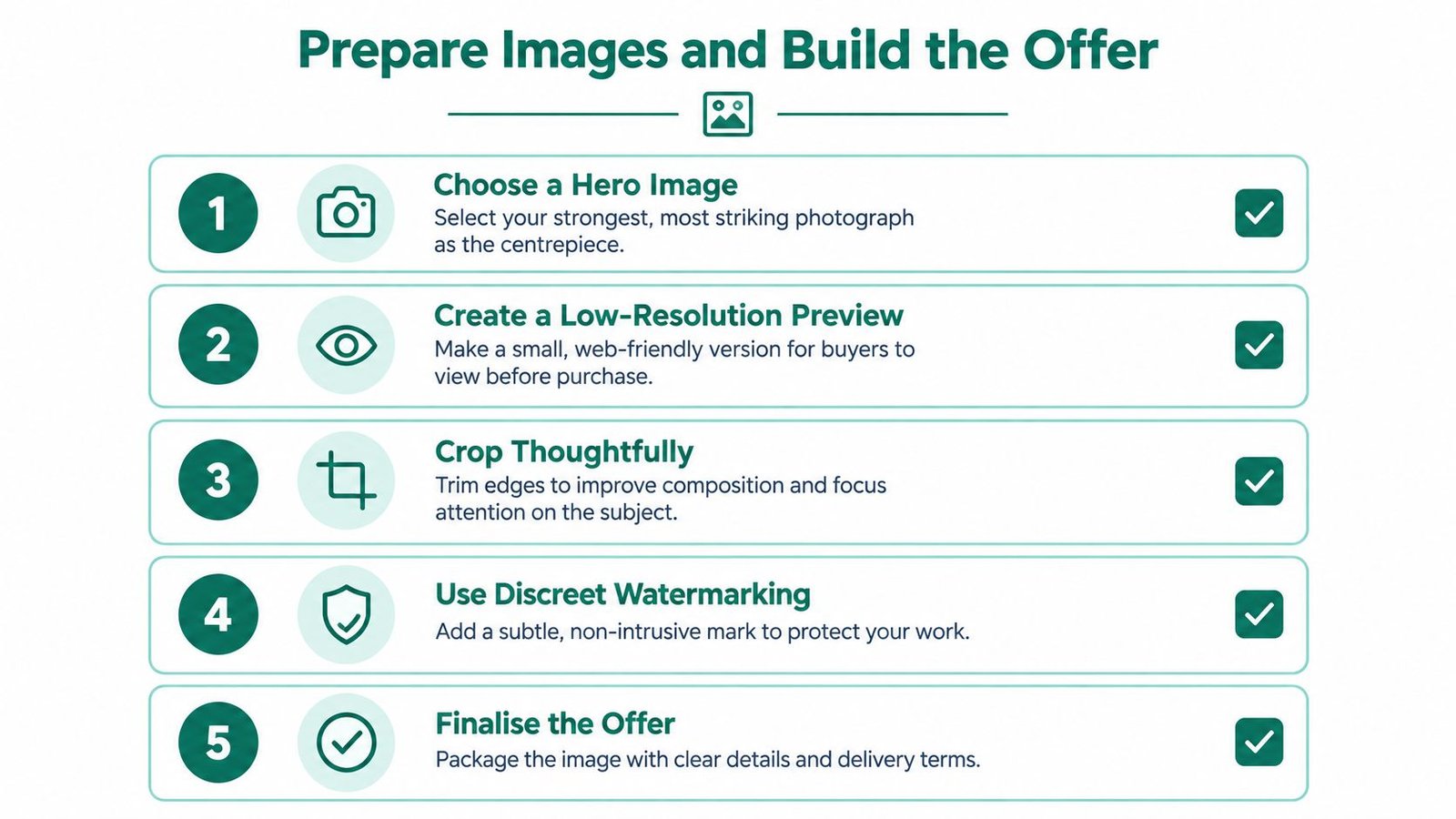
The following visual summarises the preparation sequence before the detailed checklist.
Prepare the Preview
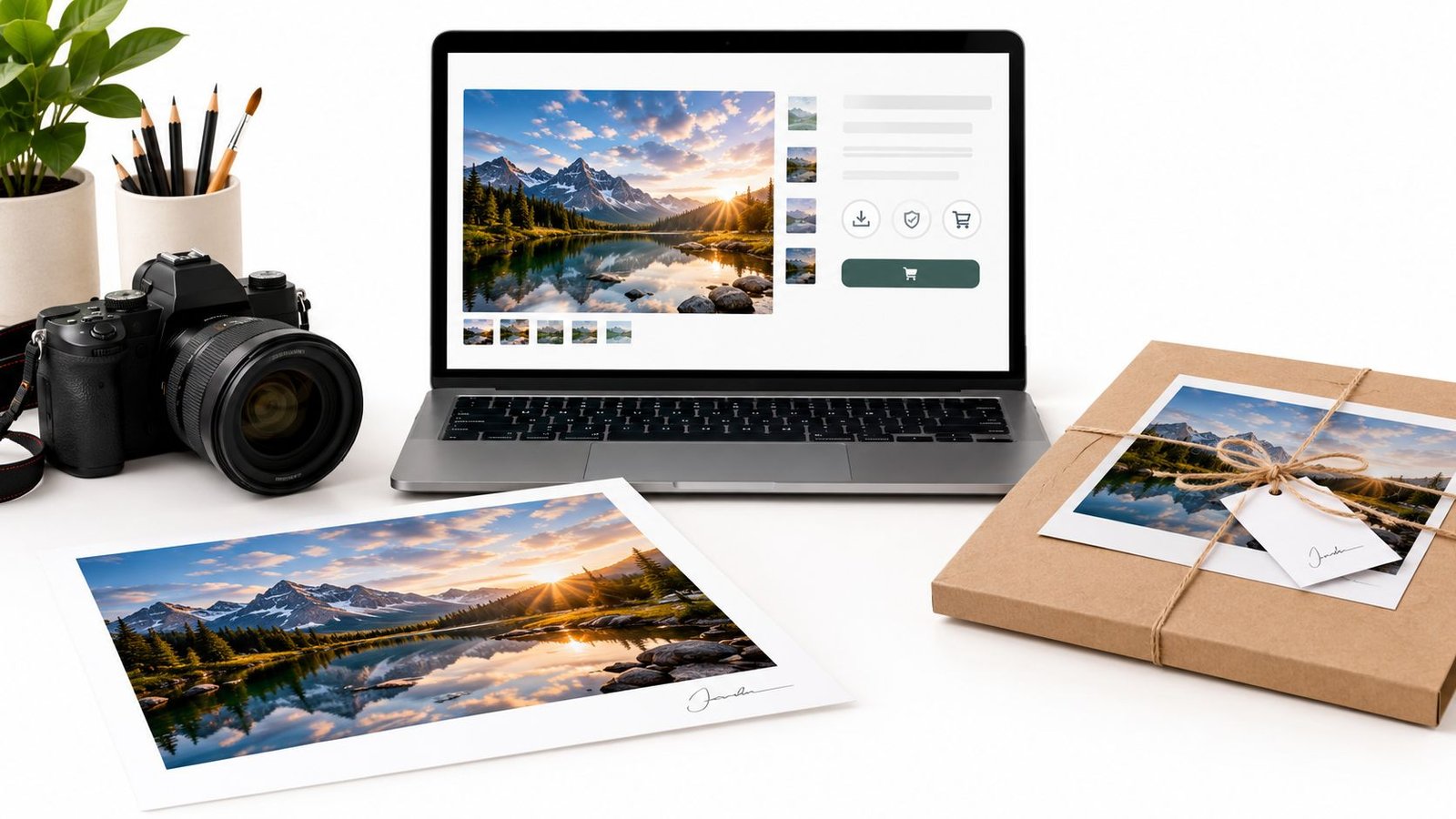
The hero image should be the strongest representative frame, not merely the first file in a folder. A low-resolution preview allows buyers to judge composition and colour without receiving the full production file. Cropping should preserve the intended composition while showing how the image behaves at the advertised ratio. A discreet watermark can discourage misuse, but heavy marks across the subject undermine confidence and make quality harder to assess.
Crop examples and a small contact sheet help buyers understand detail, alternatives and print suitability. For property and other vertical formats, guidance on how to prep listing photos for vertical offers useful context on reframing without losing the subject. Previews must remain honest. Filters, stretched dimensions or misleading room mock-ups create avoidable refund conversations.
Complete the Listing Checklist
Every offer page should state the following before checkout:
- Title and subject: Use searchable, plain language rather than an obscure file name.
- Inclusions: List the file, print, licence document, session time or extras supplied.
- Digital specification: State format, resolution, colour space and download-access period.
- Physical specification: State dimensions, paper, finish, framing and dispatch information.
- Restrictions: Identify prohibited resale, sublicensing, merchandise use or alterations.
- Fulfilment: Give production time, delivery method and support route.
For example, a digital listing might specify a 4,000-pixel JPEG, its colour space, the accompanying licence document and the period during which download access remains available. That level of detail turns an attractive image into an auditable deliverable.
The page should then lead to one purchase action. Multiple packages can exist, but each needs its own price and inclusions. AmaJova provides guided offer setup that can present a defined service, product, digital product or live session through a focused OfferLink, which is one practical way to keep scope, checkout, delivery instructions and order communication together. The platform choice matters less than the discipline. Preview, specification, restrictions and fulfilment must describe the same offer, with no contradictions between the gallery, messages and checkout.
Set Prices Without Guessing
Copying another photographer's price is not a pricing method. That figure may reflect different costs, rights, experience, audience or production obligations. A repeatable price starts with the seller's own inputs and then considers the value and risk attached to the buyer's intended use.
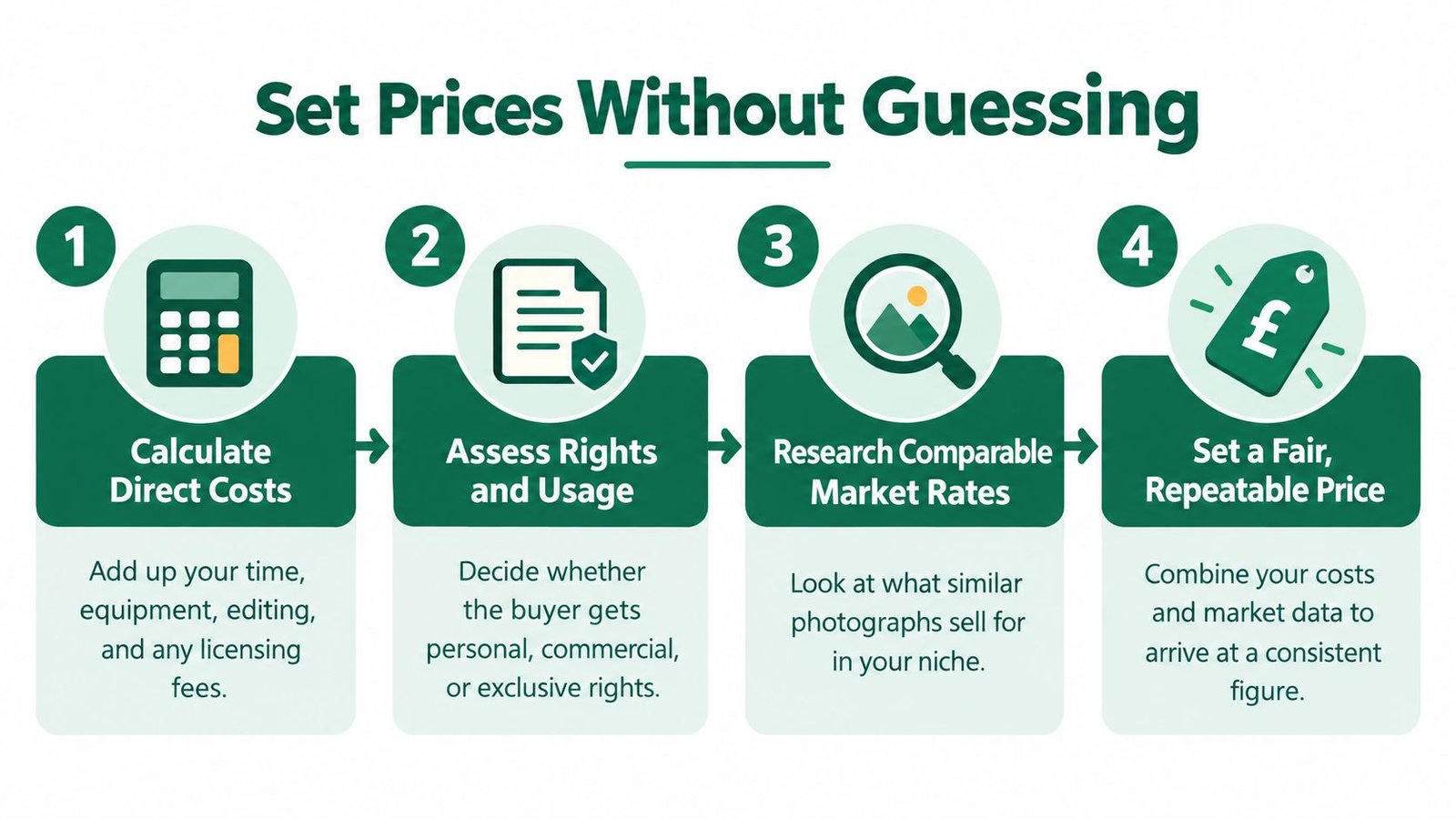
The pricing sequence below separates cost recovery from rights and market positioning.
Build the Base Price
Direct costs form the floor. Sellers should include materials, printing, packaging, software, travel, assistant time, platform or payment charges and delivery. Time spent shooting, editing, preparing files, answering questions and resolving problems also belongs in the calculation. Desired profit shouldn't be treated as whatever remains after an attractive retail price has been chosen.
Current charges should be checked against the published fee information for sellers before margins are finalised, because a price that ignores transaction costs can look profitable while producing weak returns. Print pricing also needs allowance for damaged items, reprints and postage variations. Digital pricing needs allowance for support, file replacement and licence administration.
Price the Rights Separately
Personal use and commercial use shouldn't sit under one undifferentiated figure. Commercial value changes with intended use, audience reach, territory, duration, placement and exclusivity. A small business using an image on one website presents a different proposition from a campaign using the same image across paid media. Rights-managed pricing makes that distinction visible and avoids selling an ambiguous full-rights package.
Three scenarios show the logic:
- Downloadable image: File preparation, delivery system, support and the permitted personal or editorial use determine the price.
- Small print run: Production, proofing, packaging, edition management and dispatch carry greater weight.
- Time-limited campaign licence: Media, territory, audience, duration and exclusivity become the main pricing variables.
Commissions require a deposit policy, revision limits and a chargeable route for scope changes. Extra locations, additional retouched files and broader usage shouldn't be absorbed. Written optional extras protect both sides because the buyer sees the cost before requesting more work.
Tax treatment can affect the final amount retained, but pricing guidance isn't tax advice. Sellers with growing income, overseas customers or mixed digital and physical sales should obtain support suited to the relevant circumstances rather than copying a generic percentage from an online calculator.
Write Clear Licences and Sales Terms
Payment for a photograph doesn't answer the rights question. A buyer may own a print, possess a digital file or hold permission to publish an image without owning copyright. Blurring those categories is the fastest route to unauthorised merchandise, unexpected advertising use and arguments about resale.
UK copyright normally protects original photographs as artistic works, and the photographer is generally the first copyright owner, according to the UK government copyright notice on digital images and photographs. The same guidance explains that copyright in many photographs generally lasts for the photographer's life plus 70 years from the end of the year of death. Selling a copy therefore doesn't normally transfer copyright. A buyer who is meant to own copyright needs a separately documented assignment, while a licence should define permission without implying transfer.
General copyright guidance is also available through the UK government copyright overview, which supports the practical point that creators generally control copying and online sharing of original work. Sellers should still check employer ownership, commissioned-work agreements, model releases, property permissions and visible third-party artwork or trademarks before publication.
Use a Licence Field Checklist
Every licence or download offer should state:
- Permitted use: Personal display, editorial publication, marketing, education or another defined purpose.
- Media and placement: Website, print publication, social campaign, packaging or broadcast.
- Territory and duration: Where permission applies and when it expires.
- Exclusivity: Whether comparable licences may be sold to others.
- Attribution: The exact credit wording and placement, where required.
- Alterations: Whether cropping, colour changes, overlays or composites are allowed.
- Resale and sublicensing: Whether the buyer may transfer, resell or share the file.
- Ownership: A plain statement that copyright remains with the photographer unless assignment is separately agreed.
For broader contract principles, an intellectual property licensing guide can help sellers understand the language used in permission-based agreements, although it doesn't replace advice on a specific UK transaction. Platform-specific rights expectations should also be checked against the applicable intellectual property policy before an offer is published.
Separate Tax and Cancellation Issues
Photography income and licensing receipts are normally trading income, and HMRC's trading allowance is based on gross income, not profit, with a £1,000 annual threshold, as explained in guidance on UK tax considerations for photographers. That doesn't settle an individual seller's filing position. Records should separate prints, downloads, licences and commissions.
Delivery method can also change VAT analysis. HMRC identifies stock photographs available for automatic download as an electronically supplied digital service, while individually commissioned content sent digitally isn't treated in the same way under that classification, according to HMRC guidance on VAT for digital services supplied to private consumers. Separately, HMRC states that VAT registration is required when VAT-taxable turnover exceeds £90,000 a year, as set out in HMRC guidance on VAT and online marketplace sales of goods. Neither point should be turned into a universal rule for every photography sale. Customer location, place of supply and product type can alter the analysis.
For instant downloads, UK distance-selling guidance requires the customer to agree to immediate access and confirm understanding that the normal 14-day cancellation right will be lost, as described in the UK government guidance on online and distance selling. That consent should be affirmative and recorded in the contract confirmation. Physical prints, bespoke services and live sessions don't automatically carry identical cancellation treatment, so terms must match the actual fulfilment model.
Promote Offers to the Right Buyers
Promotion fails when a photograph is shared widely without a buyer-specific reason to act. A collector, publisher, hospitality business and parent don't value the same image for the same purpose. Effective promotion starts with the audience and outcome, then selects the photograph and offer that fit.
UK industry estimates place commercial photography at about £650 million in 2025, ahead of wedding and event photography at £500 million and portrait and family work at £250 million, in a UK photography market report covering sector segments. Those figures support a direct, niche approach rather than assuming stock libraries are the default. Small businesses, local organisations, publishers and educators often need images for a launch, website, lesson, report or campaign, but they need the commercial package explained clearly.
The presentation below reflects the practical shift from showing work in isolation to explaining its use to a specific audience.

Build Buyer-Led Promotion
A useful promotional sequence contains four parts:
- Audience: Identify the business type, collector interest, publication niche or personal occasion.
- Use case: Show the photograph in a room, webpage, editorial layout or campaign context.
- Proof: Include production details, crop quality, relevant experience or a concise testimonial where permission exists.
- Action: Name the exact product, such as a signed print, licensed hospitality set or headshot session.
Generic calls to enquire create another conversation. A specific call directs the buyer to price, scope and checkout. The same image can be adapted for a social profile, direct message, email campaign or website, but the linked offer should remain consistent. Changing price, rights or delivery promises between channels damages trust.
Social content should teach or demonstrate something useful, not merely repeat a sales caption. Photographers developing an audience can use guidance on organic Instagram growth for photographers to plan consistent, niche-focused content, while keeping each post attached to a relevant product rather than a general portfolio. Behind-the-scenes preparation, print comparisons, licensing explanations and examples of permitted use give potential buyers context that a finished image alone can't provide.
Direct outreach deserves equal attention. A narrow package for a restaurant launch, holiday let, school prospectus or local publisher is easier to evaluate than a link to hundreds of images. The proposal should state the number of images, usage rights, delivery deadline, revision limit and price. Targeted relevance beats broad visibility when the buyer has a deadline and a defined commercial problem.
Fulfil Orders and Review Performance
A sale becomes professional only when delivery matches the promise. Buyers judge the file, print or session against the listing, not against the photographer's intention. Fulfilment therefore needs a recorded scope, a prepared deliverable and a clear route for questions.
Before dispatch or release, sellers should verify the correct file version, dimensions, colour profile, licence document and access instructions. Print orders need checks for size, finish, framing, packaging and address details. Commissions need confirmation of the selected images, retouching level and included usage. Proof of dispatch, download access or delivery should be retained with the transaction record.
Keeping messages, payment records, delivery steps and completion status together reduces the confusion created by scattered inboxes. Sellers who need a structured payment process can consult guidance on accepting payments online when designing the route from checkout to confirmed receipt. The important operational principle is traceability. Every promise and change should be visible in one order history.
Troubleshoot Without Improvising
Common problems usually trace back to expectation gaps:
- Unclear usage rights: Refer to the licence fields shown before payment and supply the agreed document again.
- Missing or incompatible file: Confirm the purchased specification, resend the correct version and record the replacement.
- Print delay: Notify the buyer before the promised date passes, state the revised dispatch point and preserve tracking evidence.
- Scope expansion: Quote the additional work as an extra rather than absorbing it.
- Colour or crop mismatch: Compare the delivered item with the preview and stated specification before deciding on correction.
Most fulfilment disputes aren't caused by bad photography. They're caused by two people relying on different versions of the agreement.
Launch, Then Review
A sensible launch begins with a small portfolio of defined offers rather than an entire archive. Each offer should pass one final check for buyer, preview, specification, rights, price, fulfilment and support. Promotion then points to those specific pages.
After the first selling period, sellers should review which offers generated enquiries, completed purchases, support problems or repeat demand. Weak listings may need a clearer buyer, tighter scope or better contextual preview rather than a lower price. Strong offers can be expanded into related sizes, licence tiers or commissioned packages. Reviewing the transaction, not just social engagement, shows whether the photography business is becoming easier to buy from.
Turn one strong photograph into a clearly scoped print, download, licence or commissioned offer with price, rights and fulfilment visible before payment. AmaJova helps sellers present that offer through a single OfferLink with secure checkout and connected order communication, so buyers know exactly what they're purchasing. Visit AmaJova to build a focused offer and start selling with clearer expectations.