Uploading more files isn't a business plan. A photographer can have thousands of images on a hard drive and almost no repeat buyers because nobody can see which collection solves their particular problem. The familiar advice to sell your stock photos through endless uploads misses a more useful starting point: a defined buyer, a relevant collection and permission to use it for a clear purpose.
Table of Contents
- Why Selling Stock Photos Starts with a Clear Offer
- Build a Portfolio Around Buyer Demand
- Write the Licence Before Anyone Pays
- Publish One Offer Instead of a Loose Gallery
- Attract Buyers Who Need Real UK Pictures
- Deliver the Files and Plan the Next Sale
Why Selling Stock Photos Starts with a Clear Offer
An archive isn't the same as an offer. A marketing manager buying photographs for a regional hospitality campaign doesn't necessarily need access to everything a photographer has ever shot. They need suitable pictures, understandable rights and a purchase they can justify without a lengthy email exchange.
Planning around passive income per download puts the emphasis in the wrong place. Upload counts measure activity, not demand. A targeted licence package gives the photographer something more concrete to sell and the buyer something easier to assess.
Stock belongs beside other income
The financial context calls for caution. The University of Glasgow and DACS artists' earnings report reported median annual artistic income of £12,500, compared with £16,000 in 2010, describing a 40% decline; the median was also 47% below its £23,795 full-time minimum-wage comparison.
Those are visual-arts figures, not a forecast of stock-photography earnings. They don't establish what an individual collection will earn, and they shouldn't be used to promise that image licensing will replace commissions.
A more defensible approach treats stock as another part of a photographic business. Existing pictures may support repeat licensing, but selection, administration, promotion and buyer support still require work.
Commercial starting point: A useful collection answers a buyer's question. A large archive merely gives them more files to search.
Sell a use, not access to everything
A regional tourism collection, an accessible workplace set or a hospitality campaign pack gives the seller a defined proposition. Each can address a recognisable purchasing need without pretending that every buyer wants the same images.
Before preparing a listing, the photographer should be able to identify:
- The buyer: The organisation or role likely to need the collection.
- The application: The campaign, publication or communication the pictures could support.
- The package: The actual image count, selection and intended usage.
- The transaction: The price, delivery arrangements and boundaries of the purchase.
This changes the practical question from how many files can be uploaded to which collection deserves to be published. It also makes trade-offs visible: a tightly edited pack offers less choice, but requires less searching and comparison.
The working sequence is straightforward: select the portfolio, settle the rights, publish the offer, promote it and fulfil the order. None of those jobs disappears because the product is digital.
Build a Portfolio Around Buyer Demand
A larger archive does not make a stronger stock offer. UK buyers need pictures that fit a real use, with a clear location and context they can trust. Edit the archive for those needs, not for the personal favourites that happen to be technically polished.
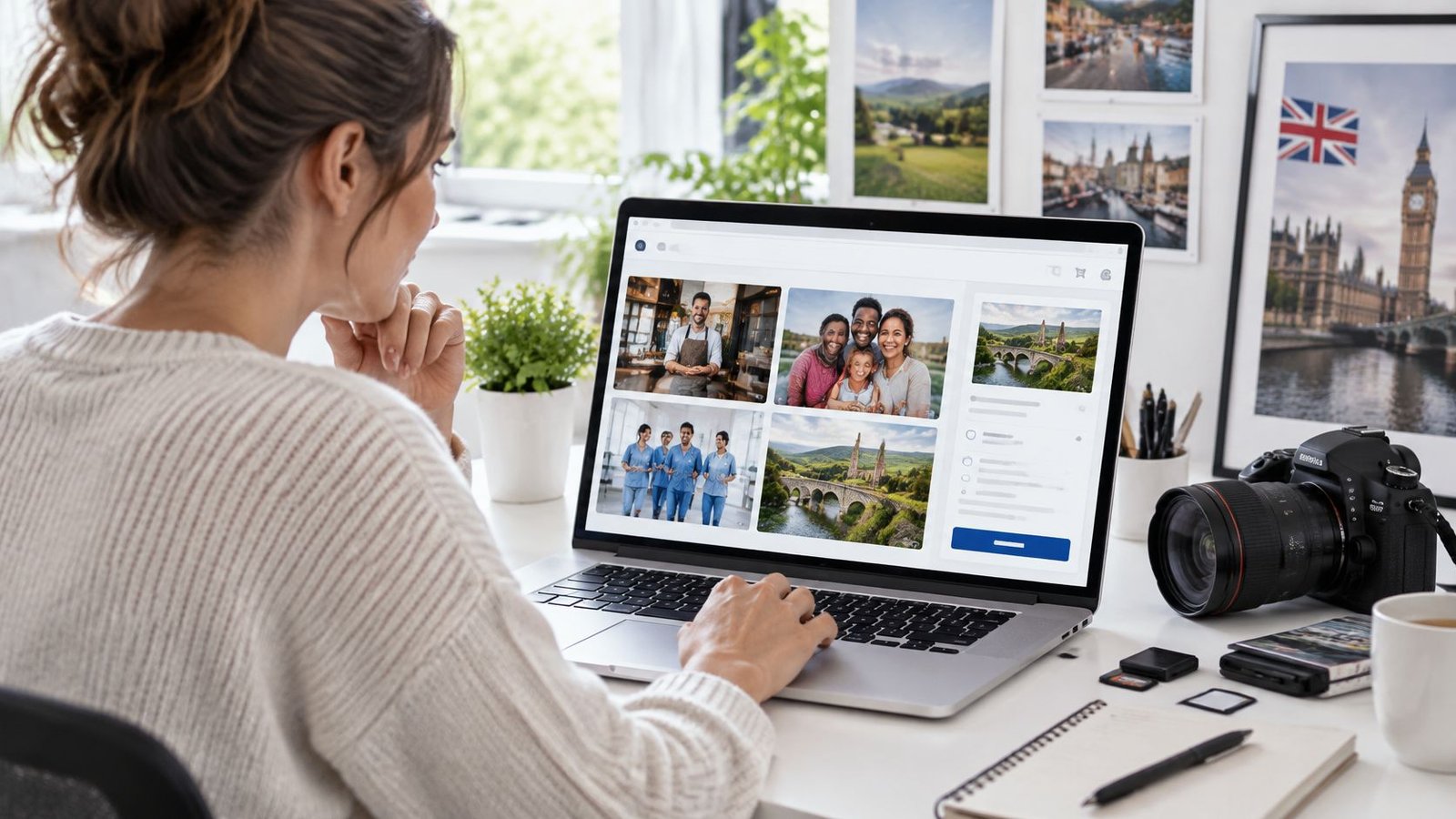
Group suitable images into searchable themes such as workplaces, healthcare, local businesses, diverse families, education and seasonal events. Tourism and street photography can work as collections too, provided the place and likely application are clear. A recognisable local setting may suit a regional organisation better than a generic office, but check that assumption with prospective buyers before arranging more shoots.

Choose commercial usefulness over personal favourites
Free stock is an alternative buyers may consider, so a collection needs a clear reason to be chosen. Local detail, accurate representation and pictures that fit a specific communication task can make a set more useful than generic imagery. That is a proposition to test, not a guarantee of sales.
During selection, check:
- Visual consistency: Keep lighting, colour treatment and finish coherent, while retaining enough variation to make the collection useful.
- Layout flexibility: Include clean copy space and framing options for different placements.
- Accurate context: Caption the actual location and activity. Do not imply an endorsement or relationship that does not exist.
- Search language: Use British spelling, place names and everyday terms that describe what is shown.
- Missing coverage: Find gaps before organising another shoot. More versions of a well-covered subject may add little value.
Test the collection before expanding it
Set a defined review period, such as 30 to 60 days, then assess what happened. Track impressions, licence enquiries, purchases, order value and refund or support issues. Compare themes rather than drawing conclusions from an isolated download. This is a practical test, not a method endorsed by a market report.
Enquiries without purchases may point to unclear rights, pricing or presentation. Enquiries from unsuitable buyers may signal that the collection needs sharper positioning. Low visibility on its own does not prove that buyers do not want the pictures.
Document the images' provenance as you prepare a targeted package: record where and when they were made, who or what is depicted where relevant, and any permissions or restrictions that affect use. This gives UK buyers practical context and helps distinguish a well-documented collection from a loose gallery. Keep the package focused enough that a buyer can judge its fit without searching an entire archive.
Keep a simple prospect record alongside the results. EmailScout's guide to build a sales pipeline that converts offers a framework for organising prospects and follow-ups, so enquiries can be compared and revisited rather than handled as isolated events.
The result should be a shortlist of credible collections, not a reason to publish everything. Expand themes that attract qualified interest, and investigate weak results before committing more production time.
Write the Licence Before Anyone Pays
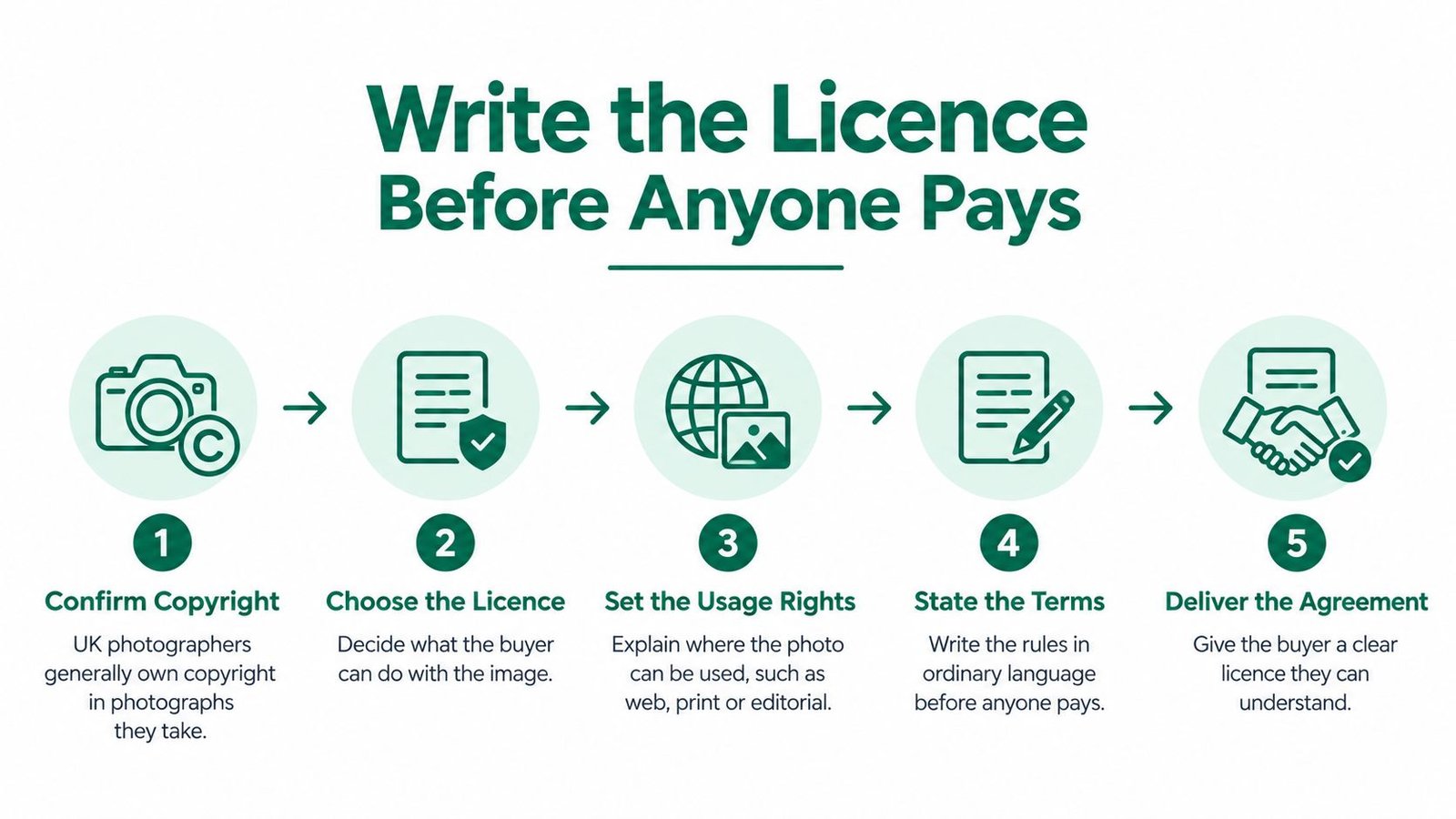
The buyer pays for permission, not an undefined claim over the photograph. Copyright ownership and licensed use need to remain separate in the wording.
Under UK Government guidance on photographs and copyright, photographers generally own copyright in photographs they create, although circumstances such as employment can affect ownership. Copyright generally lasts for the creator's life plus 70 years from the end of the calendar year of death, with transitional rules affecting some older photographs.
A stock transaction doesn't automatically transfer that copyright. The licence should describe the permission being granted, while the photographer retains records of authorship and every grant of rights.
Make the permission readable
Avoid relying on labels such as commercial, standard or royalty-free without explaining their meaning in the actual agreement. A non-lawyer buyer should be able to establish whether the intended campaign fits.
The written decisions should cover:
- Media and purpose: Specify permitted channels and applications, distinguishing commercial from editorial use.
- Territory and duration: State where and for how long the permission applies.
- Editing: Explain whether cropping, colour changes, text overlays or other alterations are permitted.
- Exclusivity: Confirm whether other buyers can license the same images, and define any exclusive scope precisely.
- Distribution: Address audience limits, agency access and sublicensing where relevant.
- Exclusions: State whether resale, redistribution, trademark use or other sensitive applications are prohibited.
For example, permission for a business's website shouldn't leave paid advertising or client redistribution unresolved. Broader permission may be appropriate, but it should be a deliberate commercial decision.
A concise licence can work well when its definitions are clear. Brevity isn't useful if it leaves the buyer guessing.
Keep clearance evidence behind the licence
A BAPLA presentation on photographers' rights and interests reported that 93% of members experienced online copyright infringement, with an average 25% reduction in licensing revenue attributed to infringement.
Maintain a private rights register recording the creator, capture date, location, identifiable people, private property, relevant releases and permitted commercial uses. Embed accurate IPTC metadata, retain signed releases outside the public download and schedule reverse-image checks after publication.
Uploading a photograph doesn't prove ownership, and owning copyright doesn't settle privacy, trade mark or property-permission questions.
The platform's intellectual property information is relevant when preparing a listing, but it doesn't replace clearance work or advice suited to your situation. This is general information: licence terms and permissions should be checked against the photographer's circumstances and the proposed use.
Publish One Offer Instead of a Loose Gallery
A gallery shows pictures. An offer explains a purchase. Both can be useful, but they do different jobs.
A large stock marketplace may provide access to people already searching for images, while requiring the seller and buyer to work within its licensing structure. An emailed folder allows a flexible negotiation, but previews, prices, permissions and delivery arrangements can become scattered across messages.
A defined offer page suits a collection that can be described before the buyer makes contact. It won't create demand by itself, but it can reduce the amount of clarification needed to complete a suitable purchase.
Match the selling route to the job
A marketplace may suit individual images intended for broad discovery. An email-led transaction can suit unusual usage or a negotiated assignment. A single offer page is worth considering for a hospitality campaign pack, accessible workplace collection or regional tourism set with settled boundaries.
These routes aren't mutually exclusive. Any combination must respect existing exclusivity commitments and other contractual restrictions.
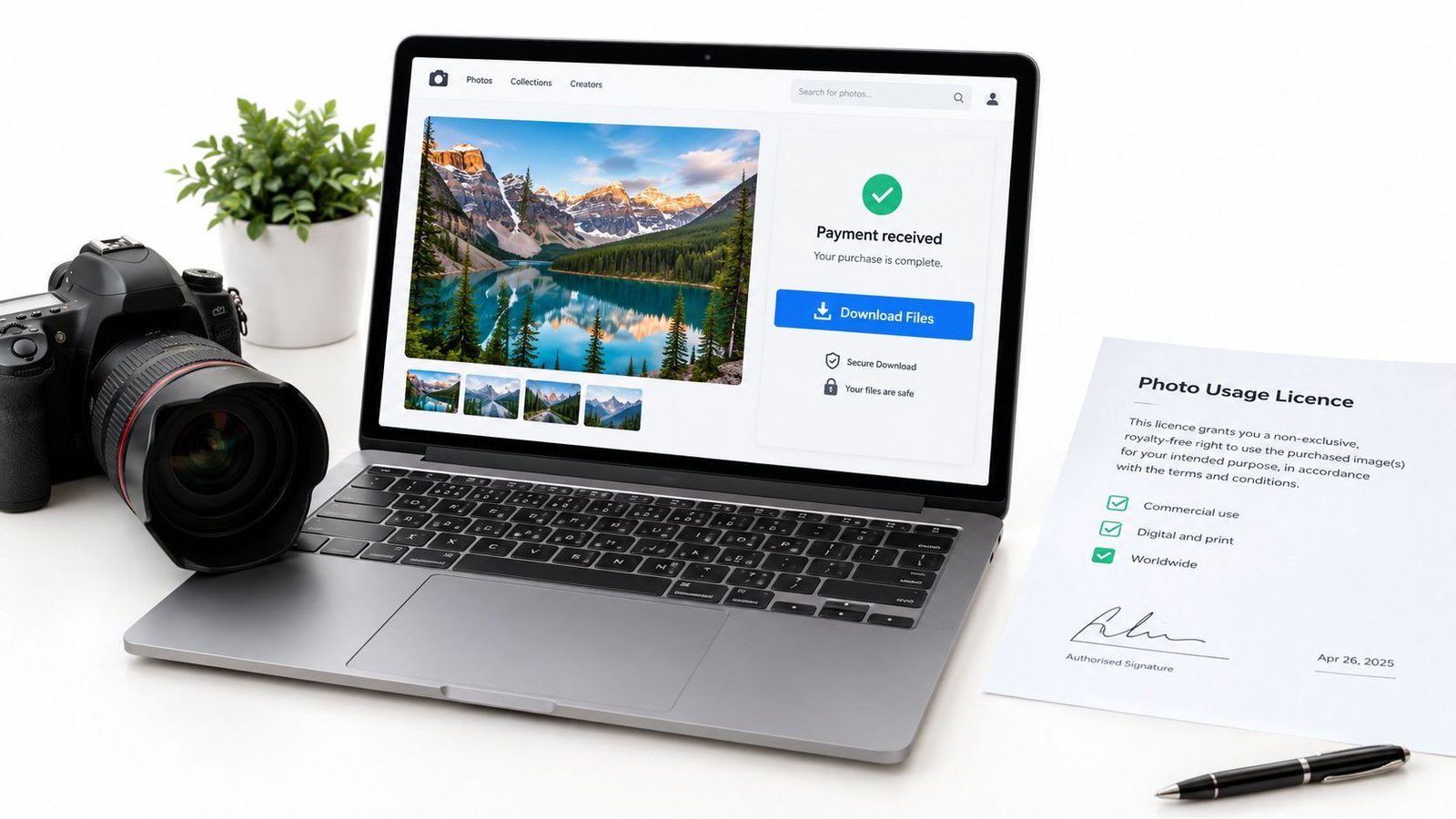
AmaJova is one option for the defined-offer route: its digital-product OfferLink can present previews, file specifications, licence inclusions and exclusions, delivery or access steps, optional extras and FAQs. Secure checkout provides an order summary and, where applicable, disclosure of an optional Buyer Service Fee.
Messages, delivery, timeline, payment record, dispute status and completion remain connected to the order. Payout clearance varies by seller level and offer type, while checkout supports 150+ currencies, as described in the platform's digital-product selling guidance.
What a stock photo offer should state
| Offer field | What to write | Buyer question it answers |
|---|---|---|
| Collection title | Subject, location and intended application | Is this relevant to the project? |
| Preview selection | Representative images from the actual collection | What visual style is included? |
| Inclusions | Exact image count, variations and accompanying documents | What will arrive? |
| File specifications | Format, pixel dimensions, colour profile and download size | Will the files suit the intended production? |
| Licence | Permitted usage and access to the full terms | Can the organisation use these pictures? |
| Exclusions | Uses, files and services not included | What requires separate permission? |
| Price | Package price and clearly identified extras | What is the purchase going to cost? |
| Delivery | Access method, timing and support route | How will the buyer receive the files? |
| Provenance | Human-authorship information and release status | What evidence supports the description? |
The price needs its own commercial judgement. Consider the scope granted, production and preparation work, support requirements and any restriction on future licensing. There's no defensible universal price per photograph in the evidence available here.
Optional customisation should also remain distinct from the standard pack. Additional retouching, a different selection or expanded usage shouldn't be implied by a vague promise of flexibility.
A useful final check is to have someone unfamiliar with the collection read the page. If they can't identify what arrives, what it costs and what they can do with it, the offer still needs editing.
Attract Buyers Who Need Real UK Pictures
Promotion should lead with the scene and its application, not a general announcement that stock is available. A local agency looking for regional business imagery has a different problem from an educator assembling teaching resources.
Build an outreach list around those differences. Local businesses, tourism boards, educators, agencies and in-house marketers are potential audiences, but each pitch should connect a finished collection to an identifiable use.

Make authenticity something a buyer can assess
Human authorship shouldn't be treated as self-evident. A 2025 University of Warwick study of news photographs found that respondents misidentified authentic photographs as AI-generated 47.2% of the time when unlabelled and 42.9% even when labelled.
That finding concerns news photographs, not stock-purchase behaviour. It nevertheless gives photographers a practical reason to support authenticity statements with evidence rather than relying on a badge.
A provenance note can explain the location, capture context and nature of the editing. RAW files and original capture metadata should be retained privately, alongside release records and the rights register.
- State human authorship accurately: Don't describe a generatively altered scene as an untouched documentary capture.
- Disclose material changes: Explain substantial composites, object removal or generative additions where relevant to the purchase.
- Use verifiable context: Identify genuine places and activities without exposing private information.
- Describe available evidence: Explain what supporting documentation can be supplied, without distributing personal release forms publicly.
Buyer-facing distinction: Authenticity is stronger when the photographer can explain how the image was made, not merely assert that it is real.
Promote consistently without broadcasting indiscriminately
Artquest's analysis of artists' earnings data reported regular artistic income falling from 49% of respondents in 2022 to 30% in 2024, while photography as a principal medium fell from 15% to 5%. These describe the survey respondents, not a measured decline in stock demand or proof that photographers changed medium.
The practical response is disciplined promotion rather than a one-off upload. Add the finished offer to relevant website pages, professional bios and appropriate pitches, with captions and keywords that match the pictures.
An outreach message should identify the collection, explain why it fits the recipient's work and provide a direct route to assess it. Follow-ups should add relevant information rather than repeat an unanswered sales message.
Maintain a short list of suitable prospects, their likely applications and their responses. That produces more useful feedback than treating general social engagement as evidence of purchase intent.
Deliver the Files and Plan the Next Sale
A clean handover fulfils the published specification without making the buyer reconstruct the transaction. Delivered format, dimensions, colour profile and file size should match the offer, while preview files should remain clearly distinguishable from the purchased full-resolution versions.
Use consistent filenames that connect each image to its licence record. Include access instructions, the agreed licence and the support route with the order so that future questions don't depend on finding an old email.
Check the handover and consumer expectations
A practical delivery check should confirm:
- File integrity: Open the delivered files and check that exports aren't corrupt or incomplete.
- Specification match: Verify that the package contains the promised images and formats.
- Document consistency: Ensure the delivered licence reflects the terms purchased.
- Support access: Make the contact route and process for reporting a problem clear.
For growing archives, Scheduler.social's guide to asset management system features and costs offers a starting point for evaluating organisation tools. The relevant question is whether a system helps maintain dependable file, version and rights records, not whether it adds another subscription.
For direct sales to UK consumers, government guidance on digital-content rights explains remedies for faulty content, including repair or replacement, and the application of the Consumer Contracts Regulations to downloads. Pre-purchase information should describe the images, format, licence, price, delivery and important restrictions.
A consumer loses the cancellation right when downloading begins only where the seller has explained that consequence and obtained the required explicit acknowledgement beforehand. Completing payment shouldn't be treated as that acknowledgement, and a blanket non-refundable statement isn't a substitute.
Business purchases, marketplaces and other fulfilment arrangements can differ. Sellers should check the rules applicable to the transaction rather than copy another photographer's policy.
Keep receipts and assess the next collection
HMRC's guidance on online-platform income explains the £1,000 trading allowance, generally assessed across total trading income during the tax year running from 6 April to 5 April; its platform-reporting examples include at least 30 sales or approximately £1,700 of platform income during 2024.
Stock receipts belong alongside other relevant trading income, not in a separate allowance for each website. Platform reporting doesn't itself create a new tax, and individual circumstances determine reporting obligations.
Retain sales statements, fees, expenses and transaction dates. The practical guide to accepting payments online can support payment setup, while tax questions belong with HMRC or a qualified adviser.
The next action is narrow: select a tested collection, finalise its licence and delivery terms, and publish that offer. The rest of the archive can wait until buyer feedback justifies further work.
AmaJova offers a shareable OfferLink for a defined digital-photo collection, with checkout and order-connected communication and delivery details. Visit AmaJova to package a tested collection with clear inclusions, usage rights and fulfilment expectations.