A hard drive holds thousands of edited images. A social feed gets likes, occasional print enquiries, and messages asking whether a business can use a photo on its website. Turning that interest into paid work means learning how to sell pics online as defined products with prices, usage terms, and delivery details, not as loose files sent after an informal chat.
Table of Contents
- What You Are Really Selling When You Sell Photos
- Setting Up Your Photo Offer
- Pricing Your Photos for Different Buyers
- Creating Previews That Protect Your Work
- Checkout, Delivery and Order Records
- Communicating with Buyers and Keeping Records
What You Are Really Selling When You Sell Photos
A buyer paying for photography doesn't automatically own the image. In the UK, photographs are generally protected as artistic works, and the creator is usually the first copyright owner, with exceptions such as work made by an employee in the course of employment, as set out in GOV.UK guidance on copyright in digital images and photographs. UK copyright in many images generally lasts for the creator's lifetime plus 70 years from the end of the year of death, although the applicable term can depend on when and how the photograph was created, according to the same guidance.
Three Different Transactions
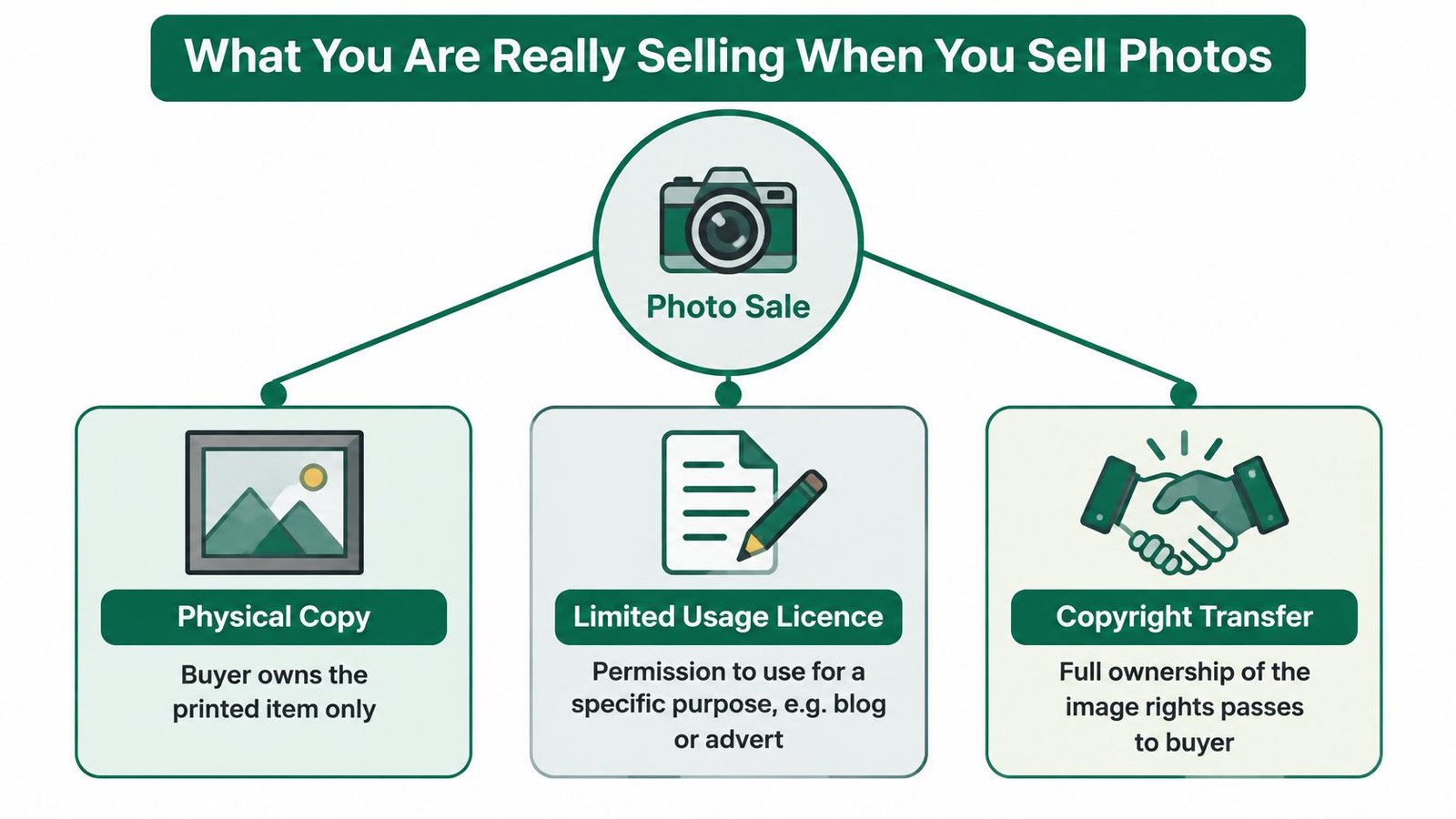
- Physical copy: The buyer owns the print or framed item, not unrestricted rights to reproduce the image.
- Limited usage licence: The buyer receives permission for specified purposes, territory, duration, and reproductions.
- Copyright transfer: Ownership of the rights passes to the buyer, which is a separate and much broader transaction.
Commissioned work needs the same clarity in writing. The creator is usually the first legal owner unless the parties agree otherwise in writing, as explained in GOV.UK guidance on ownership of copyright works. A client commissioning product shots, portraits, or campaign images should know whether the fee covers creation only or also covers a defined licence.
That distinction protects real income. Approximately 93% of photo businesses experienced online copyright infringement, with average losses equivalent to 25% of licensing revenue, in survey figures cited in British Copyright Council material on photographers' rights.
Practical rule: Sell a defined item or permission, and put the permitted use, duration, territory, credit, editing, and resale terms in the order record.
Sellers preparing detailed listings can also study presentation basics through Photo Speak's product image guide, then connect those choices to rights management using guidance on intellectual property for online sellers. The image attracts attention, but the written terms define what's been bought.
Setting Up Your Photo Offer
A general gallery forces buyers to guess. A stronger offer starts with one narrow product, such as a Lake District print, a commercial image licence, a stock photo bundle, or an edited digital download. Each version needs its own title, price in GBP, inclusions, and next step.
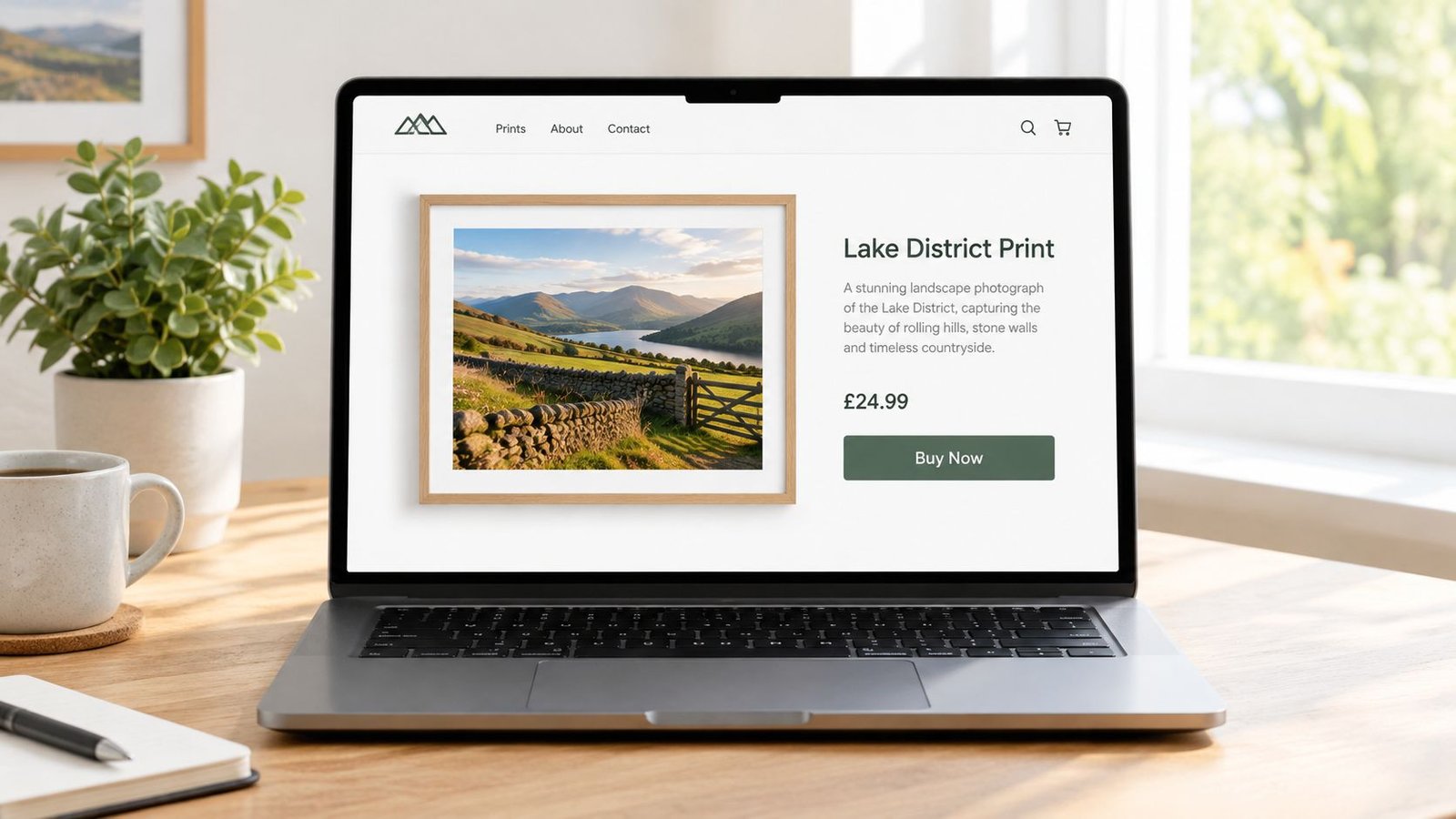
Presentation isn't decoration. 60% of UK online shoppers identify product images and videos as important product page elements, while 54% value ratings, reviews, and user generated content, according to Salsify research on UK consumer shopping habits. Previews should show accurate colour, crop, and orientation, plus a scale reference where size matters.
Details Buyers Need Before Payment
For a digital file, state the file format, pixel dimensions, resolution, delivery method, and delivery timing. For a print, state dimensions, paper type, framing, packaging, dispatch window, and returns process. For a licence, state permitted uses, territory, duration, exclusivity, and whether editing or resale is allowed.
FAQs should answer predictable friction directly. Can the image be used in advertising? Is a credit required? Are revisions included for commissioned editing? What happens if a buyer needs a different crop? Optional upgrades, such as framing or wider usage rights, work better as explicit choices than as vague messages after payment.
Channel choice also shapes fees, control, and workload. Sellers comparing storefront and marketplace routes may find that The Money Maniac compares marketplaces with useful context on those trade offs, while direct digital selling raises different considerations covered in advice on choosing a platform to sell digital products.
Before sharing any link, the offer should be tested on mobile. The checkout summary must match the advertised inclusions exactly, including tax or delivery wording where relevant. If the preview promises a framed print but the summary describes an unframed download, trust disappears before the transaction begins.
Promotion then becomes simpler because the destination is clear. The same offer can sit in a portfolio bio, email signature, social post, exhibition label, or QR code, with every route leading to the same specifications and price.
Pricing Your Photos for Different Buyers
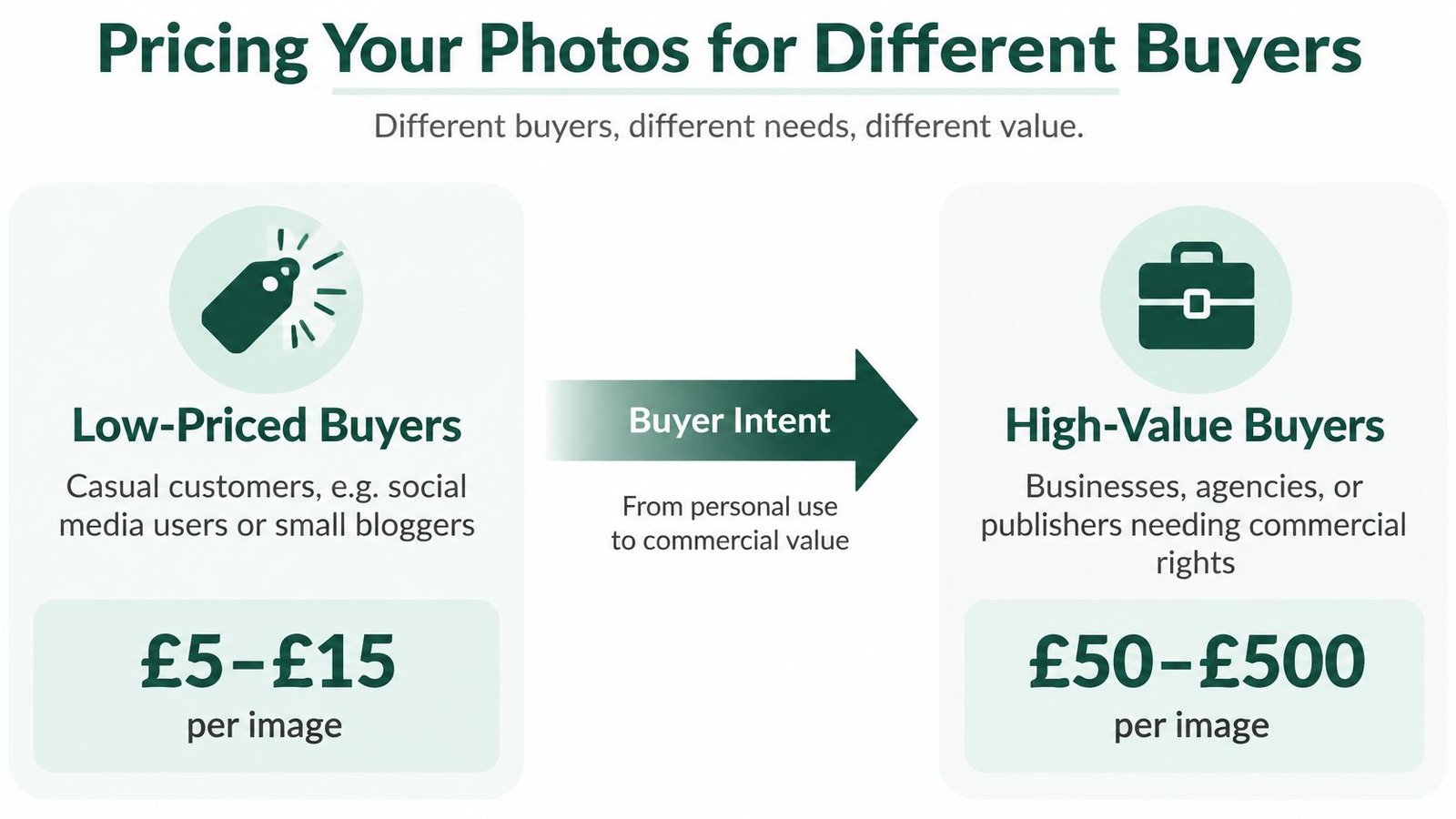
Pricing by follower count produces guesswork. Pricing by buyer intent produces offers that can be tested. A personal download, a limited print, and a commercial licence solve different problems, so they shouldn't share one price or one set of terms.
The UK market supports that separation. Total photographic activities revenue was estimated at approximately US$1.985 billion, with commercial photography at about £650 million, wedding and event photography at £500 million, and portrait and family photography at approximately £250 million, in figures set out in a UK photography market report published through Business Gateway. The same report estimated around 87,400 photographers and audiovisual operators in the UK in the second quarter of 2025.
Build Three Distinct Price Levels
- Instant downloads: Lower priced personal use files with narrow permissions and automated expectations.
- Limited prints: Mid priced physical products where paper, size, edition, and framing drive value.
- Commercial licences and commissions: Higher value packages priced around usage, exclusivity, turnaround, and production work.
Quality supports the business case. 90% of consumers surveyed by Canon considered product photo quality extremely important when purchasing, according to Canon UK guidance on ecommerce and commercial photography. That doesn't justify arbitrary pricing, but it does support testing business packages with a fixed number of product images, defined edits, a stated licence, and optional rush delivery.
Competing only on low prices creates a trap. Creation, editing, usage rights, exclusivity, rush work, printing, and postage should be separated so buyers compare scope rather than headline price alone. A cheap download with no commercial rights isn't equivalent to a campaign licence, and the listing should make that difference unmistakable.
Creating Previews That Protect Your Work
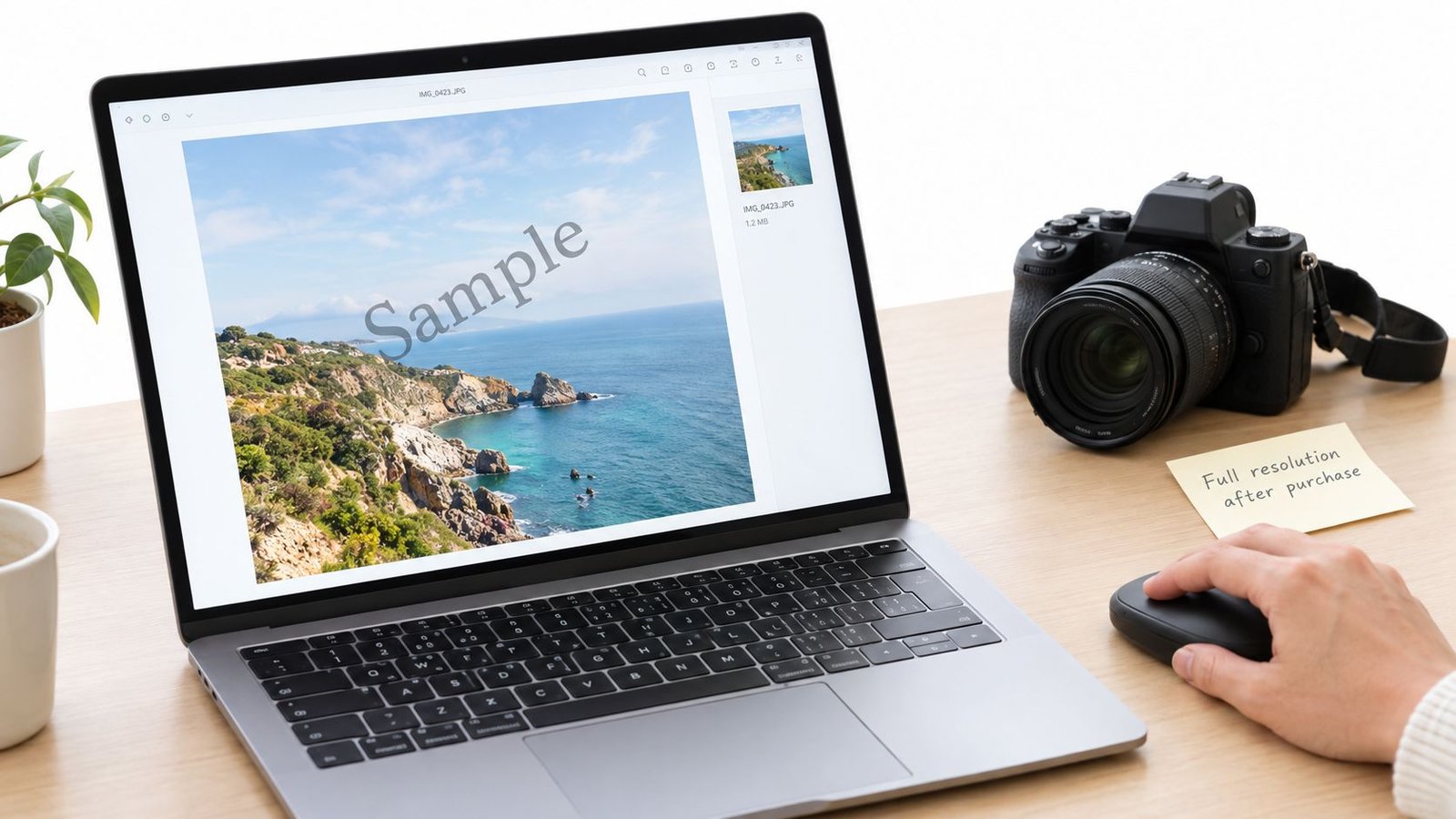
Previews have two jobs. They must prove quality clearly enough to convert browsers, while withholding the full commercial value of the original file. Publishing an unprotected high resolution image makes the paid download unnecessary.
A Workable Preview System
- Use lower resolution previews: Show composition and colour without supplying print ready detail.
- Add a proportionate watermark: Place it where removal would damage the image, without hiding the subject.
- Label the preview clearly: State that the delivered file differs in resolution and has no watermark.
- Keep originals separate: Retain RAW files, metadata, and edit history outside the public listing.
Colour and crop accuracy matter as much as protection. A preview that looks warmer, tighter, or sharper than the delivered file invites complaints. Print sellers should include room or frame scale references, while digital sellers should show a small detail crop rather than releasing the complete full size file.
Generative AI has sharpened the licensing question. The share of Association of Photographers members losing commissioned work to generative AI rose from 30% in September 2024 to a higher level five months later, with an estimated average value loss of £14,400 per professional photographer, as reported in 1854 Photography coverage of Association of Photographers copyright concerns.
A low priced download shouldn't quietly grant broad commercial reuse. Where a business wants advertising, resale, or dataset use, a limited commercial licence is the cleaner product.
AI training restrictions, attribution, territory, and duration should therefore be addressed explicitly. Silence helps neither side. It leaves the seller arguing about intent after reuse, and leaves a legitimate buyer unsure what permission has been purchased.
Checkout, Delivery and Order Records
Buyers judge professionalism at checkout. The order summary should restate the exact product, price, licence scope or physical specification, delivery method, and expected timing. Surprises at that point create abandoned purchases and disputes.
Trust is a live commercial issue. Barclays reported that 38% of consumers had either fallen victim to or knew someone targeted by an online marketplace scam in early 2025, while 49% of scam claims originated on an online or social media marketplace and purchase scams represented 71% of claims, according to a Barclays scams bulletin on online marketplace scams. Clear identity, secure payment, and a contactable seller reduce that hesitation.
From Payment to Confirmation
Digital originals should be delivered only after payment, using the method promised in the listing. The delivery message should identify the file, restate any licence limits, and ask the buyer to confirm receipt. Physical prints need dispatch confirmation, packaging details, and a route for reporting damage.
Platforms differ in how they structure that process. AmaJova, for example, is one option that lets sellers present an OfferLink with checkout and an order record, while other sellers may use a storefront or marketplace. The practical test is whether scope, messages, payment, and delivery stay connected, a point also relevant when reviewing methods for accepting payments online.
Refund wording needs care. Under section 45 of the Consumer Rights Act 2015, where a consumer is entitled to a refund for non conforming digital content, the trader must provide it without undue delay and no later than 14 days after agreeing entitlement, normally by the same payment method and without a fee, as stated in section 45 of the Consumer Rights Act 2015. Accurate specifications reduce disputes, but they don't remove statutory rights or justify a blanket no refunds claim.
Communicating with Buyers and Keeping Records
Good communication prevents ordinary uncertainty from becoming a complaint. Buyers should receive an order confirmation, a realistic delivery expectation, any access or dispatch update, and a clear way to raise problems. Replies work best inside the order record, where the agreed scope stays visible.
Records also have tax consequences. HMRC guidance states that the £1,000 trading allowance applies to total trading income for a tax year running from 6 April to 5 April, and income from different trading activities must be added together, as explained in HMRC online selling and trading allowance guidance. The threshold concerns income rather than profit, so sales and allowable expenses both need clear records. Sellers working internationally may also compare record keeping approaches discussed in 1099 tax tips for OnlyFans creators, while recognising that United States tax rules don't replace UK requirements.
First Sale Checklist
- Confirm ownership: Check the right to sell or license every image.
- Define the offer: Record format, size, usage, delivery, and price.
- Protect the preview: Publish a sample, not the full value original.
- Check checkout: Confirm the summary matches the listing on mobile.
- Deliver and document: Send the correct file or print, confirm receipt, and retain the order, messages, expenses, and licence terms.
Repeat purchases usually come from boring reliability. The buyer receives exactly what was described, understands what use is permitted, and can find the seller again. That's the operational foundation behind learning how to sell pics online sustainably, whether the next transaction is a print, a download, a commission, or a commercial licence.
Turn a photograph, print, download, or commercial licence into one clear OfferLink with defined inclusions, pricing, checkout, and fulfilment details, then share that link wherever buyers already find the work. Visit AmaJova to build a structured photo offer that tells buyers exactly what they'll receive before they pay.