Key Takeaways
Selling digital products can be an accessible way to start or expand an online business. You do not need physical inventory, shipping infrastructure or a large catalogue to begin.
The strongest starting point is simple: identify a real problem, validate that people want a solution, create a focused product, choose how you will sell and deliver it, and then improve it using customer feedback.
In this guide, we’ll walk through that process step by step.
What Are Digital Products?
Digital products are products customers receive electronically rather than as physical goods.
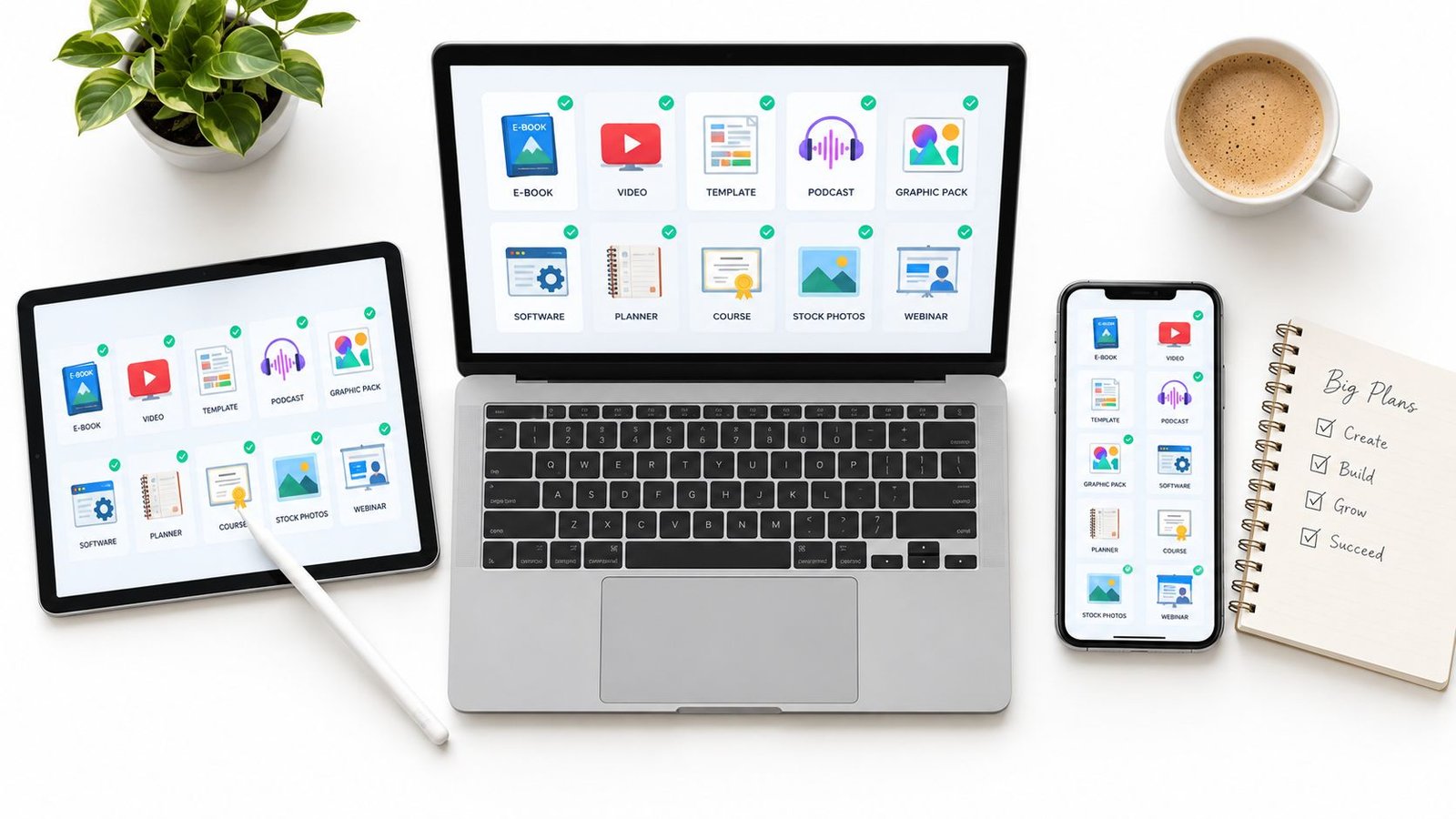
Common examples include:
- Ebooks and guides
- Templates and planners
- Downloadable worksheets
- Digital art and graphics
- Stock photography
- Fonts and design assets
- Software and apps
- Pre-recorded courses
- Audio and video content
- Membership content
Some digital offers involve significant human delivery—for example, a live consultation or tutor-led course. Those can have different operational and tax considerations from an automatically delivered download.
Why sell digital products?
Digital products remove several costs and logistical challenges associated with physical goods.
You generally do not need to manufacture individual units, hold physical stock or arrange delivery for every order. Once a product has been created, additional copies can often be delivered at relatively low incremental cost.
That can make digital products highly scalable.
But low delivery costs do not mean effortless income. You still need to create something useful, reach potential customers, answer questions, maintain your product and provide an appropriate customer experience.
Information products may also need updating as regulations, technology, platforms or best practices change.
Think of a digital product as a business asset—not a shortcut to passive income.
Step 1: Choose and Validate Your Digital Product Idea
A good digital product usually sits at the intersection of three things:
What you understand.
What skills, knowledge or experience can you turn into something useful?
What people need.
What problems, repetitive tasks or frustrations do people already have?
What people are willing to pay to solve.
Interest alone does not necessarily create a viable product.
Start by considering questions people regularly ask you, processes you repeatedly perform, or resources you have already created for yourself or your clients.
A freelancer who repeatedly creates the same client-onboarding process might turn it into a template. A designer might package reusable design assets. Someone with a useful spreadsheet or workflow might turn it into a downloadable tool.
The objective is not to create the biggest product possible. It is to solve a sufficiently important problem clearly.
Digital product ideas to consider
Depending on your skills and audience, you could create:
- Ebooks and practical guides
- Business templates
- Spreadsheet calculators
- Notion or productivity templates
- Design assets
- Digital planners
- Recorded workshops
- Online courses
- Photography or video assets
- Software or small digital tools
- Resource libraries
- Premium downloadable content
The right choice depends on your audience and the problem you can credibly solve.
Validate before you build
One of the biggest mistakes beginners make is spending weeks or months creating something before establishing whether anyone wants it.
Before building the full product, look for evidence of demand.
Search Google and relevant marketplaces. Look at competing products. Read customer reviews and discussions. Pay particular attention to recurring complaints, questions and missing features.
Keyword research can also help you understand how people describe the problem and what they search for. Google Keyword Planner is one tool you can use for this kind of research.
Search volume should not be treated as proof that people will buy. It is one signal among several.
Consider testing demand
Depending on the product, you can test an idea with:
- A waiting list
- A small beta release
- Customer interviews
- A prototype
- A sample or free version
- A pre-order
If you accept pre-orders, clearly explain what the customer is buying, when it is expected to be available and any relevant cancellation or refund terms. Do not imply that a product is already available when it is still being developed.
Real customer behaviour is generally more useful than assumptions.
Step 2: Create a Product That Solves One Clear Problem
Before opening a design tool or recording hours of video, define the outcome.
Ask: What should the customer be able to do after using this product that they could not do as easily before?
That answer should guide the product.
An ebook needs a logical progression. A template should make a task easier or faster. A course should move someone from a defined starting point towards a defined outcome. A digital tool should remove friction from a specific process.
Start with the essential version
Your first version does not need every feature you can imagine.
Create the smallest version that genuinely solves the customer’s core problem. Then use feedback from actual users to decide what deserves improvement.
This reduces the risk of spending months building features customers do not value.
Choose appropriate creation tools
You do not necessarily need expensive software.
Depending on the product, useful tools can include:
- Google Docs or Microsoft Word for written material
- Canva or other design software for visual assets
- Notion for structured workspaces and templates
- Spreadsheet software for calculators and trackers
- OBS Studio or similar software for screen recording
- Video-editing software for recorded courses or tutorials
Choose tools based on the product you need to create rather than building your product around whichever software is fashionable.
Package the experience, not just the file
A useful digital product is more than a download button.
Consider including clear instructions, a welcome page, examples, checklists or other supporting material where they genuinely help the customer.
Explain what the product does, who it is for and how to use it.
Good packaging reduces confusion and can also reduce avoidable support requests.
Step 3: Decide Where and How You Will Sell
There is no single best selling platform for every creator.
Broadly, you can sell through a marketplace, through your own website or storefront, or through a direct-selling tool that lets you present and share an offer with customers.
Marketplaces
Marketplaces can provide infrastructure and, in some cases, access to an existing audience.
The trade-off can include platform fees, marketplace rules, competition alongside similar products and less control over the customer experience.
Your own storefront
Running your own ecommerce site can give you greater control over branding, content and the buying experience.
It can also mean taking greater responsibility for hosting, maintenance, security, payments, tax configuration and other operational requirements.
Direct selling with an OfferLink
You do not necessarily need to build a full ecommerce website before testing an offer.
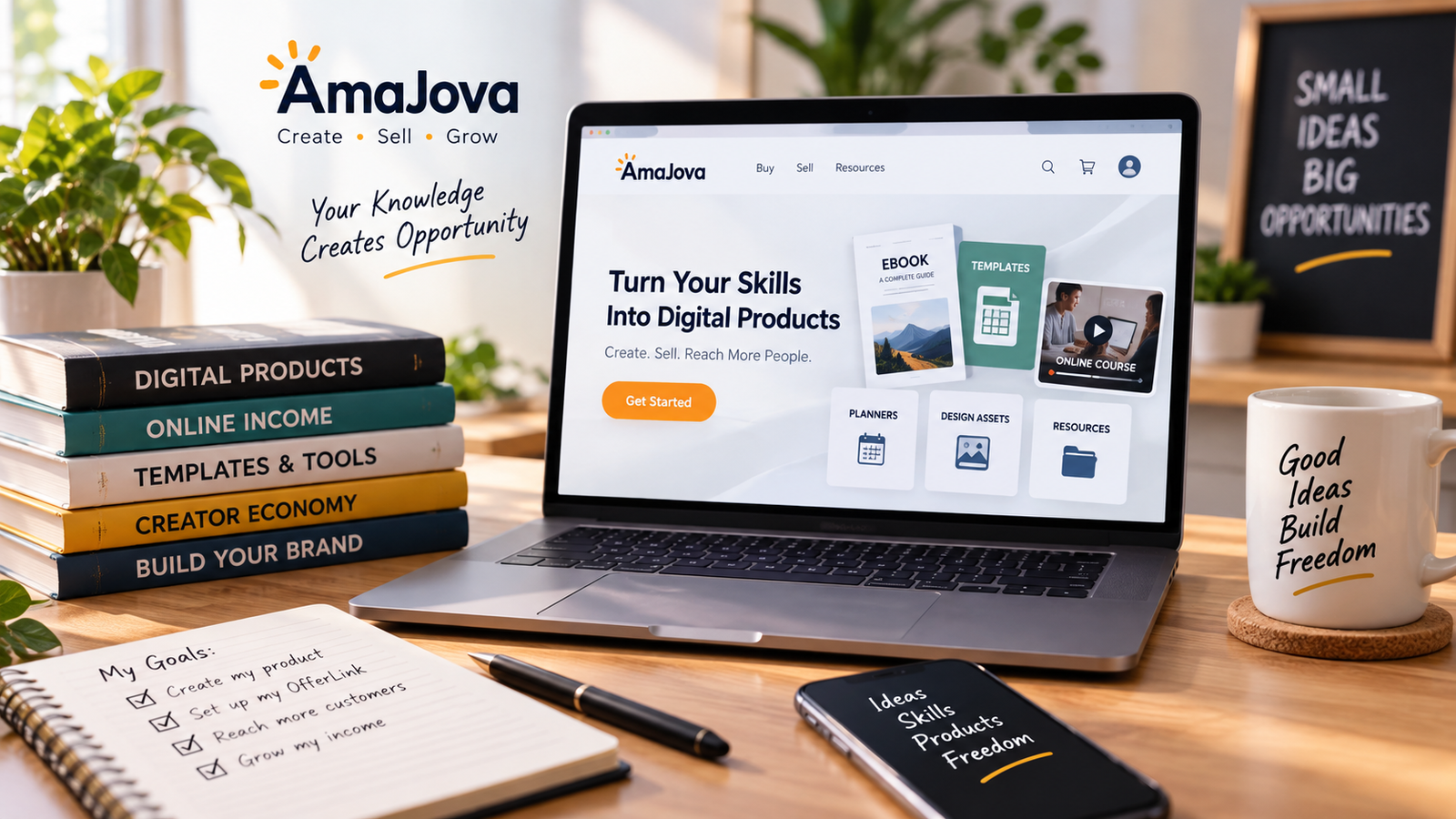
With AmaJova, sellers can create an OfferLink containing their offer, price and fulfilment details, then share that link directly with potential customers.
This can be useful when your sales originate from places such as social media, messaging, email or an existing audience and you want a focused way to present the offer.
Ready to test your first digital offer? Create your OfferLink on AmaJova, add your offer, price and fulfilment details, and share one link with your customers.
Step 4: Understand the Business, Tax and Legal Basics
Selling a digital product is still a business activity. The rules that apply depend on where you operate, what you sell and where your customers are located.
The following is general information rather than legal or tax advice.
Choose an appropriate business structure
In the UK, common structures include operating as a sole trader, forming a limited company or operating as a partnership.
A sole trader and a limited company have different legal, tax and administrative responsibilities. A limited company is legally separate from its owners, while a sole trader is personally responsible for the business.
You can review the UK government’s guidance on setting up a business and choosing an appropriate structure.
Understand VAT and digital services
VAT treatment for digital products can be more complicated than simply applying one rule to every online sale.
HMRC distinguishes between different types of supplies. Its rules for electronically supplied services can apply, for example, to automatically delivered ebooks, downloadable PDFs, software and certain automated online courses.
By contrast, some services involving meaningful human delivery can be treated differently.
For cross-border digital services sold to consumers, the customer’s location and the nature of the supply can affect where VAT is due. The treatment can also differ when sales take place through certain third-party marketplaces.
See HMRC’s guidance on VAT rules for digital services supplied to private consumers.
If you are unsure which rules apply to your product or customers, check current HMRC guidance or seek professional tax advice.
Protect your work
In the UK, qualifying original work generally receives copyright protection automatically when it is created.
You can read the UK government’s explanation of how copyright protects your work.
Copyright does not remove the need for clear commercial terms.
For downloadable products, consider explaining what customers are permitted to do with the product. For example, your licence might distinguish between personal use and commercial use or prohibit unauthorised redistribution.
Your exact terms should match the product and how you intend customers to use it.
Step 5: Price Your Digital Product
Do not assume that a digital product must be cheap simply because it costs little to duplicate.
Customers are buying the usefulness of the product, not the size of the file.
Consider:
- The problem it solves
- The value of the outcome
- The quality and depth of the product
- Comparable alternatives
- Your target customer
- Any support included
- Whether the licence permits commercial use
- The positioning of your brand
Research comparable products, but do not blindly copy their prices.
You can also test pricing as you gain customers and learn more about what they value.
Be particularly careful with permanent discounts and exaggerated “original prices”. Pricing should be clear and credible.
Step 6: Build a Clear Sales Page
A potential customer should be able to understand your offer quickly.
Your sales page should answer:
- What is this?
- Who is it for?
- What problem does it solve?
- What exactly will I receive?
- How is it delivered?
- How much does it cost?
- Are there important requirements or limitations?
- What happens after I buy?
Use a clear headline and straightforward language.
Screenshots, previews, demonstrations and genuine customer feedback can help buyers understand the product where appropriate.
Avoid invented testimonials, misleading scarcity or guarantees you cannot honour.
Clarity builds more sustainable trust than hype.
Step 7: Market Your Product
Creating the product is only part of the work. People still need to discover it.
You do not need to market everywhere at once.
Start with channels that make sense for your audience.
Search content
Useful articles, guides and tutorials can attract people who are already searching for solutions related to your product.
Focus on answering genuine questions rather than filling pages with keywords.
Social media
Choose platforms where your likely customers actually spend time.
Demonstrate the problem, share useful insights, show how the product works and answer common questions.
A smaller relevant audience can be more valuable than a large unrelated following.
An email list can give you a direct way to communicate with people who have chosen to hear from you.
If you use email marketing in the UK, make sure your collection and marketing practices comply with applicable privacy and electronic-marketing rules.
The UK Information Commissioner’s Office provides guidance on direct marketing using electronic mail.
Make subscribing and unsubscribing clear.
Partnerships and communities
Relevant communities, collaborators and creators can sometimes introduce your product to audiences you would struggle to reach alone.
The emphasis should be on relevance and genuine value rather than indiscriminate promotion.
Step 8: Launch, Learn and Improve
Your first launch does not need to be a major event.
A simple launch can be enough:
- Explain the problem.
- Introduce your solution.
- Show what the customer receives.
- Answer likely questions.
- Make the offer easy to access.
- Listen carefully to feedback.
Track useful signals such as visits, enquiries, purchases, refunds and recurring customer questions.
Do not treat a slow first launch as proof that the entire idea has failed. The problem could be the product, audience, price, positioning, sales page, distribution—or simply insufficient data.
Use what you learn to improve the next version.
Common Mistakes to Avoid
Building before validating
Do not spend months polishing an idea that nobody has shown interest in.
Trying to solve everything
A focused product with a clear purpose is easier to explain and often easier for customers to use.
Assuming digital means passive
Customer service, marketing, maintenance and updates still require work.
Choosing a platform only because it is popular
Consider fees, functionality, customer experience, control and your actual selling workflow.
Making unsupported claims
Avoid promising earnings, guaranteed results or outcomes you cannot substantiate.
Ignoring legal and tax responsibilities
Online selling does not remove your obligations as a business.
Conclusion
Selling digital products does not require a huge catalogue, complicated website or perfect launch.
Start with one useful idea.
Validate that people need it. Build the simplest version that solves the problem well. Explain the offer clearly. Choose an appropriate way to take orders and deliver the product. Then use real customer feedback to improve.
Your first product is as much a learning exercise as a revenue opportunity.
If you already know what you want to sell, you can take the next practical step today.
Create your OfferLink on AmaJova, add your offer, price and fulfilment details, and share it with your customers.
Frequently Asked Questions
Can beginners make money selling digital products?
Digital products can generate revenue, but there is no guaranteed income or profit margin. Results depend on factors including the usefulness of the product, demand, pricing, audience, competition and marketing. Beginners are usually better served by starting with a focused product and validating demand before investing heavily.
What digital products can I sell?
Examples include ebooks, guides, templates, spreadsheets, design assets, digital planners, recorded courses, stock media, software and downloadable business resources. Choose a format that fits both your expertise and the problem your customer needs solved.
Do I need a website to sell digital products?
Not necessarily. Marketplaces, hosted selling platforms and direct-selling tools can allow you to sell without building a complete ecommerce website. The right approach depends on how customers discover you and how much control you need over the buying experience.
How should I price a digital product?
Consider the value it provides, comparable alternatives, your intended customer, included support, licence terms and positioning. There is no universal price range that works for every digital product.
Do I need to pay tax when selling digital products?
Selling digital products can create tax obligations. The applicable rules depend on your circumstances, business structure, the type of product or service, customer location and other factors. UK sellers should use current HMRC guidance and seek professional advice where appropriate.
Are digital products automatically protected by copyright?
In the UK, qualifying original works generally receive copyright protection automatically when created. However, copyright rules differ internationally, and sellers should also use clear licence and usage terms appropriate to their products.
Sources & Further Reading
- GOV.UK — Set up a business: official guidance on starting a UK business and choosing a business structure.
- HM Revenue & Customs — VAT rules for digital services supplied to consumers: official guidance covering electronically supplied services, customer location and relevant VAT rules.
- GOV.UK — How copyright protects your work: official guidance on UK copyright protection.
- Information Commissioner’s Office — Direct marketing using electronic mail: UK guidance on electronic marketing and privacy requirements.
- Google — Keyword Planner: Google’s keyword research tool.
- Salesforce — User journey mapping: background guidance on understanding and mapping customer journeys.
This guide provides general information and is not legal, tax or financial advice.